Paddy Hirsch of Marketplace explains L'affaire Tourre.
Saturday, April 17, 2010
Friday, April 16, 2010
Grice: "What Is The Difference Between Greece And Rest Of The OECD? Only That It Is Small Enough To Be Bailed Out"
Grice: "What Is The Difference Between Greece And Rest Of The OECD? Only That It Is Small Enough To Be Bailed Out": " "
"
We all know what is going on in Greece. Here is Dylan's eloquent summary:
Greece misrepresented the true state of its finances, it has enormous off-balance sheet liabilities, it is expected to run a double-digit budget deficit to GDP this year, it has a heavy bond issuance schedule this year – it was bound to have a crisis at some point wasn’t it? But what’s the difference between Greece and the rest of the OECD? Only that it is small enough to be bailed out ….
Greece, as we have long been claiming, is just the beginning.
Back in January, when Greece?s problems first surfaced, I thought it would be the first in a series of fiscally driven market seizures in the following months which would potentially offer up some decent opportunities to buy stuff cheap ? I guess I got that one wrong ... but I still think Greece is the beginning of a wave of government funding crises, not the end.
For starters, we’re not out of the woods yet. The chart below shows my back-of-the-envelope calculations for the colossal amounts of debt governments need to issue this year relative to that already outstanding. I?m not a bond strategist and I?ve not done anything sophisticated or clever, but by taking Bloomberg?s data for existing debt maturity for each government (red) and using the OECD?s projected 2010 deficits as a proxy for net new issuance (grey) my numbers shouldn?t be too far out. But if my numbers are even roughly right and issuance is the problem, Greece should have had almost the least to worry about!
But it’s not just about getting this year out of the way. If it can happen in Greece, it can happen everywhere else too, because Greece just isn’t that different. OK, so it misrepresented the size of its liabilities ? but so too do most other governments; its real fiscal problems are hidden off-balance sheet in the enormous welfare obligations it can?'t afford to pay ? and so are most other governments? (first chart inside); its debt maturity isn?t notably different from the rest of the OECD?s (at about eight years it?s actually longer than those of the US and of Japan ? second chart inside); and its projected budget deficit is lower than those projected in the UK and the US (third chart inside).


In fact, the charts above show that there are no clear thresholds which say when a country will undergo a fiscal crisis ?- the UK had to call in the IMF in 1976 with a debt to GDP ratio of around 45%. Japan has a debt to GDP ratio in excess of 200% and hasn?t had any funding problems (yet). What counts is confidence, and what hurts is when weakening confidence pushes up the market risk premia on a country?s debt, pushing bond yields and therefore interest costs to such a level that government finances becomes unsustainable.
To be sure confidence is certainly buoyed by the knowledge that the deranged madmen at the money printing asylum have full access to the seemingly infinite pulp resources of northern national park neighbors. That and ink. And Greece has neither. But at its core the problem is simple: if you can't outgrow your debt, you die. To wit:
The unavoidable arithmetic behind debt sustainability is that the interest a country pays on its debt must equal the nominal growth rate of that country. If it does, the incremental government revenue generated by the economic growth will pay for the coupons on the debt. If it doesn?t, a shortfall develops between incremental revenues and incremental coupon payments and in the absence of further austerity, more debt is required to finance the deficit.
And here is the Catch 22 of the EMU. When will the Euro bureaucrats finally realize the euro is doomed?
This might sound abstract, but it?s exactly what happened in Greece. When the first austerity plan was presented, Greece cut public sector wages by a painful 10% causing angry protest and social unrest, although it saved the government ?650m. But the same austerity plan assumed Greece?s interest cost would be 4.7% and by late February it was paying 6.25%. According to the WSJ, this has blown a ?700m hole in its budget, more than offsetting the savage public sector wage cuts already enacted. Public sector pay would have to have been cut by an additional 10% to achieve the same budget repair that had originally been intended because interest costs were spiralling faster than expenditure could be brought under control. Even after the bailout agreed this weekend (which at ?30bn falls significantly short of the ?75bn The Economist believes is required) the cost of borrowing from Mr Market as I write still stands at (a bestial ...?) 6.66%, and that is even after the EU rescue plan was announced.
If Dylan is right,look for the upcoming Sotheby's auctions of various Cyclades islands to move to the Chunnel quite soon.
So I?d be surprised if this is the last we?ve heard of the Greek crisis. But without wishing to belittle their plight, the more terrifying spectre is of similar dynamics unfolding in larger economies. For the most chilling similarity between the Greeks and everyone else isn?t in the charts above showing that their various debt metrics are in the same ballpark, it’s in the realisation that we too are subject to the same iron-clad laws of budget sustainability and that we too are as helplessly vulnerable to any reassessment of sovereign risk by the famously fickle Mr Market. The Greek tragedy of being unable to pay for the debt built up during the years of unprecedented low yields reads across to the rest of our governments all too well. The fact is most of us are living on the same knife edge.
But Greece is a small enough economy to be bailed out by Europe. If we add in Portugal, Ireland, Ireland and Spain (the rest of the so-called PIIGS group), the risk could be systemic (see table overleaf). And in recent months I?ve written about the time bomb that is Japan?s government bond market, where I think the end game is in sight. Who, when the time comes, will bail them out? US health costs are escalating explosively and represent arguably the least tractable of all sovereign issues today. They too are subject to the arithmetic of budget sustainability, from which there is no hiding place. The difference between the rest of the OECD and Greece is merely that Greece could be bailed out.

For our previous perspective on the $1.5 trillion in total exposure by European Banks to 'Club Med', read here.

Guest Post: It's Impossible To "Get By" In The US
Guest Post: It's Impossible To "Get By" In The US: " "
"
Submitted by Graham Summers of Phoenix Capital Research
It’s Impossible to “Get By” In the US
While the market cheers on the fantastic job “growth” of March 2010, the more astute of us are concerned with a growing tide of personal bankruptcies. March 2010 saw 158,000 bankruptcy filings. David Rosenberg of Gluskin-Sheff notes that this is an astounding 6,900 filings per day.
This latest filing is up 19% from March 2009’s number which occurred at the absolute nadir of the economic decline, when everyone thought the world was ending. It’s also up 35% from last month’s (February 2010) number.
Given the significance of this, I thought today we’d spend some time delving into numbers for the “median” American’s experience in the US today. Regrettably, much of the data is not up to date so we’ve got to go by 2008 numbers.
In 2008, the median US household income was $50,300. Assuming that the person filing is the “head of household” and has two children (dependents), this means a 1040 tax bill of $4,100, which leaves about $45K in income after taxes (we’re not bothering with state taxes). I realize this is a simplistic calculation, but it’s a decent proxy for income in the US in 2008.
Now, $45K in income spread out over 26 pay periods (every two weeks), means a bi-weekly paycheck of $1,730 and monthly income of $3,460. This is the money “Joe America” and his family to live off of in 2008.
Now, in 2008, the median home value was roughly $225K. Assuming our “median” household put down 20% on their home (unlikely, but it used to be considered the norm), this means a $180K mortgage. Using a 5.5% fixed rate 30-year mortgage, this means Joe America’s 2008 monthly mortgage payments were roughly $1,022.
So, right off the bat, Joe’s monthly income is cut to $2,438.
According to the US Department of Agriculture, the average 2008 monthly food bill for a family of four ranged from $512-$986 depending on how “liberal” you are with your purchases. For simplicity’s sake we’ll take the mid-point of this range ($750) as a monthly food bill.
This brings Joe’s monthly income to $1,688.
Now, Joe needs light, energy, heat, and air conditioning to run his home. According to the Energy Information Administration, the average US household used about 920 kilowatt-hours per month in 2008. At a national average price of 11 cents per kilowatt-hour this comes to a monthly electrical bill of $101.20.
Joe’s now down to $1,587.
Now Joe needs to drive to work to make a living. Similarly, he needs to be able to drive to the grocery store, doctor, etc. According to AAA, the average cost per mile of driving a minivan (Joe’s a family man) in 2008 was 57 cents per mile. This cost is based on average fuel consumption, tires, maintenance, insurance, license and registration, and average loan finance charges.
Multiply this cost by 15,000 miles per year and you’ve got an annual driving bill of $8,550. Divide this into months (by 12) and you’ve got a monthly driving bill of $712.
Joe’s now down to $877 (I’m also assuming Joe’s family only has ONE car). Indeed, if Joe’s family has two cars (one minivan and one sedan) he’s already run out of money for the month.
Now, assuming Joe’s family is one of the lucky ones (depending on your perspective) they’ve got medical insurance. Trying to find an average monthly medical insurance premium for a family in the US is extremely difficult because insurance plans have a wide range in deductibles, premiums, and co-pays. But according to eHealth Insurance, the average monthly premium for family policies in February 2008 was $369.
So if Joe has medical insurance on his family, he’s now down to $508. Throw in cell phone bills, cable TV and Internet bills, and the like, and he’s maybe got $100-200 discretionary income left at the end of the month.
This analysis covers all of the basic necessities of the average American household: mortgage payments, food, energy, gas, driving expenses, and medical insurance. It also assumes that Joe:
1) Didn’t overpay for his house
2) Made a 20% down-payment of $45K on his home purchase
3) Has no debt aside from his mortgage (so no credit card debt, student loans, etc)
4) Only has one car in the family and drives 15,000 miles per year
5) Keeps his energy bill reasonable
6) Does not eat out at restaurants ever/ keeps food expenses moderate
7) Has no pets
8) Pays for health insurance but has no monthly medical expenses (unlikely with two kids)
9) Keeps his personal budget under control regarding cable TV, Internet, and the like
10) Doesn’t spoil his kids with toys, gadgets, trips to the movies, etc.
11) Doesn’t take vacations.
Suffice to say, I am assuming Joe maintains EXTREMELY conservative spending habits. Personally, I know NO ONE who meets all of the above criteria. However, even if the above assumptions applied to the average American, you’re still only looking at $100-200 in “wiggle” room for spending per month!
If Joe:
1) Overpaid on his house
2) Didn’t have a full 20% down payment
3) Owns two cars
4) Eats at restaurants
5) Splurges on heating & A/C bills
6) Has any medical expenses aside from monthly premiums…
… he is running into the red EVERY month.
I also wish to note that my analysis didn’t include real estate taxes and numerous other expenses that most folks have to pay. So even if you are extremely frugal and careful with your money, it is impossible to “get by” in the US without using credit cards, home equity lines of credit or burning through savings. The cost of living is simply TOO high relative to incomes.
This is why there simply cannot be a sustainable recovery in the US economy. Because we outsourced our jobs, incomes fell. Because incomes fell and savers were punished (thanks to abysmal returns on savings rates) we pulled future demand forward by splurging on credit. Because we splurged on credit, prices in every asset under the sun rose in value. Because prices rose while incomes fell, we had to use more credit to cover our costs, which in turn meant taking on more debt (a net drag on incomes).
And on and on.
Does this mean the market is about to tank? Not necessarily, stocks have been disconnected from reality since November if not July. Bubbles (and we ARE in a bubble) take time to pop and this time around will be no different.
Best Regards,
Graham Summers
Rosenberg Summarizes The Arguments Of The Great Treasury Bond-Bear Debate, Remains A Staunch Deflationist
Rosenberg Summarizes The Arguments Of The Great Treasury Bond-Bear Debate, Remains A Staunch Deflationist: "
 "
"
A great overview of the arguments on either
side of the great Treasury bull-bear debate, courtesy of David
Rosenberg. Rosie juxtaposes the perspectives of two of the most respect
yields strategists currently: MS' Jim Caron, and Goldman's Jan Hatzius. A dose of Jim Grant is also thrown in for good measure. Must read summary for bond bulls and bears alike.
You really have to have a read of 'Yield Views Couldn't Differ More' on page B1 of the weekend WSJ. It pits Jim Caron, a good pal and former Merrill rates-strategist colleague against Goldman Sach's Jan Hatzius, a former formidable competitor and I would argue runs one of the best, if not the best, economics houses on Wall Street. Jim is bond bearish, Jan is bond bullish. The world pretty well knows my view. The article talked more about supply than it did about inflation, which is the much more critical ingredient in any simulation of interest rate determination.
Jim Caron makes the claim that the US government has never before been raising so much debt to finance the bloated fiscal deficit and roll over existing obligations. But if truth be told, the US government never before paid down as much debt as it did previously back in that surplus year of 1999 and the Treasury market got hammered. Why? An economic boom absorbed all the slack in the economy and causes a brief episode of inflationary pressure. That was the cause. Just as in 2002 the deficit exploded, bonds rallied massively because deflationary risks moved to the front burner. Yes, Virginia -- deficits and deflation can co-exist for extended periods of time. Ask anyone who has lived in Osaka over the past decade. The two Jimmies (Caron and Grant) are entitled to their opinions but not their own facts, and I have run similar correlations as Jan Hatzius has and there is no comparison between fiscal deficits and inflation when it comes to bond yield analysis. If the deficits and bond issuance are occurring at a time when the economy is approaching full employment and private sector balance sheets are expanding, then for sure interest rates will be on a rising trend. But fiscal deficits that are designed to cushion the blow from a credit contraction, especially among households, generate far different results. With credit contracting, rents deflating, the broad money supply measures now declining and unit labour costs dropping at a record rate, it hardly seems plausible that inflation is a risk at any time on the near- or intermediate-term forecasting horizon.
Plus, keep in mind that the price-setter for the entire retail sector, Wal-Mart, just announced price cuts on 10,000 items -- you heard that right. That is deflation, not disinflation or inflation or any other 'flation. And just to show you the enormity of this announcement, the CPI contains 8,018 items!
The 'Current Yield' column in Barrons also runs with the bond-bear theme ('Next, a Sharp Jump in T-Yields'). This time, and again, it focuses on the Morgan Stanley forecast of a 5.5% peak in the yield of the 10-year note. We are told in the article to throw away the econometric models of the past and rely solely on the supply backdrop.
Again, this logic defies how bonds rallied through most of the Reagan years despite all the bond supply used to spend the Russians out of submission in terms of military expenditure. We are also told that the consensus is underestimating the recovery -- another reason to be bearish on bonds. But to get to 5.5% we had better get one heck of a renewed expansion in bank lending and household balance sheets and a good dose of inflation. It sounds so outlandish. We didn't even get past 5.25% at the 2007 peak with a late-cycle economic boom, a record-high stock market, dramatic credit expansion, a tight monetary policy stance and sky-high deficits -- not to mention an unemployment rate closer to 4% than 10%.
And to top it off, the front page of the Sunday NYT runs with "U.S. Consumers Face End of Era of Cheap Credit". When the view of higher interest rates comes to dominate the media as much as it has in recent days, you know that something else is bound to happen. That NYT article stated that housing "has only recently begun to rebound" -- well, when you look at the chart of new home sales, housing starts and the NAHB index, it's very difficult to detect any rebound at all…
One reason why interest rates cannot rise is because if they do, there will never be a sustained improvement in the pace of economic activity. Housing is the classic leading indicator, and the most interest-sensitive sector, and until it revives, it seems highly unlikely that bond yields will rise on any sustained basis or that the Fed will embark on a path towards higher policy rates. For a truly sombre assessment on the prospects for a housing recovery, see what Robert Shiller has to say on page 5 of the Sunday NYT biz section. ('Don't Bet The Farm on the Housing Recovery').
Full edition of today's Breakfast with Dave here
| Attachment | Size |
|---|---|
| Breakfast_with_Dave_041210.pdf | 669.39 KB |
Thursday, April 08, 2010
Tuesday, April 06, 2010
Why Do Some Investors Perceive This Market As Cheap?
Why Do Some Investors Perceive This Market As Cheap?: "


 "
"
Regular readers know I am not a fan of Forward P/E ratios as they are too easily gamed — plus, they always seem to miss a major turn or reversal. They also tend to justify a bad investment posture, i.e., Perma-Bullish.
Regardless, if you are scratching your head wondering why anyone is buying into stocks at these levels, this chart explains why some investors perceive the market as cheap (all data thru Q1 2010):
S&P 500 Operating Earnings, Forward P/E Ratio
click for larger chart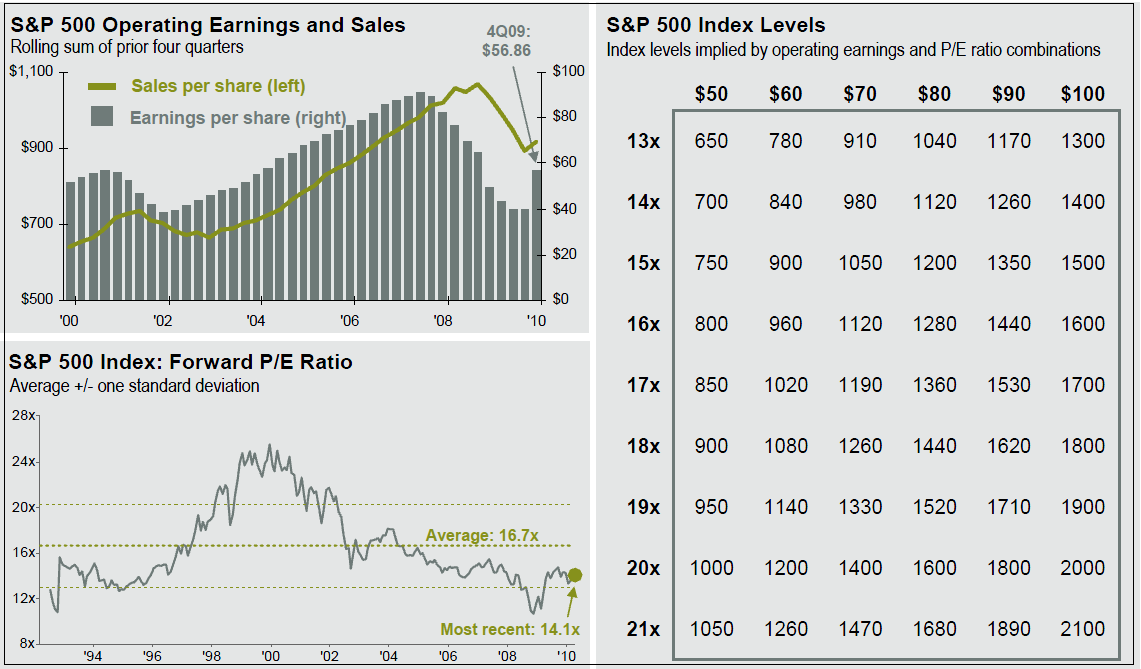
Source: Source: Standard and Poor’s, Compustat, FactSet, J.P. Morgan Asset Management.
SONDERS: IT’S A V-SHAPED RECOVERY, RALLY TO CONTINUE
SONDERS: IT’S A V-SHAPED RECOVERY, RALLY TO CONTINUE: "
Liz Ann Sonders, Chief Investment Strategist at Charles Schwab, says the v-shaped recovery is here, inflation is not a concern and the stock rally could benefit as investors move out of bonds into stocks:
Part 1:
Part 2:
Part 3:
Post Footer automatically generated by Add Post Footer Plugin for wordpress.
"
DebtWatch No. 44 April 2010: House Prices Are Not Normal
DebtWatch No. 44 April 2010: House Prices Are Not Normal: "
House Prices are Not Normal
The FHOG of Real Estate
Table One
Table Two
End of Debtwatch Report
DebtWatch No. 44 April 2010
 House Prices Are Not Normal
“I think it is a mistake to assume that a riskless, easy, guaranteed way to prosperity is to be leveraged into property. It isn’t going to be that easy.” (RBA Governor Glenn Stevens, Sunrise Program March 29 2010)
I applaud Glenn Stevens for making the above statement on national television. It was both courageous, and a succinct and accurate statement of the delusion that has come to dominate economic thinking in Australia. He effectively acknowledged that Australia has succumbed to a Ponzi Scheme: the belief that the entire country can make a living from unearned income. This something that, until recently, most public and private commentators have been strenuously denying. The great pity is that this realisation was so long in coming, while the farce is that one wing of Australia’s government has now declared its intention to bring down a Ponzi Scheme that the other wing is trying to maintain.
The data that led Stevens to this realisation is pretty obvious: the most recent quarter saw the largest increase in house prices since the ABS began keeping records in 1986.

The role of the Federal Government in causing this bubble–and earlier ones–via the First Home Owners Grant is also obvious. While previous manipulations of the market by the Grant turned a tepid rate of increase into a bubble, this time the Grant turned the fastest rate of fall in house prices into its greatest rate of increase. The current volatility of house prices is telling: eight of the ten biggest movements–in both directions–have occurred in the last two years.

With the RBA likely to increase rates specifically to prick this bubble, the volatility will doubtless continue. But even without the RBA’s expected–and I have to say justified–anti-bubble interest rate intervention, the real estate market is, as Stevens argued, far from a stable route to riches.
House Prices are Not Normal
One of the great fallacies of conventional “neoclassical” economics that encouraged behaviour that caused the GFC was the proposition that asset prices are “Normal”–in the sense that their volatility fits the pattern described by the “Normal Distribution”.
The superficial beauty of the Normal Distribution is that the behaviour of a variable can be reduced to just two numbers–its mean and standard deviation. But its real, deep beauty is that if a variable follows a Normal Distribution, then extreme events are vanishingly rare. if a variable moves normally, then:
- Movements of 5 standard deviations or more above or below the mean are so rare as to be effectively non-existent; and
- Their rarity means that they play no significant role in shaping the system: its behaviour is completely described by the events that fall within the +/- 5 standard deviations range.
As stock market speculators learnt to their great cost during the GFC, that is so not the case for share prices–since “impossible” or “Black Swan” movements in prices have been the order of the day since 2007.
For example, the average daily movement on the Dow Jones since 1914 is 0.028%, while the standard deviation is 1.13%. If stock market price movements were “Normal”, there would have been just one daily decline of more than 4.5 percent since 1914. In fact, there were 100 such falls, out of a total of 24,593 daily movements in the Index–fully 100 times as many falls as a Normal distribution would predict.
Nor could those falls be ignored in the long run: they caused a collective 612.5 percent fall in the Index, when the sum of all the percentage movements since 1914 is 688 percent.
Anyone who relies upon the Normal Distribution when investing in the stock market is ultimately on a hiding to nothing to lose his shirt, because the Normal Distribution seriously underestimates the odds and the importance of extreme volatility in share prices. A far better guide to how share prices actually behave is the “Power Law”, as well as Didier Sornette’s research based on an analogy to earthquakes.

So how do house prices stack up? Though we have a far shorter time series for house prices than for shares, one thing is for certain: house prices are not Normal. The mean quarterly change in the ABS series for nominal house prices since 1986 is 1.24%, and the standard deviation is 1.786%. If house prices were Normal, the distribution of quarterly changes would look like the red line in the next chart; the actual pattern is shown by the blue bars.

The vast majority of quarterly movements are below the mean, with the largest number–27 out of the 93 quarters–registering just above zero change (an average of 0.267% increase for the quarter). The high overall average of 1.24% growth per quarter in nominal house prices is driven by the smaller number of quarters (26 out of the 93) with increases above the average.
The data is skewed in time as well as magnitude. A truly Normal distribution would have no time pattern to the data, with a large movement just as likely to be followed by a small one. The actual distribution has long periods of low increases with clusters of large changes–and these have increasingly involved large falls as time has gone on. The next chart compares the actual pattern of price movements (in red) to a simulated random pattern (the black crosses).

There are several movements–especially the -3.4% and +7% recorded since the GFC began–which are outside the standard range for a Normal Distribution. They are not so far outside that we can categorically say that a Power Law accurately describes house price movements, as we can with share prices. But the odds are that these two leveraged asset classes share the same fundamental dynamics.
The FHOG of Real Estate
It should also come as no surprise that the First Home Owners Grant scheme significantly distorts the housing market. From the statistics, there is no doubt that the true beneficiaries of the scheme are vendors, real estate agents, and lenders–not first home buyers.
There are several ways to slice and dice the data on this point: there are years when there was no Grant, and years when there was a grant in some form or another; periods prior to the introduction of a Grant, or a change in its magnitude, and periods after the change; and periods when the Grant was doubled. The following charts show these dissections.

Periods without a FHOG had significantly lower growth in house prices, and significantly lower volatility in prices. The average quarterly price change without a FHOG was a mere 0.44%–one third of the average for the entire series. The volatility was also substantially lower, with all movements being between -1 and +2.5%.
Periods with a FHOG had both substantially higher average price rises (2% p.a. vs 1.25% for the entire set) and substantially greater volatility (ranging from -3.4% to + 7%).
A closer look at the impact of the FHOG shows that its role is that of a storm trooper for the housing market. The next chart looks at the movements in house prices in the 2 years after an introduction or change to the Scheme, and in particular at what happens to prices in the 2 years after the payment was doubled (in 2001 under Howard and 2008 under Rudd). The “Pre-FHOG” is all other quarters apart from these 2 year segments.
All but one of the large increases in house prices (4% or more in a quarter) occurred after the FHOG was doubled, while the average quarterly change in prices was over 2.9 percent. If the FHOG is the real estate sector’s storm trooper, then doubling the FHOG is its Panzer division.

The next table summarises the statistical properties of house price changes, including “Kurtosis”–a measure of how peaked the distribution is compared to the Normal Distribution–and “Skew”–a measure of how biased the distribution is towards above or below mean movements. Periods without a FHOG have a peaked distribution (Kurtosis greater than zero) and few price changes below this peak with many above (Skew greater than zero); periods with a FHOG have a flattened distribution (Kurtosis below zero, meaning that price movements are more widely dispersed), and a negative skew (meaning that there are more price movements below the mean than above).

The role of the FHOG in causing house prices to rise faster than consumer prices is even more apparent if we consider the annual CPI-deflated series–but what is then also obvious is its decreasing effectiveness over time. When rolling annual price changes are considered–a more realistic time frame for changes in house prices, since this is a slow moving asset market–the biggest price inflation bang for the FHOG buck was back in 1988, when the rate of increase hit almost 30%. Howard’s doubling could only score a 16.5% maximum rate of growth of real house prices; Rudd’s has thus far peaked at 11.25%–though this omits the impact of the most recent 7% increase in nominal house prices (since CPI numbers are only available till December 2010).


The real house price data emphasises the message that the real beneficiaries of this government intervention are not first home buyers, but vendors, real estate agents, and banks–in increasing order of benefit.


The vendors benefit from a higher price; the agents benefit from higher turnover and fees; while the banks benefit from the increased mortgage debt that first home buyers–and then the vendors they sell to–take on in order to buy into a government-supported Ponzi Scheme. The banks and mortgage lenders in general have been the biggest beneficiaries as mortgage debt has risen from under 20% of GDP in 1990 to over 85% at the end of 2009.
The revival of this Ponzi Scheme played a key role in Australia’s sidestep of the GFC. As is obvious in the next chart, the mortgage debt to GDP ratio began to fall prior to the First Home Vendors Boost, but then accelerated once the Boost was available.


The Australian economy has thus returned to debt-driven growth, with the household sector carrying the full burden for the private sector. I remain sceptical this period of debt-driven growth will last as long as in previous bubbles when our private debt to GDP ratio was half what it is today.
Table One

Table Two

End of Debtwatch Report
I started Debtwatch to raise the alarm about the approaching financial crisis that we now call the GFC, and to raise awareness of the unconventional economic theories of Hyman Minsky. Forty four Debtwatch Reports later, those objectives have been met, and maintaining the pace of one major report each month is now hampering my ability to write a book length treatment of the Financial Instability Hypothesis.
I signed a contract for this book with Edward Elgar Publishers back in 1999, with the intention of delivering it in 2001. Then I decided to write Debunking Economics, which I thought would take just six months. 18 months later, I finished it, and the debate it caused with neoclassical economists (due to my novel critique of the theory of competitive markets) took up another 4 years.
I planned to start Finance and Economic Breakdown in January 2006—and in December 2005 raising the alarm about the GFC took over.
Now I really have to give the book first priority. With each Debtwatch Report taking something close to a week to write, I can’t do both. So I am going to cease publishing Debtwatch.
What I will trial instead is publishing a monthly update on the book. I will no longer send this out as a PDF, but will make it my monthly blog entry.
"
Subscribe to:
Posts (Atom)