Sunday, August 29, 2010

The Dark Side of Deficits

The Dark Side of Deficits: "

The Dark Side of Deficits

August 27, 2010

By John Mauldin

>


Secular Bull and Bear Markets

It’s Not the (Stupid) Economy

The Consequences of a Credit Crisis

The Dark Side of Deficits

LA, Europe, Kansas City, and Houston


In the pre-crisis days, I used to write about things like P/E ratios, secular bull and bear markets, valuations, and all of the things we used to think about in the Old Normal. But what about those topics as we begin our trip through the New Normal? It’s time to reconvene class and think through what might change and what will remain the same. I think this will be a fun read – and let me tip my hand. I come out on the side of a new secular bull that gets us back to trend – but not just yet. The New Normal has to have its turn first. (Note: this will print out longer than usual, as there are a lot of charts.)


And speaking of first, I once again need some help from readers. I will be in “jail” next week for the Muscular Dystrophy Society. I need you to help bail me out. You can go to https://www.joinmda.org/downtowndallas2010/johnm and make a donation to help kids and families who really need help in these difficult times, and also help sponsor research that will eventually cure this disease. If you follow the link, you can see a cute video – and then make your donation!


I thank you and I am sure Jerry’s kids thank you too!


Secular Bull and Bear Markets


Market analysts (of which I am a minor variety) talk all the time about secular bull and bear cycles. I argued in this column in 2002 (and later in Bull’s Eye Investing) that most market analysts use the wrong metric for analyzing bull and bear cycles.


(For the record, even though I am talking about the US stock market, the principles apply to most markets everywhere. We are all human.)


“Cycles” are defined as events that repeat in a sequence. For there to be a cycle, some condition or situation must recur over a period of time. We are able to observe a wide variety of cycles in our lives: patterns in the weather, the moon, radio waves, etc. Some of the patterns are the result of fundamental factors, while others are more likely coincidence. The phases of the moon occur due to cycles among the moon, the earth, and the sun. In other situations, though, apparent patterns are no more than the alignment of random events into an observable sequence.


All cycles have several components in common. Cycles have a start and an end, they have characteristics that repeat from cycle to cycle, and they often have an explainable cause.


Stock market observers have identified what they believe to be scores of cycles, patterns, correlations, and relationships that have spawned a seemingly endless inventory of predictions and trading schemes. Every trader has his favorite system, well-fortified with back-tested “research” and “facts.” These systems all work fine until you begin to use them with real money.


The patterns are so numerous that some market experts discount all theories and acquiesce to a philosophy of randomness (that would be you, Burt!). However, just because we don’t understand it, doesn’t mean there’s not useful information contained within a pattern.


I argue that we should use valuations and not prices as the criterion for determining secular bull and bear cycles. If you use valuations, the cycles jump off the page at you. Using prices, it is very difficult. Let’s look at a table prepared by my good friend Ed Easterling of Crestmont Research. Ed co-authored the two chapters in Bull’s Eye Investing on stock market cycles and has a treasure trove of charts and tables on a wide variety of investment topics at www.crestmontresearch.com. And his book Unexpected Returns is a must-read for anyone who manages money, whether their own or someone else’s.


OK, the following chart shows secular bears in terms of valuations. There have been four bulls and five bears (we are in one now) since 1900. (You can see a larger chart at Ed’s site, under secular cycles.)


Secular bulls begin with low valuations and continue until valuations get “too high” in terms of P/E ratios. The opposite for secular bears. The average cycle over the last 110 years lasted about 13 years. These are not short-term phenomena.


Within those longer-term secular cycles you can have so-called cyclical swings based on price, and some of those counter-trend cycles can be quite large!


The first cycle of the twentieth century was a bear. It started in 1901 with the market P/E ratio cresting at 23. Twenty years later, with the P/E ratio firmly in single digits at 5, the bear went into hibernation. Over the twenty years of that secular bear, the Dow Jones Industrial Average (DJIA) had managed to tick up from 71 at year-end 1900 to 72 at year-end 1920.


But, during those two decades, the market moves were far from calm. Annual returns from New Years’ Eve to New Years’ Eve ranged from -38% to +82%! The best-performing three years were +82%, +47%, and +42%. After each of those years I am sure the pundits proclaimed the death of the bear. Yet the three worst years were -38%, -33%, and -31%. As we’ll see with most secular bear cycles, the period was as violent and choppy as the high seas in a monsoon. Across the 20 years in this bear cycle, 45% were positive-return years – but never more than two in a row! The 11 down years were generally singles or pairs, with only one three-year stretch at the start of the cycle. Although the average gain was +30% and the average loss was 17%, the change from beginning to end was a paltry +2% in total.


Yet during that secular bear cycle, the economy grew and earnings rose. However, P/E valuations declined and offset virtually all of the economic growth. The market’s price (P) was essentially unchanged from start to finish, and E (earnings per share) rose sharply. So with the market price (P) virtually unchanged, it is clear that the decline in the P/E ratio offset the gains in earnings (E). Earnings growth is often strong in bear markets – and that growth is eroded by declining P/E ratios.


Most investors do not think of the years 1933-36 as being part of a bull cycle, as the markets did not make a new high from the 1929 high. We think of those times as the heart of the Depression. But P/E ratios rose from single digits to 19, and the market tripled in just a short time. It behooves those who are genetically predisposed to a bearish position to remember that markets have a logic of their own.


The critical factor is to notice that at the start of each bull cycle, the markets had single-digit P/E ratios, with no exception. NO secular bull market ever began with high P/E ratios, even though significant rallies often started from high P/E ratios. The lesson of history is that all periods of high valuations come to an unhappy end.


And that will be the case for cycles to come. Notice that real secular bull cycles begin with low double-digit or single-digit P/E ratios. Today the P/E on reported earnings is 16.3, down from the 42 at which this cycle started, but still a long way to go until we get to low double digits.


You hear a lot of BS on various media about forward P/E ratios being only 11.5; so if that is the case then stocks are cheap, even by my standards. But those stock touts and shills use operating earnings, something that was really never done until the 1990s, and that is a way for companies and people who want you to buy stocks or mutual funds to maintain that valuations are better than you think. Operating earnings estimates are over 39% higher than estimated as-reported earnings.


Reported earnings are real, in our pockets, what we put on our tax returns. Operating earnings are of the EBIH variety, that is Earnings Before Interest and Hype, or Earnings Before Interest and Bad Stuff (the BS of earnings). Those are the expenses they ignore because they pinky swear those mistakes will never happen again. Anybody using operating earnings on TV should have a flashing warning underneath their picture that says “stock promoter” or “cheerleader” or worse. I lose patience with such pandering.


That being said, using reported earnings estimates, by the end of 2011 stocks may be getting to the place where there is some value in the broad market, based on history. Not by a lot, but enough that the next ten years might not be a write-off, again by historical standards. Enough to make me a bull? No, because we will likely not be down close to single digits. But we will be getting there.


It’s Not the (Stupid) Economy


How many times are we told by the financial “experts” that the economy drives the stock market? It’s often emphasized that when the economy picks up, the stock market will follow (or even lead).


While this may be true in the short term, the data clearly shows it is not so in the long term. The economy and earnings can be rising even as the market falls or drifts sideways. Over time, the stock market is driven by two major factors: long-term earnings and price/earnings (P/E) ratios. We do recognize that the economy clearly affects long-term earnings. As a matter of fact, research demonstrates a strong relationship between earnings and nominal economic growth.


However, the most significant driver of stock market returns is the valuation embedded in the P/E ratio. Over the past century, P/E ratios have cycled from higher levels to lower levels. The range from high to low has been substantial.


Let’s accept that earnings are generally growing, increasing over time. When P/E ratios are rising, the double impact of rising earnings and rising P/E’s produces substantial stock market gains – secular bull markets. When earnings are rising yet P/E ratios are declining, the offsetting impact is a choppy, flat stock market with some rather large downdrafts from time to time – a secular bear market.


Does the economy matter? Yes. Does the stock market necessarily follow the economy? No. The key to knowing the longer-term direction of the market is to know the longer-term direction of the P/E ratio.


Thus, the question of the day becomes: how can we know the direction of P/E ratios?


Interestingly, average P/E ratios tend to trend over long periods of time, and markets move around them. Let’s look at some charts that Ed sent to me this morning. The first is the move in P/E ratios since 1970, with Ed giving us the trendline as a dotted line. The red portion going into 2011 is based on estimated earnings. Notice that after being way below trend we are on our way (if estimates are right) to being back above.


Now, let go back to 1900 and project forward on that trend line until 2030.


Notice that earnings rise to almost $180 (in real terms), well more than double from where they are today. And that has been the trend for 110 years, so it is fairly well established. But now let’s look at this same chart on a log scale, and with me adding a few lines of my own.


Now, let me explain how I have marked up Ed’s graph. First, I have circled in yellow the period from about 1930 through 1940. Note that the trend growth in earnings per share was well below the smoothed line we saw in the previous graph. No surprise, we were in a deflationary depression. But the point is that we got back to trend after the war and continued merrily on our way. Those ten years were not fun, but we did recover.


Now fast forward to today. What if something like the same phenomena happened over the next 20 years? I penciled in a black line going sideways (from 2010) for about 7-9 years as earnings rise, but not as fast, and then a true boom back to the “normal” trendline by the end of 2030. And what a boom it would be to get back to the long-term trend!


The Consequences of a Credit Crisis


I have written in numerous letters that the aftermath of a credit-crisis recession is a lengthy period, maybe as much as ten years, where all sorts of markets are more volatile and there are more frequent recessions. By definition, recessions are not good for earnings. We should expect two recessions between now and the end of the decade. That is what comes with the end of a credit crisis and the ensuing deleveraging cycle.


That is going to weigh on corporate earnings. But it will do more. Think about the period from 1966 through 1982. Four recessions, volatility, and P/E ratios ending up at 7, as Business Week famously declared “The End of Equities” on its cover. Who wanted to own stocks? Investors were disgusted.


Could that happen this decade? I think it is very possible. The stock market goes sideways and P/E ratios keep marching right on down, as we go through two more recessions and people get disgusted with stocks, just like in the early ’80s. Then, as we (hopefully) get our government fiscal house in order, and as new technologies kick in, we see a true boom in the 2020s! It is once again the Roaring 20s!


The Dark Side of Deficits


Two last charts from Ed. The first is the average GDP for the last 110 years, and the next is a graph of real GDP above and below that average of 3.3%. Note that GDP per capita in the 2000s was the second lowest for the last 110 years. Also that real GDP was the second lowest. Not pretty.


One could take comfort from the long perspective that the US will get back to trend GDP growth of 3.3% and that earnings will go back to trend, as I illustrated in a previous chart. That would require a decade well above trend growth to balance things out. And that is what SHOULD happen.


There is one caveat. The research of Reinhardt and Rogoff demonstrates that when the government debt-to-GDP level gets to about 90%, trend growth seems to drop by about 1%. They do not offer an explanation, just an observation. My speculation is that it might be government spending and debt crowding out private savings, not leaving enough for productive private investment.


But whatever – if we do not get control of our deficit spending, we (in the US) risk putting our growth in jeopardy. If we do indeed see trend growth slip to 2.3%, then my optimistic “we get back to trend earnings by 2030,” along with a roaring bull market, is at serious risk.


Let me jump on Paul Krugman again. He writes a great op-ed in the NY Times today questioning whether we are in recovery, and then pounds the table for more stimulus money. He (and all neo-Keynesians everywhere, with too many in the government) only see the next 6-12 months. Running up debt today? No problem.


Yet we risk our future potential growth if we continue on our present track. The research is clear. If we wish avoid some pain today, we create even more pain, and not that far in the future. There are those among us who are like teenagers, wanting to make the easy choice and avoid the pain today, not worrying about the consequences down the road. Not getting our fiscal deficits under control risks the whole economy.


Let’s summarize. We are still in a secular bear market. Valuations, while lower, are still not at what could be called historical cyclical bottoms. Patience is the order of the day. We will get there.


And for the record, I will probably become a bull way too early and have to endure some pain on the way to profit. Such is life.


And we risk that ultimately positive scenario if we do not get our federal fiscal house in order. If that does not happen, all bets are off. ALL BETS.


LA, Europe, Kansas City, and Houston


I was going to comment on Bernanke’s speech, but this letter is near its end. Besides, what is there to really say? I have often complimented Bernanke on giving very clear speeches. This was not one of them. He was a three-handed economist (on the one hand, but on the other hand, and then on the other!) He covered every possible scenario, so no matter what happens he will have had something in the speech that was right. Oh, and he did say that more quantitative easing is on the table, even though the FOMC is deeply divided on that topic. Oh well.


I (and Tiffani, Ryan, Lively, and the nanny) have to fly to LA on Tuesday for two days of previously unscheduled meetings, and then it’s back to Dallas for a speech to the local Tiger 21 group. Then, starting September 11, I fly to Amsterdam for the International Broadcasting Conference, then to Malta, Zurich, Mallorca, Denmark (speech open to public), and London, home for one day, and then off for a speech to Cambridge Brokers on the 24. Then I’m in Houston on October 1 for another public speech.


And speaking of October, I turn 61 on the 4th. Where did the year go? It seems like we were just having my 60th birthday party a few weeks ago!


I am experiencing an interesting new period of life. Tiffani has the nanny bring Lively (now 9 months) to my home office 2-3 days a week for the day, plus at lots of other times. I had forgotten what it is like to watch a baby grow up so fast – that first crawl, the first time she pulls up, first a lot of things. I am so lucky to be able to see all that! She recognizes my voice and gives me the biggest smile. And then Lively goes home and I don’t have to change diapers. Is life great or what?


Time to hit the send button. A late happy hour awaits. Have a great week. Henry turns 29 this weekend, so some of the kids will gather to wish him the best. They just keep growing up.


Your waiting to channel his inner bull analyst,


John Mauldin

John@frontlinethoughts.comCopyright 2010 John Mauldin. All Rights Reserved


"

China and India: Those two big outliers

China and India: Those two big outliers: "Arnelyn Abdon, Jesus Felipe, Utsav Kumar, 26 August 2010

Why have China and India been able to grow so quickly? This column argues that while the industrial policies pursued by both countries up until the 1980s led to gross mistakes and inefficiencies, China and India would not be where they are now without them. Their export baskets are far more sophisticated and diversified than expected given their income per capita.

Full Article: China and India: Those two big outliers"

Zen and the Art of Economy Repair

Zen and the Art of Economy Repair: "

According to an article that appeared in The New York Times, written by Norihiro Kato, the Japanese have gotten good at sloughing off their worldly cares. Japan is no longer the world’s number two economy; it was eclipsed this summer by China. But the Japanese are used to slippage. We all know the story of their 20-year economic decline; Japan’s GDP actually peaked out about 15 years ago. It has been sliding ever since. That is only a part of the story. In terms of rice production, the Japanese have been downsizing for more than 40 years. Japan’s population, too, grew by 1% per year from 1917 to 1977. It peaked out in 2005. There are fewer Japanese now than there were 5 years ago. If the trend continues, eventually there will be none.


Our back page dictum: people come to think what they must think when they must think it. What do people on the road to extinction think? Ask the Japanese. According to Kato, they become less competitive and more reflective, almost zen-like, turning an eye inward, away from striving, fighting, jostling and whacking…gracefully accepting whatever the economic gods send their way. In the meantime, they stay at home and save their money; like a lap dancer in retirement, they know it is all downhill from here.


Over in the developed West on the other hand, resignation and capitulation have not yet caught on. People still rage against the dying light of the Bubble Epoque and count on quantitative easing to get it going again.


In the US, half a million Americans filed for jobless benefits last week – the highest number in 9 months. At this point in a typical recovery, job growth should be strong. Instead, it is shockingly weak. As for house sales, the drop in July was the greatest one-month decrease since 1968. Again, the direction is all wrong. Housing led the US out of 7 of the last 8 recessions. Now, it is holding it back! One out of every 7 mortgages is delinquent or in foreclosure. The nation is on target to foreclose on more than a million houses this year – a new record.


So let us take up a serious question. If an economy cannot trot out of recession, what becomes of it? To Japan or not to Japan? There are so many economists voicing an opinion on the subject that if you spent 5 minutes listening to each one you would have to be an idiot. There are those who think Europe and America will follow in Japan’s footsteps. And those who think it will not. Taking no chances, our Daily Reckoning has firmly held both opinions at one time or another.


The US is not Japan, say many. Japan’s 20-year slump was made possible by three unique circumstances: deflation imported from China, falling commodity prices and a current account surplus. The US is confronted with the opposite situation: commodities prices are strong, its current account is in deficit, and China is raising prices. These differences will bring on a crisis Japan never had to face. Interest rates will rise. The dollar will fall. Unable to finance its deficits at low rates, the US will unable to stay on the road to Tokyo. Instead, it will soon be detoured to Buenos Aires. Or Harare. The resulting panic will have nothing in common with Japan’s orderly ruination.


Those who think the US and Europe are following on Japan’s heels have at least the flow of current news to support them. Japan fell into a slump. Rather than let its markets clear, its government supported zombie banks and businesses with money borrowed from the public. This effectively transferred the burden of debt from the private sector to the public sector, while holding the economy in a state of suspended animation for two decades. Meanwhile, Japan’s people were getting older…more cautious…and more resigned to slippage.


This seems to be what is happening in America too. The private sector is de-leveraging. The latest report shows credit card debt at an 8-year low. Mortgage debt is dropping sharply too – thanks to defaults and foreclosures. Banks and private companies are stockpiling cash in anticipation of a cold winter. Households are playing it cool too.


Ben Bernanke must have gotten the message sometime between the 4th of July and the Assumption of the Virgin. On the 11th of August, the Fed announced another round of quantitative easing designed to fight against the decline. Of course, Japan tried quantitative easing too. It failed, just as monetary and fiscal stimulus had failed.


But who knows? Maybe the Japanese are just losers. They are the only people on earth to have atomic weapons dropped on them. Then again, that only seemed to encourage them. After 1945, the Japanese and the Germans picked themselves up and went from absolute ruin to become the world’s most admired economies. Let us hope the authorities don’t draw the obvious lesson: on the evidence, nuking may pack more stimulus punch than quantitative easing.


Regards,


Bill Bonner

for The Daily Reckoning


Zen and the Art of Economy Repair originally appeared in the Daily Reckoning. The Daily Reckoning, offers a uniquely refreshing, perspective on the global economy, investing, gold, stocks and today's markets. Its been called 'the most entertaining read of the day.'


"

What Bernanke doesn’t understand about deflation

What Bernanke doesn’t understand about deflation: "

Bernanke’s recent Jackson Hole speech didn’t contain one reference to the key force driving the American economy right now: private sector deleveraging. The reason the US economy is not recovering from this crisis is because all sectors of American society took on too much debt during the false boom of the last two decades, and they are now busily getting themselves out of debt any way they can.


Debt reduction is now the real story of the American economy, just as real story behind the apparent free lunch of the last two decades was rising debt. The secret that has completely eluded Bernanke is that aggregate demand is the sum of GDP plus the change in debt. So when debt is rising demand exceeds what it could be on the basis of earned incomes alone, and when debt is falling the opposite happens.


I’ve been banging the drum on this for years now, but it’s a hard idea to communicate because it’s so alien to the way most economists (and many people) think. For a start, it involves a redefinition of aggregate demand. Most economists are conditioned to think of commodity markets and asset markets as two separate spheres, but my definition lumps them together: aggregate demand is the sum of expenditure on goods and services, PLUS the net amount of money spent buying assets (shares and property) on the secondary markets. This expenditure is financed by the sum of what we earn from productive activities (largely wages and profits) PLUS the change in our debt levels. So total demand in the economy is the sum of GDP plus the change in debt.


I’ve recently developed a simple numerical example that makes this case easier to understand: imagine an economy with a nominal GDP of $1,000 billion which is growing at 10 percent a year, due to an inflation rate of 5 percent and a real growth rate of 5 percent, and in which private debt is $1,250 billion and is growing at 20% a year.


Aggregate private sector demand in this economy—expenditure on all markets, including asset markets—is therefore $1,500 billion: $1,000 billion from expenditure from income (GDP) and $250 billion from the change in debt. At the end of the year, private debt will be $1,500 billion. Expenditure is thus 20 percent above the level that could be financed by income alone.


Now imagine that the following year, the rate of growth of GDP continues at 10 percent, but the rate of growth of debt slows from 20 to 10 percent. GDP will have grown to $1,100 billion, while the increase in private debt this year will be $150 billion—10 percent of the initial $1,500 billion total and therefore $100 billion less than the $250 billion increase the year before.


Aggregate private sector demand in this economy will therefore be $1,250 billion, consisting of $1,100 billion from GDP and $150 billion from rising debt—exactly the same as the year before. But since inflation has been running at 5 percent, aggregate demand will be 5 percent lower than the year before in real terms. So simply stabilising the debt to GDP ratio results in a fall in demand in real terms, and some markets—commodities and/or assets—must take a hit.


Putting this example in a table, we get the following illustration:


Variable/YearYear 1Year 2
Nominal GDP10001100
Growth rate of Nominal GDP10%10%
Real growth rate5%5%
Inflation Rate5%5%
Private Debt12501500
Growth rate of Private Debt20%10%
Change in Private Debt250150
Nominal Aggregate demand (GDP + Change in Debt)12501250


Notice that nominal GDP remains constant across the two years–but this means that real output has to fall, since half of the recorded growth in nominal GDP is inflation. So even stabilising the debt to GDP ratio causes a fall in real aggregate demand. Some markets–whether they’re for goods and services or assets like shares and property–have to take a hit.


Now let’s apply this to the US economy for the last few years, in somewhat more detail. There are some rough edges to the following table—the year to year changes put some figures out of whack, and some change in debt is simply compounding of unpaid interest that doesn’t add to aggregate demand—but in the spirit of “I’d rather be roughly right than precisely wrong”, at your leisure please work your way through the table below.


Its key point can be grasped just by considering the GDP and the change in debt for the two years 2008 and 2010: in 2007-2008, GDP was $14.3 trillion while the change in private sector debt was $4 trillion, so aggregate private sector demand was $18.3 trillion. In calendar year 2009-10, GDP was $14.5 trillion, but the change in debt was minus $1.9 trillion, so that aggregate private sector demand was $12.6 trillion. The turnaround in two years in the change of debt has literally sucked almost $6 trillion out of the US economy.


Variable\Year20062007200820092010
GDP12,915,60013,611,50014,337,90014,347,30014,453,800
Change in Nominal GDP6.3%5.4%5.3%0.1%0.7%
Change in Real GDP2.7%2.4%2.5%-1.9%0.1%
Inflation Rate4.0%2.1%4.3%0.0%2.6%
Private Debt33,196,81736,553,38540,596,58642,045,48140,185,976
Debt Growth Rate9.6%10.1%11.1%3.6%-4.4%
Change in Debt2,914,1873,356,5684,043,2011,448,895-1,859,505
GDP + Change in Private Debt15,829,78716,968,06818,381,10115,796,19512,594,295
Change in Private Aggregate Demand0.0%7.2%8.3%-14.1%-20.3%
Government Debt6,556,391.06,893,467.07,321,592.08,615,051.010,167,585.0
Change in Government Debt478,851.0337,076.0428,125.01,293,459.01,552,534.0
GDP + Change in Total Debt16,308,638.017,305,144.018,809,226.017,089,654.014,146,829.0
Change in Total Aggregate Demand0.0%6.1%8.7%-9.1%-17.2%


That sucking sound will continue for many years, because the level of debt that was racked up under Bernanke’s watch, and that of his predecessor Alan Greenspan, was truly enormous. In the years from 1987, when Greenspan first rescued the financial system from its own follies, till 2009 when the US hit Peak Debt, the US private sector added $34 trillion in debt. Over the same period, the USA’s nominal GDP grew by a mere $9 trillion.


Ignoring this growth in debt—championing it even in the belief that the financial sector was being clever when in fact it was running a disguised Ponzi Scheme—was the greatest failing of the Federal Reserve and its many counterparts around the world.


Though this might beggar belief, there is nothing sinister in Bernanke’s failure to realize this: it’s a failing that he shares in common with the vast majority of economists. His problem is the theory he learnt in high school and university that he thought was simply “economics”—as if it was the only way one could think about how the economy operated. In reality, it was “Neoclassical economics”, which is just one of the many schools of thought within economics. In the same way that Christianity is not the only religion in the world, there are other schools of thought in economics. And just as different religions have different beliefs, so too do schools of thought within economics—only economists tend to call their beliefs “assumptions” because this sounds more scientific than “beliefs”.


Let’s call a spade a spade: two of the key beliefs of the Neoclassical school of thought are now coming to haunt Bernanke—because they are false. These are that the economy is (almost) always in equilibrium, and that private debt doesn’t matter.


One of Bernanke’s predecessors who also once believed these two things was Irving Fisher, and just like Bernanke, he was originally utterly flummoxed when the US economy collapsed from prosperity to Depression back in 1930. But ultimately he came around to a different way of thinking that he christened “The Debt Deflation Theory of Great Depressions” (Fisher 1933).


You would think Bernanke, as the alleged expert on the Great Depression—after all, that’s one of the main reasons he got the job as Chairman of the Federal Reserve—had read Fisher’s papers. And you’d be right. But the problem is that he didn’t understand them—and here we come back to the belief problem. The Great Depression forced Fisher—who was also a Neoclassical economist—to realize that the belief that the economy was always in equilibrium was false. When Bernanke read Fisher, he completely failed to grasp this point. Just as a religious scholar from, for example, the Hindu tradition might completely miss the key points in the Christian Bible, Bernanke didn’t even register how important abandoning the belief in equilibrium was to Fisher.


To know this, all you have to do is read Bernanke’s summary of Fisher in his Essays on the Great Depression:


The idea of debt-deflation goes back to Irving Fisher (1933). Fisher envisioned a dynamic process in which falling asset and commodity prices created pressure on nominal debtors, forcing them into distress sales of assets, which in turn led to further price declines and financial difficulties. His diagnosis led him to urge President Roosevelt to subordinate exchange-rate considerations to the need for reflation, advice that (ultimately) FDR followed.


Fisher’s idea was less influential in academic circles, though, because of the counterargument that debt-deflation represented no more than a redistribution from one group (debtors) to another (creditors). Absent implausibly large differences in marginal spending propensities among the groups, it was suggested, pure redistributions should have no significant macroeconomic effects. ” (Bernanke 2000, p. 24)


There’s no mention of disequilibrium there, and though Bernanke went on to try to develop the concept of debt-deflation, he did so while maintaining the belief in equilibrium. Compare this to Fisher himself on how important disequilibrium really is in the real world:


We may tentatively assume that, ordinarily and within wide limits, all, or almost all, economic variables tend, in a general way, toward a stable equilibrium… But the exact equilibrium thus sought is seldom reached and never long maintained. New disturbances are, humanly speaking, sure to occur, so that, in actual fact, any variable is almost always above or below the ideal equilibrium…


It is as absurd to assume that, for any long period of time, the variables in the economic organization, or any part of them, will “stay put,” in perfect equilibrium, as to assume that the Atlantic Ocean can ever be without a wave. (Fisher 1933, p. 339)


We might not be in such a pickle now if economics had started to become more of a science and less of a religion by following Fisher’s lead, and abandoning key beliefs when reality made a mockery of them. But instead neoclassical economics completely rebuilt its belief system after the Great Depression, and here we are again, once more experiencing the disconnect between neoclassical beliefs and economic reality.


For the record, here’s my “GDP plus change in debt” table for the 1930s, to give us some idea of what the next decade or so might hold if, once again, we repeat the mistakes of our predecessors.


Variable\Year1929193019311932193319341935
GDP103,60091,20076,50058,70056,40066,00073,300
Change in Nominal GDP6.0%-12.0%-16.1%-23.3%-3.9%17.0%11.1%
Inflation Rate-1.2%0.0%-7.0%-10.1%-9.8%2.3%3.0%
Private Debt161,800161,100148,400137,100127,900125,300124,500
Debt Growth Rate3.7%-0.4%-7.9%-7.6%-6.7%-2.0%-0.6%
Change in Debt5,700-700-12,700-11,300-9,200-2,600-800
GDP + Change in Private Debt109,30090,50063,80047,40047,20063,40072,500
Change in Private Aggregate Demand0.0%-17.2%-29.5%-25.7%-0.4%34.3%14.4%
Government Debt30,10031,20034,50037,90040,60046,30050,500
Change in Government Debt-1001,1003,3003,4002,7005,7004,200
GDP + Change in Total Debt109,20091,60067,10050,80049,90069,10076,700
Change in Total Aggregate Demand0.0%-16.1%-26.7%-24.3%-1.8%38.5%11.0%


Bernanke, B. S. (2000). Essays on the Great Depression. Princeton, Princeton University Press.


Fisher, I. (1933). “The Debt-Deflation Theory of Great Depressions.” Econometrica

1(4): 337-357.


Click here to download this post as a PDF file.


"

Friday, August 27, 2010

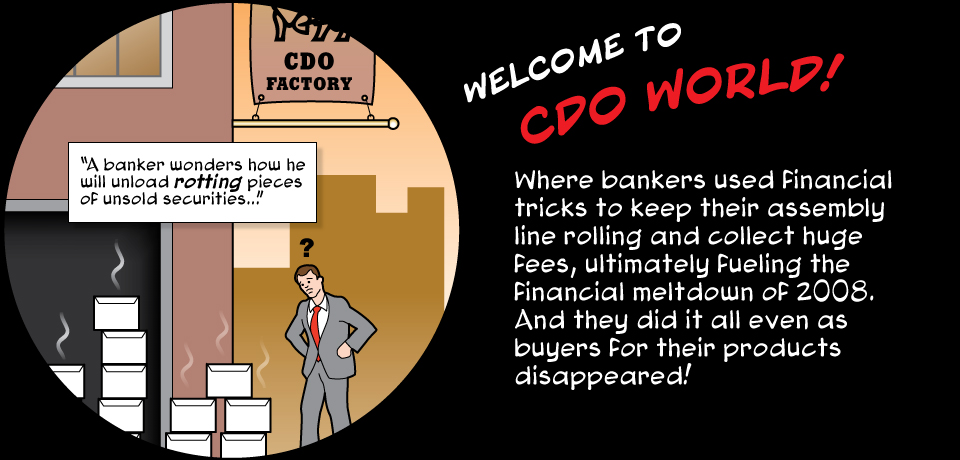
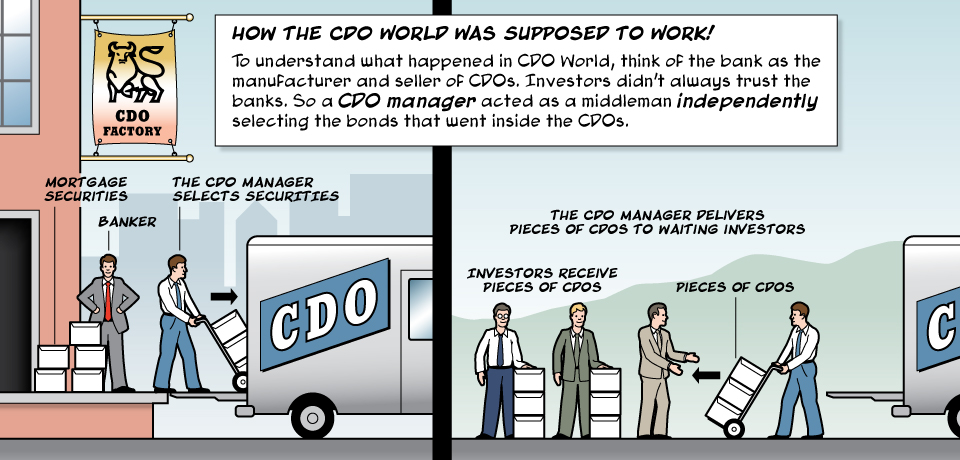
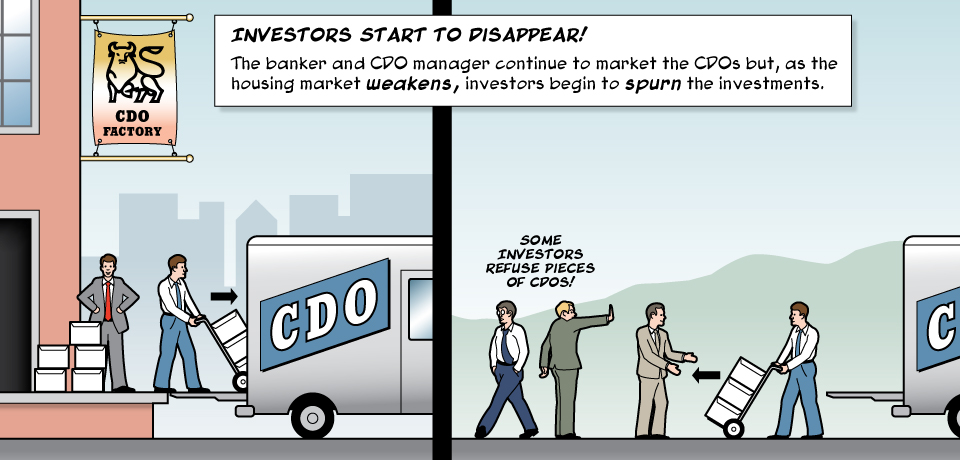
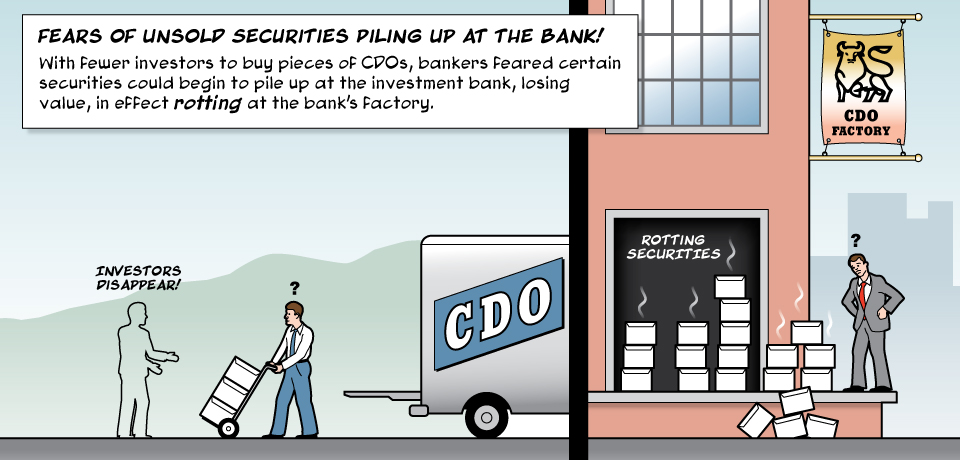
Welcome to CDO World!

Welcome to CDO World!: "

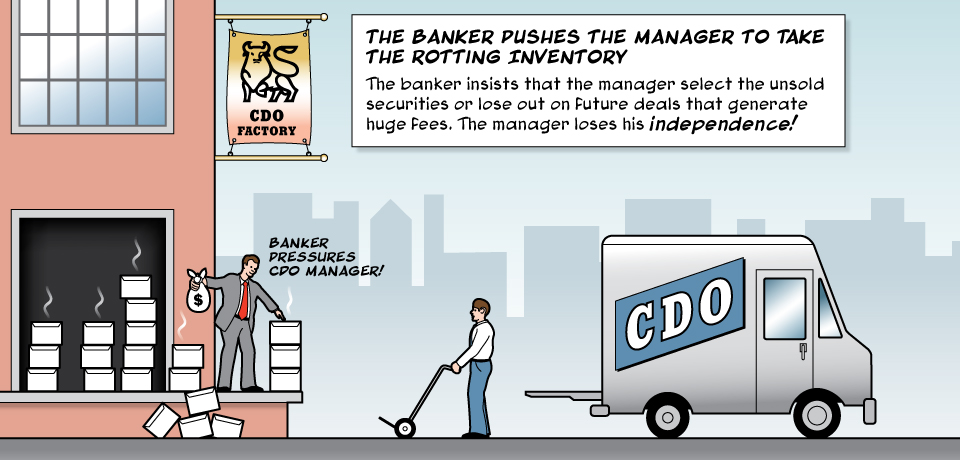
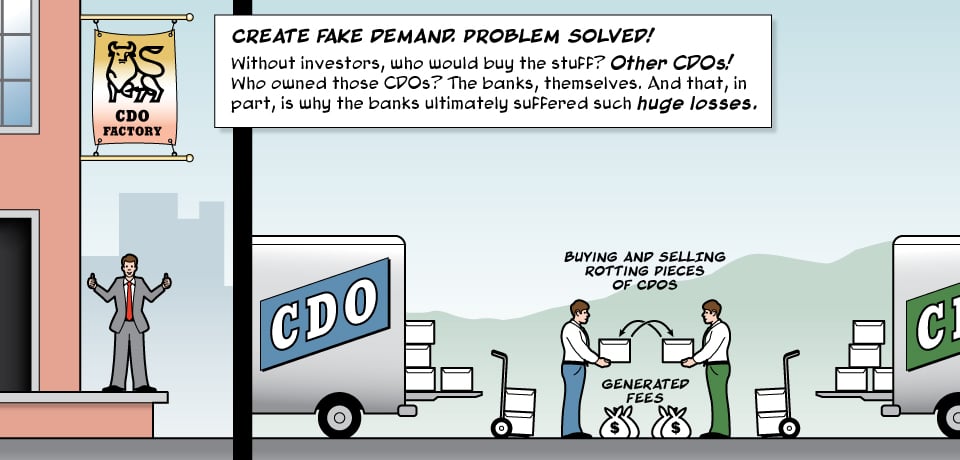
Via Pro Publica comes the latest tale of theft and woe of the big banks derivatives scams: Selling products to themselves, artificially creating fraudulent profits (capturing big bonuses). Whent he underlying assets drop, the derivatives become worthless — but the bonuses are already spent!


>


>


Sources:

Welcome to CDO World!

Al Granberg, Special to ProPublica

ProPublica, August 26, 2010


http://www.propublica.org/special/cdo-world


Banks’ Self-Dealing Super-Charged Financial Crisis

Jake Bernstein and Jesse Eisinger

ProPublica, August 26, 2010


http://www.propublica.org/article/banks-self-dealing-super-charged-financial-crisis


"

Guest Post: Hyperinflation, Part II: What It Will Look Like

Guest Post: Hyperinflation, Part II: What It Will Look Like: "

Submitted by Gonzalo Lira

Hyperinflation, Part II: What It Will Look Like

I usually don’t do follow-up pieces to any of my posts. But my recent longish piece, describing how hyperinflation might happen in the United States, clearly struck a nerve.

It was a long, boring, snowy piece of macro-economic policy speculation, discussing Treasury yields, Federal Reserve Board monetary reaction, and the difference between inflation and hyperinflation—but considering the traffic it generated, I might as well been discussing relative breast size in the porn industry. With pictures.

Essentially, I argued that Treasury bonds are the New and Improved Toxic Assets. I argued that, if there was a run on Treasuries, the Federal Reserve—in its anti-deflationary zeal, and its efforts to prop up bond market prices—would over-react, and set off a run on commodities. This, I argued, would trigger hyperinflation.

The disproportionate attention my post garnered is indicative of people’s current fears. As I’ve said before, people aren’t blind or stupid, even if they often act that way. People are worried—they’re worried about the current state of affairs: Massive quantitative easing, toxic assets replaced by the full faith and credit of the U.S. government in the shape of Treasuries, fiscal debt which cannot possibly be repaid, a second leg down in the Global Depression that seems endless and only getting worse—people are scared. Many readers gave me quite a bit of useful feedback, critiques, suggestions and comments on the piece—clearly, what I was discussing touched on a deeply felt concern.

However, there were two issues that many readers had a hard time wrapping their minds around, with regards to a hyperinflationary event:

The first was, Where does all the money come from, for hyperinflation to happen? The question wasn’t put as baldly as that—it was wrapped up in sophisticated discussions about M1, M2 and M3 money supply, as well as clever talk about the velocity of money—the acceleration of money—the anti-lock brakes on money. There were even equations thrown around, for good measure.

But stripped of all the high-falutin’ language, the question was, “Where’s all the dough gonna come from?” After all, as we know from our history books, hyperinflation involves people hoisting bundles and bundles of high-denomination bills which aren’t worth a damn, and tossing them into the chimney—’cause the bundles of cash are cheaper than firewood. If the dollar were to crash, where would all these bundles of $100 bills come from?

The second question was, Why will commodities rise, while equities, real estate and other assets fall? In other words, if there is an old fashioned run on a currency—in this case, the dollar, the world’s reserve currency—why would people get out of the dollar into commodities only, rather than into equities and real estate and other assets?

In this post, I’m going to address both of these issues.


Apart from what happened with the Weimar Republic in the 1920’s, advanced Western economies have no experience with hyperinflation. (I actually think that the high inflation that struck the dollar in the 1970’s, and which was successfully choked off by Paul Volcker, was in fact an incipient bout of commodity-driven hyperinflation—but that’s for some other time.) Though there were plenty of hyperinflationary events in the XIX century and before, after the Weimar experience, the advanced economies learned their lesson—and learned it so well, in fact, that it’s been forgotten.

However, my personal history gives me a slight edge in this discussion: During the period 1970–’73, Chile experienced hyperinflation, brought about by the failed and corrupt policies of Salvador Allende and his Popular Unity Government. Though I was too young to experience it first hand, my family and some of my older friends have vivid memories of the Allende period—vivid memories that are actually closer to nightmares.

The causes of Chile’s hyperinflation forty years ago were vastly different from what I believe will cause American hyperinflation now. But a slight detour through this history is useful to our current predicament.

To begin: In 1970, Salvador Allende was elected president by roughly a third of the population. The other two-thirds voted for the centrist Christian Democrat candidate, or for the center-right candidate in roughly equal measure. Allende’s election was a fluke.

He wasn’t a centrist, no matter what the current hagiography might claim: Allende was a hard-core Socialist, who headed a Hard Left coalition called the Unidad Popular—the Popular Unity (UP, pronounced “oo-peh”). This coalition—Socialists, Communists, and assorted Left parties—took over the administration of the country, and quickly implemented several “reforms”, which were designed to “put Chile on the road to Socialism”.

Land was expropriated—often by force—and given to the workers. Companies and mines were also nationalized, and also given to the workers. Of course, the farms, companies and mines which were stripped from their owners weren’t inefficient or ineptly run—on the contrary, Allende and his Unidad Popular thugs stole farms, companies and mines from precisely the “blood-thirsty Capitalists” who best treated their workers, and who were the most fair towards them.

Allende’s government also put UP-loyalists in management positions in those nationalized enterprises—a first step towards implementing a Leninist regime, whereby the UP would have “political control” over the means of production and distribution. From speeches and his actions, it’s clear that Allende wanted to implement a Maoist-Leninist regime, with himself as Supreme Leader.

One of the key policy initiative Allende carried out was wage and price controls. In order to appease and co-opt the workers, Allende’s regime simultaneously froze prices of basic goods and services, and augmented wages by decree.

At first, this measure worked like a charm: Workers had more money, but goods and services still had the same old low prices. So workers were happy with Allende: They went on a shopping spree—and rapidly emptied stores and warehouses of consumer goods and basic products. Allende and the UP Government then claimed it was right-wing, anti-Revolutionary “acaparadores”—hoarders—who were keeping consumer goods from the workers. Right.

Meanwhile, private companies—forced to raise worker wages while maintaining their same price structures—quickly went bankrupt: So then, of course, they were taken over by the Allende government, “in the name of the people”. Key industries were put on the State dole, as it were, and made to continue their operations at a loss, so as to satisfy internal demand. If there was a cash shortfall, the Allende government would simply print more escudos and give them to the now State-controlled companies, which would then pay the workers.

This is how hyperinflation started in Chile. Workers had plenty of cash in hand—but it was useless, because there were no goods to buy.

So Allende’s government quickly instituted the Juntas de Abastecimiento y Control de Precios (“Unions of Supply and Price Controls”, known as JAP). These were locally formed boards, composed of loyal Party members, who decided who in a given neighborhood received consumer products, and who did not. Naturally, other UP-loyalists had preference—these Allende backers received ration cards, with which to buy consumer goods and basic staples.

Of course, those people perceived as “unfriendly” to Allende and the UP Government either received insufficient rations for their families, or no rations at all, if they were vocally opposed to the Allende regime and its policies.

Very quickly, a black market in goods and staples arose. At first, these black markets accepted escudos. But with each passing month, more and more escudos were printed into circulation by the Allende government, until by late ’72, black marketeers were no longer accepting escudos. Their mantra became, “Sólo dólares”: Only dollars.

Hyperinflation had arrived in Chile.

(Most Chileans, myself included, find ourselves both amused and irritated, whenever Americans self-righteously claim that Nixon ruined Chile’s economy, and thereby derailed Allende’s “Socialist dream”. Yes, according to Kissinger’s memoirs, Nixon did in fact tell the CIA that he wanted Chile’s economy to “scream”—but Allende did such a bang-up job of fucking up Chile’s economy all on his own that, by the time Richard Helms got around to implementing his pissant little plots against the Chilean economy, there was not much left to ruin.)

One of the effects of Chile’s hyperinflation was the collapse in asset prices.

This would seem counterintuitive. After all, if the prices of consumer goods and basic staples are rising in a hyperinflationary environment, then asset prices should rise as well—right? Equities should rise in price—since more money is chasing after the same number of stock. Real estate prices should rise also—and for the same reason. Right?

Actually, wrong—and for a simple reason: Once basic necessities are unmet, and remain unmet for a sustained period of time, any asset will be willingly and instantly sacrificed, in order to meet that basic need.

To put it in simple terms: If you were dying of thirst in the middle of the desert, would you give up your family heirloom diamonds, in exchange for a gallon of water? The answer is obvious—yes. You would sacrifice anything and everyting—instantly—in order to meet your basic needs, or those of your family.

So as the situation in Chile deteriorated in ’72 and into ’73, the stock market collapsed, the housing market collapsed—everything collapsed, as people either cashed out of their assets in order to buy basic goods and staples on the black market, or cashed out so as to leave the country altogether. No asset class was safe, from this sell-off—it was across-the-board, and total.

Now let’s return to the possibility of hyperinflation in the United States:

If there were a sudden collapse in the Treasury bond market, I argued that sellers would take their cash and put them into commodities. My reasoning was, they would seek a sure store of value. If Treasury bonds ceased to be that store of value, then people would invest in the next best thing, which would be commodities, especially precious and industrial metals, as well as oil—in other words, non-perishable commodities.

Some people argued this point with me. They argued many different approaches to the problem, but essentially, it all boiled down to the argument that commodities and precious metals have no intrinsic value.

Actually, I think they’re right. In a strict sense, only oxygen, food and water have intrinsic value to human beings—everything else is superfluous. Therefore the value of everything else is arbitrary.

Yet both gold and silver have, historically, been considered valuable. Setting aside a theoretical or mathematical construct that would justify the value of gold and silver, look at it from a practical standpoint: If I went to a farmer with five ounces of silver, would he give me a sack of grain? Probably. If I offered him an ounce of gold for two or three pigs, would he give them to me? Again, probably.

Where there is a human society, there is a need to exchange. Where there is a need to exchange, a medium of exchange will soon appear. Gold and silver (and copper and brass and other metals) have served that purpose for literally millennia, but then they were replaced by paper.

Right now, there are two forms of paper currency: Actual dollars, and Treasury bonds. One is a medium of exchange, the other a store of value.

If Treasuries—the store of value—were to collapse in price, and the Fed—as I predict—tried everything in its power to at least initially prop up their prices, would those sellers who managed to get out of Treasuries in time then turn around and invest in even dodgier bits of paper, like stocks? Or REIT’s? Or even precious metal ETF’s?

No they would not: They would get out of Treasuries—supposedly the “safest” investment there is—and get into something even safer—something even more tangible: Actual commodities. Not ETF’s, not even futures (or anything else that entails counterparty risk)—sellers of Treasuries would get into actual, hard commodities. Because if suddenly even the safest of all investment vehicles is now unsafe, do you really want to get behind the wheel of an even more unsafe vehicle, like stocks or corporate bonds or ETF’s? I mean, c’mon: If Treasuries crash, what else might crash?

That’s why people in a Treasury panic would buy commodities. This ballooning of non-perishable commodities would be as a means to store value. Because that’s what people do in a panic—they batten down the hatches, and go into what’s safest. When the stock markets tanked in the Fall of ’08, where did all that sellers’ cash go? To Treasuries—because it was then considered the safest store of value. Commodities suffered in comparison—gold took a bit of a hit, as did the other precious metals—but Treasuries ballooned as the equities markets tanked.

But if Treasuries—the ultimate store of value—now tanked? If the last sure-thing in paper-based stores of value took a hit, where would people go to both store value, and have ready access to that value?

Commodities. And this rush to commodities, I argued, would trigger hyperinflation.

Now, I said I would answer two questions—one was why commodities would outpace all other asset classes in a Treasury panic and subsequent hyperinflation. The other question was, “Where’s all the dough to feed my fireplace gonna come from, in a hyperinflationary event?”

The first wave of dollars in a hyperinflationary event will come from people’s savings accounts.

If Treasuries tank, and the markets all barrel into commodities, then prices will rise for regular consumers—this should not be a controversial inference. What would consumers do, with suddenly much higher gas prices, and soon much higher food prices? Simple: They’ll bust open their piggy banks, whatsoever those piggy banks might happen to be: 401(k)s, whatever equities they might have, etc.

But if the higher consumer prices continue—or become worse—what will happen to the 320 million American consumers? They’ll start buying more gas now, rather than wait around for tomorrow—and the market will react to this. How? Two way: Prices of commodities will rise even further—and asset prices will fall even lower.

Again, the man in the desert, the diamonds, and the water: If American consumers are getting hit at the gas station and the supermarket, they’ll start selling everything so as to buy gas, heating oil (most especially) and foodstuffs. The Treasury panic will thus be transfered to the average consumer—from Wall Street to Main Street by way of $15 a gallon gas prices, and $10 a gallon heating oil prices.

All other consumer prices would soon follow the leads of gas, heating oil and food.

In the above bit of Chilean history, I described how the Allende government printed up escudos to make up for the shortfall in nationalized businesses that was produced by their policy of hiking wages, while at the same time fixing prices.

This is a completely different way to hyperinflation than the way I envision it for the American economy—but once the American economy gets there, the effects of hyperinflation will be exactly the same: People will try to get out of assets in order to get hold of commodities. To get all eccy about it, money velocity would approach infinity, as money supply remains (at first) fixed, yet in the panic over commodities, aggregate demand as measured by aggregate transactions goes vertical.

Would there be Federal government intervention of some sort? Most definitely—people would be screaming for it. Would food rationing be implemented? Probably, and probably by way of the current Food Stamps program. Troops on the streets, protecting gas stations and supermarkets? Curfews to prevent looting? Palliative dollar printing? Yes, yes, and very likely yes.

That last bit—palliative dollar-printing: That’s the key. When palliative dollar-printing happens, it will be the final stages of hyperinflation—it’s when sensible people ought to realize that the crisis is almost over, and that a new normal will soon appear. But this stage will be fucking awful.

Palliative dollar printing will take place when the Federal government simply runs out of options. Smart economists will get on CNBC and argue that, “The velocity of money is destroying the economy—we must expand the currency base!” It’ll sound logical, but palliative money-printing will be a policy option born out of panic. The final policy option. It won’t be done for evil conspiratorial reasons—always remember Aphorism #6 (“Never ascribe to malice what can be explained by incompetence.”). It’ll be carried out because of fear and panic.

A whole boatload of fools in Washington, on seeing this terrible commodity-driven crisis unfold, with consumer prices shooting the moon, will scream for dollars to be printed—and their rationale will be perfectly reasonable, I can practically hear it now: “We've got to get cash into the hands of the average American citizen, so he or she can buy food and heating oil for their families! We can’t let Americans starve and freeze to death!”

Palliative money-printing will take place—hence the average American family will likely be using bundles of $100 bills to fire up the chimney that hyperinflationary winter.

Hoo-Ah.

Now, this fairly Apocalyptic scenario is simultaneously horrifying, and exciting as all get out. Hell, why do you think disaster movies are so popular? Shit blowing up is way cool! That's why Roland Emmerich gets paid the big bucks, God bless ‘im.

But for sensible people, Apocalypse is a distraction—it’s not the main event. For sensible people who want to be prepared, Apocalypse represents opportunities.

A true story: In ’73, at the height of the Allende-created hyperinflation, an uncle of mine, who was then a college student, was offered an apartment in exchange for his car. That’s right—an apartment. He owned a crappy little Fiat 147—a POS if ever there was such a thing—but cars in Chile in the middle of that hyperinflation were so scarce, and considered so valuable, that he was offered an apartment in exchange. To this day, my uncle still tells the story—with deep regret, because he didn’t follow through on the offer: “That Fiat was in the junkyard by ’78, but that apartment still stands! And today it’s worth nearly a half a million dollars!” Actually, I think it’s worth a bit more than that.

Another true story: A banker friend of mine manages the assets of a fabulously wealthy 70-something gentleman, whom I'll call Alfredo. In 1973, Don Alfredo was a youngish man, just starting out, with a degree in engineering but no money—until he inherited US$3,000 from a deceased aunt. Alfredo realized that the $3,000 were in a sense worthless: He couldn’t buy anything with them, and it wasn’t enough for him to leave the country and start over someplace else. After all, even then, $3,000 was not that much money.

So he took those $3,000, went down to the stock exchange, and spent all of it on Chilean blue-chip companies: Mining companies, chemical companies, paper companies, and so on. The stock were selling for nothing—less than penny stock—because of the disastrous policies of the Allende government. His stock broker at the time told him not to buy stocks, as Allende’s government, it was thought, would soon nationalize these companies as well.

Alfredo ignored his broker, and went ahead with the stock purchases: He spent all of his $3,000 on buckets of near-worthless equities.

On September 11, 1973, the commanders in chief of the four branches of the Chilean military staged a coup d’état. Within a year, Alfredo’s stock had rebounded about ten-fold. Since then, they’ve multiplied several thousand-fold—yes: Several thousand-fold. Don Alfredo has lived off of that $3,000 investment ever since—it’s what made him a multi-millionare today.

He realized, of course, that either those blue-chip companies would be nationalized by Allende—in which case he would lose all his $3,000 inheritance, which really wouldn’t change his fortunes very much—or somehow a new normal would arrive in Chile. Since the $3,000 couldn’t buy him anything, he took a gamble—and won.

What do these two true stories tell us? Simple: Buy when there’s blood on the streets.

That’s Baron de Rothschild’s famous line—but it hides a key insight, one which should be highlighted perhaps even more forcefully than the line itself:

Even in the midst of Apocalypse, things will get better.

That’s something people don’t quite seem to understand. In fact, it’s why teenagers tragically kill themselves over some girl or boy: They don’t realize that, no matter how bad things are now, they will get better later. To repeat:

Even in the midst of Apocalypse, things will get better.

I’m not repeating this insight as an empty comfort to my readers—I’m saying it as a trading strategy. When things are at their crazy worst, when everyone believes the Apocalypse is well nigh here, that’s when thing are about to turn for the better. This applies to every situation—including and most especially in a hyperinflationary situation.

Why? Simple: Because hyperinflation—by definition—cannot last. Because people need a stable medium of exchange. So if the currency goes up in flames in a hyperinflationary fire, of course there will be a period of terrifying instability—but it will pass. Either the currency will be repaired somehow (as Volcker repaired the dollar back in 1980–’82). Or the currency will be completely and irrevocably trashed—and then be replaced by something else. Because—to insist—people need a stable medium of exchange.

If Treasuries tank and commodities shoot up so high that they essentially break the dollar, civilization will not come crashing down into anarchy. At worst, there’ll be a three-four years of hell—economic hell. Financial hell. But then things will settle down into a new normal.

This new normal might well have unsavory characteristics. I tend to be a pessimist, and just glancing through history, I can see that just about every period of hyperinflation has been stabilized by some subsequent form of autocratic or totalitarian government. The United States currently has all the legal decisions and practical devices to quickly transition into an authoritarian or totalitarian regime, should a crisis befall the nation: The so-called PATRIOT Acts, the Department of Homeland Security Agency, the practical suspension of habeas corpus, etc., etc.

But as I said in my previous post, and reiterate here: Speculations about the new normal are pointless at this time. The future will happen soon enough.

What I do know is, One, a hyperinflationary event will happen, following the crash in Treasuries. Two, commodities will be the go-to medium for value storage. Three, all asset classes will collapse in short order. And Four—and most importantly—civil society will not collapse along with the dollar. Civil society will stumble about like a drunken sailor, but eventually right itself and carry on with a new normal.

During that stumble, opportunities will present themselves. I hope I have explained why.

"