Saturday, February 26, 2011

MORE ON THE DEFLATIONARY EFFECTS OF HIGHER OIL PRICES…

MORE ON THE DEFLATIONARY EFFECTS OF HIGHER OIL PRICES…: "

There’s been a lot of good commentary in the last 24 hours regarding the deflationary impact of higher oil prices. Much of this discussion has been based around its impacts in Japan, however, it is applicable to the USA as well. In a piece this morning FT Alphaville commentary from Macquarie and JP Morgan regarding this effect:


As Macquarie Securities noted:


“We disagree with the view that deflation means Japan is the one country to benefit from higher oil prices. In the previous commodity boom, profits peaked in 1Q07 and domestic demand in 2Q07 as higher commodity prices pushed the economy towards recession well before the Lehman’s collapse.”


Masamichi Adachi, economist at JPMorgan in Tokyo, reinforced the point:


“Some commentators argue that the rise of commodity prices is welcome in Japan, which is suffering prolonged deflation. We disagree with this view. While the rise in food and energy prices may increase households’ inflation expectations, it does not mean that they can expect higher wages in the future. Actually, in a deflationary environment with considerable slack, the opposite will likely happen as the profit squeeze will weigh on wages, further restraining labor income and consumption. The deterioration in the terms of trade—resulting from a rise in import prices and a fall in (or flat) export prices—may be the drag on domestic demand, which is still sluggish and fragile.”


That’s right. For a nation suffering a balance sheet recession the likelihood is that higher oil costs will serve only as a tax. This supply shock results in depressing aggregate demand and furthering the likelihood of deflationary pressures. Paul Krugman elaborated on this:


“So, does a rise in food and energy prices do anything to alleviate these (deflationary) problems? No. In fact, it makes them worse, by reducing purchasing power. So while the commodity surge may temporarily lead to rising headline prices in Japan, the underlying deflation problem won’t be affected at all.”


That’s exactly right. At the end of the day rising oil prices will only crunch consumer balance sheets further which increases the likelihood of recession. And for a nation with too much debt and not enough spending power that means producers will ultimately have trouble passing along any costs as end demand remains weak. This might not lead to outright deflation, but it certainly won’t result in hyperinflation.

"

Guest Post: 2011 Tipping Points

Guest Post: 2011 Tipping Points: "

By Gordon T. Long of Tipping Points

2011 Tipping Points (pdf)

Throughout my 2010 article series "Extend & Pretend" and "Sultans of Swap" I stressed that we were rapidly moving from the Financial Crisis of 2008, through the Economic Fallout of 2009 -2010, towards a Political Crisis in 2011 -2012. We are now clearly beginning to see the early emergence of the final part of this continuum. From North Africa to Wisconsin all are fundamentally based on the single insidious underlying problem - excessive global debt and credit levels.

The global macroeconomic environment appears to be rapidly unraveling. The situations in North Africa through the Middle East are blatant proof of social unrest and accelerating political instability. Food shortages and inflation pressures are now driving people into the streets. When you feel the hunger in your stomach and see it in the eyes of your children, it quickly erupts and motivates people to action.

It is now time to revisit our Tipping Points framework to see where this is leading. A framework that is clearly pointing to a global fiat currency failure and an emerging new world order which is detailed in our '2011 Thesis - Beggar-thy-Neighbor'.

Our Tipping Points which are outlined below are adjusted continuously based on daily news flow analysis. Through a proprietary 'Process of Abstraction' news is tracked and consolidated around these potentially critical flash points.

CHANGES OF SIGNIFICANCE THIS QUARTER

INCREASES IS WAS CHANGE

1) Oil Price Pressures 14 30 +16
2) China Bubble 9 22 +13
3) Food Price Pressures 5 15 +10
4) Rising Inflation Pressures &
Interest Rate Pressures 6 14 + 8
5) Geo-Political Event Risk New
6) Social Unrest New

DECREASES

1) North & Southern Korea 30 12 -18
2) Financial Crisis Programs
Expiration Impact 34 24 -10

The Tectonic Shifts from 2007 to 2013 are best shown in the following illustration which is closely tracking our expectations and projections from the early stage of the financial crisis.

CONCLUSIONS

We need to carefully watch:

1) The increasing & accelerated contagion of social tensions. Watch for Asia demonstrations in places such as North Korea.
2) How and if the Central Banks actually do unwind their crisis ‘triage’ programs or are they realistically now permanent and necessary to maintain the illusion of financial stability?
3) New government public policy initiatives to combat growing inflation and price pressures
4) The financial sectors abilities to continue to hide massive nonperforming commercial and residential real estate loans through Federal Reserve endorsed accounting gimmickry.

These events will allow us to determine if our roadmap is still valid or if we are going to see even sooner and possibly poorer financial outcomes than we predict in our free Monthly Market Commentary and Market Analytics reports.

The public will soon wake up to the magnitude of money printing that is going on to support the economic recovery fallacy. When the public does become aware, “Money Velocity” will accelerate. When this happens, the likelihood is that the markets will dramatically rise, not because economic conditions are improving, but rather because of a depreciating US dollar. We believe this expectation is presently being priced into the market. We are truly exposed to the potential of a “Minsky Melt-Up” or more correctly from an Austrian perspective, a Von Mises “Crack-up Boom”.

The risks are presently towards a SHORT TERM corrective consolidation. The Intermediate Term calls for higher market highs into June 2011 - then it gets ugly - fast!

“The Federal Reserve historically was the lender of last resort in a crisis;
Today, the Federal Reserve is the buyer of first resort in a crisis
..... and every day for that matter”

"

How the Servant Became a Predator: Finance’s Five Fatal Flaws

How the Servant Became a Predator: Finance’s Five Fatal Flaws: "

Bill Black is the author of The Best Way to Rob a Bank is to Own One and an associate professor of economics and law at the University of Missouri-Kansas City. He is a white-collar criminologist who has spent years working on regulatory policy and fraud prevention as Executive Director of the Institute for Fraud Prevention, Litigation Director of the Federal Home Loan Bank Board and Deputy Director of the National Commission on Financial Institution Reform, Recovery and Enforcement, among other positions.


~~~


What exactly is the function of the financial sector in our society? Simply this: Its sole function is supplying capital efficiently to aid the real economy. The financial sector is a tool to help those that make real tools, not an end in itself. But five fatal flaws in the financial sector’s current structure have created a monster that drains the real economy, promotes fraud and corruption, threatens democracy, and causes recurrent, intensifying crises.


1. The financial sector harms the real economy.


Even when not in crisis, the financial sector harms the real economy. First, it is vastly too large. The finance sector is an intermediary — essentially a “middleman”. Like all middlemen, it should be as small as possible, while still being capable of accomplishing its mission. Otherwise it is inherently parasitical. Unfortunately, it is now vastly larger than necessary, dwarfing the real economy it is supposed to serve. Forty years ago, our real economy grew better with a financial sector that received one-twentieth as large a percentage of total profits (2%) than does the current financial sector (40%). The minimum measure of how much damage the bloated, grossly over-compensated finance sector causes to the real economy is this massive increase in the share of total national income wasted through the finance sector’s parasitism.


Second, the finance sector is worse than parasitic. In the title of his recent book, The Predator Statehttp://books.simonandschuster.com/Predator-State/James-Galbraith/9781416566830, James Galbraith aptly names the problem. The financial sector functions as the sharp canines that the predator state uses to rend the nation. In addition to siphoning off capital for its own benefit, the finance sector misallocates the remaining capital in ways that harm the real economy in order to reward already-rich financial elites harming the nation. The facts are alarming:


• Corporate stock repurchases and grants of stock to officers have exceeded new capital raised by the U.S. capital markets this decade. That means that the capital markets decapitalize the real economy. Too often, they do so in order to enrich corrupt corporate insiders through accounting fraud or backdated stock options.


• The U.S. real economy suffers from critical shortages of employees with strong mathematical, engineering, and scientific backgrounds. Graduates in these three fields all too frequently choose careers in finance rather than the real economy because the financial sector provides far greater executive compensation. Individuals with these quantitative backgrounds work overwhelmingly in devising the kinds of financial models that were important contributors to the financial crisis. We take people that could be conducting the research & development work essential to the success of our real economy (including its success in becoming sustainable) and put them instead in financial sector activities where, because of that sector’s perverse incentives, they further damage both the financial sector and the real economy. Michael Moore makes this point in his latest film, Capitalism: A Love Story.


• The financial sector’s fixation on accounting earnings leads it to pressure U.S manufacturing and service firms to export jobs abroad, to deny capital to firms that are unionized, and to encourage firms to use foreign tax havens to evade paying U.S. taxes.


• It misallocates capital by creating recurrent financial bubbles. Instead of flowing to the places where it will be most useful to the real economy, capital gets directed to the investments that create the greatest fraudulent accounting gains. The financial sector is particularly prone to providing exceptional amounts of funds to what I call accounting “control frauds“. Control frauds are seemingly-legitimate entities used by the people that control them as a fraud “weapons.” In the financial sector, accounting frauds are the weapons of choice. Accounting control frauds are so attractive to lenders and investors because they produce record, guaranteed short-term accounting “profits.” They optimize by growing rapidly like other Ponzi schemes, making loans to borrowers unlikely to be able to repay them (once the bubble bursts), and engaging in extreme leverage. Unless there is effective regulation and prosecution, this misallocation creates an epidemic of accounting control fraud that hyper-inflates financial bubbles. The FBI began warning of an “epidemic” of mortgage fraud in its congressional testimony in September 2004. It also reports that 80% of mortgage fraud losses come when lender personnel are involved in the fraud. (The other 20% of the fraud would have been impossible had these fraudulent lenders not suborned their underwriting systems and their internal and external controls in order to maximize their growth of bad loans.)


• Because the financial sector cares almost exclusively about high accounting yields and “profits”, it misallocates capital away from firms and entrepreneurs that could best improve the real economy (e.g., by reducing short-term profits through funding the expensive research & development that can produce innovative goods and superior sustainability) and could best reduce poverty and inequality (e.g., through microcredit finance that would put the “Payday lenders” and predatory mortgage lenders out of business).


• It misallocates capital by securing enormous governmental subsidies for financial firms, particularly those that have the greatest political power and would otherwise fail due to incompetence and fraud.


2. The financial sector produces recurrent, intensifying economic crises here and abroad.


The current crisis is only the latest in a long list of economic crises caused by the financial sector. When it is not regulated and policed effectively, the financial sector produces and hyper-inflates bubbles that cause severe economic crises. The current crisis, absent massive, global governmental bailouts, would have caused the catastrophic failure of the global economy. The financial sector has become far more unstable since this crisis began and its members used their lobbying power to convince Congress to gimmick the accounting rules to hide their massive losses. Secretary Geithner has exacerbated the problem by declaring that the largest financial institutions are exempt from receivership regardless of their insolvency. These factors greatly increase the likelihood that these systemically dangerous institutions (SDIs) will cause a global financial crisis.


3. The financial sector’s predation is so extraordinary that it now drives the upper one percent of our nation’s income distribution and has driven much of the increase in our grotesque income inequality.


4. The financial sector’s predation and its leading role in committing and aiding and abetting accounting control fraud combine to:


• Corrupt financial elites and professionals, and


• Spur a rise in Social Darwinism in an attempt to justify the elites’ power and wealth. Accounting control frauds suborn accountants, attorneys, and appraisers and create what is known as a “Gresham’s dynamic” — a system in which bad money drives out good. When this dynamic occurs, honest professionals are pushed out and cheaters are allowed to prosper. Executive compensation has become so massive, so divorced from performance, and so perverse that it, too, creates a Gresham’s dynamic that encourages widespread accounting fraud by both financial firms and firms in the real economy.


As financial sector elites became obscenely wealthy through predation and fraud, their psychological incentives to embrace unhealthy, anti-democratic Social Darwinism surged. While they were, by any objective measure, the worst elements of the public, their sycophants in the media and the recipients of their political and charitable contributions worshiped them as heroic. Finance CEOs adopted and spread the myth that they were smarter, harder working, and more innovative than the rest of us. They repeated the story of how they rose to the top entirely through their own brilliance and willingness to embrace risk. All of their employees weren’t simply above average, they told us, but exceptional. They hated collectivism and adored Ayn Rand.


5. The CEOs of the largest financial firms are so powerful that they pose a critical risk to the financial sector, the real economy, and our democracy.


The CEOs can directly, through the firm, and by “bundling” contributions of its officers and employees, easily make enormous political contributions and use their PR firms and lobbyists to manipulate the media and public officials. The ability of the financial sector to block meaningful reform after bringing the world to the brink of a second great depression proves how exceptional its powers are to corrupt nearly every critical sector of American public and economic life. The five largest U.S. banks control roughly half of all bank assets. They use their political and financial power to provide themselves with competitive advantages that allow them to dominate smaller banks.


This excessive power was a major contributor to the ongoing crisis. Effective financial and securities regulation was anathema to the CEOs’ ideology (and the greatest danger to their frauds, wealth, and power) and they successfully set out to destroy it. That produced what criminologists refer to as a “criminogenic environment” (an atmosphere that breeds criminal activity) that prompted the epidemic of accounting control fraud that hyper-inflated the housing bubble.


The financial industry’s power and progressive corruption combined to produce the perfect white-collar crimes. They successfully lobbied politicians, for example, to legalize the obscenity of “dead peasants’ insurance” (in which an employer secretly takes out insurance on an employee and receives a windfall in the event of that person’s untimely death) that Michael Moore exposes in chilling detail. State legislatures changed the law to allow a pure tax scam to subsidize large corporations at the expense of their taxpayers.


Caution: Never Forget the Need to Fix the Real Economy


Economic reform efforts are focused almost entirely on fixing finance because the finance sector is so badly broken that it produces recurrent, intensifying crises. The latest crisis brought us to the point of global catastrophe, so the focus on finance is obviously rational. But the focus on finance carries a grave risk. Remember, the sole purpose of finance is to aid the real economy. Our ultimate focus needs to be on the real economy, which creates goods and services, our jobs, and our incomes. The real economy came off the rails at least three decades ago for the great majority of Americans.


We need to commit to fixing the real economy by guaranteeing that everyone willing to work can work and making the real economy sustainable rather than recurrently causing global environmental crises. We must not spend virtually all of our reform efforts on the finance sector and assume that if we solve its defects we will have solved the other fundamental reasons why the real economy has remained so dysfunctional for decades. We need to be work simultaneously to fix finance and the real economy.


"

Wednesday, February 23, 2011

REVISITING THE SHILLER P/E

REVISITING THE SHILLER P/E: "

We got some great responses to the Merrill Lynch report last week (I highly recommend reading the comments) which argued that the Shiller P/E ratio was not useful and that its high current reading was misleading. The following excellent response comes from JJ Abodeely, CFA who writes Value Restoration Project:


Last week, Cullen Roche over at Pragmatic Capitalist covered a research report written by David Bianco, Chief US Market Strategist at Merrill Lynch, questioning the utility of the Shiller P/E. He thought Bianco “made a pretty strong case.” I felt otherwise and after reading several reports by ML on the topic I have a more thoughtful view of where their analysis and application of a normalized P/E falls short.


ML’s shortcomings start with the very premise of why determining what the level of normalized earnings is to begin with. From their piece:


“Perception of normal EPS and confidence in such drives short-term performance. Actual EPS through the full cycle drives most of long-term market performance.”


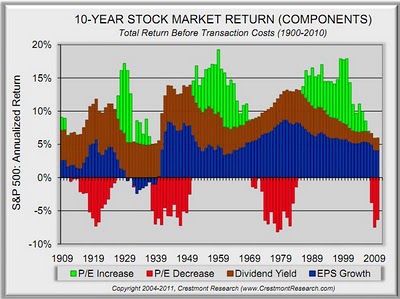
Come again? Actual EPS through the cycle drives “most” of market performance? Where has Bianco been the last 20 years? Earnings over long periods of time do not drive market performance, changes in VALUATION MULTIPLES drive market performance (with the 1930s Great Depression being a possible exception) Ed Easterling at Crestmont Research breaks down long-term stock market return components.


The EPS measure from Shiller’s Cyclically Adjusted P/E and other well crafted versions of normalized earnings, such as Crestmont’s business cycle-adjusted EPS, are useful, even essential, because they help us to smooth out the business cycle and determine whether or not the current PRICE of the market is cheap or expensive and thus whether future returns will be high or low.


So, it makes sense that Bianco and Merrill aim to improve upon Shiller’s P/E. Their most serious critique of the Shiller P/E, however, is also their most dubious argument:


Shiller’s PE understates normalized EPS

Shiller’s PE cannot be fairly compared across time because it neglects substantial shifts in dividend payout ratios over the last 110 years. Anytime the dividend payout ratio is not 100% EPS should rise with inflation plus the return on reinvested earnings (an expected real ROE). This is called an Equity Time Value Adjustment (ETVA). Shiller’s EPS does not fairly represent normal EPS because it assumes EPS only grows by inflation, which given a decade of high EPS retention, is flawed.


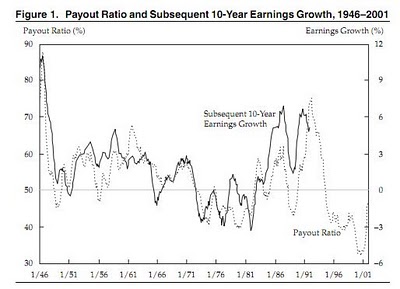
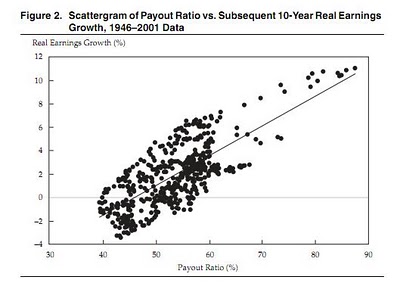
As several comments on the original Prag Cap post pointed out, higher retained earnings (lower dividend payouts) does NOT equal higher earnings growth. Merrill’s logic assumes that companies can infinitely reinvest earnings into their business at a given ROE without degrading it, when the experience of companies in the real world says otherwise. That is why good companies return cash to shareholders, because they know that at some level of retained earnings (different for each company), the reinvestment opportunities are limited without accepting lower returns. Research by Cliff Asness and Rob Arnott (Surprise! Higher Dividends = Higher Earnings Growth) proves this empirically (the charts below are theirs). Real world experience as an investor has taught me that companies that pay higher dividends actually have HIGHER earnings growth, precisely BECAUSE of the discipline it forces on executives regarding what they do with earnings.


So how does Merrill propose to improve upon the Shiller P/E? From the piece:


We adjust our normalized EPS estimate, which is based on pro forma EPS, for accounting quality. In our view, the best EPS measure for valuation generally lies between pro forma and GAAP EPS. Our accounting quality adjustment is made to ensure that EPS represents cash flow available for distribution or reinvestment. Our adjustment is based upon historical GAAP versus pro forma EPS differences and comparing pro forma EPS to adjusted cash flow measures.


The most glaring problem here is the use of pro forma operating EPS. I’m no accounting expert, but I know one thing: pro-forma operating EPS is what company management uses to make their results look as good as possible without being accused of wrongdoing. Stock option expense? It’s not real money. Business restructuring? One-time event. Overpaying for an acquisition? Just a non-cash write down. Merrill makes a “quality adjustment” and describes that adjustment without giving enough detail to support it. See the discussion of the $8 adjustment below for reasons to believe their process is less than inspiring.


Bottom line, while GAAP EPS in any given year is not a perfect measure of normalized earnings, a 10 year adjusted average should smooth out those imperfections and is certainly better that using the fiction that is pro forma operating EPS.


The next step of Merrill’s process takes their flawed EPS number and makes the following adjustment:


Normalized EPS: Represents what EPS would be in the current year if the current year were more in the middle of the economic cycle. We forecast the year when EPS returns to normal and use an equity time value discount rate (nominal cost of equity less the dividend yield) to discount that future EPS back to the year for which we are estimating normalized EPS


They take a highly problematic operating EPS forecast and try to adjust it for quality (difficult), forecast the year when EPS returns to normal (heroic), establish what that level of EPS is going to be (requires clairvoyance) and then discount that perfect number back to present. This resembles nothing close to the normalized and unbiased level of earnings that could be used to determine the long-term valuation of the market.


In fact, it seems remarkably like just another forward earnings estimate which we know are incredibly unreliable. Read far enough along and Bianco and team reveal their true intention:


While we consider the Shiller PE a useful tool we think it is often misinterpreted and does not serve as a substitute for fundamental forward looking views on EPS.


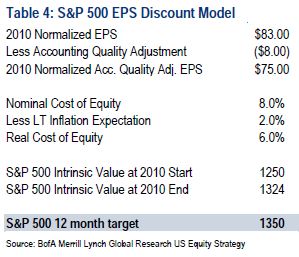
Indeed, their normalized EPS measure is nothing of the sort, but instead a measure which attempts (and fails) to assign theoretical underpinning to the often senseless world of top-down pro forma operating EPS forecasting. In less than 10 months, their normalized measure for earnings at 12/31/10 has grown by 9.5%. If their process held up, there would not be such dramatic swings in the “Intrinsic Value” of the market. The value at the end of 2010 would be the same as the Intrinsic Value of the market at the beginning of 2011 shown in the tables below.


The fact that the quality adjustment stands at $8 regardless of the level of the normalized measure (9.6% of the 2010 earnings, 8.4% of the 2011 measure) is yet another piece of evidence that their approach lacks rigor.


April 22, 2010


February 14, 2011


Okay, so they have a different methodology for calculating normalized EPS and one that we have reason to be critical of. But HOW DO THEY USE IT? Is it helpful for understanding the “probable outcomes” for the market?


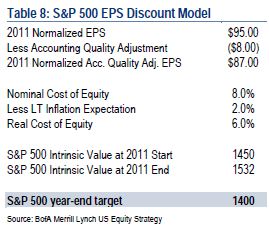
Accounting Quality Adj. Normal EPS / Fair Real Cost of Equity = Fair Value

Fair cost of equity estimate = Fair ERP + US Treasury bond yields


Our method of estimating a fair return on long-term S&P 500 investment, which is known as the S&P 500’s cost of equity, is to add an Equity Risk Premium (ERP) to US Treasury bond yields. Our fair ERP estimate is based upon the history of S&P 500 returns relative to Treasury bond returns. Using history as a guide, we assume a fair future ERP on S&P 500 investment of 3.50%. History supports a fair ERP in the range of 300-400bp for long-term S&P 500 investment. Because our fair ERP estimate aims to capture normal conditions, which should prevail over time, we add our fair ERP estimate to current Treasury bond yields which we attempt to normalize for cyclical influences. The goal is to estimate a normal Treasury bond yield and a normal S&P 500 ERP on a prospective basis.


S&P 500 Fair Cost of Equity = Normal Treasury Bond Yield + Normal ERP

8.0% = 4.5% + 3.5%

Subtracting long-term expected inflation gives the fair real S&P 500 cost of equity.

S&P 500 Real Cost of Equity = 6.0% (8% – 2%)

Fair Acc. Quality Adj. PE = 16.5 = 1/6%


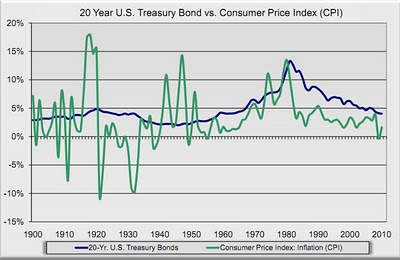
Frankly, I’m a little surprised that they would be this sloppy– if Merrill was really using history as a guide, they might draw different conclusions. I won’t even address the challenges of estimating a “long-term expected inflation” or “Normal Treasury Bond Yield” which itself fluctuates widely over time and can be influenced by policy, politicians, helicopters and a printing press. The long-term history of long-rates courtesy of Crestmont is below.


The EPS measure from Shiller’s Cyclically Adjusted P/E and other well crafted versions of normalized earnings, such as Crestmont’s business cycle-adjusted EPS, are useful, even essential, because they help us to smooth out the business cycle and determine whether or not the current PRICE of the market is cheap or expensive and thus whether future returns will be high or low.


So, it makes sense that Bianco and Merrill aim to improve upon Shiller’s P/E. Their most serious critique of the Shiller P/E, however, is also their most dubious argument:


Shiller’s PE understates normalized EPS

Shiller’s PE cannot be fairly compared across time because it neglects substantial shifts in dividend payout ratios over the last 110 years. Anytime the dividend payout ratio is not 100% EPS should rise with inflation plus the return on reinvested earnings (an expected real ROE). This is called an Equity Time Value Adjustment (ETVA). Shiller’s EPS does not fairly represent normal EPS because it assumes EPS only grows by inflation, which given a decade of high EPS retention, is flawed.


“Perception of normal EPS and confidence in such drives short-term performance. Actual EPS through the full cycle drives most of long-term market performance.”


To begin with, the Equity Risk Premium is infamously unstable. As Rob Arnott pointed out near the 2009 bottom of the stock market, “the 40-year excess return for stocks, relative to holding and rolling ordinary 20-year Treasury bonds” was NOT EVEN ZERO! Certainly, 40 years qualifies as “long-term” and as recently as two years ago, there was no excess return (which is the realized equity risk premium) to stocks!


Okay, maybe that was the 100 year flood, so what is the excess return that investors can expect from stocks versus bonds over the SUPER long term? 3.5% as David Bianco at Merrill suggests? Peter Bernstein and Rob Arnott disagree. In their 2002 “What Risk Premium Is ‘Normal’?” they show (with 207 years of data) that the Equity Risk Premium (or excess return) is empirically 2.5%. As I highlighted in another post, if you remove the bubblicious 90s, the ERP or excess returns to stocks is more like 1.5%. The fact is that Wall Street has created a false dogma about what stock market investors “deserve” or can expect in returns relative to bonds and Bianco’s “research” is designed to fit right into that storyline. Wall Street was able to get away with this sort of thing because the market returns of the 80s and 90s were so strong, however investors are wising up and realizing that there is no “natural” return to equities and that what you pay matters.


The idea that Bianco is trying to sell us something is confirmed by his selective use of history:


S&P currently trading at 14.7x 10yr ETVA trailing EPS, vs. 1960-2009 10yr ETVA trailing EPS PE of 15.6x, suggests that the market is attractive vs. history on this method.


Come on. The analysis limits the comparison to the last 50 years, because it results in a higher average PE (14-19% higher depending on methodology) and makes the current market valuation seem more reasonable. Bianco’s time period puts even more weight in the lofty valuations of the bubblicious 1990s.


I hope I’ve made the case that David Bianco and Merrill Lynch US strategy team has missed the mark with their critique of the Shiller P/E, their attempt at a better measure, AND their application of the measure to draw conclusions about the probable returns for the stock market.


Expect a future post from VRP on why and how we should be using a normalized P/E ratio to determine the likely future returns to stocks.

"

Tuesday, February 22, 2011

THE DEFLATIONARY SHOCK….

THE DEFLATIONARY SHOCK….: "

David Rosenberg makes some interesting comments in his morning note regarding the price action in US Treasuries. He cites the rally as a sign that the world is concerned about the deflationary shocks from rising oil prices:


“It is also interesting to see how government bond markets are reacting to the oil price surge — by rallying, not selling off. In other words, bond market investors are treating this latest series of events overseas as a deflationary shock.”


I think Rosey has this one spot on. The risk of rising oil is not a hyperinflationary spiral, but rather a deflationary spiral. Oil price increases are cost push inflation of the worst kind and for a country still mired in a balance sheet recession that means spending gets diverted which only gives the appearance of inflation in (highly visible) gas prices while creating deflationary trends in most (less visible) other assets (have a look at today’s Case Shiller housing report for instance).


The environment is not really so different from what we were experiencing in 2008. What we have in the USA is an underlying balance sheet recession being papered over by government deficit spending and very easy monetary policy. The math behind our economic plight is quite simple. Since we are running a -3% current account deficit the government must spend to the tune of 3%+ of GDP if the private sector desires to save. And that’s exactly what is occurring. In fact, the 10% deficit is allowing the private sector to save quite a bit (roughly 7%). Make no mistake, the deficit spending of the last 2 years is what has generated recovery. This is far from organic growth, but as we learned in Japan and during the Great Depression, the alternative is to risk something worse. Unfortunately, our implementation of the recovery plan has been mangled at several steps along the way so it is primarily Wall Street that has benefited while Main Street continues to suffer. I attribute this lopsided recovery in large part to the actions of the Fed.


The Fed’s dual mandate has them tinkering in the markets far more than they should and the repercussions are disastrous psychological impacts. They manipulate rates, bailout the banks, and generally implement policy that is based around creating a healthy banking system. After all, that’s really all their tool set can do anyhow. Not surprisingly, their policies over the last 20 years have helped in significantly financializing the US economy. The results of that world speak for themselves.


Today, in a misguided attempt to create a “wealth effect” via equities it appears as though Ben Bernanke has helped to generate a speculative boom in many commodities. This is not the direct cause of the unrest abroad, but it’s certainly not helping. But perhaps more importantly, the environment that Ben Bernanke is creating (commodity bubbles) actually increases the risk that we will relapse into a deflationary spiral (the very thing he is attempting to combat). After all, if the global economy slows once again it is highly likely that we will see price action that was very similar to 2008 – a flight to safety in US Treasuries, USD, commodities get crushed and equities sell-off. Today’s action is a small example of that sort of fear trade. And make no mistake – this is not hyperinflationary price action. This is deflationary price action.


For now it still appears as though the US economy is strong enough to generate low single digit inflation, however, if the commodity bubble were to worsen or oil prices were to cause a global recession (this looks increasingly likely as we head into summer) we are likely to find ourselves revisiting our deflationary discussions as opposed to fears over hyperinflation. This is not the 70′s and it is most certainly not Zimbabwe or the Weimar Republic. This is still an environment more akin to Japan and the 30′s.

"

The Great Depression and The New Depression

The Great Depression and The New Depression: "

A worldwide economic depression began in 2008. This New Depression was caused by the same factors as the Great Depression and followed exactly the same pattern. Thus far, however, the New Depression has been milder than the Great Depression because the policy response this time has been completely different.


Both depressions were caused because governments began creating money. The Great Depression originated with the collapse of the gold standard in 1914. The New Depression had its origins in the 1971 breakdown of the Bretton Woods system. In the earlier period, the gold standard collapsed because the European nations created more credit to finance World War I than could be supported by their gold reserves. Similarly, the Bretton Woods system broke down because the United States created more credit to finance the Vietnam War abroad and social welfare spending at home than could be underwritten by American gold reserves.


In both instances, a great economic boom was brought about by an explosion of credit creation; and in both instances the boom turned to bust when that credit could not be repaid. At that point, a systemic crisis brought down the international banking system. Immediately thereafter international trade collapsed.


The Great Depression & The New Depression


1. Gold Standard Breaks Down (1914) = Bretton Woods Breaks Down (1971)


2. Credit Boom: The Roaring Twenties = Credit Boom: Global Economic Bubble


3. Boom Leads to Bust When The Credit Can’t Be Repaid (1930 and 2008)


4. Banking Collapse (1930 and 2008)


5. International Trade Collapses (1930 and 2008)


During the 1930s, the forces of creative destruction, largely unimpeded by government intervention, ravaged the global economy as the excesses produced by the credit boom bankrupted a civilization unable to repay its debts. This time governments have intervened and, in effect, taken over the management of the economy to prevent market forces from correcting the imbalances brought about by the paper money-induced credit bubble. The commanding heights of global finance have been nationalized or bailed out, either openly or furtively, while the broader economy is sustained by government life support.


Thus far, these measures have greatly mitigated the pain of the New Depression. However, the policies introduced to date have not resolved the causes of this crisis or even targeted them. Moreover, government resources, while vast, are finite. Government spending will not be able to carry the economy forever. Policymakers must aim to do more than simply perpetuate the existing global economic disequilibrium. So far, there is little indication they understand the origins of the crisis, much less how to permanently end it.


Regards,


Richard Duncan

for The Daily Reckoning


P.S. For more perspective from Richard Duncan you can visit his blog on economics in the age of paper money at www.richardduncaneconomics.com.


The Great Depression and The New Depression originally appeared in the Daily Reckoning. The Daily Reckoning has published articles on the impact of quantitative easing, bakken oil, and hyperinflation.


"

The Market Ticker - Bernanke, You Stupid Bastard

The Market Ticker - Bernanke, You Stupid Bastard: "

Yes, you.

And Trichet, and the rest of the Central Bank fools.

But especially you, Bernanke.

There's dumb and then there's really dumb. Let's take a short walk back down history lane.

You were sure there was no housing bubble.

Then you were sure it wouldn't pop.

Then you were sure when the subprime problem hit, that it wouldn't cause a recession.

Then you were sure you had it under control with Bear Stearns' hedge funds.

Then you were sure you had it under control with Bear Stearns itself.

Then you were sure it was under control with Lehman, even though you had to know Citibank and others were refusing their collateral in the repo market.

You were sure QE would support higher bond prices - and lower yields. The exact opposite thing happened.

You were sure QE2 would suppress long end yields. The exact opposite thing happened.

Oh yeah, you made excuses both times, but in fact you publicly said that in both cases the exact opposite thing would happen that did.

Now let's look at what happened just today.

Oil went up almost $7 today for the WTI contract. For each dollar that crude oil rises, we transfer roughly $95 billion (estimates vary from $90-100) outside of the United States.

That's a direct hit to GDP.

In ONE DAY the entire impact of your so-called "QE2" was ERASED.

(As an aside, yes, I can do the math on the direct import numbers; the argument here is on the total economic impact, which is as noted above. Estimates there vary somewhat, but they're centered around $90-100 billion/year/dollar increase.)

Your entire gambit and what you sold to Congress and President Obama was that you could "restart" credit expansion with your policies. Implicit in your policy was a need to do so, because without it you cannot succeed. The World Economic Forum at Davos released a paper saying that we needed, collectively, to add one hundred trillion dollars of new debt to the system to support the paltry growth numbers you and your economists are putting up. Worse, the CBO stuck up numbers in the TBAC report that show another doubling of Federal Debt in the next nine years and a rough quadrupling of debt service costs to $800 billion, implying a paltry 3% blended rate.

We had the collapse starting in 2007 because people couldn't afford the debt they already had and yet your entire scheme, to succeed, requires doubling all systemic debt AGAIN.

So how are you going to do it Ben?

Who's going to take on that debt, and how are they going to service it?

You know damn well it can't work, and won't. You also know damn well you've goaded and prodded the Federal Government into taking on $4.5 trillion in debt we cannot afford, or nearly 30% of GDP.

How are you going to take that back off Bernanke? You keep being asked this, but all you say is that you're confident "you have the tools."

Uh huh.

You don't have jack and you know damn well you can't pull your pump-job back one iota without laying bare on the table the fact that the Federal Government is supporting 12% of GDP with borrowed money. If it disappears we have an instant Depression worse than the 1930s.

The bad news is that if you keep this crap up it will disappear by force of the market, there's not a damn thing you can do to prevent it, and that day is rapidly approaching.

EVERY prediction you've made about the economy over the last five years has been wrong.

All of them.

The market is rising only because you're "promising" infinite leverage.

But infinite leverage means certain financial ruin if you're wrong about external forces. And the economy is not a closed system under your control. You cannot control other nations, you cannot control commodity speculators and you cannot control other central banks and politicians. You think you can force China off their peg, but they can suppress riots longer than we can. You think you can keep printing but now Egypt has gone down, Libya is collapsing and if Saudi Arabia folds you're instantly FUCKED and so are the rest of us.

Never mind that it's not just the Middle East. What if Venezuela folds? Mexico goes feral with their drug war? How about South Korea, which now has how many banks closed due to runs?

The longer you keep this crap up the worse the instability will become. Eventually something will break that's important, and then it's too late.

You can't win this game Bernanke. And the longer you keep trying to protect the banks that should have been shut down and taken into receivership in 2007 the more damage you're going to do. When the history books are written on this catastrophe your name is going to be featured in bright lights as the personal architect and chief jackass who pontificated that he knew it all because he studied The Great Depression.

Yeah, you studied it all right. And now you're duplicating the mistakes made then, writ even larger.

There are no statesmen left in this nation when it comes to Congress. Not one who will haul your ass in front of them by force of subpoena, put your clear and public record of "accuracy" in front of you and then demand that you justify your twisting of the clear English language to come up with "2% inflation" as your "interpretation" of STABLE PRICES.

You're going to fail Bernanke. You're failing right now. You've destroyed one nation's government and this evening, as I write this, a second is falling apart. The madman behind the second, Qaddafi, has apparently ordered his military to strafe civilians, murdering hundreds.

But behind it all, your policies and those of your cronies, believing in an indefinite Ponzi Scheme of exponential debt without bound, are responsible for every bit of what's happening today worldwide - and what is to come tomorrow.

The only way you can stop it is to admit you were wrong, pull liquidity and allow the insolvent institutions to collapse. And collapse they will - all of them. I'm convinced you know that too. And I'm also convinced that there's three words you will never utter so long as you infest Washington DC: I fucked up.

So here we sit as Americans, with no solution. There is nobody in Congress or The Administration that has the balls to stop you, and you're too much of a douche to admit you blew it and do what should have been done three years ago.

As a result, all we have left is to be prepared for what's to come.

It's not going to be pretty, and I hope Americans are ready for it.

Congratulations Ben Bernnake. Your place in history is secure, and I'm sure Beelzebub thanks you daily for your cooperation.

Some day I'm quite sure you'll meet him face-to-face.

"

Monday, February 21, 2011

Guest Post: Prove The Mayans Right - Address Structural Economic Problems With Chicanery

Guest Post: Prove The Mayans Right - Address Structural Economic Problems With Chicanery: "

Submitted by Davos Sherman Okst of Financial Sense

Prove The Mayans Right: Address Structural Economic Problems With Chicanery: Part 1 of 2

Structural Economic Problem #1: Unemployment

Seventy percent of our economy is driven from private sector employment:

  • Without consumers the economy is finished
  • Without jobs and with maxed out debt loads the consumer is finished

A fourth grader can connect these two dots and conclude: “It’s the jobs stupid.”

Our current chicanery “fix” for high unemployment?

  1. Reporting the unemployment rate at 9.4% - not the actual 23% - as if reporting 9.4% will put the other 13.6% back to work.
  2. Dump money out there in a “willy-nilly” manner and call it “Stimulus” or “Job Creation Money.”

Given
our entire situation, which I’ll address in a second, I don’t believe
that “Stimulus” will stimulate job creation or the economy. If they had
taken Chris Martenson’s
idea of insulating homes I might think differently about this. I say
this for two reasons: first, 1 in 6 jobs were housing related—that is
the sector that needs the most help. Second, global oil demand has
recently out paced global oil production. A plan that would reduce oil
demand and global oil stress should be the focus of any stimulus. Oil is
an integral part of everything from fertilizer used in farming to the
energy that our economy needs to produce and transport the goods and
services we rely on.

That
being said our economic engineers have come up with and implemented
ideas that would make even the most ardent objector of workplace drug
screening reconsider his or her view. Case in point #1:
National
Institutes of Health (NIH) spent $823,200.00 of economic stimulus funds
in 2009 on a study by a UCLA research team to teach uncircumcised
African men how to wash their genitals after having sex.
The good news is that didn’t increase oil demand. The bad news is it didn’t do anything to create jobs here.

Case in point #2: It takes 121,600 gallons of oil to pave 1 mile of road. Last year Government Motors sold more cars in China than in the US. China bought 13.7 million passenger vehicles FY2010, up 33% from FY2009.
The bottom line is our highway stimulus will do nothing but drive oil
prices higher. China is rushing to get their highway system built to
accommodate their new drivers.

While
I respect the idea that confidence and psychology affect consumerism,
the reality is that a 23% unemployment figure is a depressionary red
flag. This tells us that the “Great Recession” has neither ended, nor
was it “just” a recession. I know it is hard to dispute the National
Bureau of Economic Research (NBER) - after all they were only 9 months
late in noticing and calling the greatest economic downturn in history.

The
fact remains: We are in a depression and failing to address the
structural unemployment problems will make matters worse not better. The
first step to fixing a problem is of course admitting that we have one.
We’ve squandered valuable time and in doing so we’ve greatly
exacerbated the situation.

Globalization was an absolute
unmitigated, disastrous failure. The only thing it did was temporally
boost stocks and allow some CEOs to make 400 times what their
wage-earners made. While the economy appeared to be doing well - it was
bubble driven credit binging - not organic spending that was fueling it.
One economic blogger who is a CPA and works as a comptroller for an Ivy
League college did what no other economist I know did - he investigated
where consumers were getting their money from. Something Starbucks
Coffee’s economist should have done. Nine billion Home Equity Line of
Credit borrowed dollars were spent on 4 dollar coffees at Starbucks. The
HELOC rush caused 900 Starbuck stores to close.

Yet,
our Federal Reserve’s Federal Open Market Committee (Fed FOMC) minutes
from FY2005 indicate that exploiting globalization is funny stuff: “But
the common concern coming from the retailers, the rails, the shippers,
the shipbuilders, and so on, was the following: Everyone I’ve talked to continues to try to figure out ways to exploit globalization.
Each of them, from the IT [information technology] guys to the big box
retailers to the specialty chemical firms to the service firms, wants to
have offshore supply. One of the CEOs said, “We have a long way to go
in exploiting China.” We’ve heard that forever.
And one of my favorites was the comment, “China, India, and Indonesia
can make Italian ceramics better than Italians can now or could 200
years ago.” [Laughter]

In the 1950s 28% of our
job base was from manufacturing. In 2000 it was 14% and today it is
11%. Water (wages) will slosh around until they stabilize at water
level. In other words, our wages will move down towards 2 dollars a day
and China’s will move up towards ours, they will meet somewhere in the
middle. The bottom line: This is why American workers are stuck at circa
1970s wages and have no money to consume or support our economy.

The
laugh is on the American consumer and the American economy. We’ve
exploited ourselves and our economy with “thinking” like this. Giving
African’s borrowed American tax payer dollars for genital washing after
sex, our lying about unemployment rates, and driving up oil demand (or
laughing about exploiting workers) won’t fix serious structural economic
problems - it'll make it a lot worse.

Structural Economic Problem #2: Absolutely Unmanageable Debt

Watching
the House Budget Committee hearing was a surreal mix of fact and
fantasy, but mostly fantasy. The fact was that our biggest problem, on a
consumer, local, state, federal and global problem is debt.

When
businesses or individuals get in over their heads with unserviceable
debt levels they make cuts and they borrow. When that fails and they are
left taking in and borrowing less than their obligations - they declare
bankruptcy, reorganize and move on.

The two options I heard during the hearings?

  1. Default.
  2. Raise the debt ceiling and counterfeit, (print more money). Basically: Debt is the problem so lets add more debt?!?!

What
I didn’t hear mentioned was even more troubling. There are a million
“millions” to a trillion. But the 14 trillion dollar public debt is an
iota of our debt. Hidden off balance sheet
we have 14.6 trillion in Social Security debt, 76.4 trillion in
Medicare debt, 19.6 trillion in Prescription Drugs and about 3 trillion
in GSE debt. We make Enron look honest. All toll our debt is roughly 128
trillion. Then we can add to that the state debt and local government
debt.

Governor Christie will soon learn that cuts won’t fix too
much debt. When your debt to income ratio becomes insanely unmanageable
the only solution is to shed the debt.

Add up sales tax, phone
bill tax, building permit fees, utility taxes, automobile registration,
tolls, parking, automobile inspections, airline taxes, hotel taxes,
property taxes
and the all the rest and you will soon realize that the consumer works 8
full months for the local, state and federal governments. Paying our
fair share is great, but is it smart to leave the consumer with 3.5
months of circa 1970s wages to support the economy with?

If we
had just one dynamic person in that room during these hearings we’d have
heard another option: Restructure. Our currency needs to be re-valued,
they need to issue one new dollar which is worth many, many, many old
dollars. Back it loosely and temprarily to gold to ensure faith in the
new dollar.

Clearly our problem is debt and there is only one historically way to fix too much debt and that is to restructure.

Don’t
get me wrong, “printing”, “counterfeiting”, “monetizing the 1.5
trillion (and rising) of debt our government doesn’t have each year
through tax income and borrowing” and “Quantitative Easing” are all
one-in-the-same. We are restructuring our debt by re-valuing our
currency subvertly, Bernanke et al have just decided to do it “a la
Hiroshima style” which will be excruciatingly painful to 99% of all
Americans, it will undoubtedly put democracy in harms way and without a
backing/anchor to something the new currency will be shunned by the rest
of the world. This is not good for a country who doesn't run a trade
surplus.

I’ve read just about everything Greenspan has written
and said over the years and one of the handful of things he got right
was this: “A democratic society requires a stable and effectively
functioning economy. I trust that we and our successors at the Federal
Reserve will be important contributors to that end.” ~Alan Greenspan

I’m not certain which end he is referring to. The United States is about 234 years old and half of the money supply has been created in this decade. Largely (read: almost entirely) because of what the then Fed Chairman
did with interest rates - and the muzzling of Brooksly Born who had the
audacious idea of putting measures in place to prevent derivatives from
ever becoming a household word.

Which brings us to the next structural economic problem.

Structural Economic Problem #3: The Value of Money & Inflation

The
irony here is one of the better explanations of what money is and how
inflation works was done by Greenspan in the 1960s when he published a
piece that was printed in Ayn Rand’s Capitalism.

He explains what money is:

  • A commodity
    that serves as a medium of exchange. (We all know what happens to the
    value of a commodity when it is too plentiful - its value decreases
    greatly)
  • Money is a store of value
  • A means of savings
  • His
    definition, since written in the 1960s before Nixon slammed the gold
    window and took us off the quasi-gold standard should be parsed with
    that in mind
  • That limited gold reserves prevented disasters by limiting the over-creation of credit/money
  • The recessions were short-lived since the money supply didn’t get out of hand

And then it gets good. Greenspan explains what caused the first Great Depression of our time (too much money):

  • “But the process of cure was misdiagnosed as the disease:
    if shortage of bank reserves was causing a business decline - argued
    economic interventionists - why not find a way of supplying increased
    reserves to the banks so they never need be short! If banks can continue
    to loan money indefinitely - it was claimed - there need never be any
    slumps in business. And so the Federal Reserve System was organized in
    1913.”
  • “When business in the United States
    underwent a mild contraction in 1927, the Federal Reserve created more
    paper reserves in the hope of forestalling any possible bank reserve
    shortage.”
  • “The excess credit which the
    Fed pumped into the economy spilled over into the stock
    market-triggering a fantastic speculative boom.
    Belatedly,
    Federal Reserve officials attempted to sop up the excess reserves and
    finally succeeded in braking the boom. But it was too late: by 1929 the
    speculative imbalances had become so overwhelming that the attempt
    precipitated a sharp retrenching and a consequent demoralizing of
    business confidence. As a result, the American economy collapsed.”

Sound familiar?

This
is, in a sick sort of way, hysterical, for it was he who created a
fantastic speculative tech and housing boom through the creation of too
much cheap money pumped into the economy and through the dismantling of
Glass-Steagall Act, and the muzzling of the watchdog who wanted to
protect us the American public from the derivatives fallout.

He then goes onto define what a welfare state is:

  • “...the realization that the gold standard is incompatible with chronic deficit spending (the hallmark of the welfare state).”

And how the welfare state steals from its productive hard working citizens:

  • “Stripped
    of its academic jargon, the welfare state is nothing more than a
    mechanism by which governments confiscate the wealth of the productive
    members of a society to support a wide variety of welfare schemes.”
  • “A substantial part of the confiscation is effected by taxation.”
  • “But
    the welfare statists were quick to recognize that if they wished to
    retain political power, the amount of taxation had to be limited and
    they had to resort to programs of massive deficit spending, i.e., they
    had to borrow money, by issuing government bonds, to finance welfare
    expenditures on a large scale.”

Somewhere between 1966 and his term from 1987 to mid 2006 the train left the tracks and kept going.

Thank
you Alan for forgetting history and decency. At least know I know to
which end you were referring to in your December 5, 2005 speech above.

Without
a doubt, with the monetization we have now, we will see hyperinflation
as the value of our dollar goes from the current .04 cents to 0.

The
Fed in the 1970s, thanks to the Nixon Administration was able to strip
out fuel and food from its “Core Inflation" number, something consumers
and businesses can’t do. During Clinton’s term Michael Boskin helped
tweak inflation by using Hedonics (Greek for feels good), weighting and
substitution.

Core inflation and Enron accounting is how they
plan on solving inflation. Just remember what the Maestro of Disaster
said: The law of supply and demand is not to be conned. As the supply of
money (of claims) increases relative to the supply of tangible assets
in the economy, prices must eventually rise.

Rise will be the understatement of the century.

Many
people wrongly argue that the money is sitting, that there is no
velocity, or that the Fed can do the Paul Volcker and raise rates. Which
brings us to our next topic, monetizing debt through “Quantitative
Easing.” (Please See Part 2).

"

The Market Ticker - The End Game Approacheth

The Market Ticker - The End Game Approacheth: "

Anyone paying attention today?

Or if you prefer silver....

The dollar, for its part, is not collapsing. It's not going materially higher either, but it's definitely not collapsing.

Other futures (particularly things like cotton and such) are not trading today. But these are. Why up so much?

Spreading of political unrest. And why the unrest?

Exported inflation caused by global money-printing designed to bail out the bankster cartels from their bad bets instead of forcing those who made the bad "investments" - bets they knew or should have known were mathematically impossible - to default.

It's not going to work folks. The "closed system" mentality of Bernanke and others has always been a scam.

We have put through three successive doublings of debt in the 1980s, 1990s, and 2000s. This was against average 10-year rates of GDP acceleration that averaged 30-40%. That is, debt service requirements at constant interest rates and constant dollar terms advanced at more than double the output of the economy.

There was no actual economic growth for the last thirty years. We simply charged it all to the collective credit card, accumulating balances that eventually must be paid.

This is how we went from ~6-7% of GDP being "consumed" by FIRE (Finance, Insurance and Real Estate) brokerage services to more than 20%. It is simple mathematics.

But the FIRE parts of the economy produce nothing. They merely reallocate money from one person to another. Therefore, they do not promote further advancement in GDP as their function is parasitic, not additive.

And it shows - the compound average rate of growth has slowed markedly over the last 30 years.

We hit the wall in 2007. The increasing diversion of these funds has driven speculators and others into monetizing commodities as a means of trying to escape what they know will not work. And while people wring their hands at the rise of silver and gold, where you really wanted to be the last nine months was in cotton, which has nearly tripled.

Financializing these products was part and parcel of tearing down Glass-Steagall and other regulations during the last 30 years. By allowing banks and brokerages to involve themselves in trading these positions under the (false) claim that they're "simply making a market" we have created a monster in hot-money flows that cannot be controlled.

Now we're gonna pay.

"Pay" means high levels of civil unrest through the world, as the speculators double, triple, even quadruple the price of basic needs. "Pay" means the overthrow of governments. "Pay" means the impoverishment of not only third-world nations but Americans who live on fixed incomes and have limited means, as those people spend nearly all of their income on food, energy and shelter - and two of the three are skyrocketing in price.

"Pay" means the alleged "promises" you think you had made to you for retirement and medical security in The United States WILL NOT be kept, because they mathematically cannot be kept.

Fortunately, refrigerator boxes and freeway underpasses are not going up in cost.

Those who think that this "rescue" program is good for the stock market and have bid up stocks in response are fools. You will soon have demonstrated to you, again, just as you did in 2008, how wrong you are.

Why?

Because without good wages there is nobody to buy the products that are produced. And while you can claim that the "growth" is coming from overseas, without good jobs here in America it doesn't matter, because the nanny-state will have more and more demanded of it, but will have less and less tax revenue with which to provide it.

Something like this will happen....

Oh wait... it already did happen.

We had the opportunity to force those who did these things to eat their losses and, when there were frauds involved, to imprison them. That was the right thing to do. It was the right thing to do in 2007, in 2008, 2009, 2010, and now. But instead the government at all levels has chosen through bribery and extortion to allow these games to continue and the perpetrators to walk free, keeping the loot in the bargain.

It doesn't matter, in the end, because this is not sustainable. It cannot continue. We hit the wall in 2007 not because of a few subprime mortgages, but because debt carrying costs exceeded the ability to pay.

We have not materially decreased those costs. Total systemic debt in the United States has gone from $52.7 trillion to $52.4 trillion, a less than one percent decrease.

There's no way out of this box without correcting that distortion.

It's that simple, in the end, and what you're seeing now is exactly what I expected to happen if we took this path. It is why I counseled against this decision back in 2007, wrote letters to Congress, ran petitions and spoke vociferously against TARP, the mark-to-market fantasy games and other bailouts.

It is not simply because we have a right to the Rule of Law in this country, although we do, and that ought to be sufficient justification standing alone.

It is because the mathematics of what was being attempted could not succeed.

I hope you're ready, because the consequences are coming and they are emergent.

Right here, right now, today.

"

Sunday, February 20, 2011

JEFF GUNDLACH: THE S&P 500 IS GOING TO 500

JEFF GUNDLACH: THE S&P 500 IS GOING TO 500: "

This weekend’s Barrons has an excellent interview with Jeff Gundlach of DoubleLine. I’ve spent quite a bit of time discussing Gundlach and his performance, because quite frankly, there is no one better in the bond space than Gundlach. His performance over the entirety of his career is simply incredible.


As the article cites, Gundlach’s outlook for bonds is likely the most credible, however, I was floored by his comment that the S&P 500 is going to 500. Gundlach may not be an equity guru, but he’s no lightweight when it comes to understanding the macroeconomy (via Barrons):


Gundlach rarely is shy about offering his opinion on markets. Like most bond honchos, including Gross, a member of the Barron’s Roundtable, he seldom likes stocks, which are, after all, bonds’ primary rival for investment dollars. “Though I rarely go public with specifics on stocks, I think the Standard & Poor’s 500, which is now over 1300, will hit 500 in the next couple of years,” he says. “I usually couch my belief by saying merely that 2011 will be a tough year for equities.”


Nor has he made a secret of his bearish views on the U.S. economy and the seemingly inexorable rise in government debt. But he sees little chance in the near term of a surge in inflation that would send Treasury-bond yields soaring. A jump in the yield on 10-year bonds to a range of 4% to 4.5% from a current 3.6% would cause economic growth to short-circuit, he says.


By the same token, a renewed slowdown in the economy would drive 10-year bond yields sharply lower, but not below 3%, unless a banking panic similar to last year’s euro-zone crisis ensues. As for the U.S. housing market, Gundlach expects home prices to fall by another 10% to 15%.


You can find Gundlach’s bond market outlook here. The full Barron’s piece is here.

"

Is Gold Crash Proof This Time Around?

Is Gold Crash Proof This Time Around?: "

I’ve been
receiving quite a few emails regarding the topic of Gold and how it will
perform if another Crash hits. The following are my thoughts on this matter.


The first
thing that needs to be said is that IF we have another systemic meltdown like
that of Autumn 2008, Gold will likely go down along with everything else. There
are simply too many big players (hedge funds, investment banks, etc) with heavy
exposure to Gold who would be forced to liquidate their positions during a
systemic collapse.


I know this
is not what the Gold bugs want to hear, but during systemic Crises, just about
every investment on the planet plunges while the US Dollar and Treasuries
rally. Of course, this time around if another 2008-type event hits, it will
undoubtedly involve or be focused on sovereign debt. So this raises the
potential that Treasuries, particularly those on the long-end of the yield
curve, could be hammered as well as all other assets outside the Dollar. This
is worth keeping in mind for those who view Treasuries as a safe haven.


So if we go
into a 2008-type event, Gold will fall.
It will likely fall much less than other assets (stocks and industrial
commodities), but it will still go
down at least at first. This forecast is confirmed by the market action in 2008
as well as the market collapse from April 2010-July 2010. Both times Gold took
a hit, but both times it came back quickly.


So if you’re
heavily exposed to Gold, you’re going to need to think “big picture” or have a very
strong stomach when the market Crashes.


Now, let’s
take a look at the charts.


For
starters, the number one metric you need to focus on in terms of determining
Gold’s market action is the 34-week exponential moving average. Since the Gold
bull market began in 2001, this has been THE support line for Gold.


As you can
see, Gold has only broken below this line ONCE in the last ten years and that
was during the 2008 systemic collapse. So take a note of this line and always
watch where Gold trades relative to it.


Indeed, a
significant break below this line that DOESN’T occur during a system Crash
would be a MAJOR warning that the Gold bull market is in trouble. Remember, the
ONLY time we took this line out before was during the systemic collapse in 2008.
So a break below it WITHOUT a Crisis would be VERY bearish.


And if Gold
breaks below this line on its own (without a Crisis) and then fails to reclaim
it… well, then it would be SERIOUS time
to reevaluate the Gold bull market story.


Because of
its significance as THE support line for the Gold bull market, the 34-week
exponential moving average also serves as an excellent gauge for determining
when Gold needs to take a breather or correct.


Indeed,
anytime Gold has stretched too far away from this line to the upside, it has
usually staged a pretty sharp reversal to re-test this line. I’ve circled the
most significant episodes of this from the last seven years in red on the chart
below.


These are the BIG picture gauges and items
to take note of: the points to remember in terms of determining where Gold is
in its bull market and whether it’s an asset class you want to “buy and hold.”


Good
Investing!


Graham
Summers


PS. If
you’re getting worried about the future of the stock market and have yet to
take steps to prepare for the Second Round of the Financial Crisis… I highly
suggest you download my FREE Special Report specifying exactly how to prepare
for what’s to come.


I call it The Financial Crisis “Round Two” Survival
Kit
. And its 17 pages contain a wealth of information about portfolio
protection, which investments to own and how to take out Catastrophe Insurance
on the stock market (this “insurance” paid out triple digit gains in the Autumn
of 2008).


Again, this
is all 100% FREE. To pick up your copy today, got to http://www.gainspainscapital.com
and click on FREE REPORTS.


PPS. We ALSO
publish a FREE Special Report on Inflation detailing three investments that
have all already SOARED as a result of the Fed’s monetary policy.


You can
access this Report at the link above.


"

Tired (And Broke) From All The "QE Is Just An Asset Swap" Rhetoric? Then Read This

Tired (And Broke) From All The "QE Is Just An Asset Swap" Rhetoric? Then Read This: "

If you, like us, are tired of all the textbook pundits claiming over and over again that QE is nothing but an asset swap (odd how asset swaps get food prices to hit all time highs, not to mention M2, and to reverse what has formerly been a trillion dollar annualized drop in shadow banking - must be that latest outbreak of disinflation...), we urge you to read the following essay from Sean Corrigan. The Diapason Securities strategist as usual manages to cut through the academic drivel and hit at the core of the issue. The conclusion: 'money does not have to be borrowed into existence, it can be
spent into existence by the state for so long as that money's recipients
show a willingness to accept it as a medium of exchange - and that is
exactly what we have at work here...
the government spends money it does not have into existence and
disburses it through its welfare/patronage network; the associated debt
is then taken up by a monetary institution (not least, the Fed itself,
whether by its earlier process of debt substitution on private sector
balance sheets when it was buying MBS, or in its current, direct uptake
of Treasuries at the NYFRB) and the non-bank sector ends up with increased holdings of new MONEY as a result... The Fed has successfully placed a great deal of new
money in the hands of those same banks' customers and this is patently
exerting its expected influence on the prices of a whole range of
non-money goods and assets, in a typically differentiated,
Cantillon-effect fashion. How anyone can deny this is truly a mystery!' Indeed.

From Sean Corrigan's February 18 Material Evidence

Last week, we appended a graph which we felt showed that the Fed was clearly complicit in producing the current rise in commodity prices - a contention which we foolishly thought was unexceptional. One criticism which quickly emerged was that the graph did not show such a link; another was that this did not apply to commodity prices (obviously responding, therefore, to their 'fundamentals') since the Fed was 'only' creating excess bank reserves before locking them safely away from where they could influence the price of anything much at all. In order to address these two cavils, we unapologetically reproduce a more detailed version of the same graph, together with some extra supporting evidence of the crime and the following address to the jury.

As we maintain that this graph shows, not only has AMS been driven by the Fed, but the excess money has clearly had an impact on commodity prices - whether via simplistic quantity theory means (more paper per resource unit) or by boosting speculative expectations (with not a little cheerleading from Blackhawk Ben) and hence bringing about the near record long positioning evident in many contracts. (Let us not either forget the impact of all the similar programmes enacted everywhere else in the world)

Next, we must counter the casuistic Bernanke defence that all he has undertaken is an 'asset swap' and not a monetization and then deal with the widespread misperception that the build up of excess bank reserves has somehow 'sterilised' the associated money creation.

In the first place, we simply need to say that the 'swap' being made — whether, as now, through regular POMOs or via the initial alphabet soup of lending programmes — is irrefutably one of non-money for money, presumably the very definition of 'monetization', whatever semantic games the Fed and its partisans wish to play.

Furthermore, look at the other figures which show the influence the Federal budget is having on the supply of money at a time when, yes, much private borrowing has been curtailed and, so, when it has not been the primary means for money creation, as it is in more normal circumstances.

What all too many commentators overlook — each either eager to beat the deflationary drum and so justify even more interventionism, or else to deny that their own favoured asset class is in another bubble — is that, as Leland Yeager long ago wrote, money does not have to be borrowed into existence, it can be spent into existence by the state for so long as that money's recipients show a willingness to accept it as a medium of exchange - and that is exactly what we have at work here.

So, the government spends money it does not have into existence and disburses it through its welfare/patronage network; the associated debt is then taken up by a monetary institution (not least, the Fed itself, whether by its earlier process of debt substitution on private sector balance sheets when it was buying MBS, or in its current, direct uptake of Treasuries at the NYFRB) and the non-bank sector ends up with increased holdings of new MONEY as a result.

The fact that the banks - for whom most of this money represents a liability — now largely offset it on the asset side of their balance sheets by placing it with the Fed (in the form of excess reserves), rather than re-lending it to others, does NOT somehow cancel out the creation of this money, it simply suppresses the commercial banking sector's possibilities for further multiplying it via the traditional operation of the fractional reserve mechanism.

So, granted, the banks are not taking the first injection of newly created money and generating 10 times, 15 times - or whatever - more money from it, in addition. But the Fed has nonetheless successfully placed a great deal of new money in the hands of those same banks' customers and this is patently exerting its expected influence on the prices of a whole range of non-money goods and assets, in a typically differentiated, Cantillon-effect fashion.

How anyone can deny this is truly a mystery!

"