Thursday, September 29, 2011

1,000,000 economists can be wrong: the free trade fallacies

1,000,000 economists can be wrong: the free trade fallacies:

Not only did the global financial crisis catch the vast majority of economists completely unawares, they instead expected tranquil and even buoyant times just as the biggest economic crisis since the Great Depression began. My favourite such observation is from the OECD‘s Economic Outlook for June 2007—in which the Chief Economist suggested that, “the current economic situation is in many ways better than what we have experienced in years . . . Our central forecast remains indeed quite benign.” But there are countless other such utterly wrong prognostications about the economy, from the profession that is supposed to be the font of wisdom on the economy.


Those “in the know” understand that this is not an isolated failing. The Neoclassical model that dominates economics today is riven with logical and empirical fallacies. If economics were a real science, it would have long ago been overthrown and replaced by something more realistic.


Yet at least 90% of academic economists believe in this model, as do almost all economists working in government and private industry. Left to their own devices, they will continue thinking that this model does describe the economy as the real economy falls deeper and deeper into a crisis, even though their model says that this can’t even happen.


Since economics has failed to clean out its own intellectual stable, it will be the public that finally forces reform upon it – as once-supporters like Anatole Kaletsky of The Times calls for “a revolution in economic thought” and George Soros funds an Institute for New Economic Thinking. With luck, in a decade or two, a more realistic approach to economics might emerge. But in the meantime, here’s a simple guide for the public: Anything the vast majority of economists believe is likely to be wrong.


Which brings me to “Free Trade.” The belief in Free Trade is one of the hallmarks not just of the Neoclassical school which began in the 1870s, but also of the original Classical school which began with Smith in 1776. It argues that almost everyone’s material welfare will be increased if all countries specialise in what they are good at—a proposition that on the surface seems plausible, and a formidable body of mathematical economic theory has been erected to support it.


Unfortunately, like so much else in economics the model of Free Trade is, to quote the humorist H.L. Mencken, “neat, plausible, and wrong.” The theoretical fallacies at its core have been there since David Ricardo first coined his model of comparative advantage during the political battle to repeal the “Corn Laws,” which restricted the importing of cereal crops into England.


The arguments in favour of the Corn Laws included the belief that if trade were unregulated, English industry—in particular its agriculture—might be wiped out by foreign competition. Ricardo, in a brilliant debating ploy, conceded his opponents’ case that a rival country (Portugal, which was then one of Britain’s major rivals) was better at both agriculture and manufacturing than England and then preceded to “prove” that England would still benefit from Free Trade.


He assumed that in Portugal 80 men could produce a quantity of wine (say, 1000 gallons), whereas England would need 120 men to produce the same amount and that Portugal was more efficient too at producing cloth—needing 90 men to produce a quantity of cloth (say, 100 square yards of cotton) whereas England needed 100.


Without trade, both countries would have to produce both goods for themselves so that per 1,000 workers, Portugal would produce some combination lying between the extremes of 12,500 gallons of wine and 1,100 yards of cotton, while England would produce a combination lying between 8,333 gallons of wine and 1,000 yards of cloth.


If however Portugal specialised only in wine and England specialised only in cloth, the total output would be 12,500 gallons of wine and 1,000 yards of cloth. This is more than the total output of the two countries in the absence of trade. With Free Trade, they could specialise in their comparative advantages and welfare in both countries would be higher.


This argument was so clever that it aided the campaign to repeal the Corn Laws and it has seduced almost all economists ever since.


But there is an obvious fallacy to this neat and plausible argument: To effect specialisation, England has to shift labour and capital from wine to cloth (and Portugal has to do the opposite). Arguably labour can be retrained—a vigneron can become a machinist—but how do you convert wine press into a spinning jenny?


The obvious answer is that you don’t. Instead, you sell the wine press and buy a spinning jenny with the proceeds. But because of the introduction of trade, the price of wine in England would have fallen, so that the sale price of the wine press will also fall (economists have modified Ricardo’s model to introduce curves where Ricardo had straight lines, so that total specialisation is no longer required and there would still be some wine production in England under the “new” model of Free Trade), while the price of spinning jennies will have risen, given the new export market to Portugal. Some capital is necessarily destroyed by the opening up of trade and it applies in reverse in Portugal as well.


Since capital is destroyed when trade is liberalised, the watertight argument that trade necessarily improves material welfare springs a leak. If economics were a real science, this real-world complication to Ricardo’s argument would be considered, but it has never been seriously addressed.


These and many other failings that explain why, when Dani Rodrik took a careful look at the empirical record of trade liberalisation, he found that it had frequently reduced material welfare rather than increasing it. Writing back in 2001, he summarised his findings for Foreign Policy magazine with the statement that:


“Advocates of global economic integration hold out utopian visions of the prosperity that developing countries will reap if they open their borders to commerce and capital. This hollow promise diverts poor nations’ attention and resources from the key domestic innovations needed to spur economic growth.”


As an economist who has specialised in dissecting the empirical claims for the role of free trade, Rodrik has the might of the majority of the profession against him. As noted above, that’s a good rule of thumb that Rodrik is right.


flattr this!

Prominent Deflationist Schilling Sees Deflation, A China Hard Landing And 800 On The S&P

Prominent Deflationist Schilling Sees Deflation, A China Hard Landing And 800 On The S&P:

When one compiles the annals of the great deflationists of the early 21st century, they will be hard pressed to decide who is deserving of the title most ferocious deflationist in a runoff between David Rosenberg and Gary Schilling. And while David did not have much notable to say today, despite his daily release of interesting and insightful commentary from his perch atop Gluskin Sheff, Gary Schilling took advantage of the media vacuum to appear on Bloomberg TV and preach, what else, deflation. Among the topics touched upon were the #1 issue du jour - the Chinese hard landing, presented earlier here, and the resulting collapse in copper, on bond market volatility, on investing and speculation, and lastly on the S&P, which just like Rosenberg, he see as deserving of a 10x multiple applied to a soon to be revised S&P 500 EPS of 80 (do the math). All in all sensible stuff except for one thing: his statement "Inflating away is an excess supply world is almost impossible, even for the Fed" leaves a little to be desired. While he may be spot on, it does not mean the Fed will not try. And try it will: we expect rumblings for full blown LSAP to commence in a few days, and QE4 in which the Fed will pull a BOJ and buy ETFs, REITs (in addition to MBS and Agency bonds) early in 2012, after which it will be time to quietly depart from these continental US, or else load up on lead, spam and precious metals.


Transcript:


Schilling on how much further the 30-year Treasury bond yield could fall:

"I think [the 3-year Treasury bond yield] might go back to 2.5%. That's where it was at the end of 2008 in the aftermath of the Lehman Brothers meltdown. That's my target for now. I think we are looking at deflation. As I said back then, I think that will be the media chatter by the end of the year. Plus, the weakening economy here and abroad. The long bond, the 30-year Treasury, is the ultimate safe haven in the world."

On why Schilling sees deflation on the horizon:

"In my new book, I identify seven different types of deflation. Now five of those are already in place -- we're having financial asset deflation, tangible asset deflation, commodities are coming down, wages are coming down. The one that hasn't kicked in yet is goods and services deflation. The point is that the whole world is really marking down assets. It's marking down the whole spectrum. I don't think goods and services are going to hold up in terms of inflation. I think that will move to deflation fairly soon."

On whether the Fed will decide to try to accelerate inflation:

"In effect, [the Fed] tried to do that with QE2. Because you remember at the time they were worried about deflation… That was one of the objectives. Of course, they spurred commodities, they spurred stocks and they got a temporary offset. But I think the forces of deleveraging in the world are greater than the Fed can handle. We're marking things down to equilibrium. Look at government sovereign debts around the world. They're much greater than taxpayers can handle. You either have to mark them down or get somebody else to handle them, like the Germans, or try to inflate them away. Inflating away is an excess supply world is almost impossible, even for the Fed."

On volatility in the bond market:

"In the portfolios I manage, we've maintained our 30-year bond positions. We haven't really changed them. We've changed them a little bit over time. When they got to 2.5% at the end of 2008, I said, we've gotten every pullback….It is awfully tricky to do this on a daily basis. At this point, I don't see anything that has fundamentally changed either in stocks or bonds. You have this volatility, this event-driven market. It's great for the latest news. Is Greece like to pass a law to tax itself or not? Markets jump up and down 100 points on the Dow. That is ridiculous. That is whipsaw. It shows a lot of day trading. It shows a lot of program trading. It doesn't show a lot of investing."

On other places to see a safe haven outside the Treasury market:

"There are some [safe havens] in the real estate area. We like medical office buildings. That's because of aging populations, the new medical health care bill, and improving technology. Also, 55% of physicians work for hospitals. Private practices with a storefront are disappearing. They're moving into campuses… Another one is rental apartments. People are deciding a house is no longer a sure shot investment. Prices can and do fall. They have, for the first time since the 30's…Rental apartments will continue to be very attractive."

On metals like gold, silver and copper:

"I'm agnostic on the precious metals. We have in our portfolios been short copper. Copper peaked out in February and it's down about 25% from its peak. I think it will go a lot lower. As you pointed out, copper goes into almost anything manufactured. It's a great indicator of global industrial production. What I think will really knock the pinnings out from under all commodities is a hard landing in China, which is what we're forecasting."

"[The Chinese] are trying to cool off a red-hot economy. They're worried about the property bubble and the high inflation rate. They are affecting a soft landing and with their crude economic tools it's tough. Bear in mind, the Fed, with more sophisticated tools, tried, by my reckoning, 12 times in the post World War II era to cool off the economy without precipitating a recession. They only succeeded once. What are the chances for China?"


On whether the stock market will go down:

"I think it probably is [headed back down] because the economy here is slowing, and it's global and of course a lot of the S&P 500 companies have their earnings predominantly overseas. In that kind of environment, we're going to see disappointing earnings. The Wall Street analysts always optimistic, of course, crank down their numbers….If you put a ten multiple on it, we'd be at S&P 800."

"We had a big sell-off but I really suspect that this is a pause before things drop further."

UPDATING THE (LACK OF AN) INFLATION THREAT

UPDATING THE (LACK OF AN) INFLATION THREAT:

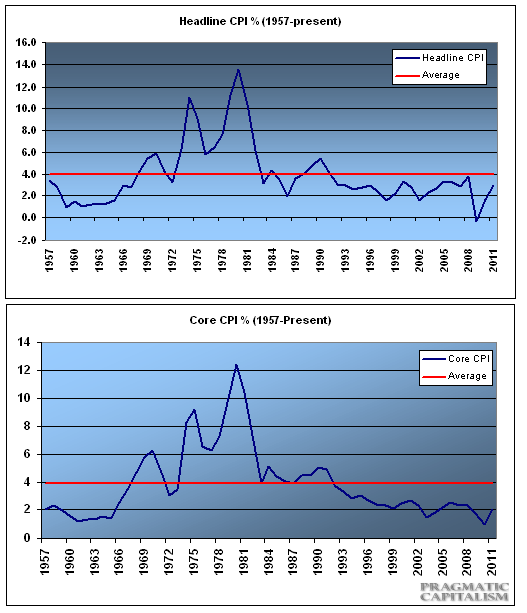
Some of the recent inflation data is causing consternation in some corners of the investment world. At 3.8% headline inflation sounds rather high. But if we study the post-war era, inflation is still low by any measure. If we look at the data going back to 1957 we actually find that headline inflation has averaged just 4% per year. Through the first 8 months of 2011 inflation has averaged 3% – nearly a full 1% below the historical average (latest reading was 3.8%). If we look at core inflation, the picture looks even less alarming. Core inflation is currently running at just 2% while the average since 1957 is 3.9%.


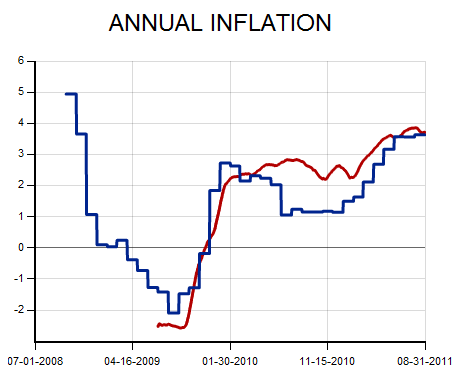
Now, some people will refute this data by claiming that the government’s CPI is flawed or misleading. But we know from the Billion Prices Project AND the ECRI’s independent inflation gauge that the government’s data is actually quite accurate. In fact, the BPP is a near perfect reflection of the government data over the last few years while the ECRI is showing declines in inflation:


(BPP Inflation)


The more important point here is that the inflation risks are now skewed to the downside following several quarters of rising prices. Admittedly, inflation has run hotter this year than I predicted (3% vs 2.5% expectations), but as the hyperinflation meme collapses, the global economy weakens and commodity prices tumble (down 10%+ in September) we should see a return of the disinflationary trend.

Monday, September 26, 2011

Investing Lessons From A Pianist

Investing Lessons From A Pianist: I urge my readers to remember the words of Pianist Artur Schnabel: “The notes I handle no better than many pianists. But the pauses between the notes – ah, that is where the art resides”.

Similarly, most investors are about equally good (or bad) at selecting stocks and other investments as well as at “timing” the market. However, some investors are more responsible and disciplined in their approach and that is where the superior performance comes from. As Dietrich Bonhoeffer noted, “Action springs not from thought, but from readiness for responsibility.”

Marc Faber is an international investor known for his uncanny predictions of the stock market and futures markets around the world.

Thursday, September 22, 2011

Guest Post: The Unwelcome Impact of Interventionist Monetary Policy In The US

Guest Post: The Unwelcome Impact of Interventionist Monetary Policy In The US:

A fascinating insight from Graham Giller of Statistical Trader Blog, who analyzes over 55 years of Treasury data to point to what is the crux of the problems of monetary policy since Greenspan took over the Fed. The Greenspan [and Bernanke] era monetary policy has altered the distribution of changes in interest rates in a way that exchanges a reduction in day-to-day 'normal' variability for a considerably higher (perhaps catastrophically higher as we are finding out this week) likelihood of extreme shocks.


I first made the attached chart in 2004 after attending a lecture by Benoit Mandelbrot, and reading his "Fractals and Scaling in Finance." Mandelbrot's argument based on his early research (in the 60's) on financial price data was that the variance of speculative prices was undefined (i.e. infinite). This has profound implications for quantitative finance as a venture since the error on the mean is proportional to the square root of the variance, and for a distribution with an infinite variance the law of large numbers does not apply ---- i.e. you cannot make precise measurements of the mean as there is no convergence of the sample mean towards the population mean. Mandelbrot's research was done before ideas such as stochastic volatility were created, and in a modern context we do find evidence of stable variance.


However, one of the interesting aspects of his work was to pose the question: how does one measure an infinite statistical moment from a finite data sample, since that finite sample will always give a finite answer? Mandelbrot suggested in his early papers looking at the time series of the cumulative sample moments of the data --- i.e. to measure using all data up to some time and to plot that value as a function of each and every time. If the true parameters of the distribution of the data being measured are unbounded (infinite) then this plot will show no signs of convergence --- the measured datum will march steadily away from zero as each additional data point is added.


Mandelbrot's ideas also apply to higher moments: the sampling error of the variance is determined by the kurtosis (degree of "fat tails") and so on. My plot illustrates the cumulative kurtosis, computed after Mandelbrot, of the daily change in US three month treasury bills. Ever since the arrival of Alan Greenspan's post '87 crash crisis management regime, this plot shows a systematic and steady march upwards in the kurtosis of changes in US interest rates. I find this chilling. This means that, if the truth is as the evidence suggests, that it is not possible to accurately determine the risk of a portfolio of bonds because it is not possible to make reliable measurements of the variance of interest rates. i.e. The whole enterprise of bond portfolio risk management is intrinsically unreliable.


The data also tells another story. Also plotted is the cumulative standard deviation of daily changes in rates. This shows a systematic (but slow) decline in the measured value. This indicates that the true value is below the current value of the cumulative measure and that the cumulative measure is slowly decaying towards that value. So a narrative for what the Greenspan era monetary policy has done to the distribution of changes in rates is to exchange a decreased daily variability for a higher (perhaps catastrophically higher as we have found out) likelihood for extreme shocks.


As you can see the Bernanke era has done little to modify the general trend. In 2006 I sent the chart to Jim Grant together with my prediction that something nasty was lurking in the future. I decided to revisit the analysis today and find nothing has changed. Discussions of the long-term consequences of interventionist monetary policy are increasing (though still not in the mainstream) and this plot shows the fingerprints of such policy writ large.


It is this constant papering-over of the day-to-day cracks (and business cycle) that is supposedly so beneficial for our society (and central planners) as a whole that creates a building tension as the underlying causes grow larger and larger and are never purged until in one fell swoop, the market mechanism finds a way.

Notes from the Pimco Lunch with Rob Arnott

Notes from the Pimco Lunch with Rob Arnott:

Today I had the pleasure of attending a luncheon at the Ritz-Carlton in NYC to hear one of the great intellects of the investment management business speak - Rob Arnott, founder of Research Affiliates and manager of Pimco's All Asset Fund.


For those who don't know:


Over his 30-year career, Robert Arnott has endeavored to bridge the worlds of academic theorists and financial markets. His success in doing so has resulted in a reputation as one of the world’s most provocative and respected financial analysts. Rob has pioneered several unconventional portfolio strategies that are now widely applied, including tactical asset allocation, global tactical asset allocation, tax-advantaged equity management, and the Fundamental Index® approach to indexation.


Rob spent some time giving us his views on the current economic picture, the big headwinds we face now and how we should be allocating for what's to come.


I'm jotting these nuggets down here off the dome, normally I take notes before putting out one of these posts but the food was actually decent so my hands were full...


***


(Mostly paraphrased except where in quotes)


On the Double Dip Recession: It's already begun, especially when you look at structural GDP (GDP minus deficit spending by the government). It looks like government spending will decline which virtually assures recession.


On Bipolar Markets: "When bonds and stocks disagree, the bond market is usually right."


On Greece and the PIIGS: By some measures of spending money we don't have, we are even bigger pigs here so we shouldn't be calling names. Greece would be wise to "cross the river" sooner than later because the river is getting faster and will only be tougher to cross with every passing day. (editor's note - I think he means default)


On Inflation: It will continue to tick up through the end of the year (in the form of CPI), the rolling three year average inflation rate will start to look scary (5% annual rate) as we start to lose the deflationary 2nd half of 2008 in that rolling three year number. Now imagine 2% Treasury yields and 5% inflation rate and how equities will respond to that.


On the Paradox of Inflation and Recession Co-Existing: So you say that with 10% unemployment and collapsing housing prices that inflation can't truly exist? Go ask the folks in Zimbabwe about their job and housing markets during the country's epic bout with inflation.


On Inflation and Stocks: It turns out that anything above a 4% inflation rate is very harsh for stock market PE ratios, they are very sensitive at that level and compress.


On Inflation Tools: TIPS are very expensive but could go even higher, junk bonds are actually a great inflation hedge - it turns out they outperform TIPS in that regard, REITs could get interesting for inflation hedging but not at today's prices. Commodities are the best bang for your buck in an inflationary environment, they are a 10x reaction, meaning if inflation jumps 2%, commodities as an asset class give you a 20% response.


On US Debt Problem: There are 3 ways to get through our current situation -


a. Austerity (too painful politically and economically, look at Greece - millions of private sector jobs lost, not a single government layoff)


b. Abrogation (as in not paying our debts. Russia and China will be thrilled, lol. There are some debts we have that aren't actually debts - merely obligations - like entitlements and such. These will come down but not enough.)


c. Run the Printing Presses (which is what Bernanke has been doing, it is politically very tempting to print more - make the debt worth less dollars - much easier to do this than austerity so it will continue)


On Demographics: Pimco's been doing a lot of work on demographics, some of their research will be out in a few months. It turns out that there are crazy high correlations between demographics and stocks but you have to use longer time frames because demographics are sloooooooow. Five year rolling average stock market and bond market returns more meaningful than annual numbers in this context. The gist is that people add the most to their nation's GDP growth in their 20's and 30's...they make the biggest impact on that nation's stock market returns at around 40 just as their contribution to GDP growth is starting to level off. This is important when looking at market opportunities around the world and at home.


On Emerging Markets: Demographically speaking emerging markets are getting into the median age sweet spot for GDP growth and then stock market performance - example was in India the median age is not yet 30 years old. China will hit that Great Wall of Demography everyone is worried about (because of the one child rule) but not for 15 to 30 years.


On What to Avoid: Growth stocks and long-dated Treasurys are an avoid. Multiples on growth stocks will not react favorably to a recession and inflation and long bonds are getting dangerous here. The one caveat is that "if Greece or Japan cross the Rubicon" in the next three months, Treasurys will certainly shoot up to even greater heights.


On Apple: Apple investors have given the company the highest market cap in the world - a de facto statement that "Apple is in a position to return more in profits to shareholders than any other company". In reality, Apple just isn't that big, it's not even in the top 40 companies by profits. Investors are betting, at these prices and multiples, that Apple is infallible. Favorite equity pairs trade (half joking I think) might be Long Bank of America, Short Apple - in one case expectations and sentiment pricing in the absolute worst case scenario, the opposite in the other.


On What to Do in Case of Recession: He is staying extremely liquid and underweight equities (only 8 to 12% of portfolios as per public filings), when the market adjusts to the high, scary inflation data and acknowledges the new recession, he expects asset prices to get "appreciably cheaper", but instead of buying the dip in US equities, he is more inclined to take advantage of the Emerging Markets stocks which will likely fall in tandem with developed markets.


On Gold and Swiss Franc as Safe Haven: He wouldn't buy either one looking for big gains and "you'd better hope you don't have big gains in those because you can just imagine what the rest of your portfolio would look like if you did..."


***


I'm not currently invested in the funds Rob manages but it was great to hear his thought process and outlook. if you guys like posts like these I'll put them up more often so let me know below.


Tags: $AAPL $BAC $SPY $EEM $GLD


The Market Ticker - Welcome To The Collapse Of 2011

The Market Ticker - Welcome To The Collapse Of 2011:

Welcome my friends to the collapse of 2011.

Remember the mantra that "consumers have delevered" which has been run over the last two years as an incessant bark from the media, attempting to goad you, the consumer, into more spending and more consumption to "lift the economy."

This claim has been a lie and a fraud upon the public and the new Fed Z1 makes this clear. The peak household credit liability was $13.92 trillion. It currently stands at $13.30 trillion, a reduction of a mere 4.6%.

This all came from home mortgages going ka-boom; $10.6 trillion to $9.9 trillion, a reduction of $700 billion. Total net reduction in liability was $620 billion; ex-mortgages consumer leverage has actually increased.

The DAX is now down nearly 10% in two days and the rest of the global markets are reacting in the same sort of fashion. This should not surprise; the same mantra of "we've de-levered" and "cash is at all time highs on the sidelines" has been claimed for years, and it's the worst sort of half-truth.

See, cash is indeed at high levels. But debt has gone higher, and yet nobody mentions the liability side. As an example non-financial business credit stands at $11.02 trillion, just barely down from the 2008 high of $11.15 trillion - and nearly a clean double from the year 2000 level of $6.21 trillion.

There's been no material "de-levering" at all. In fact the World Economic Forum claimed that in order to hit the "expected" GDP growth numbers we would have to double outstanding credit - that is, add $100 trillion in the next ten years.

But all credit comes with interest due, which means it is a forward promise to pay tomorrow for that which you wish to consume in some form or fashion today. This interest is a drag on growth as it forces transfer payments from the debtor to the creditor.

Now look closely at the following chart.

This is updated with the latest Z1. You've seen this chart dozens of times, and I'll get to history in a minute. But the ominous part of the chart is in fact right there... and you'll probably miss it.

But first, here's history up until 1980:

Note that while credit rose through the 1950s and 60s, so did GDP. And while the first seeds of the bubble game were apparent in in the 1970s, up until 1975 or so there was no manifestation of the sort of bubble economics that created this mess, and indeed we actually had a quarter in 1977 when we increased output as much as we increased debt.

Here's 1980 forward:

Note the incessant bubble economics since 1980. In fact 1980 was the last time (other than during the depths of the collapse in 08 and 09) that we actually put in a single three month period where there was more economic growth than there was new debt creation.

To those who claim that modern fiat monetary systems demand this sort of dynamic, go back to the chart above it. We've been on fiat money since the 1930s, and yet we ran through the 1950s, 1960s, and part of the 1970s with the monetary and credit system in balance. It can be done but doing so requires that your growth be real and a function of production - not bubble finance.

Here's the problem you probably missed in the first chart though - see that red box? We topped out at the end of last year and turned downward. This pattern is the same one that we saw in 2007, but from much higher levels. We're in big trouble folks, right here and now, and this data is always three months behind.

What's worse is the corporate balance sheet picture:

Note that corporate equity value compared against assets has gone back into "bubble" mode and leverage is again expanding.

Indeed, we're above the levels of 2007 and trying to break out from the 09/10 levels. More-importantly we're well beyond double the leverage level that for forty years was a reasonable "lid" on corporate leverage levels.

Claims that corporations have "de-levered" are also a lie, and this puts stock prices at extreme risk, as they are at present predicated on nothing more than the lie that "everything is ok" rather than tangible business valuations.

Finally, we have this from El-Erian:

The facts are striking and worrisome. Private institutions around the world, and even some public ones, have sharply reduced short-term lending to French banks. Credit markets now put their risk of default at levels indicative of a BB rating, which is fundamentally inconsistent with sound banking operations. Bank equity now trades at a 50 per cent discount to tangible book value on average. To make things worse, the ratio of market capital to total assets has fallen to 1 – 1.5 per cent (compared with six to eight per cent for healthier banks).

Right. But that equity value discount is not limited to French banks, as El-Erian is talking about. It is in fact even worse here in the United States, where we have major banks trading at one third of alleged "book value."

As I have repeatedly pointed out were these balance sheets accurate anyone with money could make an instant 100% or greater profit by simply buying these companies up. It's not happening, which means that either all of those with capital are individually and collectively stupid or the balance sheets are lies.

JP Morgan is trading this morning at prices seen in 2008 after Lehman's failure. So is Bank of America, Goldman Sachs, Morgan Stanley, Citibank and others. And this morning - now FedEx is as well!

A couple of weeks ago I opined that were you caught "long" equities you'd likely get another opportunity to unload them at reasonable prices before all hell broke loose. It appears that yesterday was that opportunity in the morning, as we're now trading seventy S&P points, or about than 6.6%, below where we were yesterday morning. You've once again had your 401k and IRA whacked by the incessant lies and scams promulgated by your government and the "financial wizards" who seduced you back into the markets with half-truths and siren songs.

The market opened this morning down 300+ DOW points and the VIX slammed through the 40 level. There will clearly be bounces along the line but as things stand right now the underlying financial conditions have not changed one iota from where they were in 2007. Instead of allowing those who were overlevered to go bust and have capitalism do what it does best - creative destruction of the foolish - we instead took private effectively-defaulted risk and transferred it to the public balance sheet.

But that's a scam - it simply moves the deck chairs on the economic Titanic, because governments can only raise funds through two means: They can borrow money (increasing leverage) or they can tax it (decreasing consumption or investment by private parties.) The obvious "borrow it" choice was made here in the US and elsewhere, but just as with private borrowing government borrowing has limits and we're now running into them, and deficit spending creates false demand signals in the economy that must eventually end.

Recognition that you've been scammed can be a truly ugly thing. It is usually violent at an emotional and financial level, and more often than one would like it has a habit of being violent in the physical sense as well.

Well, America (and the world), you've been scammed by the financial institutions and governments for the last 30 years. 2008 was the first spasm of recognition but was short-circuited by.... you guessed it.... even more scams. Rather than demand truth and an end to the games the American consumer lapped up the frauds and schemes of the politicians on both sides of the aisle who conspired with the financiers to rip you off once again.

The opportunity to address these issues as I have been tirelessly attempting to do, was ignored by those in policy roles in Washington DC. Those who have been reading The Ticker are well-aware of my efforts going back into 2007 and through the 2008 Presidential campaign on both sides of the aisle, along with my efforts since.

They've been ignored with the political establishment choosing to knob-job the banks and lie to you, the public, rather than address the fact that the entire last 30 years have been one gigantic economic scam and that what they were attempting to do could not, as a matter of mathematics, succeed.

Now recognition of that fact is dawning on people in a convulsive fashion, and markets of all sorts are reacting as one would expect when their entire worldview is exposed as having been a gigantic and intentional pyramid scheme constructed of debt layered upon debt that cannot be paid down. The wrong thing was done in 2008 and there is zero evidence that our government has changed one iota in their singular focus on misdirection and lies in this regard.

Welcome to awareness; I hope you've taken the last couple of years to become prepared.

Tuesday, September 20, 2011

Point of No Return: Will it be Japanization, Monetization, or Crisis 2.0?

Point of No Return: Will it be Japanization, Monetization, or Crisis 2.0?: I believe the Eurozone will break apart. Eurobonds are dead, so are fiscal unions. The question is really what path the crisis takes.

Via email, Saxo Bank chief economist Steen Jakobsen outlines several scenarios in a series of three emails that I spliced together.
There are three major ways of dealing with this crisis:

  1. Japanization – A Slow Death - Like Japan. Accept deflation, along with slow gradual restructuring, massive fiscal deficits, negative real-rates, housing prices lower than 30 years ago and a stock market valuation at less than 50 per cent of its peak

  2. Crisis 2.0 – A Forest Fire of deleveraging, political and economic changes created by necessity and need for moving forward. This scenario features a deep one-to-three year recession followed by better debt to equity, more realistic future expectations, and a public sector under control.

  3. Monetization – The extend-and-pretend forever solution, buying time – more of the same, patch work solutions, slowly forcing Europe towards fiscal consolidation not changing the Maastricht but the ECB charter to allow it to be lender-of-last-resort. This is the final phase of ‘Maximum Intervention’ – bigger and bigger direct support on liquidity(as seen today) and no impact on the solvency.

In the ‘Maximum Intervention’ macro theme the next policy response will be something new, yet more of the same – this has been the historic reaction function of the EU. The consensus right now is that the ECB wants EFSF enlarged from 440 billion EUR to 2.000 billion EUR size in order to get ahead of the EU debt crisis. This is opposed by the Germany.

Another solution is to start Quantative Easing, using the ECB to print money, similar to the US, Japan, UK and Switzerland – this is opposed, for now, by the ECB.

The European "TALF" scheme proposed by Geithner is a full blown move to QUANTATIVE EASING in Europe, the legal standing vis-à-vis Maastricht and the Constitutional Court in Karlsruhe is shaky at best.

I doubt the Germans will accept this – and even that the ECB will want their mandate changed directly. The Germans wants Crisis 2.0 – the ECB wants EFSF enlarged to + 2.000 billion EU.

Eurobonds Dead

Any solution ‘permanent’ in nature is in violation of German Constitutional Court – meaning pretty much Euro-bonds is out. (As Germany would have to be lender-of-last-resort when everyone else goes bankrupt)……Any solution temporary could fly vis-à-vis the Constitutional Court but ONLY if approved by full parliament.

Everything else coming to the table is talk, talk and more talk. American “experts” fail to understand the above and …. Most importantly as you have heard me say 1000x of times: ‘Never underestimate the political will of politicians to make this work/survive’ – Never!

The point of no return is here – Between now and the installment paid out in October we have major risk.

This week will tell if FOMC comes to rescue or we start the hard part of Crisis 2.0 – the deconstruction of capital needed to create the political will to do proper economic and political changes.
Geithner's TALF Play Rejected by Germany

Portions of Steen's comments were written last Friday. On Saturday, as Steen expected, Germany threw a money wrench into Geithner's leveraged TALF play as noted by Bloomberg in Germany Rejects Using ECB to Lift EFSF Rescue-Fund Firepower
Germany’s top two finance officials rejected using the European Central Bank to boost the euro-area rescue fund’s firepower, rebuffing a suggestion by U.S. Treasury Secretary Timothy Geithner.

The German stance risks leaving the euro area without sufficient means to prevent the crisis from engulfing Spain and Italy.

“The EFSF’s sole purpose is the financing of states and that’s in order as long as it’s done via the capital market,” Bundesbank President Jens Weidmann told reporters today. “If it’s done via the central bank it constitutes monetary state financing,” which is forbidden under European Union rules.
Fed Uncertainty Principle in Play

Please note that corollaries 2, 3, and 4 of the Fed Uncertainty Principle are in play. Simply substitute ECB wherever you see Fed.
Corollary Number Two: The government/quasi-government body most responsible for creating this mess (the Fed), will attempt a big power grab, purportedly to fix whatever problems it creates. The bigger the mess it creates, the more power it will attempt to grab. Over time this leads to dangerously concentrated power into the hands of those who have already proven they do not know what they are doing.

Corollary Number Three: Don't expect the Fed to learn from past mistakes. Instead, expect the Fed to repeat them with bigger and bigger doses of exactly what created the initial problem.

Corollary Number Four:
The Fed simply does not care whether its actions are illegal or not. The Fed is operating under the principle that it's easier to get forgiveness than permission. And forgiveness is just another means to the desired power grab it is seeking.
Note that ECB president Jean-Claude Trichet purchased sovereign bonds of Greece, Italy, Portugal, Spain, and Ireland (over the heated objections of the German Central Bank) in what many think was a violation of the Maastricht Treaty.

Thus, while it may seem Maximum Intervention is out, "Never underestimate the political will of politicians to make this work/survive – Never!"

Ultimately Crisis 2.0 It Is

Neither Maximum Intervention nor Japanization are sustainable. There simply is no political will by anyone for prolonged Japanese-style debt-deflation, and maximum intervention will blow up eventually. Eventually Crisis 2.0 will take hold, and the sooner the better.

Crisis 2.0 (at least as I see things) can itself resolve in one of three ways, as noted in Eurozone Breakup Logistics (Never Believe Anything Until It's Officially Denied)

I am not sure if Steen will agree with this, but I see Crisis 2.0 terminating in Plan B or Plan C.

  • Plan B: Greece, Spain, Portugal, Italy and the "Club-Med" states break away from the Euro.
  • Plan C: Germany, Austria, the Netherlands and Northern Europe break off the Euro. Alternatively Greece leaves via plan B, then Plan C takes over for everyone else.
  • Plan A: Defend the Euro at all Costs - is similar to Steen's Maximum Intervention play and is therefore unworkable long-term.

Plan C is the least destructive for everyone, but politics may prevent it.

Mike "Mish" Shedlock
http://globaleconomicanalysis.blogspot.com
Click Here To Scroll Thru My Recent Post List
Mike "Mish" Shedlock is a registered investment advisor representative for SitkaPacific Capital Management. Sitka Pacific is an asset management firm whose goal is strong performance and low volatility, regardless of market direction.
Visit http://www.sitkapacific.com/account_management.html to learn more about wealth management and capital preservation strategies of Sitka Pacific.

Wednesday, September 14, 2011

David Rosenberg: "It's Time To Start Calling This For What It Is: A Modern Day Depression"

David Rosenberg: "It's Time To Start Calling This For What It Is: A Modern Day Depression":

By now only the cream of the naive, Kool-Aid intoxicated crop believes that the US is not in either a deep recession, or, realistically, depression. For anyone who may still be on the fence, here is David Rosenberg's latest letter which will seal any doubts for good. It will also make it clear what the fair value of the stock market is assuming QE3 fails, which it will, and the market reverts to trading to fair value as predicated by bond spreads. To wit: "If the Treasury market is correct in its implicit assumption of a renewed contraction in the economy, then we could well be talking about corporate earnings being closer to $75 in 2011 as opposed to the current consensus view of over $110. In other words, we may wake up to find out a year from now that whoever was buying the market today under an illusion of a forward multiple of 10x was actually buying the market with a 15x multiple." And since we are in the throes of a deep depression and a 10x multiple is more than generous, applying that to $75 in S&P earnings, means that the fair value of the S&P is... we'll leave that to our readers.


From Breakfast with Rosie, of Gluskin Sheff


We just came off the weakest recovery on record despite the massive amounts of stimulus that the U.S. government has delivered in so many ways. That the yield on the 10-year U.S. Treasury note is down to 2% already speaks volumes because the last time we were at these levels was back in December 2008 when the downturn was already 12 months old. A period like the one we have endured over the past six months when bank shares are down 30% and the 10- year note yield is down 130 basis points has never in the past foreshadowed anything very good coming down the pike. If market rates are at Japanese levels, or at 1930s levels, then it's time to start calling this for what it is: A modern day depression.


Look, that entire period from 1929-1941 saw several quarters of huge bungee-jump style GDP growth and countless tradable rallies in the stock market.


But that misses the point.


The point being that a depression, put simply, is a very long period of economic malaise and when the economy fails to respond in any meaningful or lasting way to government stimulus programs. A series of rolling recessions and modest recoveries over a multi-year period of general economic stagnation as the excesses from the prior asset and credit bubble are completely wrung out of the system. In baseball parlance, we are in the third inning of this current debt deleveraging ball game.


You know you're in a depression when interest rates go to zero and there is no revival in credit-sensitive spending.


The economy is in a depression when the banks are sitting on nearly $2 trillion of cash and yet there is no lending going onto the private sector. It's otherwise known as a 'liquidity trap'.


Depressions usually are caused by a bursting of an asset bubble and a contraction in credit, whereas plain-vanilla recessions are typically caused by inflation and excessive manufacturing inventories. You tell me which fits the bill today.


When almost half of the ranks of the unemployed have been looking for a job fruitlessly for at least six months, you know you are in something much deeper than a garden-variety recession. True, we can't see the soup lines; the soup lines are in the mail — 99 weeks of unemployment cheques for over 10 million jobless Americans. Don't be lulled into the view that we are into anything remotely close to a normal economic cycle.


Basically, in a depression, secular changes take place. Attitudes towards debt, discretionary spending and homeownership are altered for many years, or at least until the scars from the traumatic experience with defaults and delinquencies fade away. That is why we saw existing home sales slide to 15- year lows and new home sales to record lows despite the fact that mortgage rates have tumbled to their lowest levels in modern history. There is no economic model that would tell you that declining mortgage rates should lead to lower home sales.


More fundamentally, in a recession, the economy is revived by government stimulus. In depressions, the economy is sustained by government stimulus. There is a very big difference between these two states.


In a recession, everything would be back to a new high nearly three years after the initial contraction in the economy. This time around, everything from organic personal income to employment to real GDP to home prices to corporate earnings to outstanding bank credit are still all below, to varying degrees, the levels prevailing in December 2007.


Let's be clear: After all the monetary, fiscal and bailout stimulus, the economy should be roaring ahead, as would be the case if the economy were coming out of a normal garden-variety recession. The fact that there has been no sustained response to all these efforts by the government to turn things around is testament to the view that this is not actually a traditional recession at all, but something closely resembling a depression. That, my friends, is exactly what the bond market is signaling, with Treasury yields rapidly approaching Japanese levels. Just because the stock market embarked on a stimulus-led speculative two-year rally, which ended abruptly in April 2011— does not change that fact.


For all the chatter about whether the recession that started in December 2007 ended in mid-2009, here is what you should know about the historical record. The 1930s depression was not marked by declining quarterly GDP data every single quarter. In fact, the technical recessionary aspect to the initial period following the asset and credit shock goes from the third quarter of 1929 to the first quarter of 1933.


I can understand how emotional the debate can get over whether or not we have actually just stumbled along some post-recession recovery path or whether or not this is actually a depression in the sense of a downward trend in economic activity merely punctuated with noise that is influenced by recurring rounds of government intervention. The reality is that the Fed cut the funds rate to zero, as was the case in Japan, to little avail. Then the Fed tripled the size of its balance sheet— again with little sustained impetus to a broken financial system. Government deficits of nearly 10% relative to GDP, or double what FDR ever ran during the 1930s, have obviously fallen flat in terms of providing any lasting impact to the economy.


This is going to sound like a broken record but it took a decade of parabolic credit growth to get the U.S. economy into this deleveraging mess and there is clearly no painless "quick fix" towards bringing household debt into historical realignment with the level of assets and income to support the prevailing level of liabilities. We are talking about $5 trillion of excess debt that has to be extinguished either by paying it down or by walking away from it (or having it socialized). Look, we can understand the need to be optimistic, but it is essential that we recognize the type of market and economic backdrop we are in.


The markets are telling us something valuable when (after a period of unprecedented government bailouts, incursions and stimulus programs) the yield on the 5-year note is south of 1% and the 10-year is down to 2%. Instead of contemplating over how attractively priced equities must be in this environment, market strategists and commentators would bring a lot more to the table if they tried to decipher what the macro message is from this price action in the Treasury market. Conducting stock market valuation analysis based on unrealistic consensus earnings assumptions does nobody any good, especially when these estimates are in the process of being cut, and at a time when the Treasury market is telling us we are the precipice of another recession.


If the Treasury market is correct in its implicit assumption of a renewed contraction in the economy, then we could well be talking about corporate earnings being closer to $75 in 2011 as opposed to the current consensus view of over $110. In other words, we may wake up to find out a year from now that whoever was buying the market today under an illusion of a forward multiple of 10x was actually buying the market with a 15x multiple.


How's that for a reality check?


This augers for capital preservation, defensive orientation in the equity market and a focus on income-yielding securities; something we've been advocating for some time.

Monday, September 12, 2011

U.S. On The Road To Fascism?

U.S. On The Road To Fascism?: David Galland: The System Is Coming Unglued Our video host Stefan Molyneux speaks with Casey Research Managing Director David Galland about the debt situation in the US and whether the federal government can do anything about it… assuming they’d even want to. [Are you prepared to face the coming debt storm? Learn more about it, [...]

Friday, September 09, 2011

The Market Ticker - Where's The Confidence?

The Market Ticker - Where's The Confidence?:

That's all I hear today in the media - that the market has lost confidence.

Yep.

Why have people lost confidence? Was it an accident? NO.

Was it an intentional act? Yes.

Who's responsible? That's easy.

  • Congress. We know why the meltdown happened in 2008. Financial institutions sold crap to people claiming it was "Grade AAA" chocolate. It was, well, crap and this was discovered when the first bite was taken. There has been no penalty assessed for doing this.

  • The Banks. They repeatedly said "we're well-capitalized" and then blew up. Bear and Lehman among them. There was no penalty assessed for doing this.

  • The President. He said he didn't come to Washington to protect the banksters. Then he did exactly that. In short, he lied. Even after we discovered over a hundred thousand perjured documents filed in foreclosure cases, there was no criminal penalty assessed for doing this.

  • The President (again). He said he'd cut the deficit in half by the end of his first term. Instead he more than doubled it and last night put forward a demand for yet more unpaid-for spending that will guarantee more than a trillion in deficits on a forward basis, along with essentially defunding Social Security and Medicare taxes while both programs are deeply in the red. In short he's driving the nation straight toward ruin exactly like a junkie demands more and more drugs even though he's aware that if he continues he will certainly die.

  • Ben Bernanke. He's been wrong about virtually every prognostication he has ever made about the economy, going back to 2006. He also lied when he told Congress that "The Federal Reserve will not monetize the debt", just months before doing exactly that. There has been no penalty assessed for doing this.

  • Wall Street itself. HFT abuse is the stuff legends are made of. It's a true outrage, really. The bid and offer manipulation on a daily basis is chronicled by Nanex; I've also written about it repeatedly. Market manipulation is illegal. There has been no penalty assessed for doing this.

  • The Banks (again) are lying about their balance sheets. We know this is a fact because in virtually every case where the FDIC has taken over a bank, from big to small, it has resulted in monstrous losses against claimed "asset values" on the balance sheet, sometimes on values claimed just weeks before in public filings. There has been no penalty assessed for doing this.

  • Case-Schiller and Zillow both claim $9 trillion in residential property value losses. The Fed claims $500 billion, approximately, in decreased mortgage debt. The rest cannot be found; the presumption must be that the banks are hiding trillions in bad paper in mortgages alone! Is there another explanation? Not really. Sure, some of this loss is equity, but not $8.5 trillion out of $9 trillion. There has been no penalty assessed for doing this.

  • Federal Regulators. They got caught allowing IndyMac to backdate deposits. The really ugly part of it is that the same people were involved in that as were involved in the same offense during the S&L crisis! The OCC sued to block state-level predatory lending statutes that would have largely cut off the housing bubble. That's not idiocy, it's rank corruption.

So on what basis should we expect "confidence" in the markets, especially when the markets all clear those those very same banks that pulled the scams, appear to be still pulling the scams, and the governments and regulators are still enabling the scams while the market has every reason to believe that the scam won't hold up and it will all fly apart on the back of Greece defaulting?

There's your answer.

Wednesday, September 07, 2011

Bernanke's Waterloo; Midst of Deflationary Collapse or Brink of Inflationary Disaster? 12 Specific Recommendations

Bernanke's Waterloo; Midst of Deflationary Collapse or Brink of Inflationary Disaster? 12 Specific Recommendations: The September Contrary Investor It's A Long Hard Road is an exceptional marriage of debt-deflation concepts, long-wave K-Cycles, credit cycles, and Austrian economic thinking. Here is a lengthy snip of several key points with permission.
If there has been one consistent theme since day one at CI, it has been our perhaps near myopic focus and focal point highlight of importance that is the macro credit cycle. Does this play into long wave and perhaps Kondratieff cycle or Austrian economics type of thinking? Call it what you will, but elements of all of these schools of thought very much overlap. Right to the point, we believe THE key thematic construct to keep in mind as a macro cycle decision making overlay and character point dead ahead is the now more than apparent collision of the generational long wave credit cycle with the current short term business cycle of the moment. Without trying to reach for melodrama, this is the first time a multi-decade long wave credit cycle has collided with the short-term business cycle since the late 1920’s/early 1930’s. Most decision makers and Street seers of the moment have absolutely no experience with this type of a generational collision. Moreover, our illustrious academician Fed Chairman has never even considered long wave or credit cycle based Austrian economics thinking in his and the broader Fed’s policy making – absolutely key and crucial mistake. Although it’s just our perception, this will be Bernanke’s legacy Waterloo. It also tells us directly that his only policy tool ahead will be more money printing.

We suggest to you that macro credit cycle issues did not end in 2009. Certainly Europe is a poster child example of this thinking, but it absolutely also applies to what lies ahead for the domestic US economy. We’ve only had a reprieve from long cycle reconciliation over the last few years due to historically unprecedented Government and Federal Reserve balance sheet levering, which itself is unsustainable longer term. Has the election cycle played havoc with needed deleveraging reconciliation and simple identification of the underlying causes of current circumstances? Without question. Although it’s clearly a personal comment, we’ve been disgusted with the short-term focus and actions of politicians at the expense of longer cycle strategic domestic economic thinking and needed financial reconciliation. These actions simply guarantee the deleveraging process will play out over a longer period than may otherwise have been the case. A very important construct with direct implications for the tone and rhythm of the domestic economy over time.

The top clip of the following chart is probably the one graphic we’ve published the most times over our short existence. Total US credit market debt relative to GDP. As is more than clear, the process of total credit cycle reconciliation has barely begun.


The bottom clip of the chart is one you’ve seen a number of times from us and we believe quite important to what lies ahead. To the point, real final sales to domestic purchasers is GDP stripped of the influence of inventories and exports. What we’re left with is as good look at domestic only GDP and as you can see, the year over year change in terms of growth in the current cycle is the weakest of any initial economic recovery cycle over the time in which official numbers have been kept. Message being? We are seeing very weak aggregate demand, exactly as one would expect in a generational credit cycle reconciliation process.


We also need to remember that THE primary goal of the Fed and politicians has been to thwart the generational credit cycle deleveraging process to the best of their abilities while it is occurring, all in the interests of being reelected. So as you look at the bottom clip of the chart above, remember that this is the growth in domestic economic activity in the current cycle that has occurred while the Government has borrowed $5 trillion and used the proceeds for increased transfer payments, cash for clunkers, help for those with mortgage problems, deals for appliances, etc. And yet still we’ve experienced incredibly subdued domestic economic activity. Just what would this have looked like in the absence of historic Government balance sheet leveraging?

Monetary Policy Useless in Deleveraging Cycles

Although it appears obvious conceptually, we're not so sure the markets yet fully appreciate the fact that in true generational deleveraging cycles, monetary policy is powerless to influence credit expansion. Again, our near myopic focus on credit is driven by the fact that credit is the cornerstone of modern economic development and balance, and certainly not just in the US. The character, availability and price of credit regulate the ongoing tone of aggregate demand, so monitoring credit is simply crucial. If credit cannot expand, then neither can aggregate demand. A simple yet key truism, especially in our current circumstances. As you can see below, we've seen literally unprecedented monetary expansion so far in the current cycle, yet private sector credit creation (as is exemplified by the bank loans and leases outstanding) remains wildly subdued at best. The whole pushing on a string thesis? Exactly.


The bottom clip of the chart above has been adjusted for the $450 billion of off balance sheet bank loans that were mandated to arrive back on bank balance sheets as per FASB dictates in April of last year. As is clear, bank loans and leases out since early 2009 have declined significantly. The bulls have trumpeted the growth over the last three months. You can decide for yourself whether this minor uptick is deserving of trumpeting, if you will. To ourselves the message appears absolutely crystal clear. In generational deleveraging cycles, Fed monetary policy is simply a non-event. Rather monetary extravagence finds its way into inflation hedge assets and can be used simply to speculate. Remember, as per Fed monetary largesse, the banks are sitting on $1.5 trillion of excess reserves as we speak. Excess reserves can be used as collateral for derivative and futures trading. You already know trading profits have been a crucial piece of bank earnings since 2009. As of now, monetary policy has been completely ineffective in the current cycle in creating credit - the lifeblood of economic activity and growth - except in one instance. And that instance lies below. Of course we are referring to Government debt.


In typical recessionary periods past, the Fed has been able to lower interest rates and stimulate demand for credit. Demand for credit ultimately stimulates broad economic activity via an increase in aggregate demand. But in deleveraging cycles as opposed to typical business cycles, interest rates can fall to zero and still not positively influence demand for credit. This is exactly what has occurred in the current cycle. You may remember from our discussions over the years we asked one question again and again, "is this a business cycle or a credit cycle?" The only borrower of substance in the current cycle has been the Federal Government, yet we are currently reaching the limits of Government balance sheet expansion tolerance, as clearly witnessed by the debt ceiling melodrama. This has only served to weaken the US as a credit. Again, the inability to generate demand for credit by almost any means (and in our present circumstance historic means) is simply a classic fingerprint of a generational deleveraging cycle.

Bernanke No Student of History

Never in modern history have we faced the type of domestic labor market circumstances we face today. As we've tried to describe, monetary policy is powerless to change this. If Mr. Bernanke was the true student of history he would fully realize exactly the circumstances we've described. It's not that we don't have precedent. The US in the 1930's and Japan over the last two decades are the model. Looking at the Depression years and claiming the issue was that the Fed was not loose enough misses the key fingerprint character points of a generational deleveraging cycle completely. Again, the refusal of Bernanke and friends to even acknowledge Austrian or Kondratieff economic constructs has been and will continue to be their policy making downfall. Who knows, maybe all of this will find its way into the economics textbooks of tomorrow. Let's hope so anyway for future generations. But as the old market saying goes, people don't repeat the mistakes of their parents, they repeat the mistakes of their grandparents.

Government and Fed policy has been aimed at fostering credit creation up to this point. Fed money printing and Government borrowing has been undertaken in an attempt to stimulate credit creation and likewise spark broad reacceleration in consumption. Certainly Government and Fed actions have also been an offset to the contraction in private sector (think financial sector) credit so far in the current cycle. As of now, unprecedented Fed actions have acted to both devalue the dollar and suppress interest rates. But in a generational deleveraging cycle, the Fed is ultimately impotent in terms of being able to successfully spark private sector credit creation that would lead to expansion in aggregate demand and macro GDP growth.

But what has occurred as a result of Fed and Government "solutions" again is a classic macro deleveraging cycle response - a devalued currency and negative real interest rates has driven investors into inflation hedge assets such as gold, oil, ag assets, etc. at the margin. As opposed to having achieved the stated goal of fostering employment growth, credit creation and raising aggregate demand, etc., Fed QE has essentially succeeded in raising the cost of living in a cycle characterized by generational labor market and direct wage pressure among the middle and lower class wealth demographic. From a broad perspective, has Fed and Government policy actually done more harm than good? It simply depends where one sits amidst the wealth demographic pyramid of life. Policy has been fabulous for Wall Street and the banks, but not so fabulous for the average household. The average household has faced vanishing interest income and negative real wage growth amidst an environment of a meaningfully rising cost of every day living (food and energy prices).

Policy has been counterproductive because policy makers continue to focus on short term outcomes as opposed to longer term structural remedies. Remember, people repeat the mistakes of their grandparents, not their parents. Mr. Bernanke is apparently an "expert" on the actions of "grandparents", yet he is very much repeating their same mistakes by his implicit refusal to even consider Austrian/Kondratieff like economic ideas. You already know, THE key character point of successful investors over time is flexibility in outlook and behavior. It's just a shame we can't clone that character point inside the Fed and Administration at present. But of course that would be counterproductive to the interests of Wall Street and the big banks.
Credit Cycle Understanding is Key to Returns

There is much more in the Contrary Investor article. I excepted the ideas pertaining to credit.

It is very refreshing to see someone else writing about debt deflation and how powerless the Fed is to stop it. Instead, we see article after article by people touting high inflation, even hyperinflation.

Hyperinflation is complete silliness at this point. Were it to come, it would be an act of Congress that would create it, not an act of the Fed, and the Fed would probably have to play along. I doubt the Fed would. For all its many faults, the Fed does not want to destroy banks. Hyperinflation would do just that.

The Republican dominated House wants little or nothing to do with more stimulus. Certainly US government debt is going to mount, but it is going to mount in Japan, the Eurozone, and the UK as well.

Moreover, Eurozone structural issues matter now, while US government debt will matter more in the years to come.

Midst of Deflationary Collapse or Brink of Inflationary Disaster?

Although the Keynesian and Monetarist economists have missed the boat on what is happening and why, Austrian minded folks who fail to understand the importance of credit and how little the Fed can do to revive it have blown the call as well.

It pains me to see articles like On the Brink of Inflationary Disaster by Austrian economist Robert Murphy.

We are clearly in the midst of a deflationary collapse as noted in Yes Virginia, U.S. Back in Deflation; Inflation Scare Ends; Hyperinflationists Wrong Twice Over

Focus on Money Supply Alone is Fatally Flawed

Deflation is about credit, it is also about attitudes that govern the demand for credit.

As I have stated many times over the years, and as stated above in the Contrary Investor, there is nothing the Fed can do to force businesses to expand or banks to lend.

That point explains why Austrian economists who focus on money supply alone have failed and will continue to fail.

Until consumer demand returns, businesses would be foolish to expand. Unfortunately, the Fed's misguided easing policies have stimulated commodity speculation thereby increasing manufacturing costs, while simultaneously clobbering those on fixed income and reducing final consumer demand.

I wrote about the plight of those on fixed income in Hello Ben Bernanke, Meet "Stephanie" back in January. Please give it a read if you have not yet done so.

The Deflationary Hurricane of Deteriorating Social Mood

One of the best posts recently on social mood and deflation is by Minyanville professor Peter Atwater.

Please consider The Deflationary Hurricane of Deteriorating Social Mood
This morning, in the aftermath of Fed Chairman Ben Bernanke’s speech on Friday, the editorial page of the Wall Street Journal noted, “Mr. Bernanke also lectured that ‘U.S. fiscal policy must be placed on a sustainable path,’ though not by cutting spending in the short-term. So the Fed chief joins the Keynesian queue of spending St. Augustines – Lord, make us fiscally chaste, but not yet.”

Everything we need to do for long-term economic, if not societal success and stability comes with very severe short-term consequences. And so the response of most policymakers (and not just those responsible for fiscal policy but also regulatory policemen like Mr. Bernanke himself) has been to advocate for short-term expansionary programs and rules, while postponing the real teeth of necessary change until some later date in the future. Basel III, for example, has a phased-in capital-strengthening requirement for the banking system that does not finish until 2019 – again, "chaste, but not yet."

I am sure that what is behind the thinking of policymakers is the notion that if we can just get through this tough “transitory” period, the economy will turn up; and at that point, whether it is fiscal or regulatory policy, our ability to handle constraints will be much, much easier to bear.

After 11 years of declining social mood, the notion that further monetary stimulus has limited use is hardly a surprise. As I have cautioned so many times, when it comes to the consumer it is not the depth of a recession that matters, but rather its length. And while for policymakers and financiers this may feel like a three-year-old recession (and for some even just a three-week-old recession!), for the American consumer this is a decade-old recession that has deteriorated well into a depression. The average American is now financially and emotionally exhausted. And given the news reports out of Washington over the past month, they are also now afraid that they are at risk of losing some or all of their government safety net, too. Like the children of fighting, divorcing parents, they are now fearful of what an increasingly uncertain future holds.

While further fiscal stimulus – particularly job-related initiatives – may slow the pace of deterioration, I am increasingly afraid that further fiscal and monetary policy actions are now impotent agents against our current social mood. Where in 2000, the future was so bright that we’d need shades, in 2011, the future for many Americans is so dark that they can’t see their way forward.

The consequence will be price deflation -- and not just further price deflation across those debt-dependent purchases like homes and automobiles, but across all categories of consumer goods. And for the first time since the 1930s, American businesses will see that lower prices are not always met with greater demand.
Price Deflation on the Way?

My definition of deflation is "a decrease of money supply and credit with credit marked-to-market". Judging by symptoms of deflation and Fed's efforts at fighting it, the US is back in deflation now by my measure. In my model, falling prices are not a requirement for deflation.

The important point is not definition, but rather the expected conditions. Yet, the conditions I expect and indeed the conditions in the US right now (in aggregate) match deflationary scenarios, not inflationary ones.

Murphy calls for an "inflationary disaster" while Atwater calls for "price deflation across all categories of consumer goods".

I do not know if we see across the board price deflation Atwater calls for given peak oil constraints and an inept US energy policy that also affects food prices.

However, I do expect to see falling education costs and falling medical costs as well as falling prices in a broad array of consumer goods and services, especially if Republicans can get a few sensible deficit measures passed.

Whether that scenario happens or not, the idea "brink of inflationary disaster" is complete silliness unless and until the Fed can revive credit, yet the Fed is powerless to do so.

So, unless Congress goes really haywire, attitudes will change and deleveraging will play out before the US experiences serious inflation. Unfortunately, Fed and Congressional policies have only served to lengthen the deleveraging timeline.

Those looking for hyperinflation or even strong inflation have missed the boat again, and again, and again, and will continue to do so, interrupted by periodic inflation scares until debt-deflation plays out.

Understanding the Deflationary Cycle

To understand what is happening, why businesses are not hiring, why housing is stagnant, and where the economy is headed, one needs a model that takes into consideration five key factors ...

  1. Mark-to-Market Measures of Bank Credit and Capitalization Ratios
  2. Credit Cycle Theory
  3. Attitudes of Banks, Businesses, and Consumers
  4. Futility and Limits of Keynesian Stimulus
  5. Futility of Monetary Stimulus

1 -Mark-to-Market Measures of Bank Credit and Capitalization Ratios

Banks cannot and will not lend unless they are not capital impaired and unless they have credit-worthy customers. Atwater noted Basel III was delayed until 2019. I noted on many occasions banks are still hiding investments off the balance sheets in SIVs and mark-to-market rules have been suspended several times.

As happened in Europe, delay tactics can only work for so long before the market questions if loans on the balance sheets of banks will ever be repaid. That time is now, not 2019. Thus banks are too capital impaired to take excessive risks, even if they wanted to. Moreover, too few credit-worthy businesses want to expand in the first place.

2 - Credit Cycle Theory

In accordance with long-wave, Kondratieff Cycle (K-Cycle) theory credit expansion and contraction cycles play out over decades. At least 75% of the time, continuously (not on and off), the economy grows in an inflationary manner. When deflation hits, few expect it because all many have known for their entire lives is inflation.

As long as consumers have ability and willingness to add debt an leverage, the Fed seems to have power to revive the economy via various stimulus efforts. Once a consumer deleveraging cycle starts, the Fed's power ends.

3 - Attitudes of Banks, Businesses, and Consumers

The willingness and ability of banks to lend and consumers to borrow and increase leverage is shot. Banks don't want to lend (or are to capital impaired to lend), and boomers are heading into retirement overleveraged in housing, without enough savings.

Consumers first thought tech stocks would be their retirement, then housing. Both dreams have been shattered. Consumers are now determined to pay down debt (saving), even if by outright default or walking away. Default and walking-away impacts banks willingness and ability to lend.

Think of attitudes like a pendulum. Attitudes can only go so far before they reverse. Housing reversed in 2007 as did the Nasdaq in 2000. Both reversed when the pool of greater fools ran out.

The Nasdaq is still nowhere close to old highs. These cycles last longer than most think. I expect housing will be weak for a decade once it bottoms, and it has not yet bottomed.

Finally, it's not just boomer attitudes that affect credit. Kids see their parents and grandparents arguing over debt, worried about bills, worried about jobs and vow not to repeat their mistakes. This point ties in with K-Cycle theory above.

4 - Futility and Limits of Keynesian Stimulus

Keynesian economists always want more, then more, then still more stimulus until the economy heals. Japan with debt-to-GDP ratio over 200% has proven such policies cannot ever work.

Keynesian economists always refuse to discuss the endgame, how the debt can be paid back, and what happens when stimulus stops.

The US has virtually nothing to show for all the make-shift, ready-to-go projects that temporarily put people back to work in 2009 and 2010. Not only did we repave roads that did not need paving, those hired still have debt-overhang and are still underwater on their houses.

All that happened was a delay in the day-of-reckoning. More Keynesian stimulus will only further delay the day-of-reckoning while adding to the national debt and interest on the national debt.

Priming-the-pump Keynesian theory will fail every time in a debt-deleveraging cycle. Indeed, it never works, it only appears to work until debt leverage is maxed out.

5 - Futility of Monetary Stimulus

As discussed above, monetary stimulus negatively affects the real economy for the temporary benefit of the financial economy and Wall Street. The tradeoff was not worth it except through the perverted-eyes of Wall Street.

Telling action in bank stocks says the limits of helping Wall Street may have even run out.

Many point to excess reserves as a sign of future inflation. I point to excess reserves as a sign of failed Fed policy. Commentary from Austrian economists shows they fail to understand how credit even works.

The idea those excess reserves are going to pour into the economy in a 10-1 leveraged fashion is simply wrong. Banks do not lend when they have excess reserves. Banks lend when they have credit-worthy borrowers, provided they are not capital impaired.

It is time Austrian economists finally wake up to this simple economic truth.

Academic Theory vs. Reality

Economists of all sorts stick to failed models.
  • The Monetarist currency cranks want more monetary stimulus even though it is counterproductive
  • The Keynesian clowns simply will not admit end-game constraints
  • The Austrians for the most part either ignore credit or incorporate failed models of credit expansion into their theories.

Each camp points the finger at the others as to why the others are wrong. Ironically, none of the camps seems to understand the combined mechanics of debt-deflation, deleveraging, and attitudes.

That said, I side with the Austrians about what to do (essentially let things play out, while implementing much needed structural reforms).

Twelve Specific Recommendations

  1. Banks and bondholders should take a hit. Banks are not going to lend anyway so bailing them out at the expense of taxpayers is both morally and economically stupid. End the bailouts, all of them, and prosecute fraud, the higher up the better.
  2. Implement serious bank reform now, not 9 years from now. Banks should be banks, not hedge funds. This proposal will necessitate breaking up banks. So be it.
  3. Scrap Davis-Bacon and all prevailing wage laws. Such laws drive up costs and have wreaked havoc on many cities and municipalities, now bankrupt or on the verge of bankruptcy.
  4. Pass national right-to-work laws. Once again, we need to reduce costs on businesses and local governments to spur more hiring and reduce costs.
  5. End collective bargaining rights of all public unions. The goal of unions is to provide the least service for the most money. The goal of government should be to provide the most services for the least money.
  6. Scrap ethanol policy and end all tariffs.
  7. Legalize hemp and tax it. Prison costs will go down, tax revenue will grow, and biofuel and fiber research will expand as hemp produces very soft fibers.
  8. Corporate income tax rates should be lower in the US than abroad. Current policy encourages capital flight and jobs flight via lower tax rates on profits overseas than in the united states. This penalizes businesses that work only in the US, especially small businesses that do not have an army of lawyers and lobbyists.
  9. Stop the wars and set a plan to bring home all US troops from Iraq, Afghanistan, and 140 or so other countries.The US can no longer afford to be the world's policeman.
  10. Implement Paul Ryan's Medicare voucher proposal. It is the only way so far that anyone has proposed that puts much needed consumer "skin-in-the-game" that will reduce medical costs.
  11. Legalize drug imports from Canada
  12. End the Fed and fractional reserve lending. Both have led to boom-bust cycles of ever-increasing amplitude.
Those are the kinds of things we need to do, not throw more money at problems. The latter does nothing but drive up national debt and interest on the national debt for short-term gratification.

Notice how counterproductive Fed policy is and how counterproductive Obama's policies are.

The Fed wants positive inflation but businesses have not been able to pass the costs on. Instead, companies outsource to China. Those on fixed income get hammered.

Fool's Mission

Obama wants to create jobs via stimulus measures. It's a fool's mission.

Prevailing wages drive up the costs, few are hired, and the cost-per-job (created or saved) is staggering. Money never goes very far because the US overpays every step of the way.

Stimulus plans that do not fix the structural problems are as productive as pissing in the wind. Then when the stimulus dies, which it is guaranteed to do, a mountain of debt remains.

Instead, my 12-point recommendation list will fix numerous structural problems, create lasting jobs, and reduce the deficit. What more can you ask?

Mike "Mish" Shedlock
http://globaleconomicanalysis.blogspot.com
Click Here To Scroll Thru My Recent Post List
Mike "Mish" Shedlock is a registered investment advisor representative for SitkaPacific Capital Management. Sitka Pacific is an asset management firm whose goal is strong performance and low volatility, regardless of market direction.
Visit http://www.sitkapacific.com/account_management.html to learn more about wealth management and capital preservation strategies of Sitka Pacific.