Wednesday, August 31, 2011

Slave Nation - Nature or Nurture?

Slave Nation - Nature or Nurture?:


Slave Nation - Nature or Nurture?


By


Cognitive Dissonance


Considering that each Zero Hedge article has a shelf life measured in hours, there is the distinct possibility you might have missed some of my recent work. Along with the more visible aspects of Zero Hedge’s recent user interface update, now there is a place for the reader to view all of a contributing editor’s work in one location. Please visit my ZH ‘blog’ (here) and see what you may have missed.


It’s remarkable the extent to which we all engage in our daily ritualistic behavior and even more so how it is carefully hidden in plain sight and perfectly blended into all we call normal. Our rituals bring us great comfort and a false sense of security while also trapping us into narrow thinking and confirmation bias seeking. And best of all, at least for those who wish to control us, our rituals feed our normalcy bias and for the most part keep us sated and fulfilled. Sated, that is, until the flimsy façade and cheap material becomes thread bare and worn out and denial finally collapses as we stand chest deep in sea water.


But that doesn’t stop the great Manufacturing Consent machine. Nope, they just floor the throttle and peg the tachometer in the red, all in the pursuit of glorious green and an increasingly productive slave nation. Remember boys and girls, consumers are created for one purpose only and that purpose is to consume. So go ahead and eat your little hearts out, then harass mom and dad for the latest transformer or anorexic doll.


You’ve got to admire it for it is brilliantly simple. If they can control the advertising message that tells us what our rituals should be, then all that is left is to supply us with the material and the means. Voila, as if by magic we now have one consumer driven slave nation idling at the curb. Now all that’s left is to beat it like the wholly owned mules we are.


I was struck with this rather unpleasant thought when I visited one of my favorite web sites and pulled up the image below. Click the link (here) to see the original and just soak it all in for a minute or so. BTW take a peek at the second image in the series, a satellite view of Hurricane Irene consuming half of the USA’s East Coast. Looks to me like an economic storm is coming.


The two people sitting on the wooden stairs to nowhere in the middle of nothing but water is an iconic image if ever I saw one, not just because it represents the full force and fury of Hurricane Irene, but how appropriate it is in illustrating the present condition of the consumer nations. What exactly do we have left after several decades of frenzied spending and mindless consumption? I’ll tell you what we have left. We have our rituals and dogma, and soon enough not much more.


Let me reproduce the caption for this image that was posted in Boston.com’s excellent ‘The Big Picture’. Billy Stinson comforts his daughter Erin Stinson as they sit on the steps where their cottage once stood on August 28, 2011 in Nags Head, N.C. The cottage, built in 1903 and destroyed by Hurricane Irene, was one of the first vacation cottages built on Albemarle Sound in Nags Head. Stinson has owned the home, which is listed in the National Register of Historic Places, since 1963. "We were pretending, just for a moment, that the cottage was still behind us and we were just sitting there watching the sunset," said Erin afterward. (Scott Olson/Getty Images)”


Billy and Erin Stinson


That pretty much says it all, doesn’t it? All that is left for Billy and Erin is the ritual practice of sitting on the steps to watch the sunset before fully internalizing the massive and unwanted change in their lives. And the impulse to act out this ritual is incredibly strong. Look closely and you can see that Billy is soaked up to the middle of his chest, meaning he probably waded out into 4 foot deep sea water to sit on his steps one last time. The shadows in the photo hide Erin’s wet clothes, but it appears she is soaked as well. It isn’t just salmon who will overcome so much to return to their ritual place of birth or beginning.


For those who were evacuated from their homes and have returned to find damage (or not) and for those who rode out the storm and were or are still without power, the disrupted rituals of our lives come into stark contrast when viewed from the current reality. I was without power for nearly 48 hours and I can’t tell you how many times I turned right at the end of the hall into my now darkened home office to check my email or begin a new article, only to quickly back out of the now useless room full of dead electronic devices.


At one point I felt my home had turned hostile and was no longer the friendly and comfortable place I remembered it to be. Silly rabbit, it was me who was lost and out of sorts because my comforting rituals had been removed without my consent. My home had not changed, only me. Yet the impulse to return again and again was at times overwhelming, an urge I suspect is ‘felt’ in all animals and plants at one time or another. Nature or nurture? That’s the real question here. Though I suspect it is both. The new born baby doesn’t require much coaching to find mother’s nipple, regardless of whether those babies are people, pandas or PIIGS.


In fact the tendency for humans to be severely out of sorts and thoroughly disorientated is being exploited by the ruling elite during the current shock and awe economic rape and destruction. Funny how the wealthy elite prosper during good times and bad, how the card game seems rigged in their favor and the die are all loaded. It must be in their genes because it most certainly is in their pocketbooks, the product of a centuries long breeding program I am told. Although it is exceedingly obvious that secret knowledge and understanding is passed down from father to son and from mother to daughter. Nature or nurture? That’s the real question here.


So why do we always fall for the same stupid elite pet tricks time after time, then wade out chest deep to sit on the remains of our lives just to pretend and pantomime? Why do we hand over our sovereignty and inalienable rights for the privilege of being corn holed by the same people using the same methods they used the last time? How is it that we don’t learn at least as quickly as my old dog Rover, probably the dumbest mutt that ever lived? Nature or nurture? That’s the real question here.


Bottle of Suds


Nature or Nurture


I was 21 and up to no good, sitting at the bar sucking on some suds and plying my illegal trade. Out of the blue the bartender gave me some unsolicited advice that most likely saved my life and the memory of it is etched into my brain. He was 30 years my senior and had seen everything in the book, one of those guys you just didn’t mess with if you had any smarts at all, something the drunks rarely possessed. He had always seemed indifferent to me and what I was doing, probably because I was fair and honest, a rarity in my trade. Plus I never caused him any grief and my tips were usually the best of the night. What wasn’t to like about me?


It was a slow weekday night and Jake used the excuse of serving up another beer to start the conversation. Or should I say lecture. He fixed me with one of those hard stares of his and then just flat out asked me.


“What do you think you’re doing?”


I was genuinely surprised and equally confused by his question. I really had no idea what he was talking about and I said as much. He just stared back at me, his dark eyes boring in which made me increasingly uncomfortable. “So this is what the hot seat feels like,” I remember thinking to myself.


“You know exactly what I’m talking about. And if you don’t you’re even stupider than I thought.”


I could feel my ears going red and I was getting hot under the collar. What did I do to deserve this? But of course I instantly knew what he was talking about, at least now that he had challenged me. At first I thought it was a shake down, so I reached into my pocket to pull out some bills. But Jake quickly reached across the bar and grabbed my arm.


“No, that’s not what I want.”


Now I was starting to freak out because it was clear this guy had my number and I had no way out. He released my arm and told me to wait while he served a new customer. It was the kind of order you didn’t ignore so I waited in quiet panic. But in those few minutes I quickly assessed my situation, then calmed down a bit when it dawned on me that if he intended me harm I would already be hurting. So if this wasn’t a shake down and all he wanted to do was talk, what could he possibly say to me other than to get the hell out of his place?


Much relieved and feeling my oats for being so smart, I relaxed and waited for Jake’s return. He must have sensed my changed demeanor because he quickly pounced and went straight for my jugular.


“Do you have any idea what you’re into? Or are you just so stupid you’re blind?”


How do you answer a question like that when the person asking can take you apart, then quickly move on to the next mess? I very wisely decided to say nothing and quickly swallowed my pride. You just don’t mess with Jake unless you have a death wish, and I most assuredly did not.


“This isn’t for you and you know it. Why don’t you just get out now before you live to regret it?”


In the year or so that I’d know Jake, never had I witnessed this side of him. Normally he was quiet, though he could get a bit animated when he wanted to close and was trying to push the drunks out the door. And when he was pissed off or trying to break up a fight, he became silent and the regulars knew to either back off or prepare to be bloodied. While I knew deep down inside exactly what he was telling me, for some reason I wanted to hear him say it. So I tempted fate and asked him to explain. His answer was short and to the point and all that I needed to hear.


“You lack the killer instinct bud.”


And there it was. With a couple of blunt words and a few figurative flicks of his wrist with the Buck knife he kept strapped to his belt, Jake had sliced me from neck to nuts and laid me out on the bar to bleed, exposed to all the world and in particular to me. All my ugly self important pretentions and fanciful pretending, together with its supporting cast of lies, self deception and justifications, was laid bare in all its beautiful buffoonery. I was playing House of Barbie while the principal players were engaged in a deadly game of cat and mouse. And Jake was telling me that I was in way past waist deep and the worst was yet to come.


While I wanted to believe that all would be well if I just played fair and didn’t fight; you know, by the rules (and you can bet that I carefully and deliberately constructed a false reality to convince myself that I was doing precisely that) Jake was busy cutting my illusion to ribbons and telling me to my face that at best I would be stranded on some wooden stairs in four feet of water, and he was betting I would be in the popsicle stick house when the Cat 5 roars ashore.


This was a crucial decision point for me. Better yet, this was one of those rare times when you get to see the end game before you’re in too deep and can’t back out. In effect Jake was telling me I didn’t have it in me. That I didn’t have what it takes to play with the big boys, those who either by nature or nurture wouldn’t bat an eye as they backed over my body for the third time. Jake wasn’t shining a light on anything I didn’t already know. On the contrary, he was informing me of something I’d been diligently trying to ignore, or better yet, paper over.


Sometimes angels take the form of beautiful winged nymphs and sometimes as grizzled old bartenders. I packed up and got the hell out of there, never to return to Jake’s place or any of my other usual haunts. Within 24 hours I had given my roommate 2 months’ rent to cover the lack of notice and any of the stuff I couldn’t jam into my car and I got the hell out of Dodge. The truth of his words was self evident and something only a true fool would ignore. Right there and then I decided that I had neither the nature nor the nurture and that the only sane decision was to totally and completely withdraw.


Jake's Place


Decision Point


So how did Billy and Erin find themselves sitting on stairs to nowhere in four feet of salt water, watching the pretty sunset while pretending their lovely little cottage was still behind them? And how do we find ourselves once again corn holed by the same financial elites using the exact same method of lies, deceit and false promises which we gratefully lap up in order to support our own House of Barbie? Hey, I promise to play by the new rules so please, please, please deal me back into your rigged game. Nature or nurture? That’s the real question.


While there is no doubt that countless millions, the so-called working poor, have very little choice and must play or die, we do have a choice and we choose to play the game because we just know we will win. We’re smarter or faster or better or stronger or whatever little lie we can concoct in order to justify bellying back up to the bar for another hand of cards. We know the game is rigged and yet we still play, certain in our belief that out of all the millions of deluded fools we will win the Gold ring and safely retire with our prize. The rigged game itself is our comforting ritual which we all endlessly act out.


But wait, what’s that I hear? Is that a collective moan of piety, a self righteous cry from the peanut gallery complaining that the lying bastards have changed the rules of the game again, that now they get to keep even more of the pie while sticking you and me with the bill? Now that the elite have 80% of the chips on their side of the table and are demanding another 10%, now we complain that the game isn’t fair? Now? You mean they cheated us again? If I understand this correctly, we have rationalized and justified our own greed and self interest in order to elbow our way into the rigged game, only to complain about their egregious greed and self interest? You can’t make this shit up.


So what are our demands here? This must be a negotiation because it sure as hell ain’t a strike or a work stoppage. All of us non working poor peons and enablers are still trudging off to our office trading cubes or fiat factory floors, so there doesn’t seem to be much resistance here. So where exactly is our leverage? How does one negotiate with someone or something when the terms are hidden from view, all the cards aren’t on the table and there’s a gun to our head?


Oh, wait a minute, I get it now. We want to be unequal partners. So this isn’t a negotiation, is it? This is about the reordering of the conditions of our slavery because we don’t like the way things have progressed. We want to go back to the time when we were cut in for a bigger slice of the pie. This isn’t about overall social justice; this is about justice for us. If the working poor just so happen to make out in the deal, well then all the better. But they sure as hell ain’t getting anything out of my slice of the pie. No way in hell. Let them eat cake or get their old percentage cut from the man just like I’m trying to do.


We’ve already had the reading of the charges against the financial elite and their henchmen. So we basically understand their alleged transgressions, though there are so many layers to this 10 dimensional chess board that I doubt anyone other than those at the top really know what’s going on and who’s screwing whom. But assuming that we know just enough to be dangerous to ourselves and those around us, what’s the plan man? Because if you think about it for a minute or so there must be fifty ways to leave your master. Unless, that is, you really don’t want to leave and instead, you just want your old deal with the devil back.


You see I’ve been asking a trick question since the beginning, this nature or nurture query. I’ve been distracting you with useless information and the false hope that if you could just answer the question you could figure it all out and win the Gold ring. It has nothing to do with nature or nurture and everything to do with whether we have it in us or not. We have deluded ourselves into thinking that we are playing a game of Barbie when in fact we are bit players, slaves if we really want to be honest, to the high stakes game of keeps where we get to keep what we are told we can keep.


Our underlying incentive to remain captive slaves, carefully hidden from view under the false promise of a system of laws meted out by the scrupulously just, but blessedly blind, lady with the scale, comes from the implied threat of violence if we don’t do as we are told. That’s it, it’s really not more complicated than that, no fancy whistles or bells or complicated playbooks to learn, though the ‘rules of the game’ is the Golden lure that keeps us all enthralled and thoroughly hooked.


The so called capitalist economic system is nothing more than a system of slave on slave competition for the betterment of the master and to the detriment of the slave. The goal is to take more blood from your fellow slave that you spill, and the incentive is to avoid being shot or imprisoned by the guard slaves who ring the arena, all of which is draped with “Democracy is Freedom” banners for our emotional and intellectual self delusion. The best and most productive slaves are those who keep themselves and we are most certainly the supreme slave nation.


The leverage used against us is provided by us, our extorted, connived and wide eyed willing participation in this macabre dance of servitude. Our slave quarters are just nice enough, what with central heat and A/C, running hot and cold water and a TV in every room feeding us 500 ritualistic propaganda channels that only the really stupid slaves would want to run for the hills and save themselves. These conditions aren’t really that bad considering. So what if the master is demanding two more pounds of flesh. If I fight real good and I’m smarter than the average slave, it won’t be my flesh that’s taken and I might just come out of this OK.


Slave Nation


http://slavenation.com


And you know what, if those conditions are good enough for you and me, if we are OK with being a slave, then fine. Let’s all just do our master’s bidding to receive our pieces of eight, then watch our cable TV to our heart’s content. Just don’t give me any bullshit about how unfair the game is and how the cheating has gotten out of hand because it is you and me who are powering our own slavery. And it is you and me who can stop it all today by just withdrawing and walking away.


The self evident truth is that at this point we don’t have it in us because walking away just might cause us all some pain, at least temporarily. And our ritual training tells us that pain relief is just another piece of eight away. So we capitulate long before we begin. Every time I hear someone bellow in self righteous tones about truth and justice and The American Way, then demand someone else step up and free our asses, all we are doing is proving my point, that we are slaves who regularly demonstrate our slave mentality by asking permission to pee on our own graves.


Slaves do as they are told. Slaves ask for permission. Slaves are seen, but not heard. Those with the slave mentality ask their masters for their leave even when the door is wide open and the coast is clear. Most importantly, slaves delude themselves into thinking that slavery is better than the alternative. Then they convince themselves that the only alternative is certain death if they resist. The best and most productive plantation slaves are those who keep themselves.


As a nation of individual slaves we are getting real close to our own Jake moment, that point when all our lies and justifications will be exposed for us to see. Will we have it in us to do what we need to do? Will we have our epiphany, that moment of clarity recovering alcoholics speak of when they realize they have used every lie, deception and ruse to avoid the truth, that they and they alone are the source of their problems? Personally I think we have it in us, but only after we shed our own emperor’s clothes and stand naked to the world and to ourselves.


08-31-2011


Cognitive Dissonance

Guest Post: Marx, Labor's Dwindling Share Of The Economy And The Crisis Of Advanced Capitalism

Guest Post: Marx, Labor's Dwindling Share Of The Economy And The Crisis Of Advanced Capitalism:


Submitted by Charles Hugh Smith from Of Two Minds


Marx, Labor's Dwindling Share of the Economy and the Crisis of Advanced Capitalism


All attempts to reform the Status Quo of advanced finance-based Capitalism will fail, as its historically inevitable crisis is finally at hand.


It is self-evident that conventional economics has failed, completely, utterly and totally. The two competing cargo cults of tax cuts/trickle-down and borrow-and-spend stimulus coupled with monetary manipulation have failed to restore advanced Capitalism's vigor, not just in America, but everywhere.


Conventional econometrics is clueless about the root causes of advanced finance-based Capitalism's ills. To really understand what's going on beneath the surface, we must return to "discredited" non-quant models of economics: for example, Marx's critique of monopoly/cartel, finance-dominated advanced Capitalism. ("Capitalism" is capitalized here to distinguish it from "primitive capitalism.")


All those fancy equation-based econometrics that supposedly model human behavior have failed because they are fundamentally and purposefully superficial: they are incapable of understanding deeper dynamics that don't fit the ruling political-economy conventions.


Marx predicted a crisis of advanced Capitalism based on the rising imbalance of capital and labor in finance-dominated Capitalism. The basic Marxist context is history, not morality, and so the Marxist critique is light on blaming the rich for Capitalism's core ills and heavy on the inevitability of larger historic forces.


In other words, what's wrong with advanced Capitalism cannot be fixed by taxing the super-wealthy at the same rate we self-employed pay (40% basic Federal rate), though that would certainly be a fair and just step in the right direction. Advanced Capitalism's ills run much deeper than superficial "class warfare" models in which the "solution" is to redistribute wealth from the top down the pyramid.


This redistributive "socialist" flavor of advanced Capitalism has bought time--the crisis of the 1930s was staved off for 70 years--but now redistribution as a saving strategy has reached its limits.


The other political-economic strategy that has been used to stave off the crisis is consumer credit: as labor's share of the economy shrank, the middle class workforce was given massive quantities of credit, based on their earnings and on the equity of the family home.


The credit model of boosting consumption has also run its course, though the Keynesian cargo cult is still busily painting radio dials on rocks and hectoring the Economic Gods to unleash their magic "animal spirits."


The third strategy to stave off advanced Capitalism's crisis was to greatly expand the workforce to compensate for labor's dwindling share of the economy. Simply put, Mom, Aunty and Sis entered the workforce en masse in the 1970s, and their earning power boosted household income enough to maintain consumption.


That gambit has run out of steam as the labor force is now shrinking for structural reasons. Though the system is eager to put Grandpa to work as a Wal-Mart greeter and Grandma to work as a retail clerk, the total number of jobs is declining, and so older workers are simply displacing younger workers. The gambit of expanding the workforce to keep finance-based Capitalism going has entered the final end-game. Moving the pawns of tax rates and fiscal stimulus around may be distracting, but neither will fix advanced finance-based Capitalism's basic ills.


The fourth and final strategy was to exploit speculation's ability to create phantom wealth. By unleashing the dogs of speculation via a vast expansion of credit, leverage and proxies for actual capital, i.e. derivatives, advanced finance-based Capitalism enabled the expansion of serial speculative bubbles, each of whcih created the illusion of systemically rising wealth, and each of which led to a rise in consumption as the "winners" in the speculative game spent some of their gains.


This strategy has also run its course, as the public at last grasps that bubbles must burst and the aftermath damages everyone, not just those who gambled and lost.


Two other essential conditions have also peaked: cheap energy and globalization, which opened vast new markets for both cheap labor and new consumption. As inflation explodes in China and its speculative credit-based bubbles burst, and as oil exporters increasingly consume their resources domestically, those drivers are now reversing.


Advanced Capitalism is broken for reasons conventional economics cannot dare recognize, because it would spell the end of its intellectual dominance and the end of the entire post-war political-economic paradigm that feeds it.


Let's look at some charts to see what conventional economists must deny to keep their jobs.


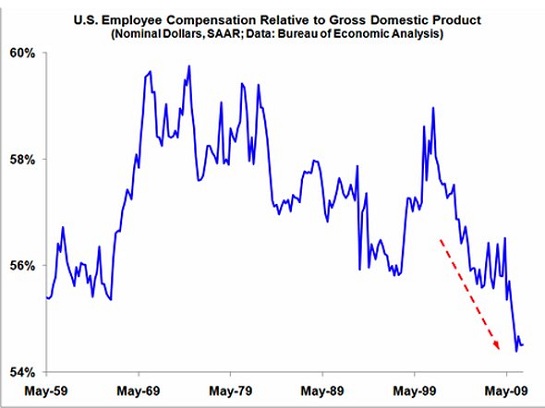
Take a look at this chart. What reality does it reflect? A failure to cut taxes enough? A failure to print enough money or extend enough credit? No. What it reflects is labor's dwindling share of the economy.


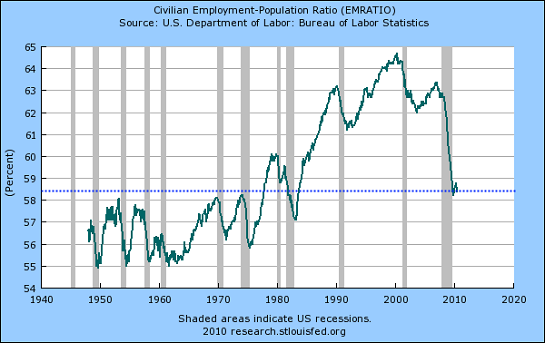
The structural reality is that employment is declining:


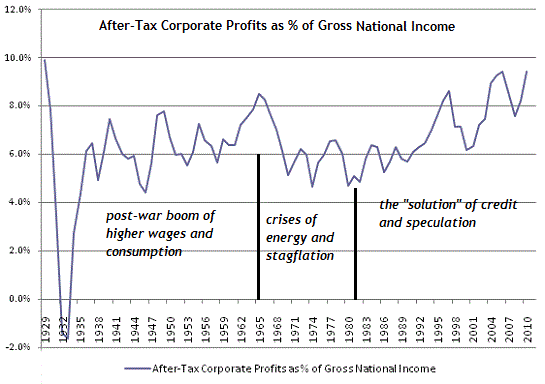
Meanwhile, after-tax corporate profits have steadily climbed to nearly 10% of the entire national income:


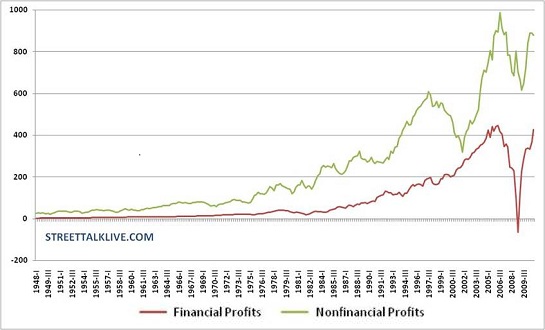
Note the recent rise of finance-based profits:


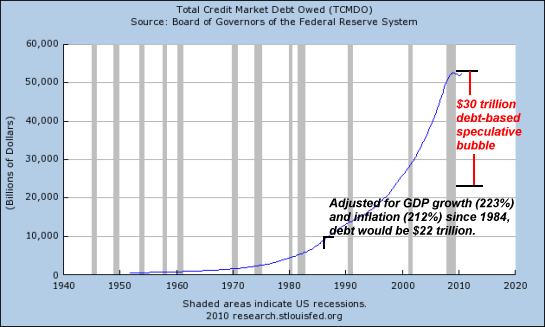
This chart leaves no doubt that the engines of the past 30 years "growth" and "prosperity" have been credit and credit-fueled speculation:


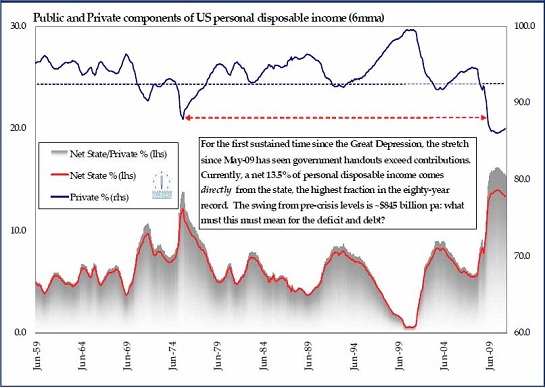
If we look at disposable income, we find that direct government transfers have masked the systemic erosion of labor's earnings and employment:


By at least some measures, the top 1% are paying a greater share of total taxes than they were 20 years ago, which suggests that "tax the rich will solve everything" stopgaps have limited purchase on the deeper structural ills of advanced finance-based Capitalism.


Marx identified two critical drivers of advanced Capitalism's final crisis:


1. Global Capital has the means and incentive to keep labor in surplus and capital scarce, which means that capital has pricing power and labor has none. The inevitable result of this is that wages, as measured in purchasing power, fall while the returns earned on capital rise.


This establishes a self-reinforcing, inevitably destructive dynamic: once labor's share of the national income falls below a critical threshold, labor can no longer consume enough or borrow enough to keep the economy afloat with its cash and credit-based consumption.


We are at that point, but massive Federal borrowing and transfers are masking that reality for the time being.


2. The dual forces of competition and technology inevitably drive down the labor component of all manufactured goods and technology-based services. Mechanization, robotics and software have lowered the labor component of everything from running shoes to computer chips from $20 per item to $2 per item, and that process cannot be reversed. While the wage paid to the workforce designing and manufacturing the products and providing the services may actually rise, the slice of revenues given over to all labor continues shrinking.


This is what I have constantly referred to (using Jeremy Rifkin's excellent phrase) as "the end of work."


Put another way: the return on capital invested in techology greatly exceeds the return on labor. Industries and enterprises which fail to leverage capital invested in technology that lowers the labor component of their good/service eventually undergo rapid and inevitable creative destruction.


We are about to witness this creative destruction in the labor-heavy industries of government, education and healthcare.


Marx's genius was to recognize the historical inevitability of these internal forces within advanced Capitalism. He also recognized the inevitability of finance-capital's dominance of industrial capital--something we have witnessed in full flower over the past 30 years.


Finance capital now dominates not just industrial capital but the machinery of governance, rendering real reform impossible. Instead, the Status Quo delivers up simulacrum "reform" which change nothing but the packaging of the Central State/Cartel Capitalism's exploitation and predation.


Add all this up and you have to conclude the final crisis of finance-based advanced Capitalism is finally at hand. All the "fixes" that extended its run over the past 70 years have run their course. Life will go on, of course, after the Status Quo devolves, and in my view, ridding the globe of financial predation and parasitism will be a positive step forward.


The real solution is to understand advanced finance-based global Capitalism will unravel as a result of the internal dynamics described above, and be replaced with an economic and political Localism that I describe in my new book An Unconventional Guide to Investing in Troubled Times.I don't claim these ideas are unique to me; many others have described the same dynamics and historical trends.

The Fed's Plan - Rumors of News

The Fed's Plan - Rumors of News:

Go back a week to an article in the NY Times (Link). The guts of this story is that the Administration is working on a plan to Re-Fi residential mortgages on a massive scale.


When I first read this, I ignored it. The scope of the proposal was too large. There was also (IMHO) a fatal flaw. The thinking was that the jumbo ReFi would be made available to only those who had a mortgage that ended up with either Fannie or Freddie. I ask the question, "What about those poor odds and sods who have a mortgage with a community bank?” Do they get nothing while those who owe F/F big bucks get a break? Where is the fairness in that result?


But every day since the NYT story, I have heard the rumblings about some deal being done. It has already impacted MBS spreads. It's back in the news today with an article in the WSJ. (Link) I have to believe that where there is smoke, there is probably some fire.


I went back to the NYT piece. There are some clues. First is that Louise Story wrote the article. She is a fine reporter. Anything that she says has been supported by “real” sources. "Who were these sources?" is a question to ask. Some words from the piece:


Administration officials said on Wednesday that they were weighing a range of proposals.


Read this to mean that people in the Administration deliberately planted this story. This was a “trail balloon” approach. This is very typical for this administration. They leak their intentions in advance. More from the NYT:


But refinancing could have far greater breadth, saving homeowners, by one estimate, $85 billion a year.


The following chart was included in the NYTs article.


The information in the chart and the very precise estimate of “85 billion a year” can only have come from one source. It has to be the FHFA that is doing the talking to the NYT. It had to come from the most senior level. That HAS to mean that it came from the Acting Director, Edward DeMarco.


The NYT functionally confirmed the source of the article as DeMarco with this written quote from him:


“F.H.F.A. remains open to all ideas that provide needed assistance to borrowers” while minimizing the cost to taxpayers, Mr. DeMarco said in a written statement.


Now consider some of the wording in the WSJ article today. Note: This article was written, in part, by Jon Hilsenrath. Jon is well known to be a mouthpiece for the Fed. He gets his thinking directly from Bernanke. Some quotes:


There are several reasons why refinancing has been weak, say Fed officials.


Some Fed officials say that it would be in Fannie and Freddie's financial interest to allow borrowers who are current on their mortgages to refinance at lower rates because it would increase the likelihood that they won't default.


Officials at the Federal Reserve are frustrated that they've pushed interest rates to the lowest levels in decades and yet many borrowers haven't been able to take advantage.


You can take these quotes to the bank. They are from Bernanke. It is Bernanke that is frustrated that his low interest rate policy has not resulted in more ReFi’s. You can also take as a fact that Bernanke wants something done on mortgage relief.


One other fact in the picture. The new IMF head, Christine Lagarde, spoke on the phone to Obama before her speech at Jackson Hole. She must have told the Big O that a program to clear up America’s mortgage mess was her top priority. She made that very clear in her speech the following day.


************************************************


Okay. Put these pieces together. What do you have? Assume for the sake of discussion that the President does announce a major new initiative to ReFi F/F mortgages. Assume further that the cost of the millions of ReFi’s would come from existing sources (the $35b of already issued and funded Hope Now Bonds), or better yet, the costs would be crammed down the neck of the banks who are servicing the loans (necessary to get DeMarco to go along). Say, for the sake of discussion, that the targeted mortgages are those who have not yet defaulted, but are desperately in need of a break. That amount would come to about $1.4 Trillion. This is a very big amount. Assume finally that the new mortgage rate would be about 4%. This (if accomplished) would be a very big shot in the arm for the economy as a whole.


Now do a flow of funds for this mega transaction.


I) Homeowners get a new loan at 4% and payoff 100% of the old mortgage.


II) The servicing banks get the proceeds and pay off the old loan.


III) The money is paid to F/F. This money is used to redeem existing mortgage pools of Agency MBS.


IV) Fannie/Freddie have the same asset mix at the end of the day. They still need to finance the new 4% mortgages they are writing.


V) Fannie and Freddie are taking on substantial new risk as they now have a book of 4% mortgages and are much more at risk to rising interest rates.


VI) It takes 90 days for a new mortgage to become a new Agency MBS. During this period F/F warehouse these loans. They finance the warehouse with short-term debt. They take action to reduce their risk by entering into new swap transactions or by buying derivatives to neutralize the market risk.


VII) As the process goes on huge chunks of EXISTING higher coupon MBS are prepaid. Investors in those MBS securities will be forced to re-invest the proceeds.


So who is going to be the biggest recipient of the cash pre-pays? That’s easy to answer. It’s the Federal Reserve. They currently own 1.0 Trillion of Agency MBS. A very substantial portion of the total prepayments of F/F MBS will be paid to the Fed. The Fed’s balance sheet will shrink very rapidly as a result.


The Fed has already established what will happen when principal is prepaid on their holdings of MBS. The have said they will reinvest any proceeds back into new purchases of US Treasury securities. As this chart of the Fed’s holdings show, this has already happened to the tune of $250 billion. The new proposal for the mega ReFi will dramatically reduce the MBS holdings. It will force the Fed back into the market to purchase big amounts of Treasury bonds. This process will take at least a year. But the total amounts could easily exceed $600 billion (QE2 size).


There is a flaw in this logic. On a macro basis, total mortgages loans remain the same. This is only a re-pricing. Not a reduction of total debt. The reality is that the Fed will be buying more treasury bonds, but F/F will have to be selling new bonds to protect themselves against interest rate risk. What will be happening is that the Fed is buying to reduce interest rates while at the same time F/F will be buying protection in the form of swaps, options and new term funding. So the real consequence to the credit markets will be a wash.


There is one solution to this dilemma that achieves the desired outcome. The Fed could easily enter into the swaps/options with F/F to eliminate their basis risk. Think of this as a different version of “Operation Twist”. The Fed wants to reduce long-term interest rates. It does not matter to them if they do it with direct purchase of bonds or if they absorb future interest rate risk by writing derivatives that would neutralize the market impact.


The Fed can’t write $1 trillion of interest rate swaps to the street in order to achieve this objective. There would be far too much counter-party risk for the Fed to do this. But they have no counter party risk with F/F. At the end of the day F/F is the government, so the Fed can say they have no counter-party concerns. The bulk of this would be financed by F/F in short-term markets. The swaps and options with the Fed would alleviate the market risk they would face from the ReFi’s.


Who would be APPOSED to this plan? No one that I can think of. DeMarco would be able to say that the plan protects the taxpayers from future losses. Obama would say that he has created a new stimulus of $85 billion a year. Bernanke would love this plan. He would be “Forced” into buying a new big amount of Treasuries. He would have his excuse for QE3 handed to him. That the Fed would be forced to absorb new risk of loss to rising interest rates is of no concern to the Fed. They are in so deep today, another $1 trillion of notional risk would not change the picture. Keep in mind that the Fed is very anxious to pull the next trigger.


Who would be the sources of SUPPORT for a plan like this? Everyone but some Republicans is the answer. DeMarco (FHFA) would get what he wants. Obama would get what he wants (10,000,000 homeowners would love him). The economy WOULD benefit from this as consumers would have new cash in their pockets. Bernanke would get everything he wants (a new QE), and would have the political cover for his efforts.


The only voice of dissent will come from Republicans in the House. But it is very likely that this could all happen without a vote. From the NYT piece:


The idea is appealing because it would not necessarily require Congressional action.


There are too many pieces of this pie to ignore. This is a solution to problems that are both political and economic. I see no significant opposition. Republicans will scream “foul”, but who cares. This can happen over their objections.


I'm looking for something along these lines to be announced soon. It will come in the President’s upcoming speech. None other than Ben Bernanke will be the biggest supporter. That makes it a very feasible outcome.


Will this work? I’m not convinced. I think this is the ultimate "kick the can down the road". But that is the only strategy that is in place today. Delay the inevitable; win the next election. That is the only thing that matters in D.C.
.
.


Rumors, rumors and more rumors


MISUNDERSTANDING THE MONETARY SYSTEM IS BAD FOR YOUR PORTFOLIO

MISUNDERSTANDING THE MONETARY SYSTEM IS BAD FOR YOUR PORTFOLIO:

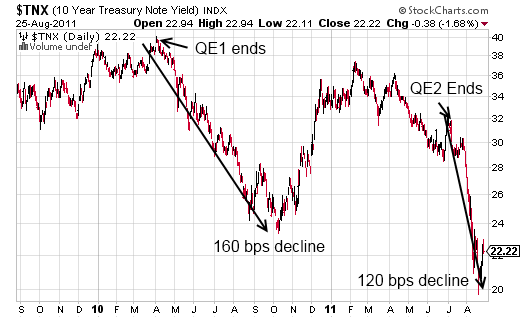
I’ve been incredibly vocal over the last year about QE2 and its likely impact on the US economy and US government bond market. Time and time again I have said that the policy was largely a waste of time and effort and unlikely to have any real substantive effect on the economy (see here and here). The policy was flawed primarily due to one rather simple mistake – it focused on size and not price. This resulted in no real transmission mechanism through which it could impact the economy and failed to control interest rates.


Most investors did not believe this perspective and maintained that QE2 would not only cause surging inflation, but would also cause US government bond yields to surge when the program ended. This was primarily due to the many myths that have persisted surrounding QE2. These were the myths of “debt monetization“, “money printing” and “stimulus”. These are nothing more than common misunderstandings, but investors who listened to these myths failed to assess how QE2 would impact the asset it targeted – US government bonds. None of these misinterpretations was more famous than Bill Gross who incorrectly analyzed QE1, but also misunderstood QE2. Yesterday, the WSJ discussed the investment performance of the PIMCO Total Return Fund as a result of this analysis:


“Bill Gross, long a rock star in the fixed income universe, has been a laggard this year as his bearish view on Treasurys has been confounded by their bull run during the past few months.


Mr. Gross, 67 years old, manages the world’s biggest bond fund–the $245.5 billion Total Return Fund–at Pacific Investment Management Co. The fund has handed investors a return of 2.99% this year through Wednesday, ranking 157th out of 179 funds in the category of intermediate-term bond funds tracked by Lipper.


Over the past three months, the fund just broke even, with a return of negative 0.04%, compared to a return of 2.7% from the benchmark Barclays Capital Aggregate Bond Index, according to data from Morningstar Inc.”


Unfortunately, the WSJ doesn’t appear to connect all of the dots. You see, what PIMCO misunderstood, was not just the impact of QE2, but the actual operational realities of the US monetary system. We’ve tracked PIMCO’s comments in real-time and called them incorrect at several points in the last year. For instance, earlier this year, Bill Gross said June 30th could be “D-Day” when the US government could experience a shortage of buyers in government bonds which would lead to surging yields. Bill Gross asked “Who will buy the bonds?” Mr. Gross misunderstood how government bonds function to “finance” the US government (they don’t). And in doing so, he misinterpreted how government bond auctions work. I said these funding fears were unfounded and unlikely to impact bonds. Last year at this time, I vigorously argued that US Treasuries were not in a bubble. And just days before an epic 10% surge in long bonds I said US Treasuries served as part of “the perfect hedge” in this environment. I followed-up to these pieces in greater detail than I cover here (I’ll spare you the repetitious commentary).


The point here is not to say “hey look at me, I was right and Bill Gross was wrong”. The point is that understanding the monetary system matters. Economics is largely “dismal” because the myths of neoclassical economics dominate our classrooms and media commentary. This causes an extraordinary disconnect between the way investors perceive the economy and the markets. And it results in underperformance by fund managers who make mistakes by incorrectly assessing the US monetary system. It doesn’t have to be this way. Hopefully, as time goes on, more and more investors will better understand the monetary system in which we reside. Not only will this avoid investment losses such as the above, but it might actually translate to better public policy. Unfortunately, we’re a long way from that reality….

Monday, August 29, 2011

Are Most Americans Debt Slaves?

Are Most Americans Debt Slaves?:

“The First Recorded Word For ‘Freedom’ In Any Human Language Is The Sumerian Amargi, A Word For Debt-Freedom … If Aristotle Were Around Today, He’d Probably Conclude That Most Americans Were, For All Intents And Purposes, Slaves”


I’ve previously noted that top economists say will have a never-ending depression unless we repudiate the mountains of bad debt choking the world, that repudiating bad debt is moral, legal, empowering and popular.


I’ve pointed out that debt always grows exponentially, while the real economy can only grow in an “s-curve”, and so periodic debt jubilees are needed. And that we have forgotten what the ancient Sumerians and Babylonians, the early Jews and Christians, the Founding Fathers and even Napoleon Bonaparte knew about money and debt.


And I’ve reported that the money of individuals, businesses, cities, states and entire nations is disappearing into the abyss of debt, and that – by choosing the pretend creditors over the little guy – the government is dooming both to failure.


Today, NakedCapitalism has a great interview with professor of social anthropology – and debt expert – David Graeber, touching on many of these themes.


Here are must-read excerpts from the interview:


Interviewer (Journalist Philip Pilkington): Most economists claim that money was invented to replace the barter system. But you’ve found something quite different, am I correct?


David Graeber: Yes there’s a standard story we’re all taught, a ‘once upon a time’ — it’s a fairy tale.


***


Rather than the standard story – first there’s barter, then money, then finally credit comes out of that – if anything its precisely the other way around. Credit and debt comes first, then coinage emerges thousands of years later and then, when you do find “I’ll give you twenty chickens for that cow” type of barter systems, it’s usually when there used to be cash markets, but for some reason – as in Russia, for example, in 1998 – the currency collapses or disappears.


***


This was the great social evil of antiquity – families would have to start pawning off their flocks, fields and before long, their wives and children would be taken off into debt peonage. Often people would start abandoning the cities entirely, joining semi-nomadic bands, threatening to come back in force and overturn the existing order entirely. Rulers would regularly conclude the only way to prevent complete social breakdown was to declare a clean slate or ‘washing of the tablets,’ they’d cancel all consumer debt and just start over. In fact, the first recorded word for ‘freedom’ in any human language is the Sumerian amargi, a word for debt-freedom, and by extension freedom more generally, which literally means ‘return to mother,’ since when they declared a clean slate, all the debt peons would get to go home.


***


Taxes are also key to creating the first markets that operate on cash, since coinage seems to be invented or at least widely popularized to pay soldiers – more or less simultaneously in China, India, and the Mediterranean, where governments find the easiest way to provision the troops is to issue them standard-issue bits of gold or silver and then demand everyone else in the kingdom give them one of those coins back again. Thus we find that the language of debt and the language of morality start to merge.


In Sanskrit, Hebrew, Aramaic, ‘debt,’ ‘guilt,’ and ‘sin’ are actually the same word. Much of the language of the great religious movements – reckoning, redemption, karmic accounting and the like – are drawn from the language of ancient finance. But that language is always found wanting and inadequate and twisted around into something completely different. It’s as if the great prophets and religious teachers had no choice but to start with that kind of language because it’s the language that existed at the time, but they only adopted it so as to turn it into its opposite: as a way of saying debts are not sacred, but forgiveness of debt, or the ability to wipe out debt, or to realize that debts aren’t real – these are the acts that are truly sacred.


How did this happen? Well, remember I said that the big question in the origins of money is how a sense of obligation – an ‘I owe you one’ – turns into something that can be precisely quantified? Well, the answer seems to be: when there is a potential for violence. If you give someone a pig and they give you a few chickens back you might think they’re a cheapskate, and mock them, but you’re unlikely to come up with a mathematical formula for exactly how cheap you think they are. If someone pokes out your eye in a fight, or kills your brother, that’s when you start saying, “traditional compensation is exactly twenty-seven heifers of the finest quality and if they’re not of the finest quality, this means war!”


Money, in the sense of exact equivalents, seems to emerge from situations like that, but also, war and plunder, the disposal of loot, slavery. In early Medieval Ireland, for example, slave-girls were the highest denomination of currency. And you could specify the exact value of everything in a typical house even though very few of those items were available for sale anywhere because they were used to pay fines or damages if someone broke them.


But once you understand that taxes and money largely begin with war it becomes easier to see what really happened. After all, every Mafiosi understands this. If you want to take a relation of violent extortion, sheer power, and turn it into something moral, and most of all, make it seem like the victims are to blame, you turn it into a relation of debt. “You owe me, but I’ll cut you a break for now…” Most human beings in history have probably been told this by their debtors. And the crucial thing is: what possible reply can you make but, “wait a minute, who owes what to who here?” And of course for thousands of years, that’s what the victims have said, but the moment you do, you are using the rulers’ language, you’re admitting that debt and morality really are the same thing. That’s the situation the religious thinkers were stuck with, so they started with the language of debt, and then they tried to turn it around and make it into something else.


PP: You’d be forgiven for thinking this was all very Nietzschean. In his ‘On the Genealogy of Morals’ the German philosopher Friedrich Nietzsche famously argued that all morality was founded upon the extraction of debt under the threat of violence. The sense of obligation instilled in the debtor was, for Nietzsche, the origin of civilisation itself.


***


DG: If however you ditch the whole myth of barter, and start with a community where people do have prior moral relations, and then ask, how do those moral relations come to be framed as ‘debts’ – that is, as something precisely quantified, impersonal, and therefore, transferrable – well, that’s an entirely different question. In that case, yes, you do have to start with the role of violence.

***


What do people who don’t use money actually do when things change hands? Anthropologists had documented an endless variety of such economic systems, but hadn’t really worked out common principles. What Mauss noticed was that in almost all of them, everyone pretended as if they were just giving one another gifts and then they fervently denied they expected anything back. But in actual fact everyone understood there were implicit rules and recipients would feel compelled to make some sort of return.


What fascinated Mauss was that this seemed to be universally true, even today. If I take a free-market economist out to dinner he’ll feel like he should return the favor and take me out to dinner later. He might even think that he is something of chump if he doesn’t and this even if his theory tells him he just got something for nothing and should be happy about it. Why is that? What is this force that compels me to want to return a gift?


This is an important argument, and it shows there is always a certain morality underlying what we call economic life.


***


Money has, for most of its history, been a strange hybrid entity that takes on aspects of both commodity (object) and credit (social relation.) What I think I’ve managed to add to that is the historical realization that while money has always been both, it swings back and forth – there are periods where credit is primary, and everyone adopts more or less Chartalist theories of money and others where cash tends to predominate and commodity theories of money instead come to the fore. We tend to forget that in, say, the Middle Ages, from France to China, Chartalism was just common sense: money was just a social convention; in practice, it was whatever the king was willing to accept in taxes.


***


The last time we saw a broad shift from commodity money to credit money it wasn’t a very pretty sight. To name a few we had the fall of the Roman Empire, the Kali Age in India and the breakdown of the Han dynasty… There was a lot of death, catastrophe and mayhem. The final outcome was in many ways profoundly libratory for the bulk of those who lived through it – chattel slavery, for example, was largely eliminated from the great civilizations. This was a remarkable historical achievement. The decline of cities actually meant most people worked far less. But still, one does rather hope the dislocation won’t be quite so epic in its scale this time around. Especially since the actual means of destruction are so much greater this time around.


***


In the past, periods dominated by virtual credit money have also been periods where there have been social protections for debtors. Once you recognize that money is just a social construct, a credit, an IOU, then first of all what is to stop people from generating it endlessly? And how do you prevent the poor from falling into debt traps and becoming effectively enslaved to the rich? That’s why you had Mesopotamian clean slates, Biblical Jubilees, Medieval laws against usury in both Christianity and Islam and so on and so forth.


Since antiquity the worst-case scenario that everyone felt would lead to total social breakdown was a major debt crisis; ordinary people would become so indebted to the top one or two percent of the population that they would start selling family members into slavery, or eventually, even themselves.


Well, what happened this time around? Instead of creating some sort of overarching institution to protect debtors, they create these grandiose, world-scale institutions like the IMF or S&P to protect creditors. They essentially declare (in defiance of all traditional economic logic) that no debtor should ever be allowed to default. Needless to say the result is catastrophic. We are experiencing something that to me, at least, looks exactly like what the ancients were most afraid of: a population of debtors skating at the edge of disaster.


And, I might add, if Aristotle were around today, I very much doubt he would think that the distinction between renting yourself or members of your family out to work and selling yourself or members of your family to work was more than a legal nicety. He’d probably conclude that most Americans were, for all intents and purposes, slaves.


PP: You mention that the IMF and S&P are institutions that are mainly geared toward extracting debts for creditors. This seems to have become the case in the European monetary union too. What do you make of the situation in Europe at the moment?


DG: Well, I think this is a prime example of why existing arrangements are clearly untenable. Obviously the ‘whole debt’ cannot be paid. But even when some French banks offered voluntary write-downs for Greece, the others insisted they would treat it as if it were a default anyway. The UK takes the even weirder position that this is true even of debts the government owes to banks that have been nationalized – that is, technically, that they owe to themselves! If that means that disabled pensioners are no longer able to use public transit or youth centers have to be closed down, well that’s simply the ‘reality of the situation,’ as they put it.


These ‘realities’ are being increasingly revealed to simply be ones of power. Clearly any pretence that markets maintain themselves, that debts always have to be honored, went by the boards in 2008. That’s one of the reasons I think you see the beginnings of a reaction in a remarkably similar form to what we saw during the heyday of the ‘Third World debt crisis’ – what got called, rather weirdly, the ‘anti-globalization movement’. This movement called for genuine democracy and actually tried to practice forms of direct, horizontal democracy. In the face of this there was the insidious alliance between financial elites and global bureaucrats (whether the IMF, World Bank, WTO, now EU, or what-have-you).


When thousands of people begin assembling in squares in Greece and Spain calling for real democracy what they are effectively saying is: “Look, in 2008 you let the cat out of the bag. If money really is just a social construct now, a promise, a set of IOUs and even trillions of debts can be made to vanish if sufficiently powerful players demand it then, if democracy is to mean anything, it means that everyone gets to weigh in on the process of how these promises are made and renegotiated.” I find this extraordinarily hopeful.


***


Eventually, there will have to be recognition that in a phase of virtual money, safeguards have to be put in place – and not just ones to protect creditors. How many disasters it will take to get there? I can’t say.


Monday, August 22, 2011

Michael Pettis: Long-Term Outlook for China, Europe, and the World; 12 Global Predictions

Michael Pettis: Long-Term Outlook for China, Europe, and the World; 12 Global Predictions: Via email, Michael Pettis at China Financial Markets shared his outlook for China, Europe, and the world. The overall outlook is not pretty, and includes a breakup of the Eurozone, a major slowdown for China, and a smack-down of the much beloved BRICs.


Pettis Writes ...

August is supposed to be a slow month, but of course this August has been hectic, and a lot crueler than April ever was. The US downgrade set off a storm of market volatility, along with bizarre concern in the US about whether or not China will stop buying US debt and the economic consequence if it does, and equally bizarre bluster within China about their refraining from buying more debt until the US reforms the economy and brings down debt levels.


What both sides seem to have in common is an almost breathtaking ignorance of the global balance of payment mechanisms. China cannot stop buying US debt until it engineers a major adjustment within its economy, which it is reluctant to do. Until it does, any move by the US to cut down its borrowing and spending will trigger a drop in global demand which will cause either US unemployment to rise, if the US ignores trade issues, or will cause Chinese unemployment to rise, if the US moves to counteract Chinese currency intervention.


The Big Picture


Rather than try to wade through all the news this month, much of which doesn’t seem to have much informational content, I thought I would duck out altogether and instead make a list of things I expect will happen over the next several years. We are so caught up in noise and market volatility – as the market swings first in one direction and then, as regulators react, in the other direction – that it is easy to lose sight of the bigger picture.


My basic sense is that we are at the end of one of the six or so major globalization cycles that have occurred in the past two centuries. If I am right, this means that there still is a pretty significant set of major adjustments globally that have to take place before we will have reversed the most important of the many global debt and payments imbalances that have been created during the last two decades. These will be driven overall by a contraction in global liquidity, a sharply rising risk premium, substantial deleveraging, and a sharp contraction in international trade and capital imbalances.


To summarize, my predictions are:


  1. BRICs and other developing countries have not decoupled in any meaningful sense, and once the current liquidity-driven investment boom subsides the developing world will be hit hard by the global crisis.
  2. Over the next two years Chinese household consumption will continue declining as a share of GDP.
  3. Chinese debt levels will continue to rise quickly over the rest of this year and next.
  4. Chinese growth will begin to slow sharply by 2013-14 and will hit an average of 3% well before the end of the decade.
  5. Any decline in GDP growth will disproportionately affect investment and so the demand for non-food commodities.
  6. If the PBoC resists interest rate cuts as inflation declines, China may even begin slowing in 2012.
  7. Much slower growth in China will not lead to social unrest if China meaningfully rebalances.
  8. Within three years Beijing will be seriously examining large-scale privatization as part of its adjustment policy.
  9. European politics will continue to deteriorate rapidly and the major political parties will either become increasingly radicalized or marginalized.
  10. Spain and several countries, perhaps even Italy (but probably not France) will be forced to leave the euro and restructure their debt with significant debt forgiveness.
  11. Germany will stubbornly (and foolishly) refuse to bear its share of the burden of the European adjustment, and the subsequent retaliation by the deficit countries will cause German growth to drop to zero or negative for many years.
  12. Trade protection sentiment in the US will rise inexorably and unemployment stays high for a few more years.


1. No BRIC Decoupling


Since most global consumption comes from the US, Europe and Japan, the collapse in their demand will ultimately be very painful for the BRICs and the rest of the developing world. The latter have postponed the impact of contracting consumption by increasing domestic investment, in some cases very sharply, but the purpose of higher current investment is to serve higher future consumption. In many countries, most notably China, the higher investment will itself limit future consumption growth, and so with weak consumption growth in the developed world, and no relief from the developing world, today’s higher investment will actually exacerbate the impact of the current contraction in consumption.


2. Near-Term Decline in Chinese Consumption


By 2013 Chinese household consumption will still not have exceeded the 35% of Chinese GDP reached in 2009. In fact it will probably be lower.


Premier Wen listed the need to raise the consumption share of GDP second in his speech last March before the unveiling of the new Five-Year Plan.


But I remain very, very skeptical. Low consumption levels are not an accidental coincidence. They are fundamental to the growth model, and the suppression of consumption is a consequence of the very policies – low wage growth relative to productivity growth, an undervalued currency and, above all, artificially low interest rates – that have generated the furious GDP growth. You cannot change the former without giving up the latter. Until Beijing acknowledges that it must dramatically transform the growth model, which it doesn’t yet seemed to have acknowledged, consumption will continue to be suppressed.


3. Chinese Debt Levels will Continue to Rise Very Quickly


The attempts to rein in debt growth will fail because they address specific areas of debt and not the overall tendency of the system to generate debt.


China funds almost all of its major investments with bank debt, and it long ago ran out of obvious investments that are economically viable – at least investments that are likely to be generated by what is a distorted system with very skewed incentives – so increases in investment must be matched by increases in debt.


To the extent that investments are not economically viable, this means that the value of debt correctly calculated must rise faster than the value of assets. By definition this results in an unsustainable rise in debt.


4. By 2013-14 Chinese GDP Growth will Slow sharply


I don’t expect a significant growth slow-down until after the new leadership takes power in late 2012, but my guess (and hope) is that by 2013 the stubborn refusal of consumption to rise as share of GDP, and the continuing surge in debt, will have convinced all but the most recalcitrant that China needs a dramatic change of policy.


Why do I say we will be talking about 3% growth soon? Two reasons. First, I am impressed by the bleakness of historical precedents. Every single case in history that I have been able to find of countries undergoing a decade or more of “miracle” levels of growth driven by investment (and there are many) has ended with long periods of extremely low or even negative growth – often referred to as “lost decades” – which turned out to be far worse than even the most pessimistic forecasts of the few skeptics that existed during the boom period. I see no reason why China, having pursued the most extreme version of this growth model, would somehow find itself immune from the consequences that have afflicted every other case.


Second, I just use a very simple calculus. Remember that rebalancing is not an option for China. It will happen one way or the other, and the sooner the less disruptive. And for China to rebalance in a meaningful way, consumption growth is going to have to outpace GDP growth by at least 3-4 full percentage points (and even then, at that rate, it will take China over five years to return to the 40% that was not long ago considered astonishingly low).


5. Non-Food Commodities Disproportionately Affected


The decline in Chinese growth will fall disproportionately on investment and, because of this, it will severely impact the price of non-food commodities. The implications are inescapable, although I think many people, especially in the commodities sector, have missed them.


6. Significant Slowing Could Start in 2012


What happens to real interest rates will determine when the process of Chinese adjustment begins. In fact there is a chance that we may see growth in China slow significantly in 2012, perhaps even to 7%, although I suspect that it will probably be in the 8-9% region.


What the PBoC does to interest rates is likely to be the outcome of a struggle in the State Council between policymakers that are worried about growth and those that are worried about imbalances. If the PBoC can hold off the former, and especially if wages continue rising, we might begin to see Chinese rebalancing taking place a little earlier than expected. Of course this must, and will, come with much slower GDP growth.


7. Social Unrest Not a Given


Growth rates of 3% will not necessarily lead to social and political instability. Most analysts argue that China needs annual growth rates of at least 8% to maintain current levels of unemployment. Anything substantially lower will cause unemployment to surge, they argue, and this would lead to social chaos and political instability.


I disagree. The employment effect of lower growth depends crucially on the kind of growth we get. Since rebalancing in China requires less emphasis on heavy investment and more on consumption, and since rebalancing also means a sharp reduction in free credit provided to SOEs and local governments and cheaper and more available credit for efficient but marginal SMEs, a rebalancing China would presumably see much more rapid growth in the service sector and in the SME sector, both of which are relatively labor intensive. Much lower growth, in that case, could easily come with minimal changes in overall employment. Japan is a useful reminder of what can happen.


8. Large-Scale Privatization


Because of its rapidly rising debt burden, the only way for China to manage a smooth social transition will be through wealth transfers from the state sector to the household sector. In the past, Chinese households received a diminishing share of a rapidly growing pie. In the future they must receive a growing share. This will probably be accomplished through formal or informal privatization.


9. Disruptive European Politics


European politics will become much more difficult and disruptive. The historical precedents are clear. During a debt crisis the political system becomes fragmented and contentious. If the major parties don’t become radicalized, smaller radical parties will take away their votes.


Remember that the process of adjustment is a political one. We all know someone has to pay for the massive adjustment countries like Spain must make. The only interesting question is about who will be forced to take the brunt of the payment – workers in the form of unemployment, the middle classes in the form of confiscated savings, small businesses in the form of taxes, large businesses in the form of taxes and nationalization, foreigners, or creditors.


Deciding who pays is a political process, and because the stakes are so high it will be a very bitter process. This means, among other things, that politics will degenerate quickly, and of course if Europe doesn’t arrive at fiscal union in the next year or two, it probably never will. This conclusion is also the reason for my next prediction.


10. Spain, other PIIGS Leave Euro


Spain will leave the euro and will be forced to restructure its debt within three or four years. So will Greece, Portugal, Ireland and possibly even Italy and Belgium.


The only strategies by which Spain can regain competitiveness are either to deflate and force down wages, which will hurt workers and small businesses, or to leave the euro and devalue. Given the large share of vote workers have, the former strategy will not last long. But of course once Spain leaves the euro and devalues, its external debt will soar. Debt restructuring and forgiveness is almost inevitable.


11. Germany Will Not Voluntarily Share Costs


Unless Germany moves quickly to reverse its current account surplus – which is very unlikely – the European crisis will force a sharp balance-of-trade adjustment onto Germany, which will cause its economy to slow sharply and even to contract. By 2015-16 German economic performance will be much worse than that of France and the UK.


For one or two years the deficit countries will try to bear the full brunt of the adjustment while Germany scolds and cajoles from the side. Eventually they will be unable politically to accept the necessary high unemployment and they will intervene in trade – almost certainly by abandoning the euro and devaluing. In that case they automatically push the brunt of the adjustment onto the surplus countries, i.e. Germany, and German unemployment will rise. I don’t know how soon this will happen, but remember that in global demand contractions it is the surplus countries who always suffer the most. I don’t see why this time will be any different.


12. Expect US Rising Trade Protection Sentiment


As the US fights over the fiscal deficit and whether or not it is the right way to expand domestic demand, more and more politicians will focus on the expansionary impact of trade protection. There will be an increasing tendency to intervene in trade – in fact I think of quantitative easing as a policy aimed at trade and currency imbalances as much as one aimed at domestic monetary management.


As unemployment persists, and as the political pressure to address unemployment rises, the US will, like Britain in 1930-31, lose its ideological commitment to free trade and become increasingly protectionist. Also like Britain in 1930-31, once it does so the US economy will begin growing more rapidly – thus putting the burden of adjustment on China, Germany (which will already be suffering from the European adjustment) and Japan.


Trade policy in the next few years will be about deciding who will bear the brunt of the global contraction in demand growth. The surplus countries, because they are so reliant on surpluses, will be very reluctant to eliminate their trade intervention policies. Because they are making the same mistake the US made in the late 1920s and Japan in the late 1980s – thinking they are in a strong enough position to dictate terms – they will refuse to take the necessary steps to adjust.


But in fact in this fight over global demand it is the deficit countries that have all the best cards. They control demand, which is the world’s scarcest and most valuable commodity. Once they begin intervening in trade and regaining the full use of their domestic demand, they will push the adjustment onto the surplus countries. Unemployment in deficit countries will drop, while it will rise in surplus countries.
That is a lengthy clip of ideas, yet hopefully within the spirit of Pettis' guidelines on these emails. His PDF is 14 pages and will appear on his blog shortly.


I added the bold headlines in the detailed discussion points above.


Six Key Ideas


  1. China Will Slow Much More than China Bulls and Commodity Bulls Think
  2. Non-food Commodities Take Big Hit

  3. Eurozone Experiment Ends in Breakup
  4. US Protectionism Takes Hold
  5. Deficit Countries Control Demand, Thus Have the Best Cards
  6. Disaster Hits BRICs


Contrarian Thinking


Except perhaps for points three and four (and perhaps for all six points) investors and analysts have taken the opposite view. Most are looking to buy the dip, invest in commodities, invest in commodity producing currencies, and invest in the BRICs.


We did not have commodity producer decoupling in 2008 and there is no reason to expect it as debt-deflation plays out and China abandons its reckless investments in infrastructure.


I suspect China slows sooner than Pettis thinks, but no sooner than the next regime change in China. Markets, however, may react well in advance.


Global Deflationary Outlook


Pettis does not use the word "deflation" in his writeup, but he describes a very deflationary global outlook complete with protectionism, beggar-thy-neighbor policies, currency wars, and falling non-food commodity prices.


Pettis did not discuss energy, but the forces are clear: peak oil. vs. global slowdown. Given peak oil and the possibility of war over it, energy is a wildcard.


What Country Leaves Eurozone First?


The current political path including the dismissal of Eurobonds by Germany and France certainly indicates a breakup of the Eurozone. However, I wonder if Germany abandons the Euro first, rather than one of the PIIGS.


I doubt it matters much, at least from the perspective of Germany. However, should Germany leave the Euro, France would then be in the position Germany is in now, certainly unable to bailout the rest of the Eurozone.


One way or another, the grand experiment will fail. Historically speaking it never had a chance. There has never been a successful currency union in history that did not also include a fiscal union.


The question at hand is how much more will governments force down the throats of taxpayers (hoping to bail out the banks and the bondholders) before this mess cracks in pieces. The more politicians force down taxpayer throats, the bigger the eventual repercussions.


Shrink to Survive


Just as I typed the above thoughts a Bloomberg headline came in on this very subject: Prospect of New Core Euro Gains Traction
The euro area may need to shrink to survive.


As its sovereign-debt crisis nears a third year and rescue efforts fail to stop the rot in financial markets, economists from Pacific Investment Management Co.’s Mohamed El-Erian to Harvard’s Martin Feldstein say ensuring the euro’s existence may require members to leave the 17-nation currency region.


The result would be what El-Erian, Pimco’s Newport Beach, California-based chief executive officer, calls a “smaller, much better integrated, fiscally strong euro zone.” While leaders such as German Chancellor Angela Merkel consistently rule out that option, El-Erian told “Bloomberg Surveillance” with Tom Keene on Aug. 17 that they eventually may embrace it over the fiscal union required to maintain the status quo.
Don' expect rational thinking from EU leaders. Instead, expect politicians to act in their perceived best interests and secondarily in the perceived bests interests of the banks and bondholders.


All it takes is for any country to leave, even Greece, before other countries consider the same thing.


There are lots of ideas in this post to consider, and I thank Michael Pettis for sharing his thoughts.


Mike "Mish" Shedlock

http://globaleconomicanalysis.blogspot.com

Click Here To Scroll Thru My Recent Post List
Mike "Mish" Shedlock is a registered investment advisor representative for SitkaPacific Capital Management. Sitka Pacific is an asset management firm whose goal is strong performance and low volatility, regardless of market direction.
Visit http://www.sitkapacific.com/account_management.html to learn more about wealth management and capital preservation strategies of Sitka Pacific.