Thursday, March 31, 2011

Hugh Hendry's Latest Argument For Why Monetization Will Continue

Hugh Hendry's Latest Argument For Why Monetization Will Continue: "

Hugh Hendry proposes a very simple thought experiment to all those (apparently the Fed) who believe that QE2 can end: who will drive global growth if the suddenly marginal economy, that would be the US for some ungodly reason, contracts, which it already is, and will do so even more once rates start rising. Sorry, but unlike last time China is not here to pick up the slack. And it appears that China will not be stepping in to fill the growth void, read inflation, (read Jasmine revolution) which can only lead to more social unrest.

The key observation from Hendry:

The ramifications of China’s actions during the crisis ensured the development of a nascent but very real over-investment/property bubble. The Chinese are at the same time nursing an unprecedented income gap between the haves and the have-nots. QE2 undoubtedly exacerbates these social disparities even further. The eerie similarities between the Great Recession and the depression of the 1920 shave to some extent dissipated, due in large part to the willingness of Asian creditors to stimulate their domestic economies and bridge the gap left in the wake of severe economic contraction in the West. Recently, however, the spectre of domestic inflation has prompted the East to remove the punch bowl. Now the question to ask has to be whether or not China would be prepared to assume the role of hero all over again if global GDP runs out of steam. The Fed's antagonistic quantitative easing program may have sapped its willingness to help out “team world”, in which case the only remedy for a prospective slowdown will be further QE and a Western commitment for rates to remain lower for longer.

Full report:


Hugh Hendry

h/t Nictrades

"

Monday, March 28, 2011

Are You Prepared For Another 2008? Part 2

Are You Prepared For Another 2008? Part 2: "

<!--StartFragment-->

The
Financial World has entered a period that is strikingly similar to that of
2008, at least regarding three key issues. They are:


1) The
Oil/ USD correlation (as noted recently on ZeroHedge)


2) Bearish
bets against the US Dollar


3) “In
the Know” investors getting out of the market


We covered
#1 in Part 1 of this series of articles. This article is focused on #2: investor
bearishness regarding the US Dollar.


As you know,
I’m a huge Dollar bear. As noted in Monday’s Free Market Forecast last week on Gains Pains & Capital, not only has
the US Dollar broken down through multi-year support, but it has even taken out
its 2010 lows:


Long-term, I
fully believe we will be seeing an 50% devaluation in the US currency in the
coming years as predicted by the massive Head and Shoulders pattern in the
greenback:


However,
right now US Dollar bearishness has gotten to a point that we should at least
get some kind of short-covering bounce. Last week, the Commodity Futures
Trading Commission reported the largest net short dollar position in three
years last week. They are even more bearish than they were in 2010 or 2009.


Now, they
have a very good reason to do this. The US deficit in February was the LARGEST
in history. And with the US’s public debt at $14 trillion we’ve got a
debt-to-GDP ratio of 100%. Throw in unfunded liabilities like Social Security
and Medicare and the REAL debt-to-GDP ratio is north of 400%.


On top of
this, our entire debt issuance system has become a giant Ponzi scheme in which
the Treasury issues new debt to Wall Street banks, which then flip the debt
over to the US Federal Reserve a few weeks later. Indeed, yesterday’s Fed QE 2
action saw the Fed buying 53% of the new debt issued a mere 13 days ago.


Thus, to say
that the US Dollar and debt system are broken would be the understatement of
the century… However, the
US Dollar has become a massively lopsided trade with investors betting heavily
on its demise. When you consider its position relative to the Euro (another
doomed currency), it is clear that the US Dollar could bounce just based on the
lopsidedness of this situation.


In this
sense we are in a state of “do or die” for the Greenback. From a “do”
perspective we could see a small bounce, possibly to 77 or 78 just based on how
lopsided the US Dollar trade has become.


In contrast,
from a “die” perspective, the greenback has taken out its multi-year trendline:


If we don’t get a bounce in the Greenback
soon, we will be heading for something far worse than 2008: a CURRENCY crisis.
Sure seeing the stock market collapse was bad. But what about the US Dollar,
the world’s reserve currency collapsing?


On that
note, if you’re getting worried about the future of the stock market and have
yet to take steps to prepare for the Second Round of the Financial Crisis… I
highly suggest you download my FREE Special Report specifying exactly how to
prepare for what’s to come.


I call it The Financial Crisis “Round Two” Survival
Kit
. And its 17 pages contain a wealth of information about portfolio protection,
which investments to own and how to take out Catastrophe Insurance on the stock
market (this “insurance” paid out triple digit gains in the Autumn of 2008).


Again, this
is all 100% FREE. To pick up your copy today, got to http://www.gainspainscapital.com
and click on FREE REPORTS.


More to
come…


Graham
Summers


PS. We ALSO
publish a FREE Special Report on Inflation detailing three investments that
have all already SOARED as a result of the Fed’s monetary policy.


You can
access this Report at the link above.


<!--EndFragment-->


"

Guest Post: If Spin Were Reality - We'd Have A Recovery

Guest Post: If Spin Were Reality - We'd Have A Recovery: "

Submitted by Nomi Prins

If Spin Were Reality - We'd Have A Recovery

Wouldn't it be awesome if spin could
actually solve problems? Then, you could just say the word 'recovery'
every time you gave a speech, ignore any negative data, assume the
markets are up because of general economic health and not a mass
infusion of cheap money, and it would be so.


It wouldn't matter that New Home Sales are at their lowest rate since reporting began in 1962.


It would be fine that Existing Home Sales (the number of completed transactions) were down 9.6% over the month, and 2.8% since last year.


It would be cool that Pending Home Sales were down 2.8% over the month, and 1.5% over the year.


It would be a symptom of recovery that
the average Sale Price for non-foreclosed homes is $246,358 - below
2003 levels, and for foreclosed homes, is $169,965.


It would just be a coincidence that 39% of homes sold in February were distressed (sold at a discount), many of those to investors, not to end-home-dwellers, up from 35% last February.


It wouldn't have anything to do with
people's housing situations, that Realty Trac, 'the leading foreclosure
online market' maintains a top ten 'Hot' foreclosure property states
list. (Ohio leads the list, with a 43% 'foreclosure savings' rate for
'investing' in a foreclosed property vs. paying up for a non-foreclosed
one.)


You could be the Treasury department,
and announce an 'orderly' sell program to get rid of 'up to' $10 billion
per month of your $142 billion agency-guaranteed mortgage-backed
securities portfolio (and yes, you would still be backing the agencies
guaranteeing those securities which has nothing to do with propping up
their value) - the one you bought as part of a multi-trillion financial
market bailout, ur 'stabilization' program - when you became a hedge
fund on behalf of the taxpayers. You wouldn't have to mention, ANYWHERE,
IN ANY SPEECH, ANYTHING about the $4.1 trillion of Treasury and other government debt you issued since September, 2008, because, what's $4 trillion when you're stabilizing the market - on behalf of the taxpayers.


You could be a mega bank, with a CEO that is also a Class-A NY Fed director (or Jamie Dimon) and impress your new soon-to-be-higher-dividend-receiving
shareholders, with your ability to reduce loan loss provisions, and it
wouldn't have anything to do with accounting rules that don't require
you to acknowledge the tremendous gap between the notional value of your
loans, and their underlying collateral (the real home values) or Fed
support.


You could be a mega bank (as say,
above), pass your second stress test with flying colors, be assured by
the Fed that no details of the test will be disclosed, and act coy about whether you want to disclose them or not.


You could be the Fed Chairman, and disregard the idea of inflation, because if you don't count the cost of food or gas
or health insurance or clothes or anything else sporting a price that
has inflated, there is no inflation, and you can carry on buying,
holding or subsidizing, the various forms of debt sustaining the
'recovery'.


Well, actually, if you looked at the
housing market or the financial condition of the majority of borrowers,
there wouldn't be any inflation. Maybe spin is reality. But, let me know
if I'm missing something.

"

Did Bernanke Permanently Cripple the Butterfly That Is US Housing? The Answer Is More Obvious Than Many Want To Believe

Did Bernanke Permanently Cripple the Butterfly That Is US Housing? The Answer Is More Obvious Than Many Want To Believe: "

Note: Tune into Bloomberg TV at 1:12 pm EST to see me
discuss the ins and outs of real estate Hopium on the “Fast Forward With
Lisa Murphy” segment.


Struggle is not only Good it is necessary for a healthy, functional market! The Market Wants to Fly on its own!


Let’s start this post off with a popular parable.


Once an academic and self proclaimed
(albeit not necessarily mistaken) intellectual was playing outdoors and
found a most exquisite caterpillar whose colors and patterns gave it a
most fantastic presence. He carefully picked it up and took it home to
show his colleagues and peers. Together, they studied this caterpillar
and wrote papers and hyper-intellectual dissertations on it. They even
went so far as to name it. They called it, “Keynesian!” and vowed to
each other that they would take great care of it.


The intellectual spent the considerable
resources available to him as the chairman of the most powerful hedge
fund cum central bank in the world to cater to, and study this Creature
called Keynesian. Every day he watched the caterpillar and brought it
new plants to eat. One day the caterpillar climbed up the stick and
started acting strangely. The academic worriedly called international
colleagues and together they came to the understanding that the
caterpillar was creating a cocoon. The academic explained to his
colleagues how the caterpillar was going to go through a metamorphosis
and to become a butterfly.


The cadre of central banking colleagues
were thrilled to hear about the changes this caterpillar known as
Keynesian would go through. They watched every day, waiting for the
butterfly to emerge. One day it happened, a small hole appeared in the
cocoon and the butterfly started to struggle to come out [for those who
are not following, thing bubble bust at this point]. At first the
academic was excited, but soon he became quite concerned. “Keynesian”
was struggling so very hard to get out! It looked like it couldn’t break
free for its chrysalis! It looked desperate! It looked like it was
making no progress whatsoever! As a matter of fact, to many academics,
it looked as if it may actually fail.


The academic was so concerned he decided
to help. He ran to his lab and pulled out (with assistant from his
colleagues in the Treasury) an alphabet soup tools (see 10 Ways to say No, the Banks Have Not Paid Back Their Bailout and Buried
Deep Within The Files That The Federal Reserve Released On Thier MBS
Purchase Program, We Found TARP 2.0!!! More Taxpayer Money To The Banks!
)
to cut the cocoon to make the hole bigger and the butterfly quickly
emerged! As a matter of fact, it emerged 100% quicker than any other
butterfly that has been observed. As the butterfly came out the
academic was shocked at the result. “Keynesian” had a swollen body and
small, shriveled, non-functional wings. The academic continued to watch
the butterfly, theorizing and expecting that, at any moment, the wings
would dry out, enlarge and expand to support the swollen body. He just
knew that in time the body would shrink and the butterfly’s wings would
expand.


Well, guess what? Neither hypothetical
actually occurred! “Keynesian” the hobbled butterfly, spent the rest of
its life crawling around with a swollen body and shriveled wings. It
never was able to fly on its own…


As the academic tried to figure out what
had gone wrong, Reggie Middleton suggested he consult with the owners
of a healthy adroit butterfly named “Austrian”. That butterfly’s
caretakers, with the assistance of Reggie, explained that the butterfly
was SUPPOSED to struggle. In fact, the butterfly’s
struggle to push its way through the tiny opening of the cocoon pushes
the fluid out of its body and into its wings. Without the struggle, the
butterfly was doomed to never, ever fly. The academic’s good intentions
severely, and most likely permanently, damaged the butterfly called
“Keynesian”.


Remember, in the Circle of Economic Life,
struggling is an important part of any growth experience. In fact, it is
the struggle that causes you to develop your ability to fly.


As excerpted from Do
Black Swans Really Matter? Not As Much as the Circle of Life, The
Circle Purposely Disrupted By Multiple Central Banks Worldwide!!!
,
Bernanke et. al. have snipped the chrysalis of the US markets and
economy one too many times. He has interrupted the circle of life…


I have always been of the contention that
the 2008 market crash was cut short by the global machinations of a
cadre of central bankers intent on somehow rewriting the rules of
economics, investment physics and global finance. They became the
buyers of last resort, then consequently the buyers of only resort
while at the same time flooding the world with liquidity and
guarantees. These central bankers and the countries they allegedly
strive to serve took on the debt and nigh worthless assets of the
private sector who threw prudence through the window during the “Peak”
phase of the circle of economic life, and engaged in rampant
speculation. Click to enlarge to print quality…


The result of this “Great Global Macro Experiment” is a market crash that never completed. BoomBustBlog subscribers should reference File Icon The Inevitability of Another Bank Crisis while non-subscribers should see Is Another Banking Crisis Inevitable? as well as The True Cause Of The 2008 Market Crash Looks Like Its About To Rear Its Ugly Head Again, With A Vengeance. All four corners of the globe are currently “hobbling along on one leg”, under the pretense of a “global recovery”.


A snapshot of the housing picture as of now, before the release of the latest Case Shiller numbers


The latest shadow inventory calculations are now available to subscribers online.
Here are a few observations that we have made regarding the March data.
The last quarter of 2010 and portions of the first quarter of 2011 have
seen a significant drop in foreclosure activity due to allegations and
blatant discoveries of fraudulent practices in the mortgage industry.


Reference:


This near cessation of foreclosure activity has materially dropped
the shadow inventory numbers, but has done so in a way that is quite
misleading. Those foreclosures either will happen and become REOs or
distressed property sales that are currently averaging a discount of
~25% to conventional retail sales (thus further pressuring sales
prices), or will result in the properties being put directly on the
market at steep discount (again, further pressuring sale prices).
Basically, the foreclosure backlog is simply accumulating in the
background and will print a very sharp spike upwards one way or another
once the foreclosure and fraud issues of the banks are sorted out – even
if they are sorted out to the detriment of the banks. Despite this
reprieve in foreclosures, the ratio of shadow inventory to home sales is
not decreasing. This is a double negative, for shadow inventory is
decreasing (albeit for very artificial and temporary reasons). The
reason for the lack of movement in this very key figure is that housing
sales are actually declining both on a seasonally adjusted and
non-adjusted basis – and if these figures were to be adjusted for “true”
inflation, would look much worse. This leaves the ratio of delinquent
and foreclosure activity to sales relatively static. One can surmise
what happens when the foreclosure backlog that was caused by the bank’s
myriad legal issues clear up.


The most valuable chart in the study just released to subscribers, File Icon Shadow Inventory Update
— March 2011 shows how quickly one can expect the shadow inventory to
be consumed by the sale of homes. To make a long story short, we still
have quite a ways to go before we reach the pre-bubble levels, and that
is without taking into consideration the foreclosure moratoriums. Keep
in mind that these numbers do not include the pent up shadow inventory
that is being hidden by the foreclosure crisis. That additional
inventory on top of a slowing housing sales metric can easily tack one
to 4 years onto the inventory numbers.


As you can see, the credit (delinquency measures) metrics are
actually moderating slightly over the last few quarters, but have
increased over the last two. This is a negative sign considering all of
the efforts that have been made by the government and the banks to
reduce that figure. The foreclosure inventory, although lulled somewhat,
is still slightly on the rise. This lull is synthetic and temporary, a
by-product of congressional pressure and legal issues pressing the banks
to undergo voluntary and involuntary moratoriums on foreclosure
activity. The consequent movement to be expected as these moratoriums
are lifted, the banks work out their legal issues, and the properties
move one way or the other will cause a very dramatic spike in the shadow
inventory numbers. This spike will occur on top of slowing housing
sales, dramatically reduced housing prices metrics and potentially
deteriorating credit metrics (if the most recent trend continues). If
that is not enough good news for you, the Goldilocks scenario of the
perfect interest rate environment for real estate needs to (and probably
will in the near to medium term) come to an end. See The True Cause Of The 2008 Market Crash Looks Like It’s About To Rear Its Ugly Head Again, With A Vengeance
Friday, March 11th, 2011. Our calculations available ot subscribers
show a very bleak outlook for housing. It is not as if there is no
precedence for such. Take a look at the Japanese situation, and this is
not taking into consideration the recent issues of the earthquake,
tsunami and radiation poisoning and nuclear meltdown. Few things are as
detrimental to property values as radiation poisoning!


A lesson to be learned: Beware for when a true black swan event occurs…


Further reading:


  1. Reggie Middleton ON CNBC’s Fast Money Discussing Hopium in Real Estate Friday, February 25th, 2011
  2. In Case You Didn’t Get The Memo, The US Is In a Real Estate Depression That Is About To Get Much Worse Wednesday, February 23rd, 2011
  3. Further Proof Of The Worsening Of The Real Estate Depression Thursday, February 24th, 2011
  4. You’ve Been Had! You’ve Been Took! Hoodwinked! Bamboozled! Led Astray! Run Amok! This Is What They Do! Monday, February 28th, 2011
  5. FASB Appears to Have Bent Over For The Final Time & Accuracy In Financial Reporting Dies An Ignominious Death!!! Wednesday, February 9th, 2011
  6. As
    JP Morgan & Other Banks Legal Costs Spike, Many Should Ask If
    It Was Not Obvious Years Ago That This Industry May Become The
    “New” Tobacco Companies
    Thursday, January 6th, 2011
  7. The Latest Case Shiller Index – Housing Continues Freefall In Aggressive Search For Equilibrium Monday, February 7th, 2011
  8. As
    Clearly Forecasted On BoomBustBlog, Housing Prices Commence Their
    Downward Price Movement In Search Of Equilibrium Scraping
    Depression Levels
    Tuesday, December 28th, 2010
"

Sunday, March 27, 2011

IT’S 2026 AND THE DEBT IS DUE….OR IS IT?

IT’S 2026 AND THE DEBT IS DUE….OR IS IT?: "

A critique of Harvard Professor Gregory Mankiw’s recent article in the NY Times, By Warren Mosler (Warren’s comments in bold)


The following is a presidential


address to the nation — to be


delivered in March 2026.


MY fellow Americans, I come to you today with a heavy heart. We have a crisis on our hands. It is one of our own making. And it is one that leaves us with no good choices.


For many years, our nation’s government has lived beyond its means.


A rookie, first year student mistake. Our real means are everything we can produce at full employment domestically plus whatever the rest of the world wants to net send us. The currency is the means for achieving this. Dollars are purely nominal, and not the real resources.


We have promised ourselves both low taxes and a generous social safety net. But we have not faced the hard reality of budget arithmetic.


The hard reality is that for a given size government, there is a ‘right level’ of taxes that corresponds with full domestic employment, with the size of any federal deficit a reflection of net world dollar savings desires.


The seeds of this crisis were planted long ago, by previous generations. Our parents and grandparents had noble aims. They saw poverty among the elderly and created Social Security.


Yes, they decided they would like our elderly to be able to enjoy at least a minimum level of consumption of goods and services that made us all proud to be Americans.


They saw sickness and created Medicare and Medicaid. They saw Americans struggle to afford health insurance and embraced health care reform with subsidies for middle-class families.


Yes, they elected to make sure everyone had at least a minimum level of actual health care services.


But this expansion in government did not come cheap. Government spending has taken up an increasing share of our national income.


The real cost of this ‘expansion’ (which was more of a reorganization than an expansion of actual real resources consumed by the elderly and consumed by actual healthcare needs) may have consumed an increasing share of real GDP, but with continued productivity this would have been at most a trivial amount at current rates of expansion.


Today, most of the large baby-boom generation is retired. They are no longer working and paying taxes, but they are eligible for the many government benefits we offer the elderly.


Yes, they are consuming real goods and services produced by others. The important consideration here is the % of the population working and overall productivity which he doesn’t even begin to address.


Our efforts to control health care costs have failed. We must now acknowledge that rising costs are driven largely by technological advances in saving lives. These advances are welcome, but they are expensive nonetheless.


Still no indication of what % of real GDP he envisions going to health care and real consumption by the elderly.


If we had chosen to tax ourselves to pay for this spending, our current problems could have been avoided. But no one likes paying taxes. Taxes not only take money out of our pockets, but they also distort incentives and reduce economic growth. So, instead, we borrowed increasing amounts to pay for these programs.


At least he gives real economic growth a passing mention. However, what he seems to continuously miss is that real output is THE issue. Right now, with potential employment perhaps 20% higher than it currently is, the lost real output, which compounds continuously, plus the real costs of unemployment- deterioration of human capital, broken families and communities, deterioration of real property, foregone investment, etc. etc. etc.- are far higher than the real resources consumed by the elderly and actual health care delivery. Nor does he understand what is meant by the term Federal borrowing- that it’s nothing more than the shift of dollar balances from reserve accounts at the Fed to securities accounts at the Fed. And that repayment is nothing more than shifting dollar balances from securities accounts at the Fed to reserve accounts at the Fed. No grandchildren involved!!!


Yet debt does not avoid hard choices. It only delays them. After last week’s events in the bond market, it is clear that further delay is no longer possible. The day of reckoning is here.


This morning, the Treasury Department released a detailed report about the nature of the problem. To put it most simply, the bond market no longer trusts us.


For years, the United States government borrowed on good terms. Investors both at home and abroad were confident that we would honor our debts. They were sure that when the time came, we would do the right thing and bring spending and taxes into line.


But over the last several years, as the ratio of our debt to gross domestic product reached ever-higher levels, investors started getting nervous. They demanded higher interest rates to compensate for the perceived risk.


This is all entirely inapplicable. It applies only to fixed exchange rate regimes, such as a gold standard, and not to non convertible currency/floating exchange rate regimes. This is nothing more than another rookie blunder.


Higher interest rates increased the cost of servicing our debt, adding to the upward pressure on spending. We found ourselves in a vicious circle of rising budget deficits and falling investor confidence.


With our non convertible dollar and a floating exchange rate, the Fed currently sets short term interest rates by voice vote, and the term structure of interest rates for the most part anticipates the Fed’s reaction function and future Fed votes. Nor is there any operational imperative for the US Government to offer longer term liabilities, such as 5 year, 7 year, 10 year, and 30 year US Treasury securities for sale, which serve to drive up long rates at levels higher than otherwise. That too is a practice left over from gold standard days that’s no longer applicable.


As economists often remind us, crises take longer to arrive than you think, but then they happen much faster than you could have imagined. Last week, when the Treasury tried to auction its most recent issue of government bonds, almost no one was buying. The private market will lend us no more. Our national credit card has been rejected.


As above, the US Government is under no operational imperative to issue Treasury securities. US Government spending is not, operationally, constrained by revenues. At the point of all US Govt. spending, all that happens is the Fed, which is controlled by Congress, credits a member bank reserve account on its own books. All US Government spending is simply a matter of data entry on the US Governments own books. Any restrictions on the US Government’s ability to make timely payment of dollars are necessarily self imposed, and in no case external.


So where do we go from here?


WE DON’T GET ‘HERE’- THERE IS NO SUCH PLACE!!!


Yesterday, I returned from a meeting at the International Monetary Fund in its new headquarters in Beijing. I am pleased to report some good news. I have managed to secure from the I.M.F. a temporary line of credit to help us through this crisis.


This loan comes with some conditions. As your president, I have to be frank: I don’t like them, and neither will you. But, under the circumstances, accepting these conditions is our only choice.


Mankiw’s display of ignorance and absurdities continues to compound geometrically.


We have to cut Social Security immediately, especially for higher-income beneficiaries. Social Security will still keep the elderly out of poverty, but just barely.


We have to limit Medicare and Medicaid. These programs will still provide basic health care, but they will no longer cover many expensive treatments. Individuals will have to pay for these treatments on their own or, sadly, do without.


We have to cut health insurance subsidies to middle-income families. Health insurance will be less a right of citizenship and more a personal responsibility.


We have to eliminate inessential government functions, like subsidies for farming, ethanol production, public broadcasting, energy conservation and trade promotion.


The only reason we would ever be ‘forced’ to make those cuts would be real resource constraints- actual shortages of land, housing, food, drugs, labor, clothing, energy, etc. etc. And yes, that could indeed happen. Those are the real issues facing us. But Mankiw is so lost in his errant understanding of actual monetary operations he doesn’t even begin to get to where he should have started.


We will raise taxes on all but the poorest Americans. We will do this primarily by broadening the tax base, eliminating deductions for mortgage interest and state and local taxes. Employer-provided health insurance will hereafter be taxable compensation.


He fails to recognize that federal taxes function to regulate aggregate demand, and not to raise revenue per se, again showing a complete lack of understanding of current monetary arrangements.


We will increase the gasoline tax by $2 a gallon. This will not only increase revenue, but will also address various social ills, from global climate change to local traffic congestion.


Ok, finally, apart from the revenue error, he’s got the rest of it sort of right, except he left out the part about that tax being highly regressive.


AS I have said, these changes are repellant to me. When you elected me, I promised to preserve the social safety net. I assured you that the budget deficit could be fixed by eliminating waste, fraud and abuse, and by increasing taxes on only the richest Americans. But now we have little choice in the matter.


Due entirely to ignorance of actual monetary operations.


If only we had faced up to this problem a generation ago. The choices then would not have been easy, but they would have been less draconian than the sudden, nonnegotiable demands we now face. Americans would have come to rely less on government and more on themselves, and so would be better prepared today.


What I wouldn’t give for a chance to go back and change the past. But what is done is done. Americans have faced hardship and adversity before, and we have triumphed. Working together, we can make the sacrifices it takes so our children and grandchildren will enjoy a more prosperous future.


N. Gregory Mankiw is a professor of economics at Harvard.


And no small part of the real problem we face as a nation!


* Warren Mosler is currently the President of Valance Co, Inc. & a founder of Illinois Income Investors that evolved into the III investment companies. III was rated number one by MAR in risk adjusted returns for the previous 10 years in 1997 when he turned control over to his partners.

"

Saturday, March 26, 2011

KRUGMAN’S RESPONSE….

KRUGMAN’S RESPONSE….: "

Paul Krugman posted his response to the original MMT piece. If you have some time the comments from the original piece are illuminating and 99:1 against Krugman. Anyhow, in his response he writes:


“A followup on my printing press post: I think one way to clarify my difference with, say, Jamie Galbraith is this: imagine that at some future date, say in 2017, we’re more or less at full employment and have a federal deficit equal to 6 percent of GDP. Does it matter whether the United States can still sell bonds on international markets?


As I understand the MMT position, it is that the only thing we need to consider is whether the deficit creates excess demand to such an extent to be inflationary. The perceived future solvency of the government is not an issue.


I disagree. A 6 percent deficit would, under normal conditions, be very expansionary; but it could be offset with tight monetary policy, so that it need not be inflationary. But if the U.S. government has lost access to the bond market, the Fed can’t pursue a tight-money policy — on the contrary, it has to increase the monetary base fast enough to finance the revenue hole. And so a deficit that would be manageable with capital-market access becomes disastrous without.”


This is a classic retort (and honestly, one I expect from someone just learning MMT). If you skip the logical sequence of events in any economic reality you can discredit anything. What Professor Krugman fails to address is why the USA will lose “access to the bond market”. This is a crucial step in the progression here. Why will savers suddenly lose their desire to save in $USD? Why will the Primary Dealers stop purchasing the bonds? Why will the buyers strike?


If it is due to high inflation then it is safe to say that the US economy has either rebounded sharply (in which case the buyers strike argument is bunk to begin with) or output has utterly collapsed (in which case you need to elaborate on the reasons why there is going to be some collapse in US economic output). If his 2017 scenario involves a much stronger economy and something resembling full employment then a 6% budget deficit would be inappropriate and as previously stated, would not be recommended by any MMTer. Interestingly, the budget deficit could fall to 6% in an environment in which the government begins a form of austerity measures, but as Professor Krugman has often said, this will likely lead to a Japan scenario and a more deflationary outcome (in which case the collapse of the US government bond market is nonsensical). He doesn’t explain the sequence of events so we have no way of knowing (I believe he has intentionally left out the details because his scenario is not realistic).


Either way, we appear to be making a one way argument down the nonsensical hyperinflation route which requires a great deal more analysis and explanation than just “the USA will lose access to the bond market”. Professor Krugman does no such thing, so while his comments may appear valid at first glance, they are in fact highly misleading.


None of this even touches on the operational realities that MMT discusses (the fact that bond markets fund nothing in the USA – a fact that Professor Krugman clearly doesn’t even begin to understand), but the sequence of events is important nonetheless. If you skip this crucial step you are merely creating a strawman argument and Professor Krugman is using his heavyweight stature in the field of economics to blow right thru that strawman with the assumption that his opinion is enough to validate the argument in the first place.


Unfortunately, his argument is the logical equivalent of debating with someone about the potential decline in oxygen levels in the atmosphere and concluding with the absurd statement that “if the oxygen runs out tomorrow we will all die”. Of course this is true, but one must first explain what will lead to the lack of oxygen and the specific sequence of events. If you fail to do so you have failed to prove a point in the first place….Professor Krugman fails to connect the dots in a rational and logical sequence of events and it entirely discredits his conclusions.

"

DEAR PAUL KRUGMAN, YOU DO NOT UNDERSTAND MMT

DEAR PAUL KRUGMAN, YOU DO NOT UNDERSTAND MMT: "

Paul Krugman is out with another misrepresentation of MMT. For some reason, he has come to the false conclusion that MMTers believe deficits don’t matter. He says:


“Right now, deficits don’t matter — a point borne out by all the evidence. But there’s a school of thought — the modern monetary theory people — who say that deficits never matter, as long as you have your own currency.


I wish I could agree with that view — and it’s not a fight I especially want, since the clear and present policy danger is from the deficit peacocks of the right. But for the record, it’s just not right.”


This is an absurd misrepresentation of the MMT position and proves that he has not taken the time to fully understand MMT. In my treatise on the subject I specifically say this is not the case:


“Some people claim that MMTers say deficits don’t matter. That is a vast misrepresentation of MMT. No MMTer would ever say such a thing. Deficits most certainly do matter. Maintaining the correct level of deficit spending is, in many ways, a balancing act performed by the government. It is best to think of the government’s maintenance of the deficit like a thermostat for the economy. When the economy is running cold the deficit can afford to be higher. When it is hot the deficit should be lower. Because there is no solvency concern in the USA (as there is in the revenue constrained European nations) the only concern is inflation and with record low inflation rates there is no fear of the deficit resulting in hyperinflation which would be a pseudo form of default.”


I have maintained that the size of the deficit matters greatly in the current environment because of the uniqueness of this recession. It matters because we are in a balance sheet recession (a description that Mr. Krugman has himself written about). Because the United States is running a current account deficit and the private sector is paying down debt (as opposed to borrowing and spending as they might do in a healthy economic environment) the government sector MUST maintain a higher than normal deficit. This is best understood by visualizing the sectoral balances approach. Currently, the Federal government is running a 10% budget deficit so the private sector is able to save in excess of 7% of GDP (we are running a -3% Current Account (CA) deficit so the math can be no other way).


As time goes on and labor markets improve and the US economy reaches something resembling full employment we will require a much smaller deficit and in fact the automatic stabilizers will do much in resolving this on their own. So, my position on the current environment is really no different than Mr. Krugman’s prescription although he appears intent on misrepresenting this position. Deficits most certainly do matter. I don’t know if I can make that much clearer.


As for the whole “funding” idea, well, perhaps Mr. Krugman would like to explain how a sovereign issuer of currency just “runs out” of money. There is simply no such thing as the USA not being able to “fund” itself in the currency that it alone can create. He appears to be stuck in his gold standard world where currency issuers are always constrained in their ability to spend. Funding is never an issue for the USA, which is the monopoly supplier of currency in a floating exchange rate system. The issue is maintaining a level of inflation that does not devolve into a hyperinflationary environment and thus maintaining the right size deficit given the economic environment is vital to ensuring that demand for the sovereign currency does not collapse. Mr. Krugman appears to agree with much of this, but has clearly not taken the time to appreciate even the most basic premise of MMT.

"

Thursday, March 24, 2011

Guest Post: Phase Shift - The Next Leg Down in House Prices

Guest Post: Phase Shift - The Next Leg Down in House Prices: "

Submitted by Charles Hugh Smith from Of Two Minds

Phase Shift: The Next Leg Down in House Prices

Housing has supposedly 'hit bottom.' Perhaps it will drop abruptly in a phase shift to much lower valuations.

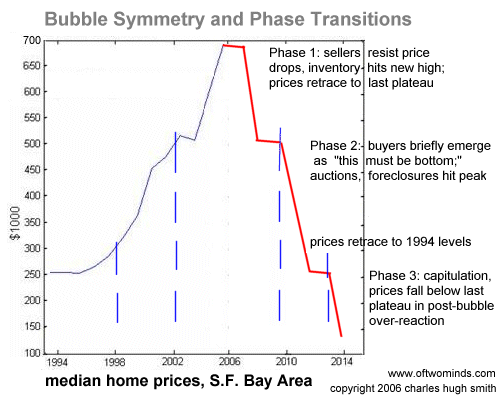
Way back in August 2006, near the top of the housing bubble, I suggested a two-part scenario for the housing bust: it would take eight more years to play out, and the declines would occur in sharp downlegs following a phase-shift model.

Phase Transitions, Symmetry and Post-Bubble Declines (August 2, 2006)

Here is the chart I presented at that time as a possible time model:


A few months later, literally at the top of the housing bubble in early 2007, I suggested that a mere 4% of homeowners defaulting could trigger a collapse of the entire U.S. housing market.

That is pretty much exactly what happened, for when the 4% who couldn't pay their subprime mortgages folded, they took down an exquisitely corrupt and vulnerable banking sector and the FIRE (finance, insurance, real estate) economy which had come to depend on it.

Can 4% of Homeowners Sink the Entire Market? (February 21, 2007)

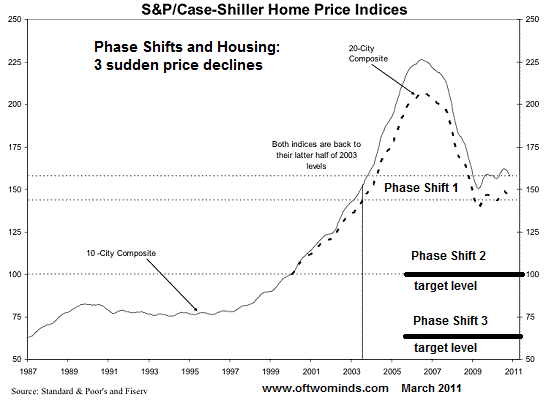
As I noted in Phase Shifts, Stick/Slip and the Demise of Our 'Socialist' Housing Policy (February 26, 2010), the 'recovery' in housing visible in the chart below was entirely the result of a 99% 'socialist' Central State intervention/prop job: the Federal Reserve bought $1.1 trillion of dodgy mortgages to mask the bad debt and keep interest rates low, and the Federal government flooded the housing market with fee money via subsidies and absurdly cheap, central State-guaranteed FHA loans.

Now that this massive Central State intervention has ended, housing sales and values are succumbing to gravity. home sales and prices fall:

The National Association of Realtors said Monday that sales of previously occupied homes fell last month to a seasonally adjusted annual rate of 4.88 million. That's down 9.6 percent from 5.4 million in January. The pace is far below the 6 million homes a year that economists say represents a healthy market.

Nearly 40 percent of the sales last month were either foreclosures or short sales, when the seller accepts less than they owe on the mortgage.

One-third of all sales were purchased in cash - twice the rate from a year ago. In troubled housing markets such as Las Vegas and Miami, cash deals represent about half of sales.

The median sales price fell 5.2 percent to $156,100, the lowest level since April 2002.

Sales of new homes tumbled 16.9% in February from the prior month to a seasonally adjusted annual rate of 250,000, the lowest level since the series began in 1963.

The median price for a new home sold in February fell 13.9% from the prior month to $202,100, the lowest since December 2003.

Here we see the first phase shift decline and the 'recovery,' which is now rolling over.


I submit that the forces acting on price are mutually reinforcing to the point that price will drop rapidly in a second phase shift, with the target noted on the chart: a return to the price levels of 2000.

Once we get into the 2012-14 timeframe, then I expect a third phase shift will drop prices back to 1987 levels. As many observers have noted, bubbles don't retrace to historical averages--they over-correct to extremely low values.

What forces are working to push housing prices to new lows?

1. As I reported on Daily Finance, new mortgage broker compensation rules are about to wipe out independent, small mortgage originators and brokers. Mortgages will probably become harder to come by and more expensive as the 'too big to fail' banks will consolidate their grasp on the mortgage market.

2. Interest rates will rise. Most financial analysts are supremely confident that the Fed can keep interest rates near-zero forever. I suspect their confidence is misplaced. As I discussed yesterday, the Fed has backed itself into a corner, where if it pursues QE3 then it will fire up inflation that will destroy profit margins and household purchasing power. If it ceases to buy U.S. Treasury debt, then interest rates will shoot up.

As interest rates rise, the amount of money home buyers can borrow drops. House prices follow this dynamic.

3. Income for the bottom 90% is stagnant. All the bogus 'housing is now affordable again' charts floating around all base their rosy conclusions on median income, neatly avoiding the reality that the top 10% has garnered the majority of income gains. Factor out the top 10% and you find real incomes have actually declined for the lower 90%.

The same effect is true of the 'wealth effect' powered by the speculative risk trade bubbles in stocks and commodities. These portfolio increases have only enriched the top 10% who own the vast majority of the financial wealth.

So yes, real estate favored by this top 10%--Manhattan, Westwood, San Francisco, etc.-- will hold its own as those benefiting from fat Federal contracts, Wall Street's renewed license to practice piracy, the bubble in lighter-than-air Web 2.0 stocks, etc. try to outbid each other, but for most housing, the support created by demand has just melted like dirty ice on a hot Spring day.

4. There are too many houses and not many buyers. The demographics are this: Baby Boomers are trying to sell to cash out or move, and the impoverished generations behind them cannot afford bubble-era prices. Just because prices have retreated to 2002 levels doesn't mean they're cheap--2002 was already a bubble, as you can see in the chart.

5. The Federal-supported 'recovery' is in trouble, politically and financially. As long as the nation obeys the whip of the Fed and allows it to print $1 trillion to buy Treasury debt every year, then the travesty of a mockery of a sham can continue. But as I noted yesterday, this policy is destroying the dollar and the purchasing power of households. That game cannot run for long without political pushback. Saving the 'too big to fail' banks and the Financial Plutocracy might be Item #1 on the Fed's list, but it ranks decidedly lower on voters' agendas.

6. Every investor who bought with cash because 'this is the bottom' will 1) be underwater and anxious to sell and 2) be out of cash, having bet their capital playing 'catch the falling knife' with real estate valuations. Sorry, cash buyers: the knife is still falling.

"

How to Debug Your Thought Code

How to Debug Your Thought Code: "

Human beings are strong pattern machines. Like any machine, we sometimes need updating and fixing.


I picked up the phrase thought code from a reddit post I read last week. It’s a perfect analogy for how we work. Our brains find patterns. We develop habits easily and break them with only a great deal of effort. This can leave even the stupidest habits ingrained in us far too long. If we don’t debug our internal code, we’ll never change.


Everyone has stupid pieces of code they need to get rid of, but we don’t always know how. This means a ton of wasted time and resources when we could be doing things simply.


In other words, we need to debug our own code– our own thought processes and habits.


Personally, one of my most pointless patterns is that when I save any document, I Cmd-Tab into Firefox so quickly it makes my head spin. It happens without me thinking. Next thing I know, I’m reading news, Twitter, or otherwise wasting my time instead of working.


This simple patterns causes an easy half-hour of slacking and distraction per day.


How do I debug this, or any, program? Easy– I break it. If I cause an error to occur, make the inefficiency evident and startle myself into awareness of it.


I can do this by closing all other programs (so I can’t Cmd-Tab into anything at all), or by shutting off my web connection (with Freedom). This makes me notice what I’m doing and laugh at myself a bit. After many broken patterns like this, the awareness of it becomes stronger, and the habit vanishes.


Another piece of stupid code is my avoidance of certain things on my todo list, such as emails I need to send. I break this, once again, by getting verbose with myself– in other words, literal. I ask myself, out loud, what are you afraid of? This jolts me into realizing that there’s nothing to worry about, which frees me to get it done.


The key to success and efficiency in any program, including your own, is recognizing inefficiencies and fixing them. I believe the first, and most important, step in this is awareness of your own mistakes.


The second– the easy part– is coming up with something that’s slightly better. Iterate this process, and the incremental improvement will keep you moving, progressing, and maybe even happy. But none of that happens without seeing what you are doing.


"

The Market Ticker - Another Voice: US Will Go Bankrupt

The Market Ticker - Another Voice: US Will Go Bankrupt: "

And.....it's gone.

"If we continue down on the path on which the fiscal authorities put us, we will become insolvent, the question is when," Dallas Federal Reserve Bank President Richard Fisher said in a question and answer session after delivering a speech at the University of Frankfurt. "The short-term negotiations are very important, I look at this as a tipping point."

Yep.

$100 billion in spending reductions from pre-planned increase levels when you're spending $1,700 billion more than you are taking in via taxes is not "real action" and do nothing to take us away from that "tipping point." It is in fact mashing the accelerator pedal despite seeing the granite wall in front of us.

The primary problem the Federal Government faces right now is that over the last three years their borrowing has become more than 10% of the economy. The "free stuff" mentality has become not entrenched in our economic mindset it has become essential to keeping us from having to recognize an economic Depression that happened in 2008.

Worse, it's still going on. Remember, economic Depression is a cumulative 10% decline in GDP according to those who practice economics. Well, how are we doing?

Blue line folks. More than 10% of GDP in 2008, 2009 and 2010. Cumulatively this is a roughly 37% GDP decrease that has been masked. The problem is that what we're trying to mask is this:

Since the 1970s we've played this game - take more debt to mask the inability of GDP to fund its own expansion. The 1980 recession led to a monstrous burst in this behavior, encouraged and permitted by The Fed and Federal Government. Everyone breached a sigh of relief when it "worked" in the mid 1980s.

The problem is that this path didn't really work. The 1990s saw even more of this lunacy, and of course we then mashed the pedal to the metal in the 2000s, reaching thirty percent of GDP being added in one single year after subtracting out nominal GDP growth in net debt additions.

This insanity went on for an entire decade without reprieve. All we're doing now is trying to cover the inevitable hangover created by our debauchery through shifting that same behavior to the Federal Government. It won't work because it mathematically can't work - the government by definition can only be a part of the economy, not all of it. This is akin to a house cat attempting to eat a cheetah; this episode is not going to end as Fluffy intends.

The sad fact is that we have built into our economy an enormous amount of false demand. The output is real but the money to pay for it is not. Expansion of the balance sheet, whether it's done by The Federal Reserve, The Federal Government or individual consumers, must be backed by expansion in actual output in excess of input costs. It wasn't for 40 years and really wasn't for the last 30 of them.

The 1930s were bad because during the 1920s we did the same thing. But this time we continued to distort the market not once but twice. When we got the official warning in 2000 in the form of the Nasdaq crash we could have chosen at that instant in time to take our medicine, accept a 10% contraction in GDP and then rebuild from there. The banksters could have been chided and left without the ability to perform more alchemy, with some of them going to prison for their ridiculously-overstated "projections" based on alleged facts they knew were false.

But we didn't do any of that; instead, we took all the restrictions that were left on the financial sector and threw them in the dustbin, and having bailed out Continental Illinois' bondholders when they blew up "investors" were led to believe (proved correct in 2008) that should they provide capital to a bank that used it poorly they would be protected from the possibility of loss. Corruption of the regulatory process left the banksters quite certain they'd not go to jail for claiming their assets were "protected" by devices like Credit Default Swaps even though they were well-aware that the people writing those swaps could not pay. This too was proved correct when AIG, among others, factually could not pay and instead of Goldman (and others) being left with the just and proper loss the government again bailed them out.

There are no serious legislators left in Washington DC. All this talk about "deficit reduction" is a scam and a fraud. The CBO itself believes that the Federal Government will double its net indebtedness by 2020. I will remind everyone that in 2000 the CBO projected that the federal government would have no debt whatsoever by 2010. They may be "independent" of either political party or any branch of government, but the CBO has a long and storied history of being far too optimistic in their projections of fiscal outcomes.

The big lie from Southerland and Miller on the 22nd was the premise that this tsunami of debt was going to be impossible to handle in 2040 or 2060, as they showed in their charts. The reason those two Representatives were lying through their teeth to their constituents in the room is that we will not make it to 2020 on the path we are on today, nor will we get there with these $100 billion ($60 billion ratably) "reductions" after you hand out $400 billion in tax reductions for the same year. In fact, assuming the $60 billion does get passed somehow you've still increased the deficit by $340 billion. Republican claims of "cuts" in the deficit ARE BALD AND INTENTIONAL LIES.

It is for this reason that the claims that "nobody over 50 will have their benefits cut" is an outrageous fraud. The government will not be able to maintain this trajectory. The $100 billion in "cuts" are the starting point for negotiations and anyone who has ever negotiated anything knows that you never get everything you begin your negotiating asking for. If the Republicans demanded $500 billion each and every year from the previous years' spending and accepted $400 billion, maintaining this on a forward basis for four or five years, the market might think the government is serious and accept their path.

But when you start by adding $400 billion to the deficit and then "take back" $100 billion of it? You're a damned pair of liars and you know it.

There are no serious people in Congress dealing with this issue, and that's the beginning and end of the discussion as it exists today. The Government will not get to 2020 before the budget overwhelms financing capacity. Attempting to "print" via The Fed out of this at a rate which will be three times or more what was done in QE2 will lead to $10/gallon gasoline within five years and more than a clean double in the price of food and other energy commodities, which in turn will cause literal impoverishment of 30% of our population, including Senior citizens.

The claim that somehow those over 50 will be "protected", ladies and gentlemen, is a damned lie.

The facts are that the government will not manage to maintain its current trajectory for just nine more years, say much less thirty - which is what is being implied in that "nobody over 50" claim. Federal "gimme" programs, that is, Social Security, Medicare, Medicaid, Unemployment and Welfare consume all of Federal Tax revenues right here, right now, today.

These are facts, and it is time we accept and deal with them.

We can fix Social Security but Medicare and Medicaid cannot be fixed. Unemployment cannot be left alone. All three of those programs must be cut dramatically, and the entire rest of the Federal Budget must be reduced by roughly half.

I'm tired of the lies, frauds and scams, and virtually all of them come from Washington DC and the pestilence that infests it, refusing to tell the truth: There is no solution that can be found when you hand out over $400 billion in additional deficits for the next two years in December, then tell us that $100 billion in "cuts" are going in the correct direction.

You're all a pack of damn liars and frauds - each and every one of you.

"

Wednesday, March 23, 2011

WARREN MOSLER: WHY WE’RE BECOMING THE NEXT JAPAN

WARREN MOSLER: WHY WE’RE BECOMING THE NEXT JAPAN: "

Warren Mosler discusses the debt ceiling, the risks of the deficit, our similarities to Japan, Yen intervention, why the USA needs further tax cuts and why QE2 was destined to fail.


Part 1 – Deficits and the debt ceiling.


Part 2 – Japan’s Yen intervention and its implications.


Part 3 – Why QE2 was destined to fail.


Source: Reuters Insider

"

Guest Post: Investment Legends - “Dollar Collapse Inevitable”

Guest Post: Investment Legends - “Dollar Collapse Inevitable”: "

Submitted by Jeff Clark of Casey Research

What will happen to the U.S. economy and the dollar in the near
term? Will inflation increase dramatically? What is the outlook for
gold, and where should you put your money? BIG GOLD
asked a world-class panel of economists, authors, and investment
advisors what they expect for the future. Caution: strong opinions
ahead...

Jim Rogers is a self-made billionaire, author of the best-sellers Adventure Capitalist and Investment Biker,
and a sought-after financial commentator. He was a co-founder of the
Quantum Fund, a successful hedge fund, and creator of the Rogers
International Commodities Index (RICI).

Bill Bonner is
the president and founder of Agora, Inc., a worldwide publisher of
financial advice and opinions. He is also the author of the
Internet-based Daily Reckoning and a regular columnist in MoneyWeek magazine.

Peter Schiff is CEO of Euro Pacific Precious Metals (www.europacmetals.com) and host of the daily radio show The Peter Schiff Show (www.schiffradio.com). He is the author of the economic parable How an Economy Grows and Why It Crashes and the recent financial bestseller The Little Book of Bull Moves: Updated and Expanded. He’s a frequent guest on CNBC, Fox Business, and is quoted often in print media.

Jeffrey Christian is managing director of CPM Group (www.cpmgroup.com)
and a prominent analyst on precious metals and commodities markets. CPM
Group produces comprehensive yearbooks on gold, silver, and platinum
group metals, and provides a wide range of consulting services. Jeffrey
publishedCommodities Rising, an investors’ guide to commodities, in 2006.

Walter J. 'John' Williams,
private consulting economist and “economic whistleblower,” has been
working with Fortune 500 companies for 30 years. His newsletter Shadow Government Statistics (shadowstats.com) provides in-depth analysis of the government’s “creative” economic reporting practices.

Steve Henningsen
is chief investment strategist and partner at The Wealth Conservancy in
Boulder, CO, assisting clients interested in wealth preservation.
Current assets under management exceed $200 million.

Frank Trotter is
an executive vice president of EverBank and a founding partner of
EverBank.com, a national branchless bank that was acquired by the
current EverBank in 2002. He received an M.B.A. from Washington
University and has over 30 years experience in the banking industry.

Dr. Krassimir Petrov
is an Austrian economist and holds a Ph.D. in economics from Ohio State
University. He was assistant professor in economics at the American
University in Bulgaria, then an associate professor in finance at Prince
Sultan University in Riyadh, Saudi Arabia. He is currently an associate
professor at Ahlia University in Manama, Bahrain. He’s been a
contributing editor for Agora Financial and Casey Research.

Bob Hoye is chief financial strategist of Institutional Advisors and writes Pivotal Events, a weekly market overview. His articles have been published by Barron’s, Financial Post, Financial Times, and National Post.

BIG
GOLD: A lot of economists, including the government, believe the worst
is behind us economically. Do you agree? If not, what should we be on
the lookout for in 2011?

Jim Rogers: It
is better for those getting all the government largesse, but the overall
situation is worse. More currency turmoil. State and local problems,
plus pension problems.

Bill Bonner: None of the
problems that caused the crises in Europe and America have been
resolved. They have been delayed and expanded by more debt and more
money printing and will lead to more and worse crises. Deleveraging
takes time. 2011 will, most likely, be a transition year... not unlike
2010. But the risk is that one of these latent crises will become an
active crisis.

Peter Schiff: To me, it's like
watching someone walk into the same sliding glass door again and again.
Wall Street must know by now that large infusions of liquidity from the
Fed spur present consumption at the expense of investment for the
future. We are an indebted family going out for an expensive meal to
celebrate getting approved for a new credit card. It might feel good (at
the time), but we're still simply delaying the inevitable.

Jeffrey Christian:
We believe the worst is behind us economically, in the short term. The
recession ended in late 2009, and 2010 saw U.S. economic growth in line
with what CPM had expected, but higher than the more pessimistic
consensus had been. In 2011 we expect continued expansion. We think some
economists and observers are too enthusiastic about economic prospects
right now.

For the U.S. in 2011, we are looking for real GDP of
2.5% - 2.8%, inflation to remain low, and for the economy to avoid
deflation. Interest rates are expected to start rising, perhaps
significantly in the second half of 2011. The dollar is expected to be
volatile, rising somewhat against the euro but continuing to weaken
against the Canadian and Australian dollars, the rupee, yuan, rand, and
other currencies.

European sovereign debt issues will continue to
plague financial markets, but market reactions will be less severe than
they were regarding Greece in April 2010.

John Williams: An
intensifying economic downturn – what formally will be viewed as the
second dip of a double-dip depression – already has started to unfold.
The problem with the economy remains structural, where household income
is not growing fast enough to beat inflation, and where debt expansion –
encouraged for many years by the Fed as a way to get around the
economic growth problems inherent from a lack of income growth –
generally is not available, as a result of the systemic solvency crisis.
Accordingly, individual consumers, who account for more than 70% GDP,
do not have the ability, and increasingly lack the willingness, to fuel
the needed growth in consumption on which the U.S. economy is so
dependent.

Steve Henningsen: The governments
worldwide (I don’t pay much attention to economists) want us to believe
that the worst is behind us because the financial system is built upon
the foundation of trust and confidence. Both of these were battered
badly when it was shown that much of the world’s prosperity over the
past few decades was simply a mirage that, once dispersed, left behind
only debt with no means of future production. Now they want us to
believe that they fixed the problem via more debt.

What I will be
watching for this year is sovereign and U.S. municipal debt corpses
floating to the surface sometime in the months ahead.

Frank Trotter: Right
now I have a somewhat dark but not dismal outlook. I think that over
2011, we will continue to experience a Jimmy Carter-style malaise that
combines continuing high unemployment, tentative business investment,
rising prices, low housing numbers when looked at on an absolute basis,
and creeping interest rates.

As a very large mortgage servicer, we
are not seeing significant improvements in payment patterns that would
indicate the worst is fully behind us, and with mortgage rates moving
upward, we see less ability for current mortgage holders to refinance
and reduce payments.

Krassimir Petrov: No, the
worst is yet to come. No structural changes have been made, no problems
have been fixed. Printing money, a.k.a. Quantitative Easing, is a quick
fix that has postponed the problem, yet also made it a lot worse. I
would say that we are still in the early stages of the crisis and have
another 4-8 years to go.

Bob Hoye: The worst of the post-bubble economic adversity is not behind us.

BG:
Price inflation is creeping up, but the enormous amount of money
printing hasn't really hit the system yet. Does that happen in 2011,
further down the road, or not at all?

Jim Rogers: It is happening. The U.S. and CNBC lie about it. Most other countries do not lie and acknowledge it is worsening.

Bill Bonner: Most
likely, substantial consumer price inflation will not show up in
2011. The explosion of money printing is being contained by the bomb
squad of deleveraging. That will probably continue in 2011. But not
forever.

Peter Schiff: 2010 was the year that
China began cutting back its Treasury purchases in favor of gold, hard
assets, and emerging market currencies. The Fed has stepped in as a
major purchaser of Treasuries. This represents a new phase on the path
to dollar collapse, and it will manifest in 2011 in the form of more
"unexplainable" inflation – as we are now seeing in the prices of
everything from corn to gasoline.

Jeffrey Christian:
We are now beginning to see some increases in monetary aggregates,
suggesting that some of the monetary accommodations are beginning to
filter into the economy. We expect this trend to accelerate over the
course of 2011. This will bring some increase in inflation, but we
expect the major manifestation will be through higher U.S. Treasury
interest rates as the Fed and Treasury seek to sell bonds to sterilize
the inflationary implications of the monetary easing and to finance
ongoing massive federal deficits.

John Williams: The
problems of the money creation will become increasingly obvious in
exchange-rate weakness of the U.S. dollar. Related upside pricing
pressure already is being seen on dollar-denominated commodities such as
oil. There is high risk of consumer prices rising rapidly before
year-end 2011, setting the stage for a hyperinflation. The outside date
for the onset of a U.S. hyperinflation is 2014.

Steve Henningsen: My
guess is further down the road, as the deleveraging cycle continues
with deflationary-housing winds in our face and the banks still hoarding
money like my 9-year-old daughter stockpiles American Girl doll
paraphernalia. I still expect inflation to continue in areas such as
energy, bread, circuses, and whatever else provides sustenance to the
Romans – I mean people.

Frank Trotter: Most
research has shown that over time the increase in money supply is not a
short-term economic stimulus, but rather has a moderate effect in the
18- to 36-month range. In addition, this theory contends that a growth
in the monetary base – which is what has happened so far – only
increases economic activity when accompanied by a decent multiplier;
this is not occurring. The real risk is that with rising rates and
continued soft economy, the Fed will feel obliged to continue to QE3,
QE4, and so on, all of which may have a significant inflationary impact.

I am more concerned about general price inflation here in the U.S. and the potential it has to reduce global growth.

Krassimir Petrov:
This is a tough one. I would have thought that price inflation would
have been raging by now, but this is obviously not the case. I have the
feeling that 2011 will be a repeat of early 2008, with commodity prices
(CRB) making new all-time highs. A falling dollar will trigger a rush
into commodities as a hedge against inflation. I am really tempted to
make a totally outrageous forecast that oil could make a run for $200 as
QE3 unleashes another dollar scare, or maybe even a dollar crisis.

Bob Hoye: Massive 'printing' has been widely publicized and is 'in the market.'

BG:
The U.S. dollar ended 2010 about where it started; does it resume its
downtrend in 2011, or are fears about its demise overblown?

Jim Rogers: No, but further down the road.

Bill Bonner: No opinion. But there is more risk in the dollar than potential reward.

Peter Schiff: It's
hard to pinpoint exactly when the dollar will collapse, but it will
take a miracle to avoid that outcome in the near term. It really depends
on when the creditors of the United States realize that they are not
going to get their principal returned to them in real terms, but rather
in grossly devalued dollars. We have already seen the average duration
of U.S. Treasury debt drop below that of Greece. No one wants to buy a
30-year bond with negative real interest rates as far as the eye can
see.

Jeffrey Christian: We expect the dollar to
be volatile against most currencies in 2011, but that its demise has
been prematurely predicted. The dollar may move sideways to slightly
higher against the euro, yen, and pound, while continuing to deteriorate
against the Canadian and Australian dollars, the rupee, yuan, rand, and
other emerging economy currencies.

John Williams: There
remains high risk of a dollar selling panic unfolding in the year
ahead, as the U.S. economy tanks anew, as the Fed continuously expands
its easing, and as dollar holders dump the U.S. currency and
dollar-denominated paper assets. Such would be a precursor to the
inflation problem.

Steve Henningsen: Similar to
my thoughts last year, I still believe the dollar is headed down
long-term, but it could bounce around over the next year. If sovereign
debts become a problem again, like I think they will later this year,
then everyone will go running back to “Mother Dollar” once again for one
last hug before she lies back down on her sickbed.

Frank Trotter: As
the economy waffles and the global investing community's attention is
drawn from one crisis to the next, I expect the U.S. dollar to bounce up
and down in the current range. After that, however, my analysis
suggests that measured by the key factors of fiscal and monetary policy,
combined with a significant trade deficit, the U.S. does not look as
good as our major trading partners, and I thus expect the dollar to
decline, perhaps significantly, in the intermediate term. Big
geopolitical events may accelerate this or create a flight to U.S.
dollar quality, so hold on to your hats.

Krassimir Petrov:
I think the dollar resumes lower. I expect QE3 and QE4 – a
dollar-printing fest that will eventually sink the dollar. Sure, all
fiat currencies are in deep trouble and prone to overprinting, but the
reserve status of the dollar actually makes it more vulnerable now.
Whether the dollar sinks against other currencies is a fool's game not
worth playing. It is like being in the hospital, where all patients are
suffering from cancer, and trying to guess who will feel best at the end
of next year, or trying to guess who will succumb first. That's why it
is so much safer to play the dollar against gold.

Bob Hoye: Fears
of the dollar's demise have been widely discussed and are "in the
market." The dollar, itself, will not be repudiated – just the mavens
that have been "managing" it.

BG: Gold has risen
10 years in a row, so some are calling it a bubble, yet it's roughly
$1,000 below its inflation-adjusted high. What's your outlook for the
metal in 2011?

Jim Rogers: It is hardly a “bubble” when very few own it still. Who knows? Overdue for a correction, but who knows?

Bill Bonner: The
smart money is in gold. It will stay in gold until the bull market that
began 10 years ago finally reaches its peak. It is extremely unlikely
that the top will come in 2011; it's probably years in the future. In
the meantime, gold is bound to have a losing year or two. Don't worry
about it. Buy gold. Be happy.

Peter Schiff: The
funny thing about a bubble is that when it's real, no one can see it.
The same commentators who were blind to the tech bubble, the housing
bubble, and now the Treasury bubble are quick to call gold a bubble. The
truth is that many of them have a personal aversion to gold because
they directly benefit from our fiat money system. Goldman Sachs was paid
100 cents on the dollar in the AIG bailout, which never would have
happened in a gold-based system. It's a lot easier to print a billion
paper dollars than dig up a million ounces of gold.

Gold will
continue to climb in 2011 as the currency war continues and investors
continue to seek stability. Unless there is a major sea change in the
way the U.S. does business, I think the gold trade is a safe one.

Jeffrey Christian:
A price of $1,550 is possible, although given the enormous investor
buying pressure, prices could spike to almost anywhere. After that, we
expect prices to fall back, initially to around $1,340 or $1,380. We
expect gold prices to stay above $1,280 or so for most of 2011, and to
average around $1,369 for the full year.

John Williams: As
the U.S. dollar increasingly is debased, and where gold tends to
preserve the purchasing power of the dollars invested in it, the upside
to gold in the year ahead is open-ended, restricted only by any limits
to the massive downside potential for the U.S. dollar. Any intermittent
gold price volatility, extreme or otherwise, will be short-lived. There
is no bubble – only increasing weakness in the U.S. dollar – with the
gold price fundamentally headed much higher in the years ahead.

Steve Henningsen: I
believe gold will once again prove the bubble-boys wrong and end the
year positive (I have no idea by how much and don’t really care).
However, I think this year will be more volatile and that Gold Bugs
better remain seated on the precious metals express or they might get
squished.

Frank Trotter: I still think that with
price inflation on the rise and big political events occurring, there
may be room to continue to rise. If stock markets take off, then there
will be a reduction in appreciation or even a significant decline, but
based on the factors I mentioned above, I don't see that as highly
likely.

Krassimir Petrov: Gold still has
outstanding fundamentals. I believe that over the course of 2010, the
fundamentals have strengthened significantly: (1) 'No Exit [Strategy]
for Ben' as he unleashed QE2, and will likely unleash QE3, QE4, etc.,
(2) no more central bank selling of gold, (3) more central banks become
buyers of gold, and (4) trial balloons for a global gold-backed
currency.

I have no idea how people could even claim that gold is
in a bubble – barely 1 out of 100 people have any idea about investing
in gold. During the real estate bubble, every second person was involved
in it. Maria "Money Honey" Bartiromo has yet to report from the COMEX
gold pits; gold fund managers and analysts have yet to obtain rock-star
status; and glamorous models are not yet dating the gold guys. Who is
the Henry Blodget [co-host of Tech Ticker] of the gold sector, do we have one yet?

Yes, gold will eventually become a bubble, but that feels 5-8 years away.

Bob Hoye: In 2011, gold's real price will resume its uptrend.

BG: What's your best investment advice for 2011?

Jim Rogers: Buy the rmb [renminbi, the Chinese currency].

Bill Bonner: We
are in a period much like the period following WWI, in which the great
debts and losses of the war had to be reckoned with. It is an era of
great risk. The U.S. faces many of the same challenges faced by Germany
and England after WWI. Like England, it has huge debts. It is a waning
imperial power. And it has the world's reserve currency. And like
Germany, it is attempting to fix its problems by printing more money.
This is not a good time to be long either U.S. stocks or U.S. bonds.

Peter Schiff: Don't
be suckered into the idea that recovery is just around the corner. The
current climate is like living in a hurricane or earthquake zone; it's
important to stay vigilant because you never know when disaster will
strike. Physical gold is the financial equivalent of a flashlight,
first-aid kit, and store of canned goods. It's a basic way to protect
yourself from any eventuality. From there, if you're looking for
returns, there are plenty of foreign markets with strong fundamentals,
as well as commodities that feed those markets.

Investing in the U.S. is now driven largely by force of habit. It's a habit you should resolve to break.

Jeffrey Christian:Do
not invest based on what you believe, but on what you know. Gold is a
market, like other markets. It rises and falls. You probably want to
stay long gold on a long-term basis, but may want to cull the weaker
gold assets from your portfolio in the first quarter, and put some
hedges in place to protect a long-term core long gold position against
the potential of significant price weakness over the next two years or
so. Such a period of weakness would be an excellent time to add to one’s
gold assets.

John Williams: As an economist, I
look for the U.S. dollar ultimately to lose virtually all of its current
purchasing power. Accordingly, for those living in a U.S.
dollar-denominated world, it would make sense to move to preserve wealth
and assets over the long-term. Physical gold is a primary hedge (as is
silver). Holding some stronger currencies outside the U.S. dollar, as
well as having some assets outside the United States, also may make
sense.

Steve Henningsen: Dramamine (for volatile
markets), a stash of cash (for potential investment opportunities), and
move some of your assets offshore if you haven’t already.

Frank Trotter: My
advice is first to look at the other side of your balance sheet – the
liability and risk equation – before seeking out absolute gains. What
are your goals, what resources do you already have to meet those goals,
and what events (health, income stream, upheavals) might impact these
risks? Place some assets to hedge these risks directly, then look to
diversify globally into markets with higher growth potential than we see
here at home, and that may balance your global purchasing power risk.
Almost like a religion, we have had the phrase "Stocks are the only
legitimate hedge against inflation" beaten into our heads. I say, look
at assets that define inflation like commodities and currencies and
evaluate where these fit into your risk portfolio.

Krassimir Petrov:
Last year I recommended silver, and I would stick to silver again,
despite the phenomenal run in 2010. Then it gets tricky. I usually don't
recommend diversification, but now I would again recommend a broad
portfolio of commodities. Investing in 2011 should be easy: stay out of
real estate, out of bonds, out of fiat currencies, and out of stocks;
stay fully invested in commodities, overweight gold and silver.

What
to watch in 2011: stay focused on the sovereign debt crisis and bond
yields. Spiking yields will trigger the next stage of the crisis.

Bob Hoye: Once past the early part of 2011, the best returns are likely to be obtained from the junior gold exploration sector.

[These
world-class experts are right to bank on gold and silver – because the
U.S. dollar keeps losing more and more of its value. Watch this eye-opening video on how China and Russia are plotting to dump the dollar… why you should be worried… and what to do about it.]

"