What If The Fed Has It All Wrong?: I wrote an exclusive article for Seeking Alpha in which I expand on the following points:
Quantitative Easing-induced wealth effects may be wishful thinking;
Earnings are the primary drivers for equities and they have peaked;
QE3 could be highly counterproductive if commodity prices [...]
Tuesday, September 25, 2012
Tuesday, September 11, 2012
Tuesday, September 04, 2012
Who Do You Blame for the Woes of the Middle-Class?
Who Do You Blame for the Woes of the Middle-Class?: The Pew Research center ponders The Lost Decade of the Middle Class.
Median net worth is back to a level first seen in the 1980s. By that measure, the US has had three lost decades. Wow.
62% Blame Politicians, Only 8% Blame Themselves
Note that 62% blame politicians and 54% blame financial institutions, but only 8% blame themselves.
Five Questions
Two Bonus Questions
Mike "Mish" Shedlock
http://globaleconomicanalysis.blogspot.com
Click Here To Scroll Thru My Recent Post List
Since 2000, the middle class has shrunk in size, fallen backward in income and wealth, and shed some—but by no means all—of its characteristic faith in the future.Three Lost Decades!
These stark assessments are based on findings from a new nationally representative Pew Research Center survey that includes 1,287 adults who describe themselves as middle class, supplemented by the Center’s analysis of data from the U.S. Census Bureau and Federal Reserve Board of Governors.
Median Income
Median Net Worth
Fully 85% of self-described middle-class adults say it is more difficult now than it was a decade ago for middle-class people to maintain their standard of living. Of those who feel this way, 62% say “a lot” of the blame lies with Congress, while 54% say the same about banks and financial institutions, 47% about large corporations, 44% about the Bush administration, 39% about foreign competition and 34% about the Obama administration. Just 8% blame the middle class itself a lot.
Who Is To Blame?


Median net worth is back to a level first seen in the 1980s. By that measure, the US has had three lost decades. Wow.
62% Blame Politicians, Only 8% Blame Themselves
Note that 62% blame politicians and 54% blame financial institutions, but only 8% blame themselves.
Five Questions
- Did banks force people to take out loans they could not pay back, or did people do so voluntarily?
- Who elects congress?
- Do people make enough effort to understand interest rates, debt, the economic policies of politicians, exponential math and its implications, the untenable nature of public union pension plans and promises?
- Do a significant number of people (if not the majority) get their economic views (assuming they have any economic views) from The View, Oprah, The Talk, or CNBC?
- Why did PEW leave off the Fed and Fractional Reserve Lending from the list of answers?
Two Bonus Questions
- Would the majority of respondents know anything at all about the Fed and Fractional Reserve lending had the PEW listed those options?
- Who is really to blame for what is happening?
Mike "Mish" Shedlock
http://globaleconomicanalysis.blogspot.com
Click Here To Scroll Thru My Recent Post List
Mike "Mish" Shedlock is a registered investment advisor representative for SitkaPacific Capital Management. Sitka Pacific is an asset management firm whose goal is strong performance and low volatility, regardless of market direction.
Visit http://www.sitkapacific.com/account_management.html to learn more about wealth management and capital preservation strategies of Sitka Pacific.
Visit http://www.sitkapacific.com/account_management.html to learn more about wealth management and capital preservation strategies of Sitka Pacific.

Saturday, September 01, 2012
Volatility Analogy
Volatility Analogy:
Today Heidi Moore interviewed me for NPR Marketplace. I won’t give away what it is about, but I will tell you two things:
Imagine you are driving down a well-engineered smooth road with gradual turns, modest traffic, and no bad weather, and you are going 60 miles per hour. This is easy. There is no volatility here. That is what an average retail investor hopes for, and rarely gets.
Now consider a road that is not so smooth, with significant and frequent curves, significant traffic, and now and then it is raining hard. That is a difficult situation. This is similar to what the market is normally like, with all of the volatility (high variation of results). Maybe you can’t do 60 MPH in that environment, but something less. Those who recognize risk must run at a slower speed or risk accidents.
Now think of someone without special skills who dares to drive the easy road at 100 MPH. He might not think it so hard, and might think he is quite a driver doing so. So it was for equity investors in the ’80s and ’90s; conditions were uniquely favorable, and average investors thought they were hot stuff.
Now think of someone without special skills attempting to do the hard conditions at 100 MPH on average. Odds are they wipe out, or even die. You can’t fight physics, or can you?
Okay, now think of a highly trained driver with a special car that is able to handle the hard conditions, and can do it at 100 MPH on average, most of the time. It doesn’t work all of the time, because there are things no one can catch — extra slipperiness, a bump in a particularly bad place that leads to an overturned car.
Finally, think of the trained driver with special car told he must average 150 MPH over the hard conditions course once. He dies on the first try, destroying the car. Several other trained drivers try with identical cars. They all die, and the cars are destroyed. Eventually, you can’t get anyone to try the hard conditions course at 150 MPH.
-=-=-=-==–=-=-==–=-=-=-=-=-=-=-=-=-=-=-=-=-=-=
In my analogy, the difference between the hard and easy course is volatility: how rough/variable are conditions. Leverage is represented by speed. Any course can be completed, but there is a maximum speed for which a course can be completed without disaster. No surprise that those who are overly aggressive in investing frequently fail.
Now for the final tweak: imagine that you have no map for the hard course, it is new to you, no GPS, nothing to aid you in the driving. That is what the markets are like. As I often say, the markets always have a new way to make a fool out of you. How fast could you go? How fast could the trained driver with a special car go?
This is why I urge caution in investing and avoiding leverage. Investing is tough enough without trying to earn something beyond what the market can bear. I encourage safety first, after that, look for best advantage.
Today Heidi Moore interviewed me for NPR Marketplace. I won’t give away what it is about, but I will tell you two things:
- If I am on Marketplace, it will be on Friday or Tuesday.
- There was a point in the interview where she stumped me. I’m usually pretty able to think on my feet, but when she asked me “Volatilty: can you explain that in language that a teenager could understand?” I choked up, did my best on short notice, and gave what I later viewed as a lame explanation, but as I said it, my heart sank, because I realized I was not clarifying anything.
Imagine you are driving down a well-engineered smooth road with gradual turns, modest traffic, and no bad weather, and you are going 60 miles per hour. This is easy. There is no volatility here. That is what an average retail investor hopes for, and rarely gets.
Now consider a road that is not so smooth, with significant and frequent curves, significant traffic, and now and then it is raining hard. That is a difficult situation. This is similar to what the market is normally like, with all of the volatility (high variation of results). Maybe you can’t do 60 MPH in that environment, but something less. Those who recognize risk must run at a slower speed or risk accidents.
Now think of someone without special skills who dares to drive the easy road at 100 MPH. He might not think it so hard, and might think he is quite a driver doing so. So it was for equity investors in the ’80s and ’90s; conditions were uniquely favorable, and average investors thought they were hot stuff.
Now think of someone without special skills attempting to do the hard conditions at 100 MPH on average. Odds are they wipe out, or even die. You can’t fight physics, or can you?
Okay, now think of a highly trained driver with a special car that is able to handle the hard conditions, and can do it at 100 MPH on average, most of the time. It doesn’t work all of the time, because there are things no one can catch — extra slipperiness, a bump in a particularly bad place that leads to an overturned car.
Finally, think of the trained driver with special car told he must average 150 MPH over the hard conditions course once. He dies on the first try, destroying the car. Several other trained drivers try with identical cars. They all die, and the cars are destroyed. Eventually, you can’t get anyone to try the hard conditions course at 150 MPH.
-=-=-=-==–=-=-==–=-=-=-=-=-=-=-=-=-=-=-=-=-=-=
In my analogy, the difference between the hard and easy course is volatility: how rough/variable are conditions. Leverage is represented by speed. Any course can be completed, but there is a maximum speed for which a course can be completed without disaster. No surprise that those who are overly aggressive in investing frequently fail.
Now for the final tweak: imagine that you have no map for the hard course, it is new to you, no GPS, nothing to aid you in the driving. That is what the markets are like. As I often say, the markets always have a new way to make a fool out of you. How fast could you go? How fast could the trained driver with a special car go?
This is why I urge caution in investing and avoiding leverage. Investing is tough enough without trying to earn something beyond what the market can bear. I encourage safety first, after that, look for best advantage.
Sunday, August 26, 2012
How Warren Buffett is Different from Most Investors, Part 1
How Warren Buffett is Different from Most Investors, Part 1:
There was an academic article published recently on the investing of Warren Buffett. Afterward, I thought I saw a few articles reflecting on it, but here is the only one I see now: There’s Warren Buffett — and then there’s the rest of us.
Buffett is different, because he grew as an investor and as a businessman, and usually made the right moves over a 50+ year career. When you don’t have a lot of assets, and few people are doing value investing, you can do amazing things with special situations, and being an activist investor. In 1967, Buffett had control of a textile company named Berkshire Hathaway, when he used the resources of the company to purchase some smallish P&C insurance companies, National Indemnity and National Fire and Marine Insurance.
This brings up the first way that Buffett is different than most investors. He understands and invests in a complex industry, P&C insurance. He begins to realize that it can be used as a platform for greater investing. As he sees that potential, he buys half of GEICO in the 70s, before buying the whole company in 1994.
This brings up the second way that Buffett is different than most investors: Buffett was willing to buy whole companies, not replace management for the most part, and operate them. Buffett limited himself to being the wholly-owned company’s board, asking questions on management competence, and redirecting free cash flow for the greater good of Berkshire Hathaway.
That brings me to the third way in which Buffett is different than most investors: He analyzes cash flow streams from investments, and buys shares in companies, or the whole company when they offer a reliable high prospective free cash flow yield. And it brings me to the fourth way Warren Buffett is different than most investors: Buffett does not diversify, particularly in the early years. He plays for best advantage. Buffett views investing through the lens of compounding cash flows, and does not pay much attention to the market as a whole.
In my opinion, it is a worthy use of time (but don’t neglect your family) to read through the annual letters of Berkshire Hathaway. If you do that, you will get a sense of a clever businessman who would invest for best advantage. His tactics shifted over time, but he was always looking to compound free cash flows at the best possible rate.
I’m going to hit the publish button now, but I will finish this in part 2.
There was an academic article published recently on the investing of Warren Buffett. Afterward, I thought I saw a few articles reflecting on it, but here is the only one I see now: There’s Warren Buffett — and then there’s the rest of us.
Buffett is different, because he grew as an investor and as a businessman, and usually made the right moves over a 50+ year career. When you don’t have a lot of assets, and few people are doing value investing, you can do amazing things with special situations, and being an activist investor. In 1967, Buffett had control of a textile company named Berkshire Hathaway, when he used the resources of the company to purchase some smallish P&C insurance companies, National Indemnity and National Fire and Marine Insurance.
This brings up the first way that Buffett is different than most investors. He understands and invests in a complex industry, P&C insurance. He begins to realize that it can be used as a platform for greater investing. As he sees that potential, he buys half of GEICO in the 70s, before buying the whole company in 1994.
This brings up the second way that Buffett is different than most investors: Buffett was willing to buy whole companies, not replace management for the most part, and operate them. Buffett limited himself to being the wholly-owned company’s board, asking questions on management competence, and redirecting free cash flow for the greater good of Berkshire Hathaway.
That brings me to the third way in which Buffett is different than most investors: He analyzes cash flow streams from investments, and buys shares in companies, or the whole company when they offer a reliable high prospective free cash flow yield. And it brings me to the fourth way Warren Buffett is different than most investors: Buffett does not diversify, particularly in the early years. He plays for best advantage. Buffett views investing through the lens of compounding cash flows, and does not pay much attention to the market as a whole.
In my opinion, it is a worthy use of time (but don’t neglect your family) to read through the annual letters of Berkshire Hathaway. If you do that, you will get a sense of a clever businessman who would invest for best advantage. His tactics shifted over time, but he was always looking to compound free cash flows at the best possible rate.
I’m going to hit the publish button now, but I will finish this in part 2.
Saturday, August 18, 2012
The Slowing De-leveraging….
The Slowing De-leveraging….:
I’ve long predicted that the balance sheet recession was likely to come to an end somewhere around 2013/2014 and it looks like the de-leveraging process in the USA has certainly slowed. This excellent chart from Morgan Stanley (via Joe W) shows how the de-leveraging has improved over the years. Unfortunately, we’re not quite at a point where the public sector can hand off the baton yet. We still have some work to do so we’re likely looking at something closer to a 2014 hand-off of the baton. Of course, that’s assuming the fiscal cliff doesn’t torpedo the private sector recovery right when it looks like it’s starting to catch its footing….

I’ve long predicted that the balance sheet recession was likely to come to an end somewhere around 2013/2014 and it looks like the de-leveraging process in the USA has certainly slowed. This excellent chart from Morgan Stanley (via Joe W) shows how the de-leveraging has improved over the years. Unfortunately, we’re not quite at a point where the public sector can hand off the baton yet. We still have some work to do so we’re likely looking at something closer to a 2014 hand-off of the baton. Of course, that’s assuming the fiscal cliff doesn’t torpedo the private sector recovery right when it looks like it’s starting to catch its footing….
Source: Morgan Stanley via Joe Weisenthal
Monday, August 13, 2012
Gary Shilling: US in Recession Now or Within 3 Months, Deleveraging Will Take 5-7 More Years
Gary Shilling: US in Recession Now or Within 3 Months, Deleveraging Will Take 5-7 More Years: In a Daily Ticker Interview with Henry Blodget, economist Gary Shilling makes the case the US is already in recession.
On June 21, I made the case 12 Reasons US Recession Has Arrived (Or Will Shortly)
On July 11, I wrote Case for US and Global Recession Right Here, Right Now; Recognizing the Limits of Madness; Permabears?
More QE is Pointless
While everyone is looking for another round of QE, on August 1, I explained Another Round of QE is Pointless.
Shilling thinks the recession started in the second quarter. Obviously, I agree.
It will be interesting to see when and where the NBER places it.
Mike "Mish" Shedlock
http://globaleconomicanalysis.blogspot.com
Click Here To Scroll Thru My Recent Post List
"We've had three consecutive months of declines in retail sales," says Shilling, president of A. Shilling & Co., an economic research and forecasting firm. "That's happened 29 times since they started collecting the data in 1947, and in 27 of the 29 we were either in a recession or within three months of it."Case for Recession
Shilling expects this recession will last about a year and shave about 3.5% from growth from peak to trough.
This time is different, says Shilling "because a lot of things that normally go down in a recession are already there, like housing." And policies that normally help revive the economy are absent. The Fed can't cut interest rates because they're already near zero and the housing market won't be a catalyst for growth, Shilling says.
Before the last presidential election Shilling said that whoever got elected then wouldn't get re-elected because the economy would still be weak with high unemployment.
Now Shilling says he'd like to see one party in control in Washington because it increases the odds of cuts for entitlements and could help "restore confidence in Washington." But even then he says it will take five to seven years to complete the deleveraging that's already underway before the economy recovers.
On June 21, I made the case 12 Reasons US Recession Has Arrived (Or Will Shortly)
On July 11, I wrote Case for US and Global Recession Right Here, Right Now; Recognizing the Limits of Madness; Permabears?
More QE is Pointless
While everyone is looking for another round of QE, on August 1, I explained Another Round of QE is Pointless.
Would Another Round of QE Help?Timing the Recession
Everyone is looking for the Fed to do something.
I have to ask what good could it possibly do? Yield on the 10-year
treasury is about 1.5%. Would it make any difference to businesses if it
was 1.25% or even 1%?
I suggest additional monetary stimulus would not do anything to spur job
creation and it would continue to punish those on fixed incomes.
An additional round of QE could ignite a further rally in equities
(already in bubble land). However, one of these QE moves by the Fed will
blow sky high, and with equities priced beyond perfection, the next
round of QE may be the one.
Shilling thinks the recession started in the second quarter. Obviously, I agree.
It will be interesting to see when and where the NBER places it.
Mike "Mish" Shedlock
http://globaleconomicanalysis.blogspot.com
Click Here To Scroll Thru My Recent Post List
Mike "Mish" Shedlock is a registered investment advisor representative for SitkaPacific Capital Management. Sitka Pacific is an asset management firm whose goal is strong performance and low volatility, regardless of market direction.
Visit http://www.sitkapacific.com/account_management.html to learn more about wealth management and capital preservation strategies of Sitka Pacific.
Visit http://www.sitkapacific.com/account_management.html to learn more about wealth management and capital preservation strategies of Sitka Pacific.
Tuesday, August 07, 2012
Guest Post: While All Eyes Are On Europe, Japan Circles A Black Hole
Guest Post: While All Eyes Are On Europe, Japan Circles A Black Hole:
Submitted by Charles Hugh-Smith of OfTwoMinds blog,
While all eyes are on the absurdist tragicomedy playing out in Europe, Japan is quietly circling a financial black hole as its export economy is destroyed by its strong currency and the global recession.
There is a terrible irony in export-dependent nations being viewed as "safe havens." Their safe haven status pushes their currencies higher, which then crushes their export sector, which then weakens their entire economy and stability, undermining the very factors that created their safe haven status.
As long as Germany stays within the Eurozone, Japan is the primary example of this dynamic. Should Germany leave the euro and return to its own currency, it too will begin orbiting the financial black hole of declining exports driven by a strengthening currency in a global recession.
Economies that are less reliant on exports are much less exposed to the consequences of a strengthening currency.
We can lay out the dynamic of Japan's currency and export-dependent economy thusly:
1. Export-dependent economies such as Japan, China and Germany rely on strong exports to sustain their employment and growth.
2. This means they must maintain positive current accounts (trade surpluses).
3. As their currencies strengthen, their exports become less competitive globally.
4. Export-dependent economies must pursue strategies to keep their currencies aligned with their buyers, the importing nations.
5. Germany has done so via the eurozone, which aligned its largest import market, Europe, with its own currency.
6. China has done so by pegging the renminbi (yuan) to the U.S. dollar and restricting foreign exchange (i.e. not allowing a free-floating renminbi).
7. Japan has neither of these advantages, and must intervene in the FX markets by buying and selling yen and dollars.
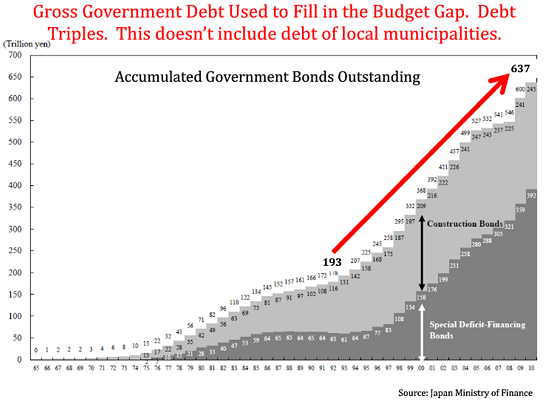
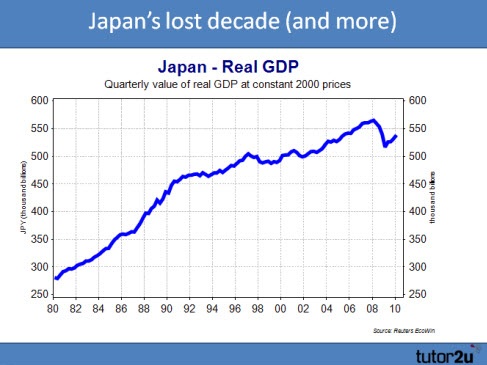
8. Despite its well-known debt problems (see chart below), Japan retains a massive and diverse industrial base, a current-account surplus (or modest deficit with its nuclear power plants largely offline) and large overseas assets.
9. These assets, plus its homogeneous culture, makes Japan an island of stability in an increasingly unstable global economy.
10. For these reasons, the yen is considered a "safe haven" currency and yen-denominated bonds as "safe haven" liquid investments.
11. As demand for yen rises, the currency strengthens, weakening the competitiveness of Japanese exports.
12. The "safe haven" status of the yen ends up hurting the Japanese economy's primary engine, exports.
13. The stronger yen ends up weakening the very attributes that make the yen and Japanese bonds "safe havens."
14. As the global economy slides into recession, exports decline sharply under the double-whammy of falling demand and a rising currency.
Ironic, to say the least.

Submitted by Charles Hugh-Smith of OfTwoMinds blog,
While all eyes are on the absurdist tragicomedy playing out in Europe, Japan is quietly circling a financial black hole as its export economy is destroyed by its strong currency and the global recession.
There is a terrible irony in export-dependent nations being viewed as "safe havens." Their safe haven status pushes their currencies higher, which then crushes their export sector, which then weakens their entire economy and stability, undermining the very factors that created their safe haven status.
As long as Germany stays within the Eurozone, Japan is the primary example of this dynamic. Should Germany leave the euro and return to its own currency, it too will begin orbiting the financial black hole of declining exports driven by a strengthening currency in a global recession.
Economies that are less reliant on exports are much less exposed to the consequences of a strengthening currency.
We can lay out the dynamic of Japan's currency and export-dependent economy thusly:
1. Export-dependent economies such as Japan, China and Germany rely on strong exports to sustain their employment and growth.
2. This means they must maintain positive current accounts (trade surpluses).
3. As their currencies strengthen, their exports become less competitive globally.
4. Export-dependent economies must pursue strategies to keep their currencies aligned with their buyers, the importing nations.
5. Germany has done so via the eurozone, which aligned its largest import market, Europe, with its own currency.
6. China has done so by pegging the renminbi (yuan) to the U.S. dollar and restricting foreign exchange (i.e. not allowing a free-floating renminbi).
7. Japan has neither of these advantages, and must intervene in the FX markets by buying and selling yen and dollars.
8. Despite its well-known debt problems (see chart below), Japan retains a massive and diverse industrial base, a current-account surplus (or modest deficit with its nuclear power plants largely offline) and large overseas assets.
9. These assets, plus its homogeneous culture, makes Japan an island of stability in an increasingly unstable global economy.
10. For these reasons, the yen is considered a "safe haven" currency and yen-denominated bonds as "safe haven" liquid investments.
11. As demand for yen rises, the currency strengthens, weakening the competitiveness of Japanese exports.
12. The "safe haven" status of the yen ends up hurting the Japanese economy's primary engine, exports.
13. The stronger yen ends up weakening the very attributes that make the yen and Japanese bonds "safe havens."
14. As the global economy slides into recession, exports decline sharply under the double-whammy of falling demand and a rising currency.
Ironic, to say the least.
Monday, July 30, 2012
The Market Ticker - Capital Account with Doug Casey
The Market Ticker - Capital Account with Doug Casey:
More good financial journalism -- another "must see" from the fine folks at Capital Account.
https://www.youtube.com/watch?v=fbyF_17GTNA
More good financial journalism -- another "must see" from the fine folks at Capital Account.
https://www.youtube.com/watch?v=fbyF_17GTNA
Sunday, July 29, 2012
How Much More Does The Bear Market Have To Go?
How Much More Does The Bear Market Have To Go?:
The secular bear market that the US has been caught in for a better part of the last decade will end. Eventually. The only question is when. Last week we reported that the bulk of market gains year to date, has been driven exclusively by PE multiple expansion, which is to be expected: EPS forecasts for the end of 2012 are now the lowest they have been since the beginning of the year. Yet while such sharp, sudden and short and bear-market rallies, exclusively on the back of the global central banks, are to be expected, the bigger question is how much more of a secular decline in PE multiples is to be expected before the bear market ends and a new bull market can begin. As the following chart from Crestmont Research shows there is quite a bit more to go, even with Fed assistance (or rather, because of it, and its forced rejection of reaching a fair clearing price sooner rather than later), before the bear market is officially over. Just over 50% more. To the downside.
How the Bear Market declines have looked in perspective, and where we ultimately have to go before all the artifical supports are cleared out:

And the Bull Markets preceding them...

h/t Things That Make you go Hmmm

The secular bear market that the US has been caught in for a better part of the last decade will end. Eventually. The only question is when. Last week we reported that the bulk of market gains year to date, has been driven exclusively by PE multiple expansion, which is to be expected: EPS forecasts for the end of 2012 are now the lowest they have been since the beginning of the year. Yet while such sharp, sudden and short and bear-market rallies, exclusively on the back of the global central banks, are to be expected, the bigger question is how much more of a secular decline in PE multiples is to be expected before the bear market ends and a new bull market can begin. As the following chart from Crestmont Research shows there is quite a bit more to go, even with Fed assistance (or rather, because of it, and its forced rejection of reaching a fair clearing price sooner rather than later), before the bear market is officially over. Just over 50% more. To the downside.
How the Bear Market declines have looked in perspective, and where we ultimately have to go before all the artifical supports are cleared out:

And the Bull Markets preceding them...

h/t Things That Make you go Hmmm
Thursday, July 26, 2012
Kyle Bass Vindication Imminent? Largest Japanese Pension Fund Begins To Sell JGBs
Kyle Bass Vindication Imminent? Largest Japanese Pension Fund Begins To Sell JGBs:
Sayonara internal funding. In what we suspect will become a major issue (and warned in April of last year), Bloomberg reports that Japan’s public pension fund, the world’s largest, said it has been selling domestic government bonds as the number of people eligible for retirement payments increases. "Payouts are getting bigger than insurance revenue, so we need to sell Japanese government bonds to raise cash." It would appear the Ponzi has reached it's Tipping Point. Japan’s population is aging, and baby boomers born in the wake of World War II are beginning to reach 65 and eligible for pensions. That’s putting GPIF under pressure to sell JGBs so it can cover the increase in payouts.
The fund needs to raise about 8.87 trillion yen this fiscal year. GPIF is historically one of the biggest buyers of Japanese debt and held 71.9 trillion yen, or 63 percent of its assets, in domestic bonds as of March.
This leaves the biggest question "to whom will the pension fund sell?" After all it is all marginal and everyone just front-runs the biggest players (Governments and their Central-Bank caring internal funds). Now that the pensions funds are out, there is no more incentive to frontrun them - a la The Fed - which is summed up by the fund's manager "There isn’t much value in short-term notes as the BOJ’s massive asset purchases have made their yields extremely low."
From our April 2011 thoughts:
and from SocGen's Dylan Grice 2010 views (full presentation here):
And As Kyle Bass has questioned numerous times, will 2010 be the beginning of the end of flawed Keynesian economics?

Sayonara internal funding. In what we suspect will become a major issue (and warned in April of last year), Bloomberg reports that Japan’s public pension fund, the world’s largest, said it has been selling domestic government bonds as the number of people eligible for retirement payments increases. "Payouts are getting bigger than insurance revenue, so we need to sell Japanese government bonds to raise cash." It would appear the Ponzi has reached it's Tipping Point. Japan’s population is aging, and baby boomers born in the wake of World War II are beginning to reach 65 and eligible for pensions. That’s putting GPIF under pressure to sell JGBs so it can cover the increase in payouts.
The fund needs to raise about 8.87 trillion yen this fiscal year. GPIF is historically one of the biggest buyers of Japanese debt and held 71.9 trillion yen, or 63 percent of its assets, in domestic bonds as of March.
This leaves the biggest question "to whom will the pension fund sell?" After all it is all marginal and everyone just front-runs the biggest players (Governments and their Central-Bank caring internal funds). Now that the pensions funds are out, there is no more incentive to frontrun them - a la The Fed - which is summed up by the fund's manager "There isn’t much value in short-term notes as the BOJ’s massive asset purchases have made their yields extremely low."
From our April 2011 thoughts:
In the world of bonds, few things have perplexed investors as much as the ridiculously low (and going lower) rates of Japanese Government Bonds (JGBs), at last check yielding 1.22%. Granted "deflation" in Japan has long been quoted as the key driver for the ongoing decline in real and nominal rates, but in practical market terms it was always the fact that there was a buyer of first and last resort, usually this being either Japanese citizens directly or their proxy, the Japanese Government Pension Investment Fund (GPIF) that kept yields in check and sliding.
and from SocGen's Dylan Grice 2010 views (full presentation here):
This is far from just a JGB market problem. As Japan's retirees age and run down their wealth, Japan's policymakers will be forced to sell assets, including US Treasuries currently worth $750bn, or Y70 trillion "eight months" worth of domestic financing. At nearly 10% of the outstanding US Treasury stock, this might well precipitate other government funding crises (bearing in mind that the Japanese model is the argument buttressing confidence in Western government bonds in the face of deteriorating fiscal conditions). At the very least I'd expect it to trigger an international bond market rout scary enough to spook all other asset classes.
And As Kyle Bass has questioned numerous times, will 2010 be the beginning of the end of flawed Keynesian economics?
(h/t Brian)Maybe Japan's will be the crisis that wakes up the rest of the world and triggers some tough decisions on world-wide debt loads. Or maybe not - maybe the Greeks will beat them to it? or the Irish or the UK, or the US? Like banks in 2007, developed market governments today rely on sustained capital markets more than any time in their history. What if they shut?
Wednesday, July 25, 2012
David Stockman: "The Capital Markets Are Simply A Branch Casino Of The Central Bank"
David Stockman: "The Capital Markets Are Simply A Branch Casino Of The Central Bank":
A selected excerpt by David Stockman from his just released interview with Alex Daley of Casey Research:
The New Economic Collapse Video: It makes uncomfortable but urgent viewing.
When Casey Research Chief Technology Investment Analyst Alex Daley met former Reagan Budget Director David Stockman to talk about the economy and where he sees it leading taxpayers investors and savers in the near future, he got some very intriguing insights from a man who served right at the heart of the US federal government.
True, some if it makes for uncomfortable watching, but the message is critical if you want to keep your assets safe in what David calls calls "the great unwind."
Watch the video and secure your money.
Full Transcript:
Interviewed by Alex Daley, Chief Technology Investment Strategist, Casey Research
Alex Daley: Hello. I'm Alex Daley. Welcome to another edition of Conversations with Casey. Today our guest is former Reagan Budget Director and Congressman David Stockman. Welcome to the show, David.
David Stockman: Glad to be here.
Alex: So we're here in Florida talking at the Recovery Reality Check Casey Summit. What do you think: is the United States economy on the road to recovery?
David: I don't think we are at the beginning of the recovery. I think we are at the end of a disastrous debt supercycle that has gone on for the last thirty or forty years, really. It started when Nixon defaulted on our obligations under Bretton Woods and closed the gold window. Incrementally, year after year since then, we have been going in a direction of extremely unsound money, of massive borrowing in both the private and the public sector. We now have an economy that is saturated with debt: $54 trillion or $53 trillion – 3.5 times the GDP – way off the charts from where it was for a hundred years prior to the beginning of this. The idea that somehow all of that debt is irrelevant, as the Keynesians would tell us, is fundamentally wrong – and the reason why the economy can't get up off the mat.
We're doing all the wrong things. We're adding to the problem, not subtracting. We are not allowing the debt to be worked down and liquidated. We're not asking people to save more and consume less, which is what we really need to do. And so therefore I think policy is just making it worse, and any day now we will have another recurrence of the kind of economic crisis we had a few years ago.
Alex: You paint a very stark picture, but if people just stop spending, start saving, won't companies like Apple see their earnings hurt? Won't the stock market then start to tumble, people's net worth fall? Isn't that a negative cycle that feeds on itself?
David: Sure it does, but you can't live beyond your means because it's pleasant. It's not sustainable. Clearly the level of debt that we have is not sustainable. We have a whole generation – the Baby Boom – that's about ready to retire, and they have no retirement savings. We have a federal government that is bankrupt, literally. Its [debt is] $16 trillion and growing by a trillion a year. Something's going to give. We can't pay for all these entitlements. There won't be the revenue generation in the economy to do it.
So as a result of that, we are deluding ourselves if we think we can just continue to spend. Look at the GDP that came out in the first quarter of this year. It was only 2.2%. Most of it was personal consumption expenditure, and half of that was due to a drawdown of the savings rate, not because the economy was earning more income or generating more real output. It was because of a drawdown of savings. That is exactly the wrong way to go – an indication of how severe the crisis is going to be.
I'm not saying the economy should stop spending entirely. I'm only saying you can't save 3% of GDP and spend 97% if you are going to get out of this fix. As the savings rate goes up both in the public sector (which means reduction of spending and the deficit) and the household sector (to seriously reduce debt burden, which has not really happened) we are going to, on the margin, spend less, save more. It will slow down the economy. It will undermine profits, I agree. But profits today are way overstated. They're based on a debt-bloated economy that isn't sustainable.
Alex: So we can only live beyond our means for so long, as any family knows.
David: Yes.
Alex: Now, the government can reduce its expenses at any time by simply reducing spending, and it can reduce debt if it brings in more tax revenue. That's austerity – I think that's how they refer to it. But won't austerity cause massive joblessness? Won't there be millions more people in this country not receiving a paycheck?
David: Yes, but the critique, the clamoring and clattering that you hear from the Keynesians (or even mainstream media, which is pretty clueless economically) that austerity is bad forgets the fact that austerity isn't an elective course. Austerity is something that happens to you when you're broke. And yes, it is painful and spending will go down and unemployment will go up and incomes will be impaired, but that is a consequence of the excess debt creation that we've had for the last thirty years. So austerity is what happens when you break the rules.
And somehow we have this debate going on. They're making a mistake. They chose the wrong strategy. Do you think Greece chose the wrong strategy with austerity? No. No one would lend them money. That's why they ended up in the place they were. Do you think that Spain today is teetering on the brink because they said, "Oh, wouldn't it be a good idea to have austerity?" No, they had a gun to their head. They were forced to do this because the markets would not continue to lend, and even now their interest rate is again rising. The markets are losing confidence, and unless the ECB prints some more money and bails them out some more, they are going to have austerity. So the austerity upon us is the backside of the debt supercycle we had for the past thirty years. It's not discretionary.
Alex: Austerity hasn't been forced upon us yet. The dollar is up, people are continuing to buy Treasuries – both nations and banks are buying Treasuries. To all extents and purposes, people are continuing to show massive confidence in the US government, lend it money at extremely cheap interest rates, and letting it build up its debt.
So you are advocating that, unlike Greece or Spain taking it to the edge and having austerity forced on them, we should volunteer for austerity today? Instead of just kicking the can down the road and living high a little bit longer, until the bill collectors finally come knocking? Why go today, why start austerity now instead of doing what Greece did and going as long as you possibly can?
David: Because Greece is a $300 billion economy. Tiny. A rounding error in the great scheme of things. It's – last time I checked – about eight and a half months' worth of Walmart sales. Okay? That's a little different than when you have the $15 trillion heartland of the world economy, and the $11 trillion Treasury market which is at the center of the whole global financial system buckle and falter. That's the risk you're taking if you say, "Mañana. Kick the can; let's just wait for something good to happen."
This market isn't real. The two percent on the ten-year, the ninety basis points on the five-year, thirty basis points on a one-year – those are medicated, pegged rates created by the Fed and which fast-money traders trade against as long as they are confident the Fed can keep the whole market rigged. Nobody in their right mind wants to own the ten-year bond at a two percent interest rate. But they're doing it because they can borrow overnight money for free, ten basis points, put it on repo, collect 190 basis points a spread, and laugh all the way to the bank. And they will keep laughing all the way to the bank on Wall Street until they lose confidence in the Fed's ability to keep the yield curve pegged where it is today. If the bond ever starts falling in price, they unwind the carry trade. They unwind the repo, because then you can't collect 190 basis points.
Then you get a message, "Do not pass go." Sell your bonds, unwind your overnight debt, your repo positions. And the system then begins to contract – exactly what happened in September and October of 2008. Only, that time it was an unwind to the repo on mortgage-backed securities and CDOs and so forth. That was a minor trial run for the great unwind that is going to happen when the Treasury market is finally shattered with a lack of confidence because, on the margin, no one owns a Treasury bond: they just rent it on borrowed money. If the price starts falling, they'll get out of that trade as fast as they got out of toxic CDOs.
Alex: So when people run away from the US, they will run away all at once.
David: Well, if they run away from the Treasury, it sends compounding forces of contagion through the entire financial system. It hits next the MBS and the mortgage market. The mortgage market then scares the hell out of people about the housing recovery, which hasn't happened anyway. And if there isn't a housing recovery, middle-class Main-Street confidence isn't going to recover, because it is the only asset they have, and for 25 million households it's under water or close to under water.
Alex: We saw something much like that in 2008. All the markets correlated. Stocks went down. Bonds went down. Gold went down with them. It sounds like what you're saying is that the Fed is effectively paying bankers to stay confident in the Fed, and that the moment that stops – either because the Fed stops paying them or something else shakes their confidence – this all goes down in one big house of cards?
David: Yes, I think that's right. The Fed has destroyed the money market. It has destroyed the capital markets. They have something that you can see on the screen called an "interest rate." That isn't a market price of money or a market price of five-year debt capital. That is an administered price that the Fed has set and that every trader watches by the minute to make sure that he's still in a positive spread. And you can't have capitalism if the capital markets are dead, if the capital markets are simply a branch office – branch casino – of the central bank. That's essentially what we have today.
Alex: Last night you told our audience that if you were elected president, the first thing you would do is quit. Or at least demand a recount, I believe were your words, which I thought was telling. Are you saying there are no policy changes we could make today that would get us out of this? Or at least that wouldn't get you assassinated?
David: Yeah, there is a paper blueprint. People who believe in sound money and fiscal responsibility, that you create wealth the old-fashioned way through savings and work and effort and not simply by printing money and trading pieces of paper – there is a plan that they could put together. One would be to put the Fed out of business. You don't have to "end the Fed," although I like Ron Paul's phrase. You have to get them out of discretionary, active, day-to-day meddling in the money markets. Abolish the Open Market Committee.
The Fed has taken its balance sheet to $3 trillion. That's enough for the next 50 years. They don't have to do a damn thing except maybe have a discount window that floats above the market, and if things get tight, let the interest rate go up. People who have been speculating will be carried out on a stretcher. That's how they used to do it. It worked prior to 1914. That's the first step: abolish the Open Market Committee. Abolish discretionary monetary policy.
Let the Fed, if you're going to keep it – I don't even know that you need to do that, but if you are going to keep it – be only a standby source. As Badgett said (Walter Badgett, the great 19th-century British financial thinker): provide liquidity at a penalty rate to sound collateral.
Now, that's what J.P. Morgan did in 1907, in the great crisis of 1907, from his library. He didn't have a printing press. He didn't bail out everybody. He didn't do what Bernanke did and say: "Stop the presses, freeze everybody, and prop up Morgan Stanley and Goldman Sachs and all the rest of the speculators." The interest rate, the call-money interest rate, which was the open-market interest rate at the time, some days went to 30, 40, 70% – and they were carrying out the speculators left and right, liquidating margin debt, taking out the real estate speculators. Eight or ten railroads went bankrupt within a couple of months. The copper magnates got carried out on their shields.
This is the only way a capital market can work, but it needs an honest interest rate. And we have no interest rate, so therefore we solve nothing and we have the kind of impaired, incapacitated markets that we have today. They're very dangerous, because they're all dependent on twelve people. It is what I call "the monetary Politburo of the Western world," and they are just as dangerous as the Politburo in Beijing or the Politburo of memory in Moscow.
Alex: A twelve-person Open Market Committee determining the future of our economy by manipulating rates. Sounds like central planning to me.
David: It is. They are monetary central planners who are attempting to use the crude instrument of interest-rate pegging and yield-curve manipulation and essentially buying debt that no one else would buy, in order to keep this whole system afloat. It's Ponzi economics. Anybody who had financial training before 1970 would instantly recognize this as Ponzi economics. It is only because of the last twenty years we got so inured to prosperity out of the end of a printing press and massive incremental debt that people lost sight of the fundamental principles of sound money, which, there's nothing arcane about it. It's just common sense. It is not common sense to think that 50, 60, 70% of all the debt that's being created by the federal government can be bought by the Federal Reserve, stuffed in a vault, and everybody can live happily ever after.
Alex: So the government has certainly put us in a precarious position, but I don't think they alone have put America in this position, have they? You mentioned consumer debt becoming a major burden on the economy. How do we shed ourselves of that? I mean, the federal government can repudiate its debts if we walk away from it. We might see a few wars or something from that. It could inflate its way out of it. It can tax its way out of it. But how do households get out from under the debt burden that they have today?
David: Well, it's very tough, and they were lured into it by bad monetary policy when Greenspan panicked in December 2000. The interest rate was 6.5%; we had an economy that was threatened by competitors around the world. We needed high interest rates, not low. He panicked after the dot-com crash, and as you remember in two years they took the interest rate all the way down to 1%, and they catalyzed an explosion of mortgage borrowing, which was crazy.
When they cut the final rate down to 1% in May, June 2003, in that quarter – the second quarter of 2003 – the run rate of mortgage borrowing was $5 trillion at an annual rate. That was nuts! There had never been even a trillion-dollar annual rate of mortgage borrowing previously. In that quarter the run rate was $5 trillion, 40% of GDP. Why? Because the Fed took the rate down to 1%. Floating-rate product got invented everywhere. Anybody that had a pulse was being given mortgage loans by the brokers. The mortgage brokers didn't have any capital or funding. They went to Wall Street. They got warehouse lines, and the whole thing got out of control. Millions of households were lured into taking on debt that was insane, and now we have a generation of debt slaves.
There are 25 million households in America who couldn't move if they wanted to, because their mortgages are under water. They cannot generate a down payment and the 5% or 6% broker fee that you need to move. So we've got 25 million households immobilized, paralyzed, and worried every day about when they are going to lose property, because of what the Fed did. It's a terrible indictment.
Alex: Mobility itself is the American dream, isn't it? It's the ability to pick up and find work and then move and do all that. So now we have people who are slaves to their debt. How do we get ourselves out of this? Is this just a matter of personal financial discipline? Is there a policy move that can happen?
David: It's policy. If we don't do something about the Fed, if we don't drive the Bernankes and the Dudleys and the Yellens and the rest of these lunatic money-printers out of the Federal Reserve and get it under the control of people who have at least a modicum of sanity, we are just going to bury everybody deeper.
It's unfortunate. The American people are as much a victim of the Fed's massive errors as anything else. People were not prudent when they took on debt at 100% of the peak value of their property at some moment in 2004 and 2005. They were lured into it. But now we're stuck with something that didn't need to happen.
Alex: The Federal Reserve was founded in 1914, and it saw America through World War I, World War II. It saw America through Vietnam, saw America through the biggest boom in the economic history of the world. Yet now, today, you are calling for the abolishment of the Fed. Wasn't the Fed here the entire time that America was a prosperous, growing, wealthy, technology-driven nation? What's changed?
David: The greatest period of growth in American history was 1870-1914 – the Fed didn't exist. Right after 1870, when we recovered from the Civil War we went back on the gold standard. It worked pretty well. World War I was a catastrophe for the financial system. The Fed financed it, but I don't give them any credit for that, okay? We shouldn't have been in that war. It was a stupid thing to get involved in. But once we got involved in it, the Fed printed money like crazy, it facilitated borrowing, set the groundwork for the boom of the 1920s and the collapse of the 1930s.
Even then though, we had great minds who coped with reality in a pragmatic way in the Fed. Even Marriner Eccles wasn't all that bad. He stood up to Truman in 1951, when Truman wanted to force the Fed to continue to peg interest rates at 2% or 2.5% when inflation was 5%. Then we had William McChesney Martin: brilliant, pragmatic. He wasn't some kind of gold-standard guy in a pure sense, but a pragmatic guy who understood that prosperity had to come out of private productivity, out of investment, out of risk-taking, and the Fed had to be very careful not to allow speculation to start or inflation to get ignited. In 1958, he invented the phrase, "The job of the Fed is to take the punchbowl away." And we had a small recession. Six months after the recession was over he was actually raising the margin rate on the stock-market loans in order to quell speculation, and raising interest rates so that the economy didn't start to inflate again.
Now that was the regime we had until, unfortunately, Lyndon Johnson came along with his "guns and butter," took William McChesney Martin down to the ranch, and beat the hell out of him and forced him to capitulate. But here's the point I would make: In 1960, at the peak of what I call the golden era – the twilight of fiscal and financial discipline – we had $30 billion on the balance sheet of the Fed. It had taken 45 years to build that up. Then, as they began to rapidly expand the balance sheet of the Fed during the inflation of the '70s and the '80s, even then it took us until September 2008 – the Lehman collapse – to get to $900 billion. Had the balance sheet only grown at 3%, which is what the capacity of the economy to grow, I think, really is, it would have been $300 billion, so they were overshooting.
Alex: We're three times where we should be.
David: Where we should have been by the Lehman crisis event. In the next seven weeks, this crazy lunatic who's running the Fed increased the balance sheet of the Fed by $900 billion, in seven weeks. In other words, they expanded the balance sheet of the Fed as rapidly in seven weeks as it had occurred during the first 93 years of its existence. And that's not all, as they say on late night TV: in the next six weeks they added another $900 billion. So in thirteen weeks they tripled the balance sheet of the Fed.
Alex: Wow, that's an incredible…
David: So no wonder we are in totally uncharted waters, and it's being run by people who are clueless as to how to get out of the corner they've painted this country into. They really ought to be run out of town on a rail.
Alex: I think you'd find that a lot of our viewers would agree with you on that one. You know, the average American is suffering. It looks like the average American is going to have to suffer more to get us out of this, but it seems like the only thing the Fed is interested in these days is propping up the stock market. Why is that? Where does that come from?
David: The Fed has taken itself hostage with this whole misbegotten doctrine of wealth effects, which was created by Greenspan. In other words, if we get the stock market going up and we get the stock averages going up, people feel wealthier, they will spend more. If they spend more, there is more production and income and you get a virtuous circle. Well, that says you can create wealth through speculation. That can't be true, because if it is true, we should have had a totally different kind of system than we've had historically.
So they got into that game, and then the crisis came in September, 2008. They panicked and pulled out the stops everywhere. As I said, tripled the balance sheet in thirteen weeks, [compared to what] they had done in 93 years. They are now at a point where they don't dare begin to reduce the balance sheet, begin to contract, or they'll cause Wall Street to go into a hissy fit. They are afraid to death of Wall Street going into a hissy fit, so essentially, the robots and the boys and girls and the fast-money traders on Wall Street run the Fed indirectly.
Alex: So, in the 1960s, the Fed is taking away the punchbowl. Sounds like in 2010 the Fed is the one adding the alcohol. They are afraid to stop, lest everybody riot.
David: Yes, they got the party going, and they're afraid to stop it. As a result of that you have a doomsday machine.
Alex: At some point we are going to be forced to stop. Market forces will kick in and Europe and China and India will stop lending us money.
David: Yes. As I say, when the crisis comes in the Treasury market, it will be the great margin call in the sky. They'll start unwinding all of the carry trades, all of the repo. Asset prices generally will be affected, because this will ricochet and compound through the system.
Alex: When does this happen?
David: People looked at the housing market and the mortgage market way back in 2003 – there were some smart people looking at this. They looked at the run rate of gross mortgage issuance, the $5 trillion I was talking about, and said: "This is insane, this is off the charts, this is so far beyond anything that has ever happened before, something bad is going to come of this." It's obvious, if you pour debt into markets… I mean a lot of people leveraged 98%, or whatever they were doing at the time with so-called mortgage insurance, and just high loan to value ratios. They were driving up prices, and so there was a housing-price boom going on. It was sucking the whole middle class into speculation. So that's the nature of the system, and now they don't know how to unwind it.
Alex: That's a pretty stark picture. So as an individual investor, what are we to do? How do we protect ourselves in this type of situation? Should I be owning bonds and staying out of stocks? Should I be owning stocks?
David: No, I would stay out of any security markets. These are unsafe markets at any speed. It's all tied together. As I was saying when the great margin call comes and they start selling the Treasury bond, they'll take everything else with it. Real estate is priced off Treasuries. Mortgaged-backed securities are priced off Treasuries. Corporates are priced off Treasuries. Junk bonds are priced off Treasuries. Everything. The stock market will go into a panic. We don't know when the timing will come – we've never been in a world where there is $15 trillion worth of central-bank balance sheets, like we have today. The only thing I think you can conclude is preservation is the only thing you are about as an investor. Forget about yield. Forget about return. Just keep yourself liquid and preserve your capital, because you can't predict the day when, as I say, the great margin call in the sky comes down.
Alex: So if it's not about coming out ahead, it's about coming out not behind everybody else. It's just losing a little less. What's the most effective way to do that? Do you want to hold cash? Alternative options?
David: Yes. I don't even think there's nothing wrong with owning Treasury bills. I mean, if you want to get, for a one-year Treasury, what is the thing now? Twenty basis points or something?
Alex: So when the great Treasury crash comes, I should own Treasury bills?
David: Well, it doesn't mean the price of the Treasury is going to crash, no.
Alex: Okay, so we are just going to see interest rates skyrocket on new issues. The US government is not going to be able to borrow.
David: That's why you're short. If you're in a thirty-day piece of paper, you're not going to lose principal.
Alex: What happens to the dollar in all of this? If I'm holding dollar denominated assets –?
David: Well, the dollar, in theory, people would think is going to crash. I don't think it is because all the rest of the currencies in the world are worse.
Alex: So once again, America is not that bad off.
David: Well, we're bad off because when the financial markets reprice drastically, it's going to have a shocking effect on economic activity. It's going to paralyze things. It's going to finally cause consumption to come down. It's going to cause government spending to be retracted.
You know, the Keynesians are right. Borrowing does add to GDP accounts. But it doesn't add to wealth. It doesn't add to real productivity, but it does add to GDP as it's calculated and published – because GDP accounts were designed by Keynesians who don't believe in a balance sheet. So they said, "If the public sector and the household sector are borrowing, let's say, $10 trillion next year, run it though GDP, you'll get a big bump to GDP." But sooner or later your balance sheet will collapse. They forgot about that one. So my point is that we've gone through a thirty-year expansion of the balance sheet, an artificial growth in GDP; now we're going to have to be retracting the collective balance sheets. That means that GDP will not grow. It may even contract, and no one's prepared for that.
Alex: So the economy will collapse. The dollar will be okay, because we still need a medium of exchange and the dollar is the least-bad currency in the world. How does gold fit into the picture? Do you think that gold is a good asset?
David: Yes, I think that gold is a good asset. It's the only currency that anybody is going to believe in after a while.
Alex: Okay, so maybe hold that as an insurance policy. Do you own gold yourself?
David: Yes, as an insurance policy.
Alex: Where else do you invest in today?
David: I'm preserving capital. I'm in cash. I don't think the risk of the system is worth it.
Alex: So you are practicing what you preach, 100%?
David: Yes.
Alex: That's great. It's good to hear. This is excellent advice for our subscribers as well, to consider that there's a lot of potential energy built up in the system. You've articulated it well, a lot of painful policy moves ahead of us, and probably something that makes 2008 look like a preview, if you will.
David: It was just a warm-up.
Alex: Just a warm-up. Thank you very much.
David: Thank you.

A selected excerpt by David Stockman from his just released interview with Alex Daley of Casey Research:
This market isn't real. The two percent on the ten-year, the ninety basis points on the five-year, thirty basis points on a one-year – those are medicated, pegged rates created by the Fed and which fast-money traders trade against as long as they are confident the Fed can keep the whole market rigged. Nobody in their right mind wants to own the ten-year bond at a two percent interest rate. But they're doing it because they can borrow overnight money for free, ten basis points, put it on repo, collect 190 basis points a spread, and laugh all the way to the bank. And they will keep laughing all the way to the bank on Wall Street until they lose confidence in the Fed's ability to keep the yield curve pegged where it is today. If the bond ever starts falling in price, they unwind the carry trade. Then you get a message, "Do not pass go." Sell your bonds, unwind your overnight debt, your repo positions. And the system then begins to contract... The Fed has destroyed the money market. It has destroyed the capital markets. They have something that you can see on the screen called an "interest rate." That isn't a market price of money or a market price of five-year debt capital. That is an administered price that the Fed has set and that every trader watches by the minute to make sure that he's still in a positive spread. And you can't have capitalism if the capital markets are dead, if the capital markets are simply a branch office – branch casino – of the central bank. That's essentially what we have today.From Casey Research
The New Economic Collapse Video: It makes uncomfortable but urgent viewing.
When Casey Research Chief Technology Investment Analyst Alex Daley met former Reagan Budget Director David Stockman to talk about the economy and where he sees it leading taxpayers investors and savers in the near future, he got some very intriguing insights from a man who served right at the heart of the US federal government.
True, some if it makes for uncomfortable watching, but the message is critical if you want to keep your assets safe in what David calls calls "the great unwind."
Watch the video and secure your money.
Full Transcript:
Interviewed by Alex Daley, Chief Technology Investment Strategist, Casey Research
Alex Daley: Hello. I'm Alex Daley. Welcome to another edition of Conversations with Casey. Today our guest is former Reagan Budget Director and Congressman David Stockman. Welcome to the show, David.
David Stockman: Glad to be here.
Alex: So we're here in Florida talking at the Recovery Reality Check Casey Summit. What do you think: is the United States economy on the road to recovery?
David: I don't think we are at the beginning of the recovery. I think we are at the end of a disastrous debt supercycle that has gone on for the last thirty or forty years, really. It started when Nixon defaulted on our obligations under Bretton Woods and closed the gold window. Incrementally, year after year since then, we have been going in a direction of extremely unsound money, of massive borrowing in both the private and the public sector. We now have an economy that is saturated with debt: $54 trillion or $53 trillion – 3.5 times the GDP – way off the charts from where it was for a hundred years prior to the beginning of this. The idea that somehow all of that debt is irrelevant, as the Keynesians would tell us, is fundamentally wrong – and the reason why the economy can't get up off the mat.
We're doing all the wrong things. We're adding to the problem, not subtracting. We are not allowing the debt to be worked down and liquidated. We're not asking people to save more and consume less, which is what we really need to do. And so therefore I think policy is just making it worse, and any day now we will have another recurrence of the kind of economic crisis we had a few years ago.
Alex: You paint a very stark picture, but if people just stop spending, start saving, won't companies like Apple see their earnings hurt? Won't the stock market then start to tumble, people's net worth fall? Isn't that a negative cycle that feeds on itself?
David: Sure it does, but you can't live beyond your means because it's pleasant. It's not sustainable. Clearly the level of debt that we have is not sustainable. We have a whole generation – the Baby Boom – that's about ready to retire, and they have no retirement savings. We have a federal government that is bankrupt, literally. Its [debt is] $16 trillion and growing by a trillion a year. Something's going to give. We can't pay for all these entitlements. There won't be the revenue generation in the economy to do it.
So as a result of that, we are deluding ourselves if we think we can just continue to spend. Look at the GDP that came out in the first quarter of this year. It was only 2.2%. Most of it was personal consumption expenditure, and half of that was due to a drawdown of the savings rate, not because the economy was earning more income or generating more real output. It was because of a drawdown of savings. That is exactly the wrong way to go – an indication of how severe the crisis is going to be.
I'm not saying the economy should stop spending entirely. I'm only saying you can't save 3% of GDP and spend 97% if you are going to get out of this fix. As the savings rate goes up both in the public sector (which means reduction of spending and the deficit) and the household sector (to seriously reduce debt burden, which has not really happened) we are going to, on the margin, spend less, save more. It will slow down the economy. It will undermine profits, I agree. But profits today are way overstated. They're based on a debt-bloated economy that isn't sustainable.
Alex: So we can only live beyond our means for so long, as any family knows.
David: Yes.
Alex: Now, the government can reduce its expenses at any time by simply reducing spending, and it can reduce debt if it brings in more tax revenue. That's austerity – I think that's how they refer to it. But won't austerity cause massive joblessness? Won't there be millions more people in this country not receiving a paycheck?
David: Yes, but the critique, the clamoring and clattering that you hear from the Keynesians (or even mainstream media, which is pretty clueless economically) that austerity is bad forgets the fact that austerity isn't an elective course. Austerity is something that happens to you when you're broke. And yes, it is painful and spending will go down and unemployment will go up and incomes will be impaired, but that is a consequence of the excess debt creation that we've had for the last thirty years. So austerity is what happens when you break the rules.
And somehow we have this debate going on. They're making a mistake. They chose the wrong strategy. Do you think Greece chose the wrong strategy with austerity? No. No one would lend them money. That's why they ended up in the place they were. Do you think that Spain today is teetering on the brink because they said, "Oh, wouldn't it be a good idea to have austerity?" No, they had a gun to their head. They were forced to do this because the markets would not continue to lend, and even now their interest rate is again rising. The markets are losing confidence, and unless the ECB prints some more money and bails them out some more, they are going to have austerity. So the austerity upon us is the backside of the debt supercycle we had for the past thirty years. It's not discretionary.
Alex: Austerity hasn't been forced upon us yet. The dollar is up, people are continuing to buy Treasuries – both nations and banks are buying Treasuries. To all extents and purposes, people are continuing to show massive confidence in the US government, lend it money at extremely cheap interest rates, and letting it build up its debt.
So you are advocating that, unlike Greece or Spain taking it to the edge and having austerity forced on them, we should volunteer for austerity today? Instead of just kicking the can down the road and living high a little bit longer, until the bill collectors finally come knocking? Why go today, why start austerity now instead of doing what Greece did and going as long as you possibly can?
David: Because Greece is a $300 billion economy. Tiny. A rounding error in the great scheme of things. It's – last time I checked – about eight and a half months' worth of Walmart sales. Okay? That's a little different than when you have the $15 trillion heartland of the world economy, and the $11 trillion Treasury market which is at the center of the whole global financial system buckle and falter. That's the risk you're taking if you say, "Mañana. Kick the can; let's just wait for something good to happen."
This market isn't real. The two percent on the ten-year, the ninety basis points on the five-year, thirty basis points on a one-year – those are medicated, pegged rates created by the Fed and which fast-money traders trade against as long as they are confident the Fed can keep the whole market rigged. Nobody in their right mind wants to own the ten-year bond at a two percent interest rate. But they're doing it because they can borrow overnight money for free, ten basis points, put it on repo, collect 190 basis points a spread, and laugh all the way to the bank. And they will keep laughing all the way to the bank on Wall Street until they lose confidence in the Fed's ability to keep the yield curve pegged where it is today. If the bond ever starts falling in price, they unwind the carry trade. They unwind the repo, because then you can't collect 190 basis points.
Then you get a message, "Do not pass go." Sell your bonds, unwind your overnight debt, your repo positions. And the system then begins to contract – exactly what happened in September and October of 2008. Only, that time it was an unwind to the repo on mortgage-backed securities and CDOs and so forth. That was a minor trial run for the great unwind that is going to happen when the Treasury market is finally shattered with a lack of confidence because, on the margin, no one owns a Treasury bond: they just rent it on borrowed money. If the price starts falling, they'll get out of that trade as fast as they got out of toxic CDOs.
Alex: So when people run away from the US, they will run away all at once.
David: Well, if they run away from the Treasury, it sends compounding forces of contagion through the entire financial system. It hits next the MBS and the mortgage market. The mortgage market then scares the hell out of people about the housing recovery, which hasn't happened anyway. And if there isn't a housing recovery, middle-class Main-Street confidence isn't going to recover, because it is the only asset they have, and for 25 million households it's under water or close to under water.
Alex: We saw something much like that in 2008. All the markets correlated. Stocks went down. Bonds went down. Gold went down with them. It sounds like what you're saying is that the Fed is effectively paying bankers to stay confident in the Fed, and that the moment that stops – either because the Fed stops paying them or something else shakes their confidence – this all goes down in one big house of cards?
David: Yes, I think that's right. The Fed has destroyed the money market. It has destroyed the capital markets. They have something that you can see on the screen called an "interest rate." That isn't a market price of money or a market price of five-year debt capital. That is an administered price that the Fed has set and that every trader watches by the minute to make sure that he's still in a positive spread. And you can't have capitalism if the capital markets are dead, if the capital markets are simply a branch office – branch casino – of the central bank. That's essentially what we have today.
Alex: Last night you told our audience that if you were elected president, the first thing you would do is quit. Or at least demand a recount, I believe were your words, which I thought was telling. Are you saying there are no policy changes we could make today that would get us out of this? Or at least that wouldn't get you assassinated?
David: Yeah, there is a paper blueprint. People who believe in sound money and fiscal responsibility, that you create wealth the old-fashioned way through savings and work and effort and not simply by printing money and trading pieces of paper – there is a plan that they could put together. One would be to put the Fed out of business. You don't have to "end the Fed," although I like Ron Paul's phrase. You have to get them out of discretionary, active, day-to-day meddling in the money markets. Abolish the Open Market Committee.
The Fed has taken its balance sheet to $3 trillion. That's enough for the next 50 years. They don't have to do a damn thing except maybe have a discount window that floats above the market, and if things get tight, let the interest rate go up. People who have been speculating will be carried out on a stretcher. That's how they used to do it. It worked prior to 1914. That's the first step: abolish the Open Market Committee. Abolish discretionary monetary policy.
Let the Fed, if you're going to keep it – I don't even know that you need to do that, but if you are going to keep it – be only a standby source. As Badgett said (Walter Badgett, the great 19th-century British financial thinker): provide liquidity at a penalty rate to sound collateral.
Now, that's what J.P. Morgan did in 1907, in the great crisis of 1907, from his library. He didn't have a printing press. He didn't bail out everybody. He didn't do what Bernanke did and say: "Stop the presses, freeze everybody, and prop up Morgan Stanley and Goldman Sachs and all the rest of the speculators." The interest rate, the call-money interest rate, which was the open-market interest rate at the time, some days went to 30, 40, 70% – and they were carrying out the speculators left and right, liquidating margin debt, taking out the real estate speculators. Eight or ten railroads went bankrupt within a couple of months. The copper magnates got carried out on their shields.
This is the only way a capital market can work, but it needs an honest interest rate. And we have no interest rate, so therefore we solve nothing and we have the kind of impaired, incapacitated markets that we have today. They're very dangerous, because they're all dependent on twelve people. It is what I call "the monetary Politburo of the Western world," and they are just as dangerous as the Politburo in Beijing or the Politburo of memory in Moscow.
Alex: A twelve-person Open Market Committee determining the future of our economy by manipulating rates. Sounds like central planning to me.
David: It is. They are monetary central planners who are attempting to use the crude instrument of interest-rate pegging and yield-curve manipulation and essentially buying debt that no one else would buy, in order to keep this whole system afloat. It's Ponzi economics. Anybody who had financial training before 1970 would instantly recognize this as Ponzi economics. It is only because of the last twenty years we got so inured to prosperity out of the end of a printing press and massive incremental debt that people lost sight of the fundamental principles of sound money, which, there's nothing arcane about it. It's just common sense. It is not common sense to think that 50, 60, 70% of all the debt that's being created by the federal government can be bought by the Federal Reserve, stuffed in a vault, and everybody can live happily ever after.
Alex: So the government has certainly put us in a precarious position, but I don't think they alone have put America in this position, have they? You mentioned consumer debt becoming a major burden on the economy. How do we shed ourselves of that? I mean, the federal government can repudiate its debts if we walk away from it. We might see a few wars or something from that. It could inflate its way out of it. It can tax its way out of it. But how do households get out from under the debt burden that they have today?
David: Well, it's very tough, and they were lured into it by bad monetary policy when Greenspan panicked in December 2000. The interest rate was 6.5%; we had an economy that was threatened by competitors around the world. We needed high interest rates, not low. He panicked after the dot-com crash, and as you remember in two years they took the interest rate all the way down to 1%, and they catalyzed an explosion of mortgage borrowing, which was crazy.
When they cut the final rate down to 1% in May, June 2003, in that quarter – the second quarter of 2003 – the run rate of mortgage borrowing was $5 trillion at an annual rate. That was nuts! There had never been even a trillion-dollar annual rate of mortgage borrowing previously. In that quarter the run rate was $5 trillion, 40% of GDP. Why? Because the Fed took the rate down to 1%. Floating-rate product got invented everywhere. Anybody that had a pulse was being given mortgage loans by the brokers. The mortgage brokers didn't have any capital or funding. They went to Wall Street. They got warehouse lines, and the whole thing got out of control. Millions of households were lured into taking on debt that was insane, and now we have a generation of debt slaves.
There are 25 million households in America who couldn't move if they wanted to, because their mortgages are under water. They cannot generate a down payment and the 5% or 6% broker fee that you need to move. So we've got 25 million households immobilized, paralyzed, and worried every day about when they are going to lose property, because of what the Fed did. It's a terrible indictment.
Alex: Mobility itself is the American dream, isn't it? It's the ability to pick up and find work and then move and do all that. So now we have people who are slaves to their debt. How do we get ourselves out of this? Is this just a matter of personal financial discipline? Is there a policy move that can happen?
David: It's policy. If we don't do something about the Fed, if we don't drive the Bernankes and the Dudleys and the Yellens and the rest of these lunatic money-printers out of the Federal Reserve and get it under the control of people who have at least a modicum of sanity, we are just going to bury everybody deeper.
It's unfortunate. The American people are as much a victim of the Fed's massive errors as anything else. People were not prudent when they took on debt at 100% of the peak value of their property at some moment in 2004 and 2005. They were lured into it. But now we're stuck with something that didn't need to happen.
Alex: The Federal Reserve was founded in 1914, and it saw America through World War I, World War II. It saw America through Vietnam, saw America through the biggest boom in the economic history of the world. Yet now, today, you are calling for the abolishment of the Fed. Wasn't the Fed here the entire time that America was a prosperous, growing, wealthy, technology-driven nation? What's changed?
David: The greatest period of growth in American history was 1870-1914 – the Fed didn't exist. Right after 1870, when we recovered from the Civil War we went back on the gold standard. It worked pretty well. World War I was a catastrophe for the financial system. The Fed financed it, but I don't give them any credit for that, okay? We shouldn't have been in that war. It was a stupid thing to get involved in. But once we got involved in it, the Fed printed money like crazy, it facilitated borrowing, set the groundwork for the boom of the 1920s and the collapse of the 1930s.
Even then though, we had great minds who coped with reality in a pragmatic way in the Fed. Even Marriner Eccles wasn't all that bad. He stood up to Truman in 1951, when Truman wanted to force the Fed to continue to peg interest rates at 2% or 2.5% when inflation was 5%. Then we had William McChesney Martin: brilliant, pragmatic. He wasn't some kind of gold-standard guy in a pure sense, but a pragmatic guy who understood that prosperity had to come out of private productivity, out of investment, out of risk-taking, and the Fed had to be very careful not to allow speculation to start or inflation to get ignited. In 1958, he invented the phrase, "The job of the Fed is to take the punchbowl away." And we had a small recession. Six months after the recession was over he was actually raising the margin rate on the stock-market loans in order to quell speculation, and raising interest rates so that the economy didn't start to inflate again.
Now that was the regime we had until, unfortunately, Lyndon Johnson came along with his "guns and butter," took William McChesney Martin down to the ranch, and beat the hell out of him and forced him to capitulate. But here's the point I would make: In 1960, at the peak of what I call the golden era – the twilight of fiscal and financial discipline – we had $30 billion on the balance sheet of the Fed. It had taken 45 years to build that up. Then, as they began to rapidly expand the balance sheet of the Fed during the inflation of the '70s and the '80s, even then it took us until September 2008 – the Lehman collapse – to get to $900 billion. Had the balance sheet only grown at 3%, which is what the capacity of the economy to grow, I think, really is, it would have been $300 billion, so they were overshooting.
Alex: We're three times where we should be.
David: Where we should have been by the Lehman crisis event. In the next seven weeks, this crazy lunatic who's running the Fed increased the balance sheet of the Fed by $900 billion, in seven weeks. In other words, they expanded the balance sheet of the Fed as rapidly in seven weeks as it had occurred during the first 93 years of its existence. And that's not all, as they say on late night TV: in the next six weeks they added another $900 billion. So in thirteen weeks they tripled the balance sheet of the Fed.
Alex: Wow, that's an incredible…
David: So no wonder we are in totally uncharted waters, and it's being run by people who are clueless as to how to get out of the corner they've painted this country into. They really ought to be run out of town on a rail.
Alex: I think you'd find that a lot of our viewers would agree with you on that one. You know, the average American is suffering. It looks like the average American is going to have to suffer more to get us out of this, but it seems like the only thing the Fed is interested in these days is propping up the stock market. Why is that? Where does that come from?
David: The Fed has taken itself hostage with this whole misbegotten doctrine of wealth effects, which was created by Greenspan. In other words, if we get the stock market going up and we get the stock averages going up, people feel wealthier, they will spend more. If they spend more, there is more production and income and you get a virtuous circle. Well, that says you can create wealth through speculation. That can't be true, because if it is true, we should have had a totally different kind of system than we've had historically.
So they got into that game, and then the crisis came in September, 2008. They panicked and pulled out the stops everywhere. As I said, tripled the balance sheet in thirteen weeks, [compared to what] they had done in 93 years. They are now at a point where they don't dare begin to reduce the balance sheet, begin to contract, or they'll cause Wall Street to go into a hissy fit. They are afraid to death of Wall Street going into a hissy fit, so essentially, the robots and the boys and girls and the fast-money traders on Wall Street run the Fed indirectly.
Alex: So, in the 1960s, the Fed is taking away the punchbowl. Sounds like in 2010 the Fed is the one adding the alcohol. They are afraid to stop, lest everybody riot.
David: Yes, they got the party going, and they're afraid to stop it. As a result of that you have a doomsday machine.
Alex: At some point we are going to be forced to stop. Market forces will kick in and Europe and China and India will stop lending us money.
David: Yes. As I say, when the crisis comes in the Treasury market, it will be the great margin call in the sky. They'll start unwinding all of the carry trades, all of the repo. Asset prices generally will be affected, because this will ricochet and compound through the system.
Alex: When does this happen?
David: People looked at the housing market and the mortgage market way back in 2003 – there were some smart people looking at this. They looked at the run rate of gross mortgage issuance, the $5 trillion I was talking about, and said: "This is insane, this is off the charts, this is so far beyond anything that has ever happened before, something bad is going to come of this." It's obvious, if you pour debt into markets… I mean a lot of people leveraged 98%, or whatever they were doing at the time with so-called mortgage insurance, and just high loan to value ratios. They were driving up prices, and so there was a housing-price boom going on. It was sucking the whole middle class into speculation. So that's the nature of the system, and now they don't know how to unwind it.
Alex: That's a pretty stark picture. So as an individual investor, what are we to do? How do we protect ourselves in this type of situation? Should I be owning bonds and staying out of stocks? Should I be owning stocks?
David: No, I would stay out of any security markets. These are unsafe markets at any speed. It's all tied together. As I was saying when the great margin call comes and they start selling the Treasury bond, they'll take everything else with it. Real estate is priced off Treasuries. Mortgaged-backed securities are priced off Treasuries. Corporates are priced off Treasuries. Junk bonds are priced off Treasuries. Everything. The stock market will go into a panic. We don't know when the timing will come – we've never been in a world where there is $15 trillion worth of central-bank balance sheets, like we have today. The only thing I think you can conclude is preservation is the only thing you are about as an investor. Forget about yield. Forget about return. Just keep yourself liquid and preserve your capital, because you can't predict the day when, as I say, the great margin call in the sky comes down.
Alex: So if it's not about coming out ahead, it's about coming out not behind everybody else. It's just losing a little less. What's the most effective way to do that? Do you want to hold cash? Alternative options?
David: Yes. I don't even think there's nothing wrong with owning Treasury bills. I mean, if you want to get, for a one-year Treasury, what is the thing now? Twenty basis points or something?
Alex: So when the great Treasury crash comes, I should own Treasury bills?
David: Well, it doesn't mean the price of the Treasury is going to crash, no.
Alex: Okay, so we are just going to see interest rates skyrocket on new issues. The US government is not going to be able to borrow.
David: That's why you're short. If you're in a thirty-day piece of paper, you're not going to lose principal.
Alex: What happens to the dollar in all of this? If I'm holding dollar denominated assets –?
David: Well, the dollar, in theory, people would think is going to crash. I don't think it is because all the rest of the currencies in the world are worse.
Alex: So once again, America is not that bad off.
David: Well, we're bad off because when the financial markets reprice drastically, it's going to have a shocking effect on economic activity. It's going to paralyze things. It's going to finally cause consumption to come down. It's going to cause government spending to be retracted.
You know, the Keynesians are right. Borrowing does add to GDP accounts. But it doesn't add to wealth. It doesn't add to real productivity, but it does add to GDP as it's calculated and published – because GDP accounts were designed by Keynesians who don't believe in a balance sheet. So they said, "If the public sector and the household sector are borrowing, let's say, $10 trillion next year, run it though GDP, you'll get a big bump to GDP." But sooner or later your balance sheet will collapse. They forgot about that one. So my point is that we've gone through a thirty-year expansion of the balance sheet, an artificial growth in GDP; now we're going to have to be retracting the collective balance sheets. That means that GDP will not grow. It may even contract, and no one's prepared for that.
Alex: So the economy will collapse. The dollar will be okay, because we still need a medium of exchange and the dollar is the least-bad currency in the world. How does gold fit into the picture? Do you think that gold is a good asset?
David: Yes, I think that gold is a good asset. It's the only currency that anybody is going to believe in after a while.
Alex: Okay, so maybe hold that as an insurance policy. Do you own gold yourself?
David: Yes, as an insurance policy.
Alex: Where else do you invest in today?
David: I'm preserving capital. I'm in cash. I don't think the risk of the system is worth it.
Alex: So you are practicing what you preach, 100%?
David: Yes.
Alex: That's great. It's good to hear. This is excellent advice for our subscribers as well, to consider that there's a lot of potential energy built up in the system. You've articulated it well, a lot of painful policy moves ahead of us, and probably something that makes 2008 look like a preview, if you will.
David: It was just a warm-up.
Alex: Just a warm-up. Thank you very much.
David: Thank you.
Monday, July 16, 2012
How the Feds Feed the Rich
How the Feds Feed the Rich:
The Daily Reckoning…proved right again!
We’ve been sticking our necks out. We had a strong hunch that the rich had gotten a whole lot richer not because they were suddenly greedier or suddenly smarter, but because of the feds. The feds were handing out money. The rich were first in line.
But we didn’t have any real proof…until now.
Relatively speaking, the rich have gotten a lot richer over the last 30 years. The whiners and fixers want to do something about it. They say the rich weren’t taxed heavily enough…and they weren’t regulated enough.
That had little to do with it, we pointed out. Instead, the meddlers themselves caused the rich to get richer.
Who’s right? We are, of course…
Let’s look at how the rich got so rich. Did they get a lot smarter in the last 30 years? Did they become a lot greedier? Nah…they were in the right place at the right time. They owned stocks just when the Fed was dumping beaucoup money into the financial system.
We didn’t have much proof for these assertions when we first made them. They just seemed, superficially, correct. The Fed increased the money supply (M2) 13 times since the early ’80s…and the Dow rose about 13 times too. It seemed a little fishy to us.
Wages and prices, meanwhile, were held in check by outsourcing. The US outsourced its consumer and labor inflation to China. So relatively, the rich got richer…leaving the tired, poor multitudes to get even poorer.
And now we have proof. Without the intervention of the central bank, stocks would be at half today’s prices.
One scam after another. It is amazing anyone takes economists or central bankers seriously. And now the same bumblers who caused the rich to get so rich are still on the job…offering more scammy solutions. Here’s The Atlantic Magazine:
And here’s Jeffrey Sachs calling for major new central planning…
Bob Diamond hoped so. Moyers and Winship report:
Regards,
Bill Bonner
for The Daily Reckoning
How the Feds Feed the Rich originally appeared in the Daily Reckoning. The Daily Reckoning, published by Agora Financial provides over 400,000 global readers economic news, market analysis, and contrarian investment ideas. Recently Agora Financial released a video titled "What Causes Gas Price to Increase?".


The Daily Reckoning…proved right again!
We’ve been sticking our necks out. We had a strong hunch that the rich had gotten a whole lot richer not because they were suddenly greedier or suddenly smarter, but because of the feds. The feds were handing out money. The rich were first in line.
But we didn’t have any real proof…until now.
Relatively speaking, the rich have gotten a lot richer over the last 30 years. The whiners and fixers want to do something about it. They say the rich weren’t taxed heavily enough…and they weren’t regulated enough.
That had little to do with it, we pointed out. Instead, the meddlers themselves caused the rich to get richer.
Who’s right? We are, of course…
A report from the Federal Reserve Bank of New York suggests that the bulk of equity returns for more than a decade are due to actions by the US central bank. Theoretically, the S&P 500 would be more than 50 percent lower — at the 600 level — if the bullish price action preceding Fed announcements was excluded, the study showed. Posted on the New York Fed’s web site Wednesday, the study sought out to explain why equities receive such a high premium over less risky assets such as bonds. What they found was that the Federal Reserve has had an outsized impact on equities relative to other asset classes. For example, the market has a tendency to rise in the 24-hour period before the release of the Fed’s statement on interest rates and the economy, presumably on expectations Chairman Ben Bernanke and his predecessor, Alan Greenspan, would discuss or implement a stimulus measure to lift asset prices. — CNBC
How do you like that? Without the intervention of the central bankers, the rich would be about $7.5 trillion less rich. But wait…actually, they’d be even less rich than that. We’ll come back to that, tomorrow…Let’s look at how the rich got so rich. Did they get a lot smarter in the last 30 years? Did they become a lot greedier? Nah…they were in the right place at the right time. They owned stocks just when the Fed was dumping beaucoup money into the financial system.
We didn’t have much proof for these assertions when we first made them. They just seemed, superficially, correct. The Fed increased the money supply (M2) 13 times since the early ’80s…and the Dow rose about 13 times too. It seemed a little fishy to us.
Wages and prices, meanwhile, were held in check by outsourcing. The US outsourced its consumer and labor inflation to China. So relatively, the rich got richer…leaving the tired, poor multitudes to get even poorer.
And now we have proof. Without the intervention of the central bank, stocks would be at half today’s prices.
One scam after another. It is amazing anyone takes economists or central bankers seriously. And now the same bumblers who caused the rich to get so rich are still on the job…offering more scammy solutions. Here’s The Atlantic Magazine:
…in one of the most famous passages from the Federalist Papers (No.51). James Madison wrote: “If men were angels, no government would be necessary.”
…the issue [is] how to realize the benefits of market capitalism while restraining the powerful impulses to cut corners, cheat, and commit fraud. This ageless question is of special moment in this polarized political season, in which the role of government is central. The cases rebut the assertions of the Republicans, Tea Partyers, libertarians, and corporate leaders who wish to reduce the reach of law and government and who believe that markets will always self-regulate — people from Ayn Rand and Russell Kirk, to Ron Paul and Grover Norquist, to Tea-Party Republican majorities in the House who want to “starve government,” to individual and corporate donors to super PACs, all of whom are today shaping the Republican message.
The cases support people who believe in a mixed economy that gives a central role to economic freedom and free markets — but a system that also places important legal and regulatory limits in order to prevent corruption and protect social goods.
Get it? Businessmen and investors aren’t angels. So government regulators…backed by economists…and opinion leaders…have to step in.And here’s Jeffrey Sachs calling for major new central planning…
In short, we need new economic strategies to overhaul broken systems of finance, labour markets, taxation, ecological management, budget management and investment incentives. Those challenges cannot be fixed through lowering taxes on the rich or higher fiscal deficits to create aggregate demand. The new approaches must be long-term, structural, sensitive to inequalities of skills and education, aligned with the need for more sustainable technologies and “smarter” infrastructure (empowered by information technology) and congruent with long-term demographic trends. It’s time we moved beyond the Republican Party economics of the 1920s and the Democratic Party economics of the 1930s, to a new macroeconomics for the 21st century.
Never explained is how people on the public payroll got to be such angels…and so smart! If you cut them, do they not bleed? If you insult them, aren’t their feelings hurt? If you wave a $100 bill in front of them, won’t they do your bidding?Bob Diamond hoped so. Moyers and Winship report:
…the disgraced financier would no longer be hosting one of two Romney fundraising events for American expatriates being held in London later this month. But no worries. The Boston Globe notes that “still among those hosting the events is Patrick Durkin, a registered lobbyist for Barclays… Durkin, who has been a top Romney bundler, is one of seven chairs for the reception and among the 13 co-chairs for the dinner.
Others involved in hosting the events are Dwight Poler, managing director at the European branch of Bain Capital, the firm Romney founded; Raj Bhattacharyya, managing director at Deutsche Bank; and Dan Bricken, a managing director at Wells Fargo Securities. Each guest at the dinner event will pay between $25,000 and $75,000 for the opportunity to sup with the Republican presidential nominee…
More tomorrow…on the whole corrupt and degenerate spectacle. How the feds rigged the system…and how they use the crisis they caused to rig it even more.Regards,
Bill Bonner
for The Daily Reckoning
How the Feds Feed the Rich originally appeared in the Daily Reckoning. The Daily Reckoning, published by Agora Financial provides over 400,000 global readers economic news, market analysis, and contrarian investment ideas. Recently Agora Financial released a video titled "What Causes Gas Price to Increase?".
Saturday, July 14, 2012
The Politicians Have To Stop Doing What They Have Done Since WWII Or "The Markets Will Do It For Them"
The Politicians Have To Stop Doing What They Have Done Since WWII Or "The Markets Will Do It For Them":
In an interview on Bloomberg TV, RDM Financial's Ron Weiner summarizes the thing that keeps him up at night as in over thirty years he has never seen "The fate of the world economy rests so much on politicians." Pointing out the sad reality that since WWII the US has always spent more than it earns; he warns that if the politicians don't make it right, then "the markets will!" The heuristic bias to accept the spending status quo, as for most young-to-middle-aged people 'it has always been this way' - just like rising home prices (and the current hope-for-a-housing-recovery myth - which Bloomberg's Joe Brusuelas destroys in a single-chart of shadow inventory and discussion of the opacity of bank balance sheets), is so entrenched, thanks to the last sixty years or so of 'growth', that when asked 'if it is possible to cut spending', he replies "you have to!" and if it's not politically possible then once again "the market will take care of it". This brief three minute clip reminds us of the disbelief and head-in-the-sand mean-reverting bias so widespread in developed nations (citizens and politicians) and summarily dismisses it with a reminder that 'it just has to be reasonable men that we elect to do it" - and better that than let the market force their hand.
Weiner's epic (and realistic) rant is the first 2:30 followed by Joe Brusuelas' destruction of the housing market recovery myth:

In an interview on Bloomberg TV, RDM Financial's Ron Weiner summarizes the thing that keeps him up at night as in over thirty years he has never seen "The fate of the world economy rests so much on politicians." Pointing out the sad reality that since WWII the US has always spent more than it earns; he warns that if the politicians don't make it right, then "the markets will!" The heuristic bias to accept the spending status quo, as for most young-to-middle-aged people 'it has always been this way' - just like rising home prices (and the current hope-for-a-housing-recovery myth - which Bloomberg's Joe Brusuelas destroys in a single-chart of shadow inventory and discussion of the opacity of bank balance sheets), is so entrenched, thanks to the last sixty years or so of 'growth', that when asked 'if it is possible to cut spending', he replies "you have to!" and if it's not politically possible then once again "the market will take care of it". This brief three minute clip reminds us of the disbelief and head-in-the-sand mean-reverting bias so widespread in developed nations (citizens and politicians) and summarily dismisses it with a reminder that 'it just has to be reasonable men that we elect to do it" - and better that than let the market force their hand.
Weiner's epic (and realistic) rant is the first 2:30 followed by Joe Brusuelas' destruction of the housing market recovery myth:
Wednesday, July 11, 2012
Deep Thoughts From Jim Chanos
Deep Thoughts From Jim Chanos:
Good interview here with Wall Street legend Jim Chanos. In the interview he discusses his background on Wall Street, how he got into short selling, his process for short selling, the psychology behind his approach and the asymmetries of the long and short side.
The middle portion of the interview on China is a must see. Chanos makes some really fascinating points on his short China thesis. He also dives into his short China thesis, how he got into this short theme and why he continues to believe the Chinese economy is due for a sizable decline.
The last portion of the interview discusses some of the global macro risks and how he’s been approaching some of the various influential policies and trends (via Market Folly):
Good interview here with Wall Street legend Jim Chanos. In the interview he discusses his background on Wall Street, how he got into short selling, his process for short selling, the psychology behind his approach and the asymmetries of the long and short side.
The middle portion of the interview on China is a must see. Chanos makes some really fascinating points on his short China thesis. He also dives into his short China thesis, how he got into this short theme and why he continues to believe the Chinese economy is due for a sizable decline.
The last portion of the interview discusses some of the global macro risks and how he’s been approaching some of the various influential policies and trends (via Market Folly):
Saturday, July 07, 2012
Doug Casey: A Eurozone Crash Is Baked In The Cake
Doug Casey: A Eurozone Crash Is Baked In The Cake:
Louis James: So Doug, you’re off to FreedomFest 2012 shortly, where people will be able to hear your latest thoughts on many subjects. Maybe you can give us a sneak preview on whatever is uppermost on your mind today.
Doug: FreedomFest should be especially outrageous, since I’ll be tag-teaming with my friend Jeff Berwick of the Dollar Vigilante for a featured lunch. I’m not sure exactly what topics we’re going to discuss, but I hope we aren’t prosecuted for breaking too many federal, state, and local statutes at one sitting.
Anyway, lately I’ve been thinking about the EU’s rising tide of troubles. We talked about this last January, when I said it was coming, but it seems to me that at this point it’s rapidly coming to a head. A major financial and economic catastrophe in Europe is unavoidable. From there, it’s likely to spread out to the whole world.
L: I fear you’re right, but the latest headlines have it that the EU bigwigs are taking measures to make it easier for Greece’s new pro-bailout government to honor its austerity obligations. Doesn’t that mean the EU has dodged the bullet for now?
Doug: As far as I can tell, they’re doing absolutely nothing except print up more currency, in hope that will move the problem further into the future, when a deus ex machina device will magically appear.
I haven’t seen any hard numbers published as to exactly what Greece has to cut to meet its EU-imposed austerity obligations, nor how that fits into Greek budgetary realities. But, as usual with popular reporting, the terms used are inaccurate, which makes clear thinking impossible. These idiots aren’t even capable of framing the problem, much less solving it.
First of all, it’s not “Greece” we’re talking about, but the Greek government. It’s the Greek government that’s made the laws that got people used to pensions for retirement at age 55. It’s the Greek government that’s built up a giant and highly paid bureaucracy that just sits around when it’s not actively gumming up the economy. It’s the Greek government that’s saddled the country with onerous taxes and regulations that make most business more trouble than it’s worth. It’s the Greek government that borrowed billions that the citizens are arguably responsible for. It’s the Greek government that’s set the legal and moral tone for the pickle the place is in.
Second, the term “austerity” is used very loosely by the talking heads on TV. It sounds bad, even though it just means living within one’s means… or, for Europeans, not too insanely above them. But who knows what’s actually included or excluded from what the EU leaders think of as austerity? Take the Greek pension funds, for example: exactly how are they funded? I’d expect that private companies make payments to a state fund, as Americans do via the Social Security program. I suspect there’s no money in the coffers; it’s all been frittered on high living and socialist boondoggles. Tough luck for pensioners. Maybe they can convince the Chinese to give them money to keep living high off the hog…
L: Social Security. Now there’s a misnomer. No one I know my age or younger actually expects to ever get a penny of that money back.
Doug: Yes, my generation, the Boomers, will have totally looted what little viability is left in it by the time you never get your check. Sorry, Lobo. It was our supposed “Greatest Generation,” however – who are mostly gone now – who really got a cushy ride. But the point at the moment is that just because the Greeks voted – basically to stay in the EU in hopes of economic benefits outweighing the pain of whatever the austerity requirements are – that doesn’t mean they’ll actually be able to deliver. Once the new half-measures begin to bite, I expect to see more angry mobs back out on the streets. These people have become so corrupt that they think the government is some kind of a magic cornucopia, when first and foremost it’s really just a vehicle for institutionalized theft.
And it’s not just austerity, and it’s not just Greece, nor even Spain, which has formally asked for a bailout. All of these European economies are rigidly regulated: first, by their national governments; and then, even worse, by this extra layer of unbelievably oppressive regulation from Brussels. I understand there are some 30,000 people working for the EU, making new rules and regulations like an army of spiders, spinning their webs, sucking the life out of their victims. None of these rules are constructive. They’re a waste of time at best, and most are actively destructive – like for instance, the EU rules telling the French how to make cheese.
I was reading in David Galland’s report from Portugal last Friday that the EU forced the Portuguese to destroy half of their fishing fleet. Not because there was anything bad, dangerous, or wrong with the boats, but because they were too good and the Portuguese were too successful as competitors; it’s life imitating Atlas Shrugged. He also said that most of the oranges grown in Portugal are either thrown in the trash or trucked to Spain, where they can’t be eaten but must be made into marmalade, which is then sent back to be sold to the Portuguese. Apparently about half of the chickens in Portugal are about to be executed – just killed, not eaten – because they were raised in conditions the EU doesn’t consider appropriate. The list goes on and on, and the madness is happening all over Europe.
The proposed austerity measures will change absolutely nothing important; at best they’ll just lengthen the economic agony. Instead of austerity programs, cutting back marginally on the salaries of public employees and national pensions, all these hordes of Eurocrats should be summarily fired, and their agencies totally abolished. The markets should be liberated.
And individuals should plan for their own retirements. They should behave like adults, not children who spend today with no thought for tomorrow, as state-sponsored retirement benefits encourage them to do.
L: Excessive regulation and disincentives to production created by government intervention in the economy. Can you give us some examples of this happening and what the consequences are?
Doug: The classic example is the Roman Empire after it passed through its time of troubles in the third century. After 50 years of utter chaos, constant crisis, and recurring civil wars, Diocletian gripped it in a stranglehold, regulating everything from top to bottom. I suppose, given a choice between chaotic violence and a police state, people will opt for the latter – as if there are no other alternatives. He instituted all manner of price controls and “people controls,” including forcing sons to take up their father’s occupations. The ultimate collapse of Rome and the success of the barbarian invasions wasn’t due to superior barbarian military technology or tactics, but Roman economic collapse. Romans were actually deserting the empire to live among the so-called “barbarians,” where they could both be free and prosperous. History is repeating itself.
L: That’s pretty dramatic, Doug. You think Europe is in a similar death spiral now?
Doug: Yes. Those governments are all bankrupt. But much more serious than financial bankruptcy is their total moral and intellectual bankruptcy. At this point the Europeans are so craven and degraded they deserve to be indentured servants of the Chinese, which they will be. The debt they are using to finance their bulging bureaucracies, bloated welfare rolls, giant pensions, and so forth is largely coming from the banks. But the banks are all bankrupt too, partly because they’ve lent so much capital to bankrupt governments. So you’ve got two sets of bankrupt institutions trading debt back and forth between themselves. It doesn’t help to say that it’s the PIIGS that are in the worst shape, because it’s the banks in the supposedly wealthier countries that own the PIIGS’s debt. They are all tied together.
It’s much worse, on a global scale, because Europe is China’s largest trading partner. When the EU really goes into reverse and suffers a major economic collapse, the Chinese are going to lose their main customers – and end up owning a lot of chateaux. That also means the Chinese will stop buying the raw materials – commodities – they use to make what they sell to the Europeans. That will hammer the Australian, Brazilian, Canadian, and other resource-driven economies.
And the problems with Japan are even worse, though somewhat different, than the ones in Europe. Chronically corrupt and now depopulating Russia is headed for a fall; its economy produces nothing but raw materials and weapons. The problem is truly global. The headlines keep pointing at Europe right now, but the EU is just the tip of the iceberg the global economy is aimed at.
L: In this context, it’s not encouraging that the French have not only elected a socialist president, but a socialist parliament. I’d be fighting severe nausea right now if I were a French taxpayer.
Doug: And France is not one of the PIIGS on the periphery, but one of the two big countries at the core of the EU. I don’t understand how anyone can conduct a profitable business in France today. It seems heroic to me, if anyone can do it, but it’s getting just about impossible. And now France is going to slide a couple standard deviations further to the left. If I were a Frenchman with any money, I would get my money and myself out of France – tomorrow morning.
L: I read somewhere that Cameron in the UK announced that French people with money were welcome in the UK.
Doug: I heard that too. But if I were a Brit, I’d also liquidate my assets and get out; there’s no reason to believe the situation is any better in Britain. It’s just not currently in the news. These governments are completely out of control, forces unto themselves, and they view their populations as milk cows. Governments all over the world are following Diocletian’s example.
L: If it’s happening all over the world, what’s the point of packing up and leaving?
Doug: Well, there really is almost no place you can run, no one place where it’s reasonably safe to be a citizen these days. We’re heading toward a time like in the book, Atlas Shrugged, when the productive people in society are just going to stop producing. Why should anyone work hard to create value when a substantial portion of that value will get diverted into fighting off regulators and other government goons, only to have half of what you do make seized to pay for those very same thugs?
L: Are you telling all the Atlases out there that it’s time to shrug?
Doug: I think so, on a moral basis. I’m sick and tired of supporting my oppressors. It makes me feel like dissipating my capital on high living, simply because that will deny it to the state. It’s perverse, how they’ve structured society with incentives to be a consumer, not a producer. Why save, when it’s likely your savings will be stolen?
L: Well… I guess that explains why you’re building a house in a beautiful but rural corner of Argentina. You’re on strike, no longer wanting to be your brother’s financial keeper. But Argentina’s government is just as scary as any other.
Doug: Yes, but that’s why I’m an Uruguayan resident, have my bank accounts in various jurisdictions other than Argentina – or the US, for that matter – and I’m also working on becoming a Paraguayan taxpayer.
L: But Paraguay doesn’t have a personal income tax…
Doug: Exactly. And this is my message to the Hank Reardens of the world: become a “permanent tourist.“
There’s no such thing as a real tax haven anymore – even Swiss bank accounts, if you can get one, are not what they used to be. You ask what the point is of leaving when all governments look at their subjects as milk cows? Well, a tourist is an honored guest who spends money in the local economy; he’s welcome and largely left alone. No one place is perfect – certainly not Argentina – but if you distribute your life across various jurisdictions, none of them consider you to be their cow. I simply prefer Argentina as a place to spend most of my time. Other countries are to be used for different things for different reasons.
L: So where’s the least-bad place to have your corporate office these days?
Doug: I think you’ve got to look at Singapore. Hong Kong is still very good. Dubai offers some advantages in that part of the world. Other than that, you’ve got to go to a place where the government is small and incompetent.
L: Hence your interest in Paraguay.
Doug: Exactly. But that’s not a place I’d actually want to live; it’s a backwater, with little more than farms and a capital that’s like a small Midwestern city with colonial architecture in the center. The weather is unbearably hot during the summer. I also have to caution readers that the OECD is pressuring Paraguay to adopt a personal income tax – though none has yet been implemented, and it’s currently a good place to be a taxpayer.
L: The US is still an economic powerhouse and a place where a lot of people make a lot of money…
Doug: Yes, it’s shocking to me, though, how the US has gone downhill. In past decades, if anyone wanted to set up a business, the US would almost certainly have been the best place to do so. But it has become less and less so over the years. Now it’s just asking for trouble. But everything is relative. I’d advise anyone with capital to deploy it elsewhere, not in the US, because it has just become too dangerous, financially and morally. But if I had nothing, if I were a landless serf struggling to live in Nigeria or Burma or Venezuela, sure, I’d try to make it to the US. Bad as it’s getting, it’s vastly better than where they come from – and will likely be for years.
The fact that there are some 50 million people relying on food stamps these days – about one in six US citizens gets money for food – just goes to show how bad things are getting. And worse, government agencies are trying to get more people on to these programs, instead of helping them to stand on their own two feet. According to a Wall Street Journal article I was reading the other day, Republicans and Democrats alike have blocked reform of the food stamp program, even minimal and sensible reforms like means testing. The program is projected to spend more than $700 billion over the next ten years.
L: Gee, Doug: doom and gloom and dark despair. But that’s not a new tune for you. Let’s suppose that your analysis is essentially correct; what makes you think that the pot’s about to boil over? How can we know that this is not just more grumbling from a permabear?
Doug: Well, it’s true: “inevitable” is not the same thing as “imminent.” When people see that something is inevitable – and I’m guilty of this mistake myself – they tend to believe those things are also imminent, even when that’s not so. But the inevitable is inevitable, and that means it must happen. We usually can’t predict exactly when – and such things often take far longer to arrive than we imagine they possibly can – but once things to start unravel, they tend to accelerate quickly. The crisis seems far off for a long period of time, and then suddenly it’s upon us.
It’s much like the ground rush effect when you’re skydiving. When you first exit the plane, typically at around 7,500 feet for a 30-second free-fall, it seems like you could fall forever. That’s partly because it takes 5 or 10 seconds to reach terminal velocity and partly because of the way geometry plays with your visual perception. At around 2,500 feet, though, you can see the ride is coming to an end. By 2,000 feet, you don’t need to look at your altimeter to figure when to pull, because you’re feeling urgent ground rush. Europe is under 1,000 feet, and even if they do pull the ripcord, they’ll find there’s no chute… just a bunch of dirty laundry their economists packed as a joke. It’s pointless to talk about anything but a very, very hard landing. Unfortunately, when we’re talking about the economy, the analogy breaks down a bit. That’s because you actually don’t need a parachute to go sky diving.
You only need one to go skydiving twice.
L: [Laughs]
Doug: Let me change the metaphor. Europe is in hot water. One of the things that has me thinking the water in the pot might hit its boiling point this summer is that people generally prefer to riot in the summer… for all kinds of reasons. Feeling ripped off by “the system” is a really big one. Take the bank runs in Greece – to the tune of a billion dollars a day. If I were a resident of any European country, I’d definitely run to the bank and get cash. Sure, it’s just paper, but that’s better than nothing if the bank fails and governments don’t bail it out quickly enough.
Even the US has seen many bank failures since 2008, but the FDIC and the Fed always paper it over. And yet, more and more people are recognizing that the system rests on nothing more than confidence. More and more people are going to physical cash in their physical possession all over the world. Most people don’t have a lot of financial sophistication, but they read enough and see enough, and have enough sense to be scared. When that’s the case, they’d rather have more cash in their pockets or mattresses than they would normally. That’s because money left in banks can become suddenly inaccessible if there’s a problem with the banking system, or if the government declares a bank holiday, or if the government just takes it, alleging tax evasion or money “laundering”…
Note to those living in the US: this can happen to you, too. I’d definitely recommend building up a stash of twenties and hundreds, enough for several months’ living expenses, in case banks suddenly don’t have cash on hand. Better yet, put it in gold and silver, because you never know what the banks will give you when push comes to shove – or if anyone will accept what the banks give you in exchange for goods and services you need … especially if Bernanke dumps too many hundred-dollar bills from helicopters. All these paper currencies are rapidly headed for their intrinsic values. And when they reach them, billions of people all over the world are going to feel very, very pissed off – and basically at the same time.
During the last Argentine crisis, some people thought they were being smart, keeping their savings in dollars in banks. Well, the government declared a bank holiday, and when the banks opened, their dollars were converted to pesos – and devalued by about 75% to boot. Essentially the same thing happened in the US when Roosevelt devalued the dollar.
L: So… the short version would be that what’s inevitable may or may not be that imminent, but on such matters, it’s better to be a year early than a day late?
Doug: That’s exactly right. And I really do think we’re getting close to the edge of the precipice.
You know, people can read this and just view it as entertainment, or dismiss it as just another opinion. But it’s like the old oak that was there for a hundred years and looked like it would last another hundred years, but fell suddenly in a storm. Only then did we see that it was hollow and had long been close to collapse. That’s where the world’s financial situation is: it’s rotten to the core because of fractional reserve banking and fiat currencies, and totally corrupt because of state intervention in the marketplace.
L: I remember how we – people who understood market economics – all knew the Soviet Union had to collapse from its internal contradictions and economically self-destructive policies. But we didn’t know how long it could last, and sometimes it seemed like it would be forever. But then when it came unglued, it fell apart with breathtaking speed.
Doug: Just so. But when the Soviet bloc collapsed, at least the West was there to help them out. Who’s going to bail out the West? A giant reset button will get pushed, with unpredictable results. Personally, I am buying more gold every month. I anticipate a genuine world-class and world-spanning crisis. And it wouldn’t just be financial and economic; everything will be in turmoil – society, the military, culture, education, art, science – everything. Really interesting times are coming up here. But on the bright side, I have a low threshold of boredom. I admit I’m something of both an adrenalin and an entertainment junkie.
L: Right. But for those of us still working to amass the kind of capital it takes to be able to regard a global calamity as an adrenalin rush, it should be noted that this crisis will bring loads of opportunities to those who see it coming and prepare.
Doug: Word to the wise. More on that in future conversations. The markets are going to be full of great speculations for the next few years. And, eventually, some great investments as well. I trust that by now our readers know the difference.
Doug Casey: A Eurozone Crash Is Baked In The Cake was originally featured on Whiskey and Gunpowder. Visit Laissez Faire Books for the best selection of libertarian book titles.


Louis James: So Doug, you’re off to FreedomFest 2012 shortly, where people will be able to hear your latest thoughts on many subjects. Maybe you can give us a sneak preview on whatever is uppermost on your mind today.
Doug: FreedomFest should be especially outrageous, since I’ll be tag-teaming with my friend Jeff Berwick of the Dollar Vigilante for a featured lunch. I’m not sure exactly what topics we’re going to discuss, but I hope we aren’t prosecuted for breaking too many federal, state, and local statutes at one sitting.
Anyway, lately I’ve been thinking about the EU’s rising tide of troubles. We talked about this last January, when I said it was coming, but it seems to me that at this point it’s rapidly coming to a head. A major financial and economic catastrophe in Europe is unavoidable. From there, it’s likely to spread out to the whole world.
L: I fear you’re right, but the latest headlines have it that the EU bigwigs are taking measures to make it easier for Greece’s new pro-bailout government to honor its austerity obligations. Doesn’t that mean the EU has dodged the bullet for now?
Doug: As far as I can tell, they’re doing absolutely nothing except print up more currency, in hope that will move the problem further into the future, when a deus ex machina device will magically appear.
I haven’t seen any hard numbers published as to exactly what Greece has to cut to meet its EU-imposed austerity obligations, nor how that fits into Greek budgetary realities. But, as usual with popular reporting, the terms used are inaccurate, which makes clear thinking impossible. These idiots aren’t even capable of framing the problem, much less solving it.
First of all, it’s not “Greece” we’re talking about, but the Greek government. It’s the Greek government that’s made the laws that got people used to pensions for retirement at age 55. It’s the Greek government that’s built up a giant and highly paid bureaucracy that just sits around when it’s not actively gumming up the economy. It’s the Greek government that’s saddled the country with onerous taxes and regulations that make most business more trouble than it’s worth. It’s the Greek government that borrowed billions that the citizens are arguably responsible for. It’s the Greek government that’s set the legal and moral tone for the pickle the place is in.
Second, the term “austerity” is used very loosely by the talking heads on TV. It sounds bad, even though it just means living within one’s means… or, for Europeans, not too insanely above them. But who knows what’s actually included or excluded from what the EU leaders think of as austerity? Take the Greek pension funds, for example: exactly how are they funded? I’d expect that private companies make payments to a state fund, as Americans do via the Social Security program. I suspect there’s no money in the coffers; it’s all been frittered on high living and socialist boondoggles. Tough luck for pensioners. Maybe they can convince the Chinese to give them money to keep living high off the hog…
L: Social Security. Now there’s a misnomer. No one I know my age or younger actually expects to ever get a penny of that money back.
Doug: Yes, my generation, the Boomers, will have totally looted what little viability is left in it by the time you never get your check. Sorry, Lobo. It was our supposed “Greatest Generation,” however – who are mostly gone now – who really got a cushy ride. But the point at the moment is that just because the Greeks voted – basically to stay in the EU in hopes of economic benefits outweighing the pain of whatever the austerity requirements are – that doesn’t mean they’ll actually be able to deliver. Once the new half-measures begin to bite, I expect to see more angry mobs back out on the streets. These people have become so corrupt that they think the government is some kind of a magic cornucopia, when first and foremost it’s really just a vehicle for institutionalized theft.
And it’s not just austerity, and it’s not just Greece, nor even Spain, which has formally asked for a bailout. All of these European economies are rigidly regulated: first, by their national governments; and then, even worse, by this extra layer of unbelievably oppressive regulation from Brussels. I understand there are some 30,000 people working for the EU, making new rules and regulations like an army of spiders, spinning their webs, sucking the life out of their victims. None of these rules are constructive. They’re a waste of time at best, and most are actively destructive – like for instance, the EU rules telling the French how to make cheese.
I was reading in David Galland’s report from Portugal last Friday that the EU forced the Portuguese to destroy half of their fishing fleet. Not because there was anything bad, dangerous, or wrong with the boats, but because they were too good and the Portuguese were too successful as competitors; it’s life imitating Atlas Shrugged. He also said that most of the oranges grown in Portugal are either thrown in the trash or trucked to Spain, where they can’t be eaten but must be made into marmalade, which is then sent back to be sold to the Portuguese. Apparently about half of the chickens in Portugal are about to be executed – just killed, not eaten – because they were raised in conditions the EU doesn’t consider appropriate. The list goes on and on, and the madness is happening all over Europe.
The proposed austerity measures will change absolutely nothing important; at best they’ll just lengthen the economic agony. Instead of austerity programs, cutting back marginally on the salaries of public employees and national pensions, all these hordes of Eurocrats should be summarily fired, and their agencies totally abolished. The markets should be liberated.
And individuals should plan for their own retirements. They should behave like adults, not children who spend today with no thought for tomorrow, as state-sponsored retirement benefits encourage them to do.
L: Excessive regulation and disincentives to production created by government intervention in the economy. Can you give us some examples of this happening and what the consequences are?
Doug: The classic example is the Roman Empire after it passed through its time of troubles in the third century. After 50 years of utter chaos, constant crisis, and recurring civil wars, Diocletian gripped it in a stranglehold, regulating everything from top to bottom. I suppose, given a choice between chaotic violence and a police state, people will opt for the latter – as if there are no other alternatives. He instituted all manner of price controls and “people controls,” including forcing sons to take up their father’s occupations. The ultimate collapse of Rome and the success of the barbarian invasions wasn’t due to superior barbarian military technology or tactics, but Roman economic collapse. Romans were actually deserting the empire to live among the so-called “barbarians,” where they could both be free and prosperous. History is repeating itself.
L: That’s pretty dramatic, Doug. You think Europe is in a similar death spiral now?
Doug: Yes. Those governments are all bankrupt. But much more serious than financial bankruptcy is their total moral and intellectual bankruptcy. At this point the Europeans are so craven and degraded they deserve to be indentured servants of the Chinese, which they will be. The debt they are using to finance their bulging bureaucracies, bloated welfare rolls, giant pensions, and so forth is largely coming from the banks. But the banks are all bankrupt too, partly because they’ve lent so much capital to bankrupt governments. So you’ve got two sets of bankrupt institutions trading debt back and forth between themselves. It doesn’t help to say that it’s the PIIGS that are in the worst shape, because it’s the banks in the supposedly wealthier countries that own the PIIGS’s debt. They are all tied together.
It’s much worse, on a global scale, because Europe is China’s largest trading partner. When the EU really goes into reverse and suffers a major economic collapse, the Chinese are going to lose their main customers – and end up owning a lot of chateaux. That also means the Chinese will stop buying the raw materials – commodities – they use to make what they sell to the Europeans. That will hammer the Australian, Brazilian, Canadian, and other resource-driven economies.
And the problems with Japan are even worse, though somewhat different, than the ones in Europe. Chronically corrupt and now depopulating Russia is headed for a fall; its economy produces nothing but raw materials and weapons. The problem is truly global. The headlines keep pointing at Europe right now, but the EU is just the tip of the iceberg the global economy is aimed at.
L: In this context, it’s not encouraging that the French have not only elected a socialist president, but a socialist parliament. I’d be fighting severe nausea right now if I were a French taxpayer.
Doug: And France is not one of the PIIGS on the periphery, but one of the two big countries at the core of the EU. I don’t understand how anyone can conduct a profitable business in France today. It seems heroic to me, if anyone can do it, but it’s getting just about impossible. And now France is going to slide a couple standard deviations further to the left. If I were a Frenchman with any money, I would get my money and myself out of France – tomorrow morning.
L: I read somewhere that Cameron in the UK announced that French people with money were welcome in the UK.
Doug: I heard that too. But if I were a Brit, I’d also liquidate my assets and get out; there’s no reason to believe the situation is any better in Britain. It’s just not currently in the news. These governments are completely out of control, forces unto themselves, and they view their populations as milk cows. Governments all over the world are following Diocletian’s example.
L: If it’s happening all over the world, what’s the point of packing up and leaving?
Doug: Well, there really is almost no place you can run, no one place where it’s reasonably safe to be a citizen these days. We’re heading toward a time like in the book, Atlas Shrugged, when the productive people in society are just going to stop producing. Why should anyone work hard to create value when a substantial portion of that value will get diverted into fighting off regulators and other government goons, only to have half of what you do make seized to pay for those very same thugs?
L: Are you telling all the Atlases out there that it’s time to shrug?
Doug: I think so, on a moral basis. I’m sick and tired of supporting my oppressors. It makes me feel like dissipating my capital on high living, simply because that will deny it to the state. It’s perverse, how they’ve structured society with incentives to be a consumer, not a producer. Why save, when it’s likely your savings will be stolen?
L: Well… I guess that explains why you’re building a house in a beautiful but rural corner of Argentina. You’re on strike, no longer wanting to be your brother’s financial keeper. But Argentina’s government is just as scary as any other.
Doug: Yes, but that’s why I’m an Uruguayan resident, have my bank accounts in various jurisdictions other than Argentina – or the US, for that matter – and I’m also working on becoming a Paraguayan taxpayer.
L: But Paraguay doesn’t have a personal income tax…
Doug: Exactly. And this is my message to the Hank Reardens of the world: become a “permanent tourist.“
There’s no such thing as a real tax haven anymore – even Swiss bank accounts, if you can get one, are not what they used to be. You ask what the point is of leaving when all governments look at their subjects as milk cows? Well, a tourist is an honored guest who spends money in the local economy; he’s welcome and largely left alone. No one place is perfect – certainly not Argentina – but if you distribute your life across various jurisdictions, none of them consider you to be their cow. I simply prefer Argentina as a place to spend most of my time. Other countries are to be used for different things for different reasons.
L: So where’s the least-bad place to have your corporate office these days?
Doug: I think you’ve got to look at Singapore. Hong Kong is still very good. Dubai offers some advantages in that part of the world. Other than that, you’ve got to go to a place where the government is small and incompetent.
L: Hence your interest in Paraguay.
Doug: Exactly. But that’s not a place I’d actually want to live; it’s a backwater, with little more than farms and a capital that’s like a small Midwestern city with colonial architecture in the center. The weather is unbearably hot during the summer. I also have to caution readers that the OECD is pressuring Paraguay to adopt a personal income tax – though none has yet been implemented, and it’s currently a good place to be a taxpayer.
L: The US is still an economic powerhouse and a place where a lot of people make a lot of money…
Doug: Yes, it’s shocking to me, though, how the US has gone downhill. In past decades, if anyone wanted to set up a business, the US would almost certainly have been the best place to do so. But it has become less and less so over the years. Now it’s just asking for trouble. But everything is relative. I’d advise anyone with capital to deploy it elsewhere, not in the US, because it has just become too dangerous, financially and morally. But if I had nothing, if I were a landless serf struggling to live in Nigeria or Burma or Venezuela, sure, I’d try to make it to the US. Bad as it’s getting, it’s vastly better than where they come from – and will likely be for years.
The fact that there are some 50 million people relying on food stamps these days – about one in six US citizens gets money for food – just goes to show how bad things are getting. And worse, government agencies are trying to get more people on to these programs, instead of helping them to stand on their own two feet. According to a Wall Street Journal article I was reading the other day, Republicans and Democrats alike have blocked reform of the food stamp program, even minimal and sensible reforms like means testing. The program is projected to spend more than $700 billion over the next ten years.
L: Gee, Doug: doom and gloom and dark despair. But that’s not a new tune for you. Let’s suppose that your analysis is essentially correct; what makes you think that the pot’s about to boil over? How can we know that this is not just more grumbling from a permabear?
Doug: Well, it’s true: “inevitable” is not the same thing as “imminent.” When people see that something is inevitable – and I’m guilty of this mistake myself – they tend to believe those things are also imminent, even when that’s not so. But the inevitable is inevitable, and that means it must happen. We usually can’t predict exactly when – and such things often take far longer to arrive than we imagine they possibly can – but once things to start unravel, they tend to accelerate quickly. The crisis seems far off for a long period of time, and then suddenly it’s upon us.
It’s much like the ground rush effect when you’re skydiving. When you first exit the plane, typically at around 7,500 feet for a 30-second free-fall, it seems like you could fall forever. That’s partly because it takes 5 or 10 seconds to reach terminal velocity and partly because of the way geometry plays with your visual perception. At around 2,500 feet, though, you can see the ride is coming to an end. By 2,000 feet, you don’t need to look at your altimeter to figure when to pull, because you’re feeling urgent ground rush. Europe is under 1,000 feet, and even if they do pull the ripcord, they’ll find there’s no chute… just a bunch of dirty laundry their economists packed as a joke. It’s pointless to talk about anything but a very, very hard landing. Unfortunately, when we’re talking about the economy, the analogy breaks down a bit. That’s because you actually don’t need a parachute to go sky diving.
You only need one to go skydiving twice.
L: [Laughs]
Doug: Let me change the metaphor. Europe is in hot water. One of the things that has me thinking the water in the pot might hit its boiling point this summer is that people generally prefer to riot in the summer… for all kinds of reasons. Feeling ripped off by “the system” is a really big one. Take the bank runs in Greece – to the tune of a billion dollars a day. If I were a resident of any European country, I’d definitely run to the bank and get cash. Sure, it’s just paper, but that’s better than nothing if the bank fails and governments don’t bail it out quickly enough.
Even the US has seen many bank failures since 2008, but the FDIC and the Fed always paper it over. And yet, more and more people are recognizing that the system rests on nothing more than confidence. More and more people are going to physical cash in their physical possession all over the world. Most people don’t have a lot of financial sophistication, but they read enough and see enough, and have enough sense to be scared. When that’s the case, they’d rather have more cash in their pockets or mattresses than they would normally. That’s because money left in banks can become suddenly inaccessible if there’s a problem with the banking system, or if the government declares a bank holiday, or if the government just takes it, alleging tax evasion or money “laundering”…
Note to those living in the US: this can happen to you, too. I’d definitely recommend building up a stash of twenties and hundreds, enough for several months’ living expenses, in case banks suddenly don’t have cash on hand. Better yet, put it in gold and silver, because you never know what the banks will give you when push comes to shove – or if anyone will accept what the banks give you in exchange for goods and services you need … especially if Bernanke dumps too many hundred-dollar bills from helicopters. All these paper currencies are rapidly headed for their intrinsic values. And when they reach them, billions of people all over the world are going to feel very, very pissed off – and basically at the same time.
During the last Argentine crisis, some people thought they were being smart, keeping their savings in dollars in banks. Well, the government declared a bank holiday, and when the banks opened, their dollars were converted to pesos – and devalued by about 75% to boot. Essentially the same thing happened in the US when Roosevelt devalued the dollar.
L: So… the short version would be that what’s inevitable may or may not be that imminent, but on such matters, it’s better to be a year early than a day late?
Doug: That’s exactly right. And I really do think we’re getting close to the edge of the precipice.
You know, people can read this and just view it as entertainment, or dismiss it as just another opinion. But it’s like the old oak that was there for a hundred years and looked like it would last another hundred years, but fell suddenly in a storm. Only then did we see that it was hollow and had long been close to collapse. That’s where the world’s financial situation is: it’s rotten to the core because of fractional reserve banking and fiat currencies, and totally corrupt because of state intervention in the marketplace.
L: I remember how we – people who understood market economics – all knew the Soviet Union had to collapse from its internal contradictions and economically self-destructive policies. But we didn’t know how long it could last, and sometimes it seemed like it would be forever. But then when it came unglued, it fell apart with breathtaking speed.
Doug: Just so. But when the Soviet bloc collapsed, at least the West was there to help them out. Who’s going to bail out the West? A giant reset button will get pushed, with unpredictable results. Personally, I am buying more gold every month. I anticipate a genuine world-class and world-spanning crisis. And it wouldn’t just be financial and economic; everything will be in turmoil – society, the military, culture, education, art, science – everything. Really interesting times are coming up here. But on the bright side, I have a low threshold of boredom. I admit I’m something of both an adrenalin and an entertainment junkie.
L: Right. But for those of us still working to amass the kind of capital it takes to be able to regard a global calamity as an adrenalin rush, it should be noted that this crisis will bring loads of opportunities to those who see it coming and prepare.
Doug: Word to the wise. More on that in future conversations. The markets are going to be full of great speculations for the next few years. And, eventually, some great investments as well. I trust that by now our readers know the difference.
Doug Casey: A Eurozone Crash Is Baked In The Cake was originally featured on Whiskey and Gunpowder. Visit Laissez Faire Books for the best selection of libertarian book titles.
Tuesday, July 03, 2012
The Investing Checklist….
The Investing Checklist….:
Here’s a great investment checklist from Bob Seawright at Above the Market. Thanks for the great insights Bob!
Here’s a great investment checklist from Bob Seawright at Above the Market. Thanks for the great insights Bob!
- Understand the “arithmetic of loss” (a 10% loss followed by a 10% gain does not get you back to even).
- Correlation is not causation; consensus is not truth; and what is conventional is rarely wisdom.
- High fees are a major drag on returns; tax advantages and consequences matter a lot too.
- All other things being equal, ETFs are better than mutual funds.
- Complex instruments, reaching for yield and illiquidity are usually more dangerous than they appear.
- Asset allocation is more important than the product selection of a portfolio’s component parts.
- Since passive management beats active management most of the time, it is the appropriate default.
- Be clear about and cognizant of what Barry Ritholtz calls the “long cycle” – secular and cyclical markets.
- Our psychological make-up and the behavioral biases and cognitive impairments caused thereby conspire against our investment success and even when we recognize these problems generally, we typically miss them in ourselves (“We have met the enemy and he is us” – Pogo).
- Forgetting that nobody is close to objective and that nearly everyone wants a piece of the action will cost you a lot of money.
- An otherwise great investment plan can readily become a disaster is it doesn’t line up with our understanding, goals, objectives and risk tolerances.
- Risk is a complex and multi-faceted thing – it’s much more than just volatility.
- Manage risks before managing returns.
- Never lose sight of the facts that investing is both probabilistic and mean-reverting.
- Saving, trading and investing are very different things.
- We always know less than we think we know; thus forecasts are rarely even close to accurate.
- When making a trading decision, measure twice, cut once.
- It’s very dangerous to fight the Fed and/or the government.
- When reading financial or investment papers, the best stuff is usually in the footnotes.
- When you have reached your goal, stop playing.
- “For the simplicity on this side of complexity, I wouldn’t give you a fig. But for the simplicity on the other side of complexity, for that I would give you anything I have” (Oliver Wendell Holmes, Sr.).
- Data should always trump opinion and ideology.
- It is little consolation to lose less money than others or less than one’s benchmark.
- History doesn’t repeat, but it does rhyme.
- Save as much as you can as early as you can.
- Always have a contingency plan.
- Create and implement a written investment policy statement; review it often but alter it rarely and only for very good, data-driven reasons or due to a change in personal circumstances and after very careful consideration.
- When the cost of a negative outcome is greater than you can bear, don’t do it (or get out), no matter how great the odds of success appear.
- “This time is different” Is almost never true, especially in investing.
- Re-balance regularly.
Subscribe to:
Posts (Atom)