Monday, January 31, 2011

THE FINANCIAL CRISIS OF 2015

THE FINANCIAL CRISIS OF 2015: "

Oliver Wyman Group has released a very interesting piece about the potential for a future financial crisis (thanks to the FT). They make the case that the next great financial crisis will occur around 2015 and will be the result of a massive bubble in commodity markets that results in widespread economic collapse and sovereign defaults.


I’ve described in recent reports how the financialization of the USA is helping to drive commodity prices higher (see here for more) and generate economic instability. This, combined with the other two major structural imbalances in the global economy (China’s flawed economic policy and the inherently flawed single currency system in Europe) are creating an environment that is ripe for disequilibrium and turmoil. The potential for bubbles is not only likely, but now appears like a near certainty.


Wyman describes how the bubble will form in commodities and ultimately collapse:


“Based on favorable demographic trends and continued liberalization, the growth story for emerging markets was accepted by almost everyone. However, much of the economic activity in these markets was buoyed by cheap money being pumped into the system by Western central banks. Commodities prices had acted as a sponge to soak up the excess global money supply, and commodities-rich emerging economies such as Brazil and Russia were the main beneficiaries.


High commodities prices created strong incentives for these emerging economies to launch expensive development projects to dig more commodities out of the ground, creating a massive oversupply of commodities relative to the demand coming from the real economy. In the same way that over-valued property prices in the US had allowed people to go on debt-fueled spending sprees, the governments of commodities-rich economies started spending beyond their means. They fell into the familiar trap of borrowing from foreign investors to finance huge development projects justified by unrealistic valuations. Western banks built up large and concentrated loan exposures in these new and exciting growth markets.


The banking M&A market was turned on its head. Banks pursuing high growth strategies, particularly those focussed on lending to the booming commodities-rich economies, started to attract high market valuations and shareholder praise. In the second half of 2012 some of these banks made successful bids for some of the leading European players that had been cut down to a digestible size by the new anti-“too big to fail” regulations. The market was, once again, rewarding the riskiest strategies. Stakeholders and commentators began pressing risk-averse banks to mimic their bolder rivals.


The narrative driving the global commodities bubble assumed a continuation of the increasing demand from China, which had become the largest commodities importer in the world. Any rumors of a slowing Chinese economy sent tremors through global markets. Much now depended on continued demand growth in China and continued appreciation of commodities prices.”


The bubble bursts

Western central banks pumping cheap money into the financial system was seen by many as having the dual purposes of kick-starting Western economies and pressing China to appreciate its currency. Strict capital controls initially enabled the Chinese authorities to resist pressure on their currency. Yet the dramatic rises in commodities prices resulting from loose Western monetary policies eventually caused rampant inflation in China. China was forced to raise interest rates and appreciate its currency to bring inflation under control. The Western central banks had been granted their wish of an appreciating Chinese currency but with the unwanted side effect of a slowing Chinese economy and the reduction in global demand that came with it.


Once the Chinese economy began to slow, investors quickly realized that the demand for commodities was unsustainable. Combined with the massive oversupply that had built up during the boom, this led to a collapse of commodities prices. Having borrowed to finance expensive development projects, the commodities-rich countries in Latin America and Africa and some of the world’s leading mining companies were suddenly the focus of a new debt crisis. In the same way that the sub-prime crisis led to a plethora of half-completed real estate development projects in the US, Ireland and Spain, the commodities crisis of 2013 left many expensive commodity exploration projects unfinished.


Western banks and insurers did not escape the consequences of the commodities crisis. Some, such as the Spanish banks, had built up direct exposure by financing Latin American development projects. Others, such as US insurers, had amassed indirect exposures through investments in infrastructure funds and bank debt. Inflation pressure in the US and UK during the commodities boom had forced the Bank of England and Fed to push through a series of interest rate hikes that forced many Western debtors that had been holding on since the subprime crisis, to finally to default on their debts. With growth in both developed and emerging markets suppressed, the world once again fell into recession.”


Of course, this scenario is already largely playing out in real-time. We are seeing investors drive up the prices of commodities as the global economy recovers and speculators look for the next big boom. Wyman elaborates:


“However, it is already apparent that increasing commodities prices are also creating inflationary pressure in China, which is exacerbated by China holding its currency artificially low by effectively pegging it to the US dollar. This makes commodities look like an attractive hedge against inflation for Chinese investors. The loose monetary policy in developed markets is similarly making commodities look attractive for Western investors. This “commodities rush” is demonstrated in the right-hand chart below, which shows the asset allocations of European and Asian investors. A recent investor survey by Barclays also found that 76% of investors predicted an even bigger inflow into commodities in 2011.”
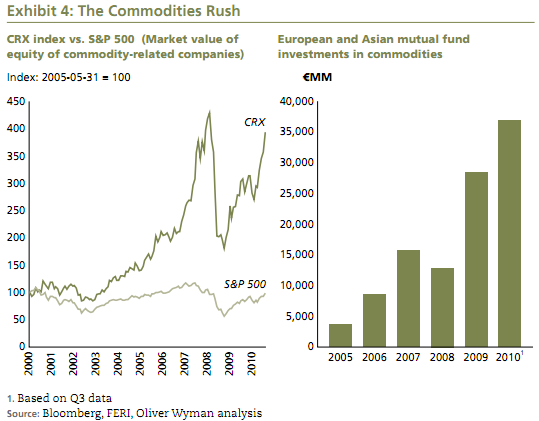


Ultimately, they conclude that the imploding commodity bubble will lead to another financial crisis and sovereign defaults. Their “base case” scenario involves mostly European nations experiencing defaults. This looks not only likely, but probable. It is likely that the periphery of Europe will remain mired in recession for several years as austerity measures put downward pressure on their economies and the Euro governments fail to enact a true fix to the flawed single currency system. Persistent weakness in Greece and Ireland will cause continual political turmoil and ultimately the scenes of Egypt would not be surprising throughout many parts of Europe as citizens demand real change. The Euro would likely remain the primary European currency, however, several periphery nations would reconsider their involvement.


Now, where I disagree with the Wyman analysis is in their “worst case” scenario. Any regular reader knows that it is highly flawed analysis to conclude that the USA could potentially default on its obligations – all of which are denominated in the currency in which it alone has monopoly supply of. This simple point eludes even the brightest minds in economics today. A default of the USA is impossible. The only form of default could come through hyperinflation. Considering the deflationary collapse that would likely result during the Wyman “worst case” scenario I think it’s likely that we would once again see the USA become the global safehaven and the USD would not collapse, but surge as it did in 2008. Still, the economic impacts would be deeply negative for the entire global economy though a collapse of the USA is not on the table.


We continue to see increasing disequilibrium in the global economy. The flaws in the Euro, China’s misguided economic policy and the endless financialization of the USA are the three primary factors contributing to what is unavoidable future calamity. It’s clear that none of these countries are willing to risk any sort of near-term pain that would be required to fix these structural imbalances so it’s not a stretch to assume that we will continue the boom/bust cycle that has become a trademark of the last 25 years of global economic growth. The commodity bubble will merely be a symptom of these imbalances.


Wyman concludes that this event could be several years away, however, I fear that this event could easily occur sooner than 2015. We remain in one continuing balance sheet recession with rippling waves that could cause these imbalances to resurface sooner than anyone believes. The resulting impacts will be broad and have the potential to forever change the way we approach future economic growth and the way governments intervene in markets. I would expect the Bernanke Fed to be in the middle of the ensuing storm. Such a crisis would likely result in wide ranging policy changes that will finally clear the imbalances of the credit crisis and create a foundation for truly sustainable economic prosperity.


Post Footer automatically generated by Add Post Footer Plugin for wordpress.

"

The 5 Black Swans That Keep Dylan Grice Up At Night... And How To Hedge Against Them All

The 5 Black Swans That Keep Dylan Grice Up At Night... And How To Hedge Against Them All: "

With all the hoopla over Egypt some have forgotten that this is merely a geopolitical event (one of those that absolutely nobody, with a few exceptions, was talking about less a month ago, so in many ways this is a mainstream media black swan which once again exposes the entire punditry for the pseudo-sophist hacks they are), and that the actual mines embedded within the financial system continue to float just below the surface. Below we present the five key fat tail concerns that keep SocGen strategist Dylan Grice up at night, which happen to be: i) long-term deflation, ii) a bond market blow-up, iii) a Chinese hard-landing, iv) an inflation pick-up, and v) an Emerging Markets bubble. Far more importantly, Grice provides the most comprehensive basket of trades to put on as a hedge against all five of these, while also pocketing a premium associated with simple market beta in a world in which the Central Banks continue to successfully defy gravity and economic cycles. For all those who continue to trade as brainless lemmings, seeking comfort in numbers, no matter how wrong the 'numbers' of the groupthink herd are, we urge you to establish at least some of the recommended trades in advance of what will inevitably be a greater crash than anything the markets experienced during the depths of the 2008 near-cataclysm.

But before we get into the meat of the piece, we were delighted to find that Zero Hedge is not the only entity that believes that providing traditional annual forward looking forecasts is nothing more than an exercise in vanity (and more oftan than usual, error).

At this time of the year we’re supposed to give our predictions for what’s in store for the year ahead. The problem is I don’t have any. Not because making forecasts is difficult. It isn’t. It’s just pointless. Instead, I suggest getting in touch with our inner Kevin Keegan, the hapless former England football manager who, facing the sack after a bad run of results famously lamented “I know what’s around the corner, I just don’t know where the corner is.” The more people construct portfolios on the assumption that they can see the future, the greater the opportunity for those building portfolios which are robust to the reality that we can’t.

That said, no matter how ridiculous the act of Oracular vanity ends up being, those who charge an arm and a leg for their 'financial services' continue to do it, only to be among the first carted out head first when reality is imposed upon them and their blind belief that this time is different and the crowd is actually right. Few are willing to accept and recognize the humility that they really know little if anything about how a non-linear, chaotic system evolves. Which is once again why we believe that Grice is among the best strategists out there: in his attempt to hedge the stupidity of the crowd, he has coined a term that may well be the term that defines 21st century finance and economics: instead of foresight, Grice believes the far more correct term to explain the process of prognostication should be one based on foreblindness.

In financial markets, craziness creates opportunity. It affects only prices, not values. And one of the craziest afflictions I know of is our faith in our ability to see the future. Indeed, there isn?t even an appropriate opposite to the word ?foresight? in the English language. So I'?m going to make one up. And rather than build a portfolio based on the pretence we have foresight, let?s explore some ideas for building one that is robust to our foreblindness.

This is the kind of insight that one will never find from a TBTF 'strategist'... And one wonders where all those softdollars go.

So now that we know that unlike the traditional cadre of sell side idiots who are always wrong in the long-run, Grice actually admits that he has no clue what will happen, which is precisely the reason to listen far more carefully to what he has to say.

Let's dig in:

Here are some things I think are true:

  • developed economy governments are insolvent
  • Japan is the highest risk developed market (DM) to an inflation crisis (though it might be Greece)
  • there is too much debt around
  • China?s economic model is biased towards misallocating resources
  • every country which has industrialized has experienced nasty bumps on the way
  • China and the US are in the early stages of an arms race
  • demographic trends suggest more conflict in the oil rich regions of the world
  • bottlenecks are developing in key commodity markets
  • the only thing central banks are good at is blowing the bubbles that cause the crashes which are used to justify their existence
  • market prices only reflect fair value by accident and in passing
  • most people don?t think these things are important
  • they might be right.

Here are some things I know are true:

  • perceived uncertainty causes emotional discomfort which isn?t conducive to good decision making
  • all the above situations have the potential to cause significant asset price volatility
  • I have no idea when.

What to do? To my mind, the ideal is not to make huge bets on particular events happening because failure of the expected event to materialize will materially endanger your capital. Instead, the ideal is purchase insurance at a price which won?t materially pressure the returns from your core portfolio of investments if the event fail to materialize, but will protect capital from significant impairment if it does.

Is such an ideal attainable? By evaluating insurance and using the same valuation discipline you'?d apply to anything else, I think it is. So what follows is not a list of recommendations here, or even any suggestions. Everyone should do their own homework. What follows is an illustration of why I think the macro research we?ve been doing is relevant and can be used to lower portfolio risk. The insurable risks I'?m most worried about at the moment are:

  • long-term deflation
  • a bond market blow-up
  • a Chinese hard-landing
  • an inflation pick-up
  • an EM bubble

The first thing you?'ll notice is that these aren?t all consistent with one another. It?s difficult to get a Chinese hard landing and an EM bubble at the same time, for example. But internal consistency is overrated. It?s only relevant for point-in-time forecasts, and the assumption underlying this entire exercise is that I haven'?t a clue if/when any of what follows is going to happen. At the risk of repetition, I?'m interested in the possibility of building a profitable portfolio which is robust to my ignorance.

Let's take a look at the five fat tails in detail:

Long-term deflation

Not surprisingly, Grice gives the least amount of weight to the one thing most troubling to such economic disgraces as Ben Bernanke and Paul Krugman. Yet it should not be avoided. After all there are many deflationists out there, who believe that the Fed, which has now clearly telegraphed it is all in on reflating (or after the Fed, the monetary collapse deluge) may actually succumb to what has been ailing Japan for two decades.

According to economists the primary risk faced by economies is that a huge deleveraging spiral becomes self-fulfilling: deleveraging reduces demand, which lowers prices, which further lowers demand, and so on. The idea was first developed by Irvine Fisher in the 1930s to describe the great depression, and has been used to explain the ?First Great Depression? of the 1870s and Japan since the early 1990s.

Paul Krugman says everything has changed because we?re in a liquidity trap. The fear of prolonged deflation is what keeps poor old Ben Bernanke awake at night. And maybe that?s the clue. At our London conference this year, James Montier said that Bernanke as the worst economist of all time. Now, I?m not sure I agree with James on this one because I can?t make up my mind, sometimes I think it?s the Bernanke, other times I think it?s the Krugman. But usually I think nearly all economists to be the joint worst economists of all time. So I have a lot of sympathy with the idea that if the consensus macroeconomic opinion is worried about something, it probably isn'?t worth worrying about. In fact, if they worry about deflation, I?'m going to worry about inflation.

We couldn't have said it better ourselves.

So how does one trade deflation insurance?

More importantly though, deflation insurance is expensive. The following chart shows the price of 5y 0% US CPI floors to be trading for just under 200bps. The way these floors work is that they provide the owner of the contract with the right to payments equal to the rate of deflation. Since the floors in the chart have a five-year maturity, they entitle the owner to five annual payments. For example, if inflation was -1% in year one, the owner would receive 100bps of the notional value of the contract. If inflation was -1% in year two, he?'d receive another 100bps. And if the rate of deflation remained at -1% for years three, four and five, he?d receive 100bp cashflow for each of those annual payments so that over the life of the contract he?d have received a total cashflow of 500bps. So if you?'re worried by the prospect of CPI deflation, this is the product for you.

And sceptical though I am of the debt deflation hypothesis, Western demographics worry me. Although we don?t know what ageing economies look like, we know that the glimpse into the future provided by Japan isn?t encouraging. So I do take the scenario seriously and would be happy to put the hedge on at the right price. The problem is, I don?t think the price is right. I think this insurance should be sold, not bought.

Chinese Hard Landing

While Grice is obviously far less worried about a systemic deflation scenario arising out of events in the US, what may happen in China is obviously a far riskier proposition, and one that could generate deflation out of the proverbial 'Hard Landing.' Luckily there is an instrument with some wonderfully convex properties to hedge this...

Albert calls China a ‘freak economy.’ Certainly, running with an investment to GDP ratio of over 50% doesn?'t seem normal. Neither does keeping interest rates at 5% when the economy is growing by 15% in nominal terms each year. Such lax monetary conditions have helped land prices rise by 800% in the last seven years, according to NBER economists. And when you come to think of it, more recent examples of real estate inflation fuelled by negative real interest rates ? Ireland, Spain, the US ? didn?t end too well. Jim Chanos says China is a shortseller ?s dream and that there?s not one company he?s looked at that passes the accounting sniff test. And if Jim Chanos, who built a very successful business around spotting accounting gimmickry says something like that, my guess is he?s right.

Taking a step back though, as far as I?m aware all industrialized countries have experienced financial crashes. It seems a part of the maturing process. Why should China be any different? A credit crisis wouldn?t necessarily mean the end of the China story any more than the panic of 1873 meant the end of America?s, (though US demographic prospects were considerably more favourable at the end of the 18th century than China?s are today ?). For the record, I think the Chinese have a bright future. My son is learning Mandarin. But when I look at the numbers I can?t help but think there?s going to be a crash and that it?s going to be quite unpleasant. It?s just that my guess as to when it?s going to happen is as good as Kevin Keegan?s.

What happens if and when the inevitable crash happens? One word - Australia. Another word(s): 10x-20x payout.

When it does happen though, the Australian economy will be toast and its government bond yields will collapse. During the panic of 2008, AUD 10y swap rates fell around 3% to 4.40%.

The panic of 2008 was a ?good crisis? for Australia though. A Chinese crash would be more serious.

And you can get pretty attractive odds on AUD rates collapsing. The following chart shows the payout available using AUD receiver swaptions prices with a three-year maturity, based on the 10y swap rate. Effectively, these are put options that pay out when rates fall below the strike price. The prices I?ve used here are from Bloomberg based on the swaptions striking at about 5.5% (i.e. 100bp below the current rate of 6.50%). What'?s interesting is that at current prices, if Australian swaps were to break their 2008 lows, you'?d be making about 10x your premium (for the record, these swaptions are priced at about 120bps, or 40bps per year over three years, which is about the same as the annualized revenue you?'d get if you sold the CPI floors discussed above). If swap rates fell by 300bps ? as they did during the panic of 2008 ? the rate would fall to 3.5% and you'?d make nearly 15x your premium. To repeat the point I made earlier, this isn?'t a recommendation. It?'s just a starting point (my guess is that you'?d find more attractive payouts as you went further out of the money with the strike price, and that capital structures of Australian banks, property companies and levered resource stocks would be worth looking into too).

Asset Bubbles

Grice provides one of the best and most succinct explanations of bubble mentality we have read to date:

For reasons I won'?t go into now, but which are probably obvious from what I just wrote about China, I think EM is riskier than it seems. I'?m not even sure I feel comfortable valuing EMs yet. So should EMs bubble up, the risk for investors sharing my concern is that they?ll be faced with quite a nasty dilemma: do they buy something they don?t feel sure is cheap because everyone else is and they?'re scared of underperforming, or do they stick to their principles and prepare themselves to take on the business and career risk of underperforming their competitors, seeing clients withdraw their funds, and possibly finding themselves out of work?

And the sad reality is that ultimately nearly everyone gets hurt during a bubble. Sceptics get hurt as it inflates, believers get hurt when it bursts. George Soros says when he sees bubbles he buys them. He?'s been pretty good at selling them at the right time too. But most of us aren?'t so clever.

Regardless of the psychology behind each and every bubble, the good thing is that there is a good way to hedge this risk outright.

One way to hedge the inflation of a bubble, rather than its bursting, is to buy out of the money call options on the equity indices. Calls are usually cheaper than puts ? I think because fear is a more powerful emotion than greed and the tails in equity markets tend to be on the downside. But the following chart shows that that difference (or skew, the difference in implied volatilities between puts and calls) is close to unprecedented highs, at around 4.5 vol points (the chart shows skew for the S&P500 though other equity indices show a similar picture).

In other words, the upside is close to unprecedentedly cheap relative to the downside. If you could get two year call options 30-35% out of the money for 130bps per year you?'d be getting good value (of course you could make this zero cost, or even ?ve cost by selling puts to fund the purchase, and you could do it in such a way that your downside risk would be similar to that of holding stock, but I?'m no derivatives strategist ?- as usual, if you want to talk about this stuff to people who know more than I do, speak to your SG derivatives salesman, or ask me and I?'ll put you in touch).

Hyperinflation

A topic near and dear to many. Luckily, once again, one which can be hedged proximally in a form that generates massive returns should it transpire there where it most needed: no, not the US. Japan. In fact, if Grice is right about Japan, his proposed trade takes the returns generated by Paulson in shorting subprime... And magnifies them by about a million.

Historically, bankrupt governments have used inflation to alleviate their indebtedness. I doubt things will ultimately be different this time. And as regular readers know, I think Japan is the country closest to the edge. All DM governments have the same problems: they?'ve made promises to their electorates which they?re unlikely to be able to keep. But while there?s time for European and US governments to fix the problem, for Japan I think it?s already too late. John Mauldin says the Japanese government debt position is a “bug in search of a windshield”. I agree with him.

I'?ve already written too much this week, so I don?t want to rehash all the stuff I?ve already written on Japan and which regular readers will be familiar with. But if you chart past episodes of extreme inflations with how stock markets behaved during the episodes, you invariably find something similar to what happened to Israel in the 1980s.

In Steven Drobny?'s excellent “Hedge Funds Off the Record” (which I consider a must read ?- almost every interview oozes with profound risk-management wisdom), Steve Leitner talks about buying out of the money call options to hedge against such a hyperinflation. Buying 40,000 strike Nikkei calls with a ten- year maturity, with a payout in a strong currency can be done for around 40bps per year. And to give you an idea of how explosive that asymmetry might be, if Japan was to follow the Israeli experience from here, the Nikkei ?- currently 10,500 would trade at around 60,000,000 (sixty million). So putting even one-tenth of your notional into that kind of hedge would cost 4bp per year (for reference, the Nikkei currently offers in excess of a 2% annual yield, while some JREITS offer in excess of 4% - I'?d argue that 40bp is a bearable burden, and 4bps certainly is).

Bond Market Blow-up

When a few weeks ago we presented Sean Corrigan's chart which we dubbed the Great Regime Change, few put two and two together, and realized the vast trading implications of this chart. And they are profound. As Grice rightfully observes, they stand at the base of nonthing less than the hedge against that most critical of fat-tail events: a bond market blow up, one which is getting increasingly more probable with every single $X0 billion UST bond auctions (the bulk of which is now monetized directly by the Fed).

One obvious way to hedge against a bond market blow-up is to use the swaptions market as we did in the Australian market to hedge a Chinese crash, only this time buying payer swaps, which are effectively call options on rates. But I thought I?'d show you something I think is a bit more interesting: the correlation between the S&P500 and bond yields.

Bonds represent poor value in my opinion, with little margin of safety to protect against the very real risk that governments try to inflate away their debts. But one good reason to continue holding them is that they protect risk asset positions during the '?tails'?. The following chart shows that over the last ten years the correlation has been volatile, but positive: when equities have fallen so have bond yields, offsetting losses in the equity portfolio as bonds benefit during ?risk-off? events.

When inflation expectations were (probably) around zero (before the 1960s) the correlation between bonds and equities was zero too. But look what happened during the 1960s when inflation expectations broke (this was during the Vietnam war, as the Bretton-Woods system was coming under pressure and as the bear market in bonds was getting into full swing). The chart shows that the correlation went negative. When bond yields rose equities fell because government bonds were reflecting the same tensions that were pulling down equity valuations (fear of ever-higher inflation).

As the bond bear market reached its climax in the early 1980s, the correlation remained negative. But as the worm turned, and central banks across the developed world made new and credible commitments to stop printing money, a bond market rally was born. And as inflation expectations began to fall, what was good for the bond market was good for the equity market. Now, falling yields coincided with rising equity prices and so the correlation remained negative. But during the last ten years, inflation expectations have been roughly stable and, if anything, slightly biased towards the deflationary side. So what?s been good for bonds hasn'?t been good for equities, and the correlation between yields and equity prices has been positive to reflect that.

The point is this: if governments are insolvent, and the government bond market becomes a source of risk once again (as opposed to the nonsensical '?risk-free?' description it has somehow obtained in recent years) what?s bad for the bond market will be bad for risk assets too. As yields rise, risk assets will fall. The correlation will go negative. Bonds will provide less protection against the tail events than they have done in recent years because they will be a source of the tail event.

For all those who figured this out based on the Corrigan chart, congratulations. This could well be the holy grail of the biggest black swan insurance trade of all. For those who haven't quite grasped it, here is some more from Grice:

This correlation is tradeable. Any bank with a derivatives operation must have an implicit correlation exposure between products they?'ve sold options on. So for derivatives houses, correlation is a by-product in much the same way that molybdenum is a by-product of copper miners. and correlations like this trade in the IDM market. And sometimes that means you can get it for a very good price. I recently heard of a correlation trade between the S&P500 and the US 10y swap rate done at 40 correlation points, which seems a decent enough price to me (of course, selling at 50 points would give you even more margin of safety), although current pricing is at around 30 I believe. Pricing can be volatile though and waiting to sell in the 40-50 range seems sensible to me. It would hedge risk positions against a regime in which government bonds were seen as the source of risk, rather than the reliever of it.

Finalizing the Black Swan Insurance basket.

Let?s add it all up and see how much it would cost to insure our portfolio. If we were to sell the 5y US CPI floors for 200bps (40bps annualized); buy the 3yr AUD receiver swaption for 120bps (-40bps annualized); buy 2yr 30% S&P500 calls for around 130bps (-65bps annualized) and bought one tenth of our notional on NKY calls for 40bps (-4bps annualised) the net upfront cost would be 90bps (200bps-120bps-130bps-40bps). If we wanted to hedge the risk of bond market turbulence with a correlation product, this would cost nothing upfront because it would be done on a swap basis with the bank. On a roughly annualized basis our cost would be 69bps each year.

Of course, we'?d have a maturity mismatch because our hedges would have different time horizons. So we'?d have to adjust them from year to year. We?'d also be more vulnerable to deflation because we don?t think the deflationary hedges offer value. So our portfolio wouldn?'t quite be bullet-proof because it would be tilted towards inflationary outcomes. But we?'d have insurance against deflation with the Australian receiver swaption. And since the correlation swap hedges us against any bond market blow-up which also blows up the equity market, we can feel more comfortable allocating some capital towards bonds we think might offer good value (not that there are many, I?d say maybe about 20-30% in Australian and New Zealand bonds).

I?'d put 10% in gold. I?ll explain more in another note but for now, although I'?ve said I?'m not a fan of plain commodities as investment vehicles because buying commodities was equivalent to selling human ingenuity, I exclude gold from that logic. I prefer to see buying gold as buying into the stupidity of governments, policy-makers and economists, and I'?m comfortable doing that.

With the exception of Japan (which we?'d be hedged against anyway) I'?m not so worried about ?traditional? CPI inflation any time soon. At the moment, I think the first signpost on the way to that kind of crisis will be via the bond market, which the correlation swap should protect us against. That and my gold holdings would make me comfortable allocating 20%-25% cash. I still think risk assets are generally overvalued and cash is the simplest insurance ?option?, whose relative value rises proportionate to the decline in other assets. So let?s say I?'m 20% in cash,10% in gold, and 20% in mainly Australian and New Zealand government bonds. That leaves just under 50% of my capital for me to put into the equity market (the 69bps per year for my insurance bucket to be precise).

Which equities? I'?ve always thought investing in index funds to be crazy, but nearly everyone does it and it?'s a part of the craziness we can use to our advantage. The EMH says that market prices are always broadly efficient because all market participants respond to all available information. But around 10% of the market is explicitly passive and probably another 50% is benchmarked and therefore implicitly passive. In other words, the overriding variable for the majority of equity investors is a company?'s weight in the index! Intuitively therefore, the prices can?'t fairly reflect fundamental value, which means that at any point in time, there will be lots of stocks which are mispriced.

The following chart shows two lines. The red line shows the cumulative return to buying stocks in the cheapest decile, while shorting stocks in the most expensive decile (I define value as the discount relative to the estimated intrinsic value ?- a methodology I?'ve been meaning to write up in detail for several months now but which I will definitely do within the next few weeks). Using a monthly rebalance, the annualized return is 750bps. This shows that there is meaningful alpha in identifying and owning those stocks trading at a discount to intrinsic value. The black line shows the relative outperformance of the top decile against our wider stock universe. (In passing, note that this value strategy underperformed in the late 1990s during the tech bubble, and remember that this is the reason our hypothetical portfolio has out of the money call options.)

The relative outperformance of this long-only basket has been 330bps. If I expect a stock market return of 5% per year over the coming years, that 330bps outperformance is highly significant. It means we only need to put 60% of our capital into that basket of stocks to generate the same incremental return as a market portfolio would generate. So owning 50% isn?'t as cautious as it sounds.

The bottom line, and the reason why we think this is a great basket trade, is that it makes money in a normal environment while at the same time, providing great positional hedges to those 5 events which sooner or later are bound to happen.

In the sort of world in which everything is normally distributed, well behaved, and in which our insurance expires worthless (i.e. the sort of world most economists forecast), we'?d still be making decent returns. And while there?'s no such thing as a truly bullet proof portfolio, we?'d have done so with far less embedded risk. Because if any of the scenarios I'?ve explored here come to pass we?'d be in a much better position to take advantage of the distressed selling of others.

The said, and as Dylan would be the first to acknowledge, if and when everyone is positioned with precisely this hedge on their books, it will be something totally different that will cause the next great financial wipeout. But until then, those who step in first, will benefit from appreciating prices precisely on their hedges. At that point it will be up to the principal to decide whether to take profits or to hold off until the bitter end. The problem, however, at least the way we see it, is that should any of these five black swans occur, any currency that one generates as a result of a successful trade, no matter the P&L, will probably not be all that useful for the world that materalizes at T+1.

"

"The 18 Year Cycle" - S&P Adjusted For Business Revenues Means The 666 Lows Are Just The First Stop

"The 18 Year Cycle" - S&P Adjusted For Business Revenues Means The 666 Lows Are Just The First Stop: "

Sean Corrigan's weekly "Material Evidence" is always a must read. In his latest edition, the uber-eloquent Brit puts simplistically worded Fed bashing to shame with an anti-Fed manifesto masterpiece that is off the charts on the Flesch-Kincaid reading level. While we will post the full piece shortly, we wanted to bring attention to one particular chart which has not received any prominence in the past, namely the S&P adjusted for business revenues, which appears to have an 18 year periodicity, and whose mean reversion implies that we are only half way through the correction phase. In other words when all is said and done, when the Fed's POMO gun is finally out of bullets, Albert Edwards' and Nic Lenoir's S&P targets of ~400 will be spot on.

"

Saturday, January 29, 2011

David Freedom's Vision of 2011 and Beyond

David Freedom's Vision of 2011 and Beyond: "

The world’s banking system (which is the western banking system) has the same problems that existed before the collapse in 2008, with two exceptions: 1) The problems are much larger; and 2) They have been shifted to the public. Since 2008, the Fed has loaded up on all sorts of “toxic debt”, including Fannie & Freddie (MBS), FHA, US Treasuries ($900B) and many more. Newly issued US debt ($2T annual deficit) is being purchased/monetized by the Fed and those holdings along with all the previously mentioned toxins are now backed by the US Treasury. As of October 20, 2010 the Fed’s balance sheet exceeded $2.3 trillion ($832b in Treasury debt). What’s the Fed’s plan to manage this liability in the event of a dollar collapse? Suffices to say, the US citizen is now the largest debtor in the history of the world.

Who’s Holding the Bag?

The Bernanke recently stated publically that: “Under a scenario in which short-term interest rates rise very significantly, it’s possible that there sammymight come a period where we don’t remit anything to the Treasury for a couple of years. That would be I think a worst-case scenario.” You need to understand that all of the Treasuries purchased by the Fed will soon be ‘under-water’ which would result in the Fed being insolvent. This new twist allows the Fed to pass losses to the Treasury via interest payments (or lack of) on the US Treasury Bonds (i.e., paid by the US citizens). In simple terms, the US citizens are now the holders (back-stop) for the massive amounts of debt, debt that CANNOT be paid under any circumstance. That means the next insolvency crisis, which is a certainty, will be one of a sovereign nature. This fact changes significantly how the markets will react.

What Ignites the Next Blaze?

The potential list is long, so I’ll mention only a few. All of these things could happen in the next couple years, the first of which will start a fire the likes of which we’ve never witnessed. It could be US municipal defaults, policy shifts from the Chinese, a EU crisis, or an expanded war in the Middle East. I could go into detail about the crisis-solution agenda, but I’ll leave that for another day.

The US Market

QE2 is set to expire in June 2011 and The US Congress will need to address the debt ceiling by March. Expect the debt ceiling to be revised up in the near future and QE3 will probably be masked under a different name, but make no mistake, it’ll be money printing all the same. My understanding is that the banking system intends to continue increasing credit/debt throughout the world.

Through the next month or two (through Feb) we’ll likely see a continued rise in commodities and US equities. Picking a line in the sand is tricky business though, so making preparations now is prudent. As food and energy prices rise, nations will feel the sting of money printing (already happening). This will only increase the number of civil protests (RIOTS). Developing nations will feel the brunt of higher inflation, which will lead to various measures to control price increases (e.g., Russia’s recent announcement of food controls or COMEX margin hikes). The increased costs of commodities will be a drag on the world’s economy as well as the attempted policies to control the rise. As a result, I expect significant volatility throughout 2011. The global slowdown will lead to a drop in US markets by the middle of the year, giving the Fed impetus for more money printing. For anyone still expecting a return to ‘normal’, 2011 will be a wake-up call.

Beyond 2011

Similar to the “Choose-Your-Own-Ending” books (remember those?), the Fed has gone too far down the easing path to save the USD as it exists today. In the short-term, the USD is still being managed by the Fed, but this is only a temporary mirage. For the sake of this article, let’s assume they try (though highly unlikely) to restore confidence in the USD. The Fed could allow the bad debt to default (written off). As defaults rage the USD would skyrocket, due to massive liquidations and to a lesser extent, the safety trade. However, as a result of massive defaults, US banks would immediately be unable to honor deposits. Of course, the government could “back stop”/guarantee all the banks, but then we’re back into easing which puts the currency at risk. In addition to the banking collapse, The Fed and US Treasury (as the Fed’s back-stop) would default. Since this would be a sovereign default, and the USD is stock of that sovereign entity, the USD would collapse. There is one possibility in reviving the USD, albeit under a new/old system. That new system would require a huge revaluation in US gold holdings to be used as backing for the new USD. Jim Rickards has done some good work on the process and price of gold to make it a reality. Whether this happens or not remains to be seen.

As we work through this crisis, there will be a combination of defaults and austerity. Pensions will be slashed, state assets will be sold to the highest bidder (at massively undervalued prices), while new and existing taxes are imposed on the citizenry. Government services will be slashed and newly privatized assets will increase all types of expenses – things like water, energy and transportation. See the IMF blueprint for how this works, or ask an Argentine.

Civil unrest will increase dramatically, in places never before expected. Tensions between nations will rise and war will inevitably breakout throughout the globe. Sound gloomy? This too shall pass.

What to do?

If you have wealth to protect, a minimum of 30% should be held in gold, silver or productive land. I do not advocate 100% into PMs. Although the outcome of the USD is abundantly clear, current laws enforce the USD which should be held for expenses, emergencies, purchases and so forth. Rather, I suggest 30% be stored in physical gold and silver, 30% in cash and 30% in growth. Within the growth category you will have many paper options and should look to exceed the rate of inflation. As a further precaution, it’s advantageous to hold assets and citizenship outside of your primary residence.

The issues we face today are extremely complex and although the outcome appears certain, the specific events and timeline are impossible to predict. By maintaining a sound portfolio, you will afford yourself the most protection against a variety of financial outcomes.

Non-Financial

You should have water and food stocks along with necessary supplies, such as water filters, alternative heat sources, community networks and other essentials for surviving disasters. In all likelihood, systems will continue to function, but on a temporary basis, these items will keep you comfortable (relatively).

Learn who you are and what’s important to you. Find the meaning of your existence and strive to fulfill your purpose. Live in harmony with your surroundings and community. Love God and men. Don’t follow any institution and think for yourself. When making charitable donations, give them personally. I advise reading the bible (KJV), starting with the New Testament. Most importantly promote and vigorously protect freewill. If the Euro crashes, reduce USD positions!
~david freedom

david@thevictoryreport.org

"

Friday, January 28, 2011

Inequality In America Is Worse Than In Egypt, Tunisia Or Yemen

Inequality In America Is Worse Than In Egypt, Tunisia Or Yemen: "


Washington’s Blog


Egyptian, Tunisian and Yemeni protesters all say that inequality is one of the main reasons they're protesting.

However, the U.S. actually has much greater inequality than in any of those countries.

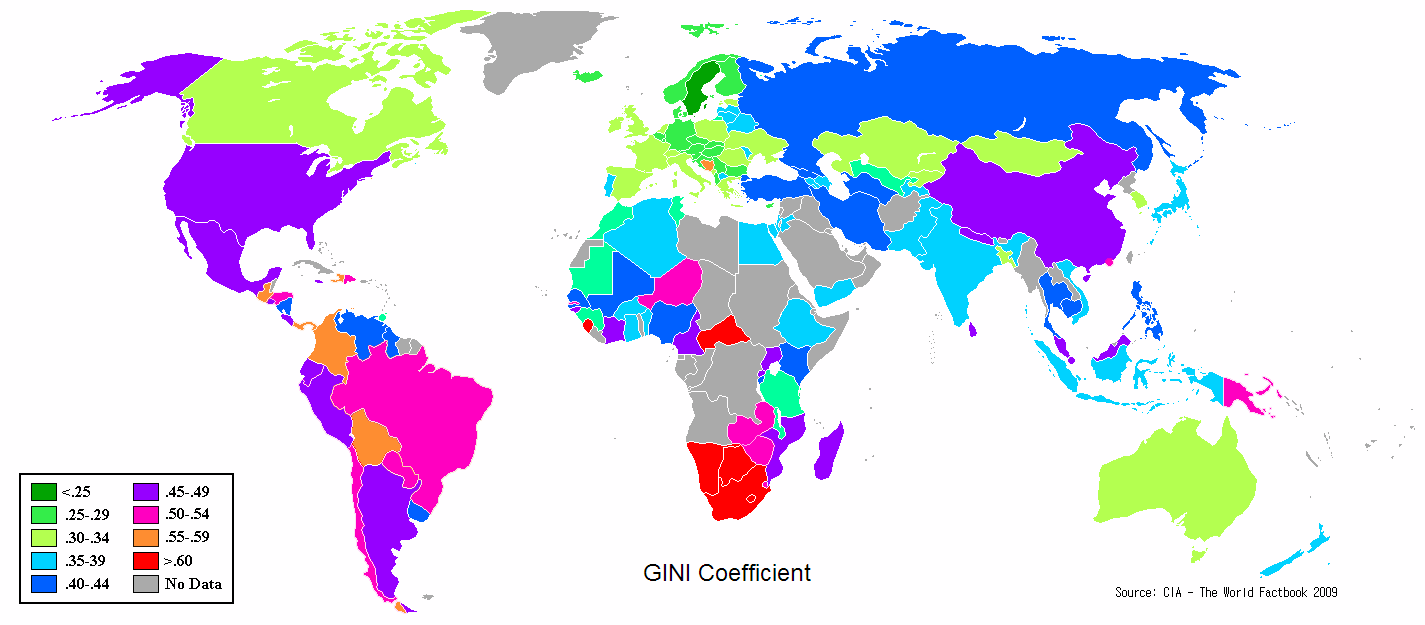
Specifically, the 'Gini Coefficient' - the figure economists use to measure inequality - is higher in the U.S.

[Click for larger image]

Gini Coefficients are like golf - the lower the score, the better (i.e. the more equality).

According to the CIA World Fact Book, the U.S. is ranked as the 42nd most unequal country in the world, with a Gini Coefficient of 45.

In contrast:

  • Tunisia is ranked the 62nd most unequal country, with a Gini Coefficient of 40.
  • And Yemen is ranked 76th most unequal, with a Gini Coefficient of 37.7.
  • Egypt is ranked as the 90th most unequal country, with a Gini Coefficient of around 34.4.

And inequality in the U.S. has soared in the last couple of years, since the Gini Coefficient was last calculated, so it is undoubtedly currently much higher.)

So why are Egyptians rioting, while the Americans are complacent?

Well, Americans - until recently - have been some of the wealthiest
people in the world, with most having plenty of comforts (and/or
entertainment) and more than enough to eat.

But another reason is that - as Dan Ariely of Duke University and Michael I. Norton of Harvard Business School demonstrate - Americans consistently underestimate the amount of inequality in our nation.

As William Alden wrote last September:

Americans vastly underestimate the degree of wealth inequality in America, and we believe that the distribution should be far more equitable than it actually is, according to a new study.

Or, as the study's authors put it: 'All demographic groups -- even those not usually associated with wealth redistribution such as Republicans and the wealthy -- desired a more equal distribution of wealth than the status quo.'

The report ... 'Building a Better America -- One Wealth Quintile At A Time' by Dan Ariely of Duke University and Michael I. Norton of Harvard Business School ... shows that across ideological, economic and gender groups, Americans thought the richest 20 percent of our society controlled about 59 percent of the wealth, while the real number is closer to 84 percent.

Here's the study:


norton ariely in press -

"

Thank GDP It’s Friday!

Thank GDP It’s Friday!: "

Thank GDP It’s Friday!


Courtesy of Phil of Phil's Stock World


What an amazing market!


Nothing can stop it. (Though today's looking weak.) A 12.5% increase in unemployment claims - BUY! A 2.5% drop in durable goods orders - BUY! Japan's credit rating downgraded - BUY! Amazon missing revenues - BUY! Gold falling $35 from Wednesday's close - BUY! Oil at the lowest level since November - BUY! Thousands of protesters rioting (video of the police shooting a man dead) in Egypt this morning - BUY!


Not only are the markets being bought (albeit on very low volume by TradeBots) under any and all conditions but they are being bought with little or no downside protection - as indicated by the VIX, which has fallen to 16 again, back at the 2008 pre-crash lows, when Bush's Economic Stimulus Act of 2008 'saved' us by sending everyone in America $300 (which we ended up using to buy 2 barrels of oil as it raced to $140 per barrel that June). At the time (February 14th, Dow 12,400. S&P 1,350, Nas 2,332), I thought it was a very bad idea, saying:


Kudos to Sen Bob Corker of TN (R), who said: 'Sprinkling $160 billion around the country and asking people to spend it quickly to me was not a solution worth debating or passing." When we had our economic crisis in the ’80s, Ronald Reagan (who is rumored to have been a Republican) and Paul Volcker fixed the economy by RAISING interest rates to STRENGTHEN the dollar, which lowered those pesky food and energy prices that the government likes to pretend don’t exist. This administration has just three weapons – cuts, cuts and more cuts, and the dollar took another dive this week, failing the critical 50 dma at 76.32 while the Chairman was demonstrating his monoline mindset on how to solve our problems.


I mentioned in the morning post how a gallon of gasoline takes a European 75% further than it takes an American but I forgot to mention that a Euro takes a European 40% further than a dollar takes an American consumer. This is the gigantic, gaping hole of a joke of our economic policy – we import energy and everyone has to buy it. You can’t have an economic policy without an energy policy – it’s a guarantee of failure before you even start. While the dollar drowned on the Bush gang’s $168Bn giveaway, the price of oil rose from $86.24 to $95.55 in the past 5 sessions, that’s 11%!


$9 per barrel costs US consumers $12 by the time it’s refined (42 gallons a barrel, $3 per gallon) and the US uses 20M barrels of oil a day so that’s $240M A DAY coming out of US consumers hands in just the past week! Over the course of the year, that’s $88Bn of damage from rising oil prices caused by the "stimulus" package so, like virtually all policies put in place by this administration, the only thing being stimulated is the price of oil!


What is different this time? As I said on Monday when looking ahead to whether we'd have our Alpha 2 drop pattern we had last year: 'Surely the Fed can break this patten as we have as much as $9Bn worth of POMO today, $8Bn tomorrow, $6Bn on Thursday and $9Bn on Friday (see SWW for chart) for a whopping $32Bn of fresh money created by the Fed in just 5 days. As I said to Members this morning – that is like handing everyone in America $100 to spend – you would think that would boost the markets just a little, right?" So you can see why I'm still a little cynical - we've seen this movie before and we know how it's going to end, it's just a question of when.


Like 2008, the attempts by the Fed and the Government to prop up the economy are doing nothing at all to fix the problem, merely shoving the problems under the rug for another few months until we have that final day of reckoning. If you are a short-term investor, taking quick profits and running - that makes sense, good job - we can make money that way! If you are a long-term, well-hedged investor - that's good too. But, if you are a medium-term investor who, like most apparently, is not prepared to face the consequences of a sudden 10-20% drop in the market - then you are nuts!


John Nyaradi does a nice job of pointing out that 'Global Markets Teeter on the Knife's Edge" and that it's déjà vu all over again as we fly "Once more unto the breach, dear friends, once more." Of course, the second part of that quote (from Henry V) is "Or close the wall up with our English dead" - which is very apropos as the English economy is looking very dead these days with the declining GDP we touched on in Tuesday's post and, this morning, the worst Consumer Confidence numbers we've seen in 22 months. "January's eight point drop represents an astonishing collapse in consumer confidence,' said Nick Moon, managing director of GfK NOP Social Research. 'In the 35 years since the index began, confidence has only slumped this much on six occasions, the last being in the midst of the 1992 recession."


Separately, the Confederation of British Industry Thursday said retail sales growth slowed in January, and is expected to continue to decelerate. Its monthly measure of sales volume fell to 37 in January from 56 in December, the weakest reading in three months. The balance is the percentage of respondents reporting higher sales than in the corresponding period the previous year minus the percentage reporting weaker sales. "Consumer demand is expected to be weak in the coming months, as the spending power of households is hit by a combination of sharply rising prices and weak wage growth,' said Ian McCafferty, chief economic adviser to the CBI. 'Retailers can expect a challenging period ahead.'


Don't worry kids - I'm sure that won't happen here. England is nothing like us - they speak a different language and everything! Sure our household spending power is also being hit by sharply rising prices and weak wage growth and sure retailers are already showing signs of not-so-great Q4 numbers with margins contracting and top-line sales failing estimates but USA, USA, U! S! A! There, see, no problem...


Joe Stiglitz read the riot act to Tim Geithner and the other belt tighteners in Congress this morning commenting on Geithner's comment that Keynesian economics is not working saying: 'Anybody who says that doesn't understand economics. Keynesian economics does not say you don't deal with the deficit. What it does say is that, when you have excess capacity - and ANYBODY looking at the United States says there is excess capacity, 1 out of 6 Americans who would like a full-time job can't get one. Those are times in which you HAVE to stimulate the economy and what matters is the quality of the spending. Over the long run, over the long run you have to have fiscal order."


I love Stiglitz! He also said "The real problem is the way we are spending money, not the amount we're spending. Right now, if we cut back on our support, the economy is going to get weaker, tax revenues are going to get lower. What we really need to do is actually increase our spending on investments in infrastructure, technology and education and cut back our spending, for instance on weapons that don't work against enemies that don't exist in wars that we are going to lose in any case and let's focus on strengthening our economy." That pretty well sums up our current National policy, doesn't it?


When I was at the Buttonwood Conference this Fall, I sat next to Joe and I will tell you that the expression 'the smartest guy in the room" is about Joe Stiglitz. Joe's wife Anya is no slouch either. She wrote "Bad News," about how the MSM completely missed the signs of the brewing financial crisis and cheer-leaded us straight to Hell (kind of like they are doing now). Anya wrote a very funny article on Davos where, among other things, she noted:


The point about Davos is that it makes everyone feel wildly insecure. Billionaires and heads of state alike are all convinced that they have been given the worst hotel rooms, put on the least interesting panels and excluded from the most important events/most interesting private dinners. The genius of World Economic Founder Klaus Schwab is that he has been able to persuade hundreds of accomplished businessmen to pay thousands of dollars to attend an event which is largely based on mass humiliation and paranoia.


Speaking of the last crisis. It turns out that "only" 12 of the 13 biggest Financial Firms in the US were on the brink of failure in 2008. Bernanke told the Financial Crisis Inquiry Commission. 'In that period… only one… was not at serious risk of failure… Even Goldman Sachs (GS), we thought there was a real chance that they would go under." The deeply divided 10-member panel's final report was endorsed only by its six Democratic members. It criticized the culture of deregulation championed by former Federal Reserve Chairman Alan Greenspan and said the government had ample power to avert the crisis but chose not to use it. A competing minority report from three Republican commissioners largely exonerated Greenspan, a fellow Republican, saying, "U.S. monetary policy may have contributed to the credit bubble but did not cause it." Thank goodness we put those guys back in charge, right?


2009_07_goldmanco.jpgThe report also notes how $2.9Bn was handed from Treasury to Goldman Sachs through AIG and, according to analyst Josh Rosner: 'If these allegations are correct, it appears to have been a direct transfer of wealth from the Treasury to Goldman’s shareholders." What does this mean for our portfolios? Why BUY of course! The GDP was a miss at 3.2%, Ford's (F) earnings were a miss on earnings, Oshkosh Trucks (OSK) missed revenues, Dominion Resources (D) missed top and bottom, Chevron missed revenues by 4% and Employment Costs are rising at just 0.4% for the quarter, which means the American people continue to earn less money for doing the same jobs relative to inflation (if they are lucky enough to have jobs at all). Relative to the BS total lie Government inflation statistics, that is. Speaking of America - Moody's now says it may need to place a “negative” outlook on the U.S. That's USA! USA! U! S! A!


So, in conclusion - BUYBUYBUY! Come on, it's what Cramer is going to tell us to do tonight. EVERYBODY's doing it, right?


Well, maybe not everybody - but we're getting very lonely on the sidelines. As promised, we will hold our noses and buy something next week as we start our new $25,000 Portfolio for Members - looking to turn it into a virtual $100,000 in the next 11 months. If the market keeps going the way it's gone since our December picks - it will be a piece of cake!


Have a great weekend,


- Phil

"

Thursday, January 27, 2011

Seven Men, Nine Days, One New Monetary Cartel, Pt. 2

Seven Men, Nine Days, One New Monetary Cartel, Pt. 2: "

<!--StartFragment-->

Thus, on a wintery day in November 1910, seven men retreated
to JP Morgan’s private Jekyll Island resort to plan a system of banking that
would address all of these problems, while simultaneously expanding their power
and influence over the US banking system.


G. Edward Griffin, in The
Creature From Jekyll Island
, puts their primary goals as the following:


1)
To stop the growing influence of smaller banks and
increase the Anglo-American banking giants’ grip on the US financial system


2)
To shift US banking to a more “loan heavy” structure
thereby expanding the monetary base more dramatically (making money more
“elastic”)


3)
To pool all national banks reserves and set nation-wide
standards for loans to reserves ratios, thereby minimizing the risks of bank
runs and failure


4)
To establish a means of shifting the losses from bank
failures away from the banks and onto the public


And finally…


5)
To develop a PR campaign that would result in the US
populace accepting the implementation of a full-scale private banking cartel


I do not have time to detail the precise proceedings of the
meetings these men held over their nine day stay at Jekyll Island, nor is there
room to explain precisely how they infiltrated the US political system and
managed to introduce a banking plan that was written by Frank Vanderlip and
Benjamin Strong (who represented the Rockefeller and Morgan families,
respectively) as if it were a bill produced by
members of Congress.


However, a brief overview is as follows:


Initially Senator Aldrich proposed something quite similar
to the Bank of England, in which there would be one single large bank. However,
the Rockefeller interests (who had ample experience with the US populace’s
reaction to monopolies) thought this would be too much for Americans to
stomach. Instead, they proposed the creation of 12 regional banks largely to
maintain the illusion that the Fed would be a union, not a single central bank.


This is where the expertise of Paul Warburg, who had the
most experience with European-style central banking cartels, came in. Warburg
proposed creating a banking structure that would be more conservative at first
so that the general public would be more willing to accept it, then stripping
away the conservative props once the system was in place.


For instance, Warburg proposed the Federal Reserve Board of
Governors, a group of semi-elected officials who would meet and decide Fed
policy on interest rates and the like. This created the illusion that the Fed
would resemble a normal banking corporation with a board of directors. However,
in point of fact the Fed Board was a means to keep all the key decision making
centralized at one bank in Washington DC (close to New York where the Bank
Oligarchs were headquartered).


Warburg also came up with the name “Federal Reserve” which
evoked the sense that the organization was aligned with the Government and was
secure. His view was that the words “central” and “bank” must be avoided at all
costs.


However, the most daring and provocative of all Warburg’s
proposals was that the Fed would take over the issuance of ALL money in the US.
For the first time in US history, money would be produced by privately held
banks, NOT the US Government.


From then on, US Federal Reserve notes would be legal tender
for settling all debts public or private. Thus, if someone was owed money and
refused to accept Federal Reserve Notes (Dollars) as payment, he or she could
go to jail. The Dollar even says this in the top left corner of its face.


Obviously, getting the public to swallow this proposal
wasn’t going to be easy. The bankers put together a special committee to
investigate the plan. However, the Pujo Committee was largely a farce in which
various members of Congress (all bought out by the banks) questioned the
bankers on the more innocuous portions of the proposal.


As part of their PR campaign, the bankers also donated some
$5 million to Harvard, Princeton, and the University of Chicago (the last of
which was founded using contributions from John D Rockefeller) all of which
began turning out studies and academic papers promoting the virtues of the
proposed system.


However, the bill remained a tough pill to swallow
especially given Senator Aldrich’s close affiliation with Wall Street
(remember, he was an associate of JP Morgan). The “Aldrich Bill” as it was
known never even made it to vote in the Senate.


Splitting the Vote… and
Backing All Three Candidates


Bruised, but not defeated, the bankers knew that in order to
get their plan put into action they needed support from the very TOP of the US
Government: the President of the United States. Consequently, they engaged in
one of the most sophisticated lobbying efforts in history, backing all THREE
candidates (Taft, Wilson, and Roosevelt) in the 1912 election.


In fact, it was JP Morgan’s associates who pushed Roosevelt
to run in the first place (giving him the monetary backing to do so) in order
to pull voters from Taft who was publicly recognized as pro-Wall Street and so
would not have been as effective at getting the bankers plan implemented
without public outcry.


Thus the 1912 election consisted of three pro-Wall Street
candidates, though only one of them (Taft) was publicly recognized as such.
Roosevelt and Wilson were both backed by private banking money, though their
backers urged them to sound out an “anti Wall Street” bank campaign (which they
did with great success).


The results worked as hoped. Roosevelt served as the
“anti-bank” foil to Taft’s pro-Wall Street/ Big Business status, splitting the
vote and allowing Wilson to win with just 42% of votes (the other 58% were
split between Taft and Roosevelt). The bankers now had a supporter in the White
House, most importantly, one who was thought by the public to be against the
banks and their “Aldrich Plan” plan as it had come to be known.


Officially Backed and Bailed
Out By Uncle Sam


Ready to make a second attempt at implementing their plan,
the bankers enlisted the Democratic Chairman of the House Banking and Currency
Committee, Carter Glass, to draft a new banking bill. Glass, who by his own
admission knew nothing about banking, was merely a front, a figurehead who
denounced the Aldrich Plan, pointed out its biggest flaws to the public, and
the proposed an identical plan with the very same flaws included.


The Glass-Owen bill (it was co-sponsored by Senator Robert
Owen) moved along towards becoming law much more quickly than the Aldrich Plan,
largely due to the fact that the Wall Street banks engaged in a massive PR
campaign in whch they publicly decried it as wrong and evil and against their
interests (despite the fact they themselves wrote it).


The final coup was accomplished when William Jennings Bryan,
the most powerful Democrat in Congress, met with Glass and said he would pass
the bill provided that the money issued by the Federal Reserve was backed by
the US Government and that the Governor of the Federal Reserve would be
appointed by the President and approved by the Senate: two clauses that the
Wall Street bankers wanted but had intentionally left out of the draft so that
they could be used as “bargaining chips” to make it appear as though
compromises were made.


G. Edward Griffin, repeats a quote Fed mastermind Paul
Warburg regarding their success:


While
technically and legally the Federal Reserve note is an obligation of the United
States Government, in reality it is an obligation, the sole responsibility for
which rests on the reserve banks… The
Government could only be called to take them up after the reserve banks failed.


Here lies the ultimate triumph of the cartel, not only would
the Federal Reserve issue money (collecting interest on the loans since the
money was technically being leant to the US), but should the system ever go
bust, the US Government would be
required to step in and bailout the Federal Reserve’s losses.


It had taken three years and countless strategies and
deceptions, but on December 23 1913 the Federal Reserve Act was passed into
law. From then on, the US monetary system would be controlled by private
interests in a government-backed cartel.


The above account is a very condensed version of the history
of the Federal Reserve’s creation. The actual story is even more rife with
twists and power struggles. For those of you who are interested in knowing more
about it, I highly recommend reading The
Creature From Jekyll Island
by G. Edward Griffin. It’s a stunning book and
full of revelations that range from shocking to outright infuriating.


Best Regards,


Graham Summers


PS. If you’re getting worried about the future of the stock
market and have yet to take steps to prepare for the Second Round of the
Financial Crisis… I highly suggest you download my FREE Special Report
specifying exactly how to prepare for what’s to come.


I call it The Financial
Crisis “Round Two” Survival Kit
. And its 17 pages contain a wealth of
information about portfolio protection, which investments to own and how to
take out Catastrophe Insurance on the stock market (this “insurance” paid out
triple digit gains in the Autumn of 2008).


Again, this is all 100% FREE. To pick up your copy today, got
to http://www.gainspainscapital.com
and click on FREE REPORTS.


PPS. We ALSO publish a FREE Special Report on Inflation
detailing three investments that have all already SOARED as a result of the
Fed’s monetary policy.


You can access this Report at the link above.


<!--EndFragment-->


"

Seven Men, Nine Days, One New Monetary Cartel, Pt. 1

Seven Men, Nine Days, One New Monetary Cartel, Pt. 1: "

Many investors today, as they learn more about the nature of
the Federal Reserve, are asking themselves how the US, the supposed land of the
free, permit a non-Government-based cartel to take control of its monetary system?
Who controls the Fed? And just how did they attain this unbelievable power to
operate with the Government’s approval?


To answer all of these questions, we need to put on our
winter coats and step back in time to a New Jersey train platform on a cold
wintery night in November 1910…


At first glance, nothing around us would look unusual. The
train at the platform was comprised of your standard chair cars which would be
converted to sleepers at night. Poorer passengers took the cars closer to the
engine, while the more well off sat and slept in cars behind the dining car.


However, one thing was very unusual about this particular
train. And that something unusual was a single private train car located at the
end of the train.


Unlike the others cars whose interiors were dreary affairs
of metal and wood, this car’s interior was filled with rich mahogany, velvet,
and polished brass. And unlike the other cars which had regular train porters,
this car had private servants who were scurrying about stocking the bar and
cigar boxes. Finally, unlike the other railcars whose sides were marked with
numbers, this particular car had a single plague reading “Aldrich.”


As in Senator Nelson
Aldrich, Republican “whip,” investment associate of JP Morgan, and father in
law to John D Rockefeller, Jr.


Aldrich arrived at the train car first, decked out in the
finest clothes imaginable and accompanied by several porters carrying his
luggage. However, once he arrived, he was soon joined at his private car by six
guests.


Each guest arrived separately so as not to imply that they
knew each other. Indeed, two of them bumped into each other on the platform,
they feigned ignorance of each other’s identity. They only addressed one another
by first name both in public and in Aldrich’s private car. In fact, their
identities were kept so secret that even Aldrich’s servants didn’t know who the
six guests were.


Fortunately for us, G. Edward Griffin, author of The Creature From Jekyll Island has
painstakingly proved their identities. As he notes, they were:


1)
Nelson Aldrich, Senator of Rhode Island and Republican
“whip,” Chairman of the National Monetary Commission business associate of JP
Morgan and father-in-law to John D. Rockefeller, Jr.


2)
Abraham Andrew, Assistant Secretary of the Treasury.


3)
Frank Vanderlip, President of National City Bank of New
York, the most powerful US bank at the time, representing William Rockefeller
and the international investment house of Kuhn, Loeb, & Co.


4)
Henry Davidson, Senior Partner at the JP Morgan
Company.


5)
Charles Norton, President of JP Morgan’s First National
Bank of New York.


6)
Benjamin Strong, head of JP Morgan’s Bankers Trust
Company.


7)
Paul Warburg, partner of Kuhn, Loeb, & Co, a
representative of the Rothschild banking dynasty in England and France, and
brother to Max Warburg who was head of the Warburg banking consortium in
Germany and the Netherlands.


Together, these six men, represented interests that
controlled one fourth of the world’s
entire wealth.
That is not a typo. These individuals represented the


four most powerful groups in the Anglo-American banking
world. They were:


From the US From Europe


Rockefellers Rothschilds


Morgans Warburgs


The train took Aldrich’s private car to Georgia where it was
unfastened from the rest of the train. The men then boarded a ferry to Jekyll
Island: a private vacation resort recently purchased by JP Morgan and several
business associates. To maintain secrecy, the resort’s normal staff were put on
vacation and all new servants and porters were brought in.


During the next nine days, these seven men (still only using
their first names to avoid recognition) hatched out a plan to create the system
that would eventually become the Federal Reserve banking system.


The reason for their doing this was simple: competition.


The Nationals Vs. The
Non-Nationals


Before the creation of the Federal Reserve banking system,
the US’s banking system was divided into two types of banks: national banks and
non-national banks.


National banks received their charters from the Federal
Government and could issue their own notes, or money. These were the “old
money” vanguard of the banking system, the elite banks based in NY and backed
by the noble class families mentioned before.


In contrast, non-nationals were private banks that operated
without government charters. These were the “upstarts” of the US banking
industry, springing up mainly in the south and west.And the nationals were none
too pleased about their presence.


The upstarts were not only giving banking a bad name (the
industry suffered 1,748 bank failures from 1890 to 1910), but they were also
eating into the Old Vanguard’s profits: as early as 1896, non-national banks
controlled up to 54% of the US’s savings deposits.


A second, more pressing issue was also on the minds to the
Anglo-American banking giants as they journeyed to Jekyll Island: the US
monetary system was moving away from
debt usage to private capital.


Because there was no centralized system for determining
interest rates, banks set their own interest rates. This in turn, kept the
money supply relatively tight as there were strict limits on how many loans
banks could generate relative to their assets. Because of this, many
corporations were seeking funding privately or from operations (cash reserves).


G. Edward Griffin, in The
Creature From Jekyll Island
, notes that from 1900 to 1910, some 70% of
corporate funding was generated internally, rather than taking out loans.


In other words, big business was moving away from dealing
with the banks. This was a huge issue for the Anglo-American banking giants as
I shall explain.


Let’s say that back in 1900, Joe America makes a deposit of
$100 in ABC bank, earning an interest rate of 1%. ABC then turns around and using
Joe’s $100 as reserves, lends out as much as $1,000 at an interest rate of 5%.


In essence the bank has just created $900 out of thin air.
However, by doing this the bank is now earning $50 in interest (5% on $1,000)
while paying out $1 to Joe (1% of $100) thus pocketing $49 in profits.


As you can imagine, this set-up was obscenely profitable for
the banks, which is why the Morgans, Rothschilds, et al were so concerned that
Corporate America was moving away from borrowing to fund growth.


Moreover, the fractured nature of the banking system (there
were no set rates or capital standards) meant that banks had a tendency to go
under. Consider that in the early 20th century, banks in general
often lent out ten times the amount of money they held in deposits, assuming it
unlikely that any large number of customers might decide to cash out at the
same time.


Even more insane, more reckless banks typically only had 3%
of deposits in actual cash on hand (the
rest was often tied up in short-term loans and investments).


This obviously put the bank in a very tenuous position.
Suppose Joe decides to withdraw his $100? Or what if Joe wrote a check for $50
to buy some groceries? Well, if the grocery store clerk used the same bank as
Joe, there was no problem because no physical cash had to actually leave its
vaults.


However, if the Grocer took the check to another bank and
cashed it, then $50 in actual physical cash would have to leave Joe’s bank and
be transferred to the other bank. Multiply this by a few hundred transactions
at a time when most banks only had 3% of reserves in physical cash and you
quickly realize why nearly 2,000 banks went under between 1890 and 1910.


I’ll continue to remainder of my analysis in the second
portion of this article.


Best Regards,


Graham Summers


PS. If you’re getting worried about the future of the stock
market and have yet to take steps to prepare for the Second Round of the
Financial Crisis… I highly suggest you download my FREE Special Report
specifying exactly how to prepare for what’s to come.


I call it The
Financial Crisis “Round Two” Survival Kit
. And its 17 pages contain a
wealth of information about portfolio protection, which investments to own and
how to take out Catastrophe Insurance on the stock market (this “insurance”
paid out triple digit gains in the Autumn of 2008).


Again, this is all 100% FREE. To pick up your copy today, got
to http://www.gainspainscapital.com
and click on FREE REPORTS.


PPS. We ALSO publish a FREE Special Report on Inflation
detailing three investments that have all already SOARED as a result of the
Fed’s monetary policy.


You can access this Report at the link above.


"

Guest Post: The Opposite Of Apocalypse

Guest Post: The Opposite Of Apocalypse: "

Submitted by JM

Fear is where the Power Is

November 2008: the situation was dire. But was it ever really an apocalypse? We were all conditioned to think that without government intervention a waking hellscape of crappiness awaited. And it continues. Over and over, we are told of being just a step away from US government default if someone dares fiscal sensibility. Or some variation of bank implosion catastrophe, or everyone going into foreclosure immediately, or something else equally horrible. These outcomes are debatable, and they deserve to be debated. Everything that happens in the future is debatable.

What is not debatable is that we continue to be threatened with imminent doom if politicos don’t get what they want. I’m not a believer in global conspiracy theories, much less a perpetual ruling class, but I am a believer that democracies are absolutely awash with propaganda, veiled threats, and fear-mongering.

Why? Fear is where the power is.

Anybody who knew what was going on in November 2008 was afraid. I know I was. Being afraid of the unknown is exhausting and defeating. The only way to defeat this fear is to make it known, to see the beast in the clarity of thought-light. Being willing to communicate and engage is the step forward. No matter how big, ugly, or evil it is, one can stand up to it, fight it, and break it.

It’s time to break the spell of fear that makes this whole planet reek like week-old gym socks. Breaking the spell means only this: to be unafraid to communicate, to be open and receptive to ideas, to weigh them on their merits. It doesn’t mean “find some guru and accept their crap ideology at face value.” No one is totally, unambiguously, right. Ideas may be challenging and unpleasant, but ones based on facts don’t wither under scrutiny. Here goes.

Can a Company be “Shorted to Death?”

I’ve heard many reasonable, intelligent people say that AIG was shorted to death by Goldman Sachs among others. On the face of it, sure looks like it. After all, Goldman Sachs took out protection on AIG exactly when it was most vulnerable. They profited from the demise of the largest insurance firm in the world.

The question is not if Goldman Sachs did it. The question is why.

The reason why they did it is because AIG was the insurer of a large chunk of the equity tranche securitizations they held. These securities were risky, and Goldman Sachs bought protection on them in the case of default. This protection was desirable not just as default protection. The price of protection goes up in times of stress, meaning profit, so it was a way to manage daily marks.

So Goldman knew there was a housing bubble that would pop and they would lose when it did because of these securities on book. They also knew that AIG insured more than just their paper, but most of the world’s paper. Before the crisis even started, AIG was having trouble posting needed collateral to cover their losses associated with the securitizations for which Goldman paid insurance. This means Goldman would effectively pay insurance premiums for nothing, because AIG was at risk of not being around when they needed to pay out.

So they bought CDS on AIG as a company. At least they would be able to recover a portion of their losses in the event that AIG went under. This is the naked shorting that has been talked about so much. It isn’t really naked at all, because it was insurance on the insurer of their book assets. This is a good business decision. It didn’t bankrupt AIG, because the swap counterparties, not AIG paid out if AIG went under. What bankrupted AIG were bad business decisions by AIG. They had to mitigate risk exposure, which they did.

So did this “shorting AIG” actually bankrupt AIG? Could the situation be repeated for other companies? No and no. AIG didn’t pay out CDS upon default, the CDS counterparty paid out. Now it is true that a blow out CDS curve can affect a company’s funding costs and this is especially bad for financial companies. But insurance policy holders aren’t to blame for the spread blow-outs. A company that makes bad business decisions that take them to bankruptcy is to blame for spread blow-outs.

And this isn’t a Goldman Sachs issue. Just about everybody with securitizations on book that knew what was going on did the same thing. In a sense, Goldman Sachs gets singled out because they weren’t a sucker holding the bag. Why should anyone weep for some suckers on Wall Street? Nobody weeps when the hammer comes down on retail.

Am I saying all the bailouts and effectively free money was the right thing to do? No. I am saying that free money and political cronyism is a separate issue. No hedge fund I know of got a bailout. Is it Goldman’s fault that Uncle Sugar and the Fed screwed the taxpayers for generations to come? I don’t know the answer to that and remain open to evidence to know either way. I pass over it in silence until I know more.

The Opposite of the Black Swan: Did Margining Mitigate the Apocalypse?

CDS were designed to manage credit risk: one leg gets a payout given a triggering event and the other leg receives a premium up to that event—sort of like an insurance premium. To do this there has to be a buyer as well as a seller. Market makers are flat credit risk. Prop desks, hedge funds, and institutional books buy protection. Net sellers are the monoclines and insurers—beat-up companies like AIG.

Credit default swaps are transacted in terms of notional amounts, but the notional amount isn’t paid at the outset… it is funded, meaning it is paid in some series of installments. Because they are paid in this way, and because the price of a credit default swap fluctuates in price based on supply and demand, the market value of the credit default swap position is monitored, mostly on a daily basis. To cover adverse swings in price, the party affected must post collateral.

So we come to times of crisis. What do you think happens to CDS in these times? That’s right, the spreads blow out and more collateral has to be posted. More collateral is very beneficial to dealing with a crisis because a chunk of the crisis is paid for as spreads widen, before the default actually happens. This means that the losses were less sudden and more manageable than they would have been otherwise. Losses accumulated on a daily basis instead of all at once. CDS helped because the problem was insolvency. CDS procedurally expedite the insolvency process.

The problem was inordinate concentration of risk, meaning that one side of the risk was taken on by too few parties, or equivalently, the parties that paid in the event of default didn’t charge enough premium (because more premium reduces risk).

Has Nothing Been Learned?

Well, this is an open question which is in some ways a legal issue that others should address. What I do know is that the industry is moving towards exchange traded derivatives, where there are a few central counterparties. This isn’t just some cosmetic hogwash. It can be clearly seen in the fact that non-OTC CDS contracts are being standardized. Standardization means that contracts are more like homogenous transaction units where the differences in circumstance are dealt with via an upfront payment by buyer or seller. The events that trigger CDS payouts are simpler and straightforward to manage than OTC, so a clearing house can settle up a contract easily. Counterparty exposures will be known, so you won’t have entities like AIGs effectively taking on risk that make no economic sense. Far before crisis happens, entities won’t buy protection from counterparties with insane exposures.

Exchange cleared CDS is huge because it means multiple layers of protection for transaction settlement. More importantly, it means that dealers which make the market are responsible for each other’s failures. The clearinghouse is a business that survives or fails on the basis of its risk management. How?

That’s how. All this still does not mean that the system is unbreakable. Things are simply better in an imperfect world. But consider this… when was the last time that the CME busted on an options meltdown, or oil price spikes? The answer is never.

OTC (meaning non-clearinghouse for this purpose) CDS will continue to exist, at least until bank regulations catch up to how the market is evolving. This is because some parties need to have trigger events that are contingent on restructuring events, not just defaults. The motive is no speculation. It is pure insurance need.

The Sun Also Rises

All the fear-mongering facilitates a symbiotic victimhood simply because it is so paralyzing. It makes it easy to believe that never before has a society had to endure the trouble seen by those unfortunates living right now—because of the abomination unleashed by those whom voters legitimately brought into power. The great depression needs its capital letters removed. Chairman Mao was a benevolent breeze of fresh air compared to Bush. Cambodian genocide victims should heave a tremendous sigh of relief that they never saw the like of Ben Bernanke’s blasphemous money printing. This socioemotional hypocrisy is an obscenity.

Take comfort in knowing that Joseph Fourier showed (Riemann proved) that everything can come in cycles, just like the sun coming up day after day on what is usually nothing new. And the sun will come up just like it always has independent of anything that happens on Wall Street.

The last thing fear spreaders want is calm acceptance of truth; they want control. It is truly debatable whether anything alive and feral like a financial market can be controlled. But this is precisely what one is supposed to believe: a pretence that everything is under control. Accept that the experts have it all worked out, simply because they say so. Give in to public servant demands, or risk that hellscape scenario again and again. And when the endgame finally vaporizes what is regardless of any action or reaction, the ruse just starts again with the hideously stupid formula: “We can get things back under control. Oh yes, we can!”

At their core, time-honored religious texts like Dao Te Ching and Ecclesiastes contain the vision of an intrinsic moral logic in the universe that makes things right. Even if the universe rolls like that (debatable), convergence is slow and unpredictable. The support for anybody having anything completely under control is pretty flimsy. Ben Bernanke could scarcely control himself on a “60 minutes” interview.

Break on through to the Other Side

So what to do? Let go of fear of the unknown and try to make it known. Let go of easy comfortable ideas that just can’t stand up to news flow. Holding on to shimmering BS is a sham unworthy of the intellect. That is to say: communicate and engage.

There’s no going back as memory ensures that ideas aren’t reversible. There never was a Golden Age when everything was clean and easy anyway, because nothing has ever been easy or clean. So what if the 1950s didn’t have derivatives. They had Jim Crow laws and H-bomb tests that literally annihilated pristine South Pacific islands instead. They had to put up with this awful crap too.

Everybody needs containers to hold their insecurities, including the author of this joint. But I know enough to know I haven’t figured it all out. And I never will. I will keep trying to figure out the nature of things, use the knowledge to make things better and adapt when it all changes in an instant. This is the spice of life.

Living things don’t stay still unless they are dead, so don’t let your thinking stall out. Break on through to the other side.

"