Saturday, July 31, 2010

Three Out of Four Economists are Wrong

Three Out of Four Economists are Wrong: "

What does an economist think…when he adjourns to the local bar…or is hauled away to the asylum? In the dead of night or the quiet of a confessional, does he laugh sourly at having fooled most of the people most of the time? Or does he curse his trade and feel like hanging himself?


The thing economists said was nearly impossible actually happened last week. Yields on 2-year US debt hit a record low just as the Treasury prepares for another record-setting deficit. The supply of Treasury debt and the demand for it hit new highs – together. Stranger things have happened. But the strangeness of this event has caused a furor loquendi amongst economists. Usually, there are only two major ways of misunderstanding current events. Now there are at least four of them.


Party economists take the party line; whenever the party flags, get out more gin. Now, they say the recovery is proceeding, thanks to adroit demand management. Unsurprisingly, since they are the authorities, they claim that record low Treasury yields mean investors have confidence in the authorities. Deficits don’t matter, they add.


Another group – the Paul Krugman, Martin Wolf, Joseph Stiglitz wing of the neo-Keynesian faction – fear the recovery may stall, as it did in America in the ’30s and Japan in the ’90s. They say deficits do matter; they wish there were more of them. Low bond yields are cheap gin to them.


In opposition is a large group of “inflationistas.” (Marc Faber, Jim Rogers…). They believe the authorities have already added too much monetary juice. And now they’re afraid the feds will run bigger deficits and add even more monetary inflation. Along with tightened supplies and demand pressure from the emerging markets, this will cause consumer prices to rise more than expected. The dollar and bonds will be crushed.


A small group of ‘hardcore deflationists,’ meanwhile, believes falling yields prove the economy is sinking into a deep hole of debt destruction and depression. (Robert Prechter, Gary Shilling) These Jeremiahs expect the main US stock index – the Dow – to lose 95% of its value and the bond market to continue to rise.


Yet another school of thought confines itself to this Daily Reckoning. It acknowledges that nobody knows anything, but it doesn’t mind taking a guess. Herewith is its view, beginning with a critique of its opponents. Fair-minded reader, you be the judge.


Mainstream opinion is contradicted by the facts. Fewer people are employed today in the US than when the stimulus program began. Sales are down. Growth is falling. Credit is contracting. Even hairstylists and cab drivers know something is wrong.


As for the ‘inflationistas’ view, it makes sense. The feds add money. Prices should rise. But in Europe and America, the rate of consumer price inflation is generally ebbing. That’s what low bond yields are really telling us; they signal deflation, not inflation. Maybe the inflationistas will be proven right, eventually. But for the moment, prices in the developed world are going down; they should remain weak until this phase of debt reduction is largely complete.


Meanwhile, ‘hard-core’ deflationists could be right too. A big credit expansion typically gives way to a big credit contraction. The past is not prologue, it is an account payable. Now it’s due. But there’s room for negotiation. If the ‘hard-core deflationists’ are right, credit will contract back to ’70s levels and asset prices will correct as much. But a lot has happened since the Carter era. There’s much more demand, for example, coming from all over the world. China is now a bigger energy consumer than the US, and a bigger auto buyer too. Demand for just about everything is growing. This new demand is bound to boost prices.


The supply side, too, puts a brake on deflation. The easy, cheap oil has already been pumped. Other resources – including food and water – require huge new capital investments before supplies will increase. Domestic inflation rates in China and India are already increasing. It’s just a matter of time before the exporters put inflation in a shipping container and send it west.


But we don’t need to rely purely on guesswork. We have an example right in front of us – Japan. The island has been de-leveraging its private sector since 1990 – complete with ultra-low bond yields. Consumer prices fell. Between real estate and stocks, investors lost an amount equal to three years’ total output.


Economists misunderstood it completely and gave consistently bad advice. And the authorities took the advice and squandered a whole generation’s savings. But the world did not come to an end. Japan de-leveraged while the rest of the world went on a buying spree. Now, the entire developed world de-leverages, while the emerging world continues to shop.


Nobody knows anything. But readers should expect a long, soft correction just the same.


Regards,


Bill Bonner

for The Daily Reckoning


Three Out of Four Economists are Wrong originally appeared in the Daily Reckoning. The Daily Reckoning, offers a uniquely refreshing, perspective on the global economy, investing, gold, stocks and today's markets. Its been called 'the most entertaining read of the day.'


"

Tuesday, July 27, 2010

Japan Iwato and Heisei stock and housing bubbles – How the U.S. is following in the path of Japan. Real estate lost decade, technology stock market bust, quantitative easing, and mania inducing monetary policy.

Japan Iwato and Heisei stock and housing bubbles – How the U.S. is following in the path of Japan. Real estate lost decade, technology stock market bust, quantitative easing, and mania inducing monetary policy.: "

Asset bubbles and economies built on inflated prices are nothing new. We have many lessons during the Great Depression that reflect boom and bust cycles. As policy makers try to look at historical references for guidance many are now turning their analysis to the Japanese bubble economy. Japan serves as a good reference since there are many parallels between their bubble economy and the one we are currently facing. Yet Japan never fully emerged from their bust. The decisions taken by the Federal Reserve and our government reflect many of the policy decisions taken by Japan after their Iwato and Heisei booms and busts. The first bubble was reflected in the stock market followed by a giant real estate bubble. You can parallel the NASDAQ boom of the 1990s and the real estate bubble of the 2000s.


Some will point to smaller countries that suffered rampant inflation after their central banks printed money but we have more in common with Japan, what was the 2nd largest economy in the world. In this article we will try to carefully look at research on the Japanese boom and bust and also take a look where we stand in our current financial crisis.
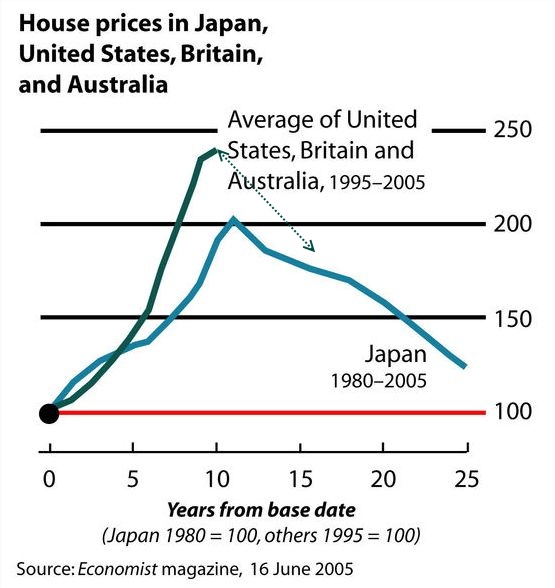


Source: The Economist


The first definite comparison we can make is with the rampant rise in home values. Japanese real estate values saw a massive ten year boom during the Heisei boom. The chart above clearly shows the trajectory of land values. Yet research shows that a large part of this was concentrated on a few urban cities. In this regard, the U.S. had a much larger and more pervasive boom impacting multiple cities across the nation like Miami, Las Vegas, New York, Los Angeles, San Francisco, Phoenix, and many other locations. If we separate Tokyo out we see that overall Japan did have a bubble but it doesn’t seem as large or as widespread:
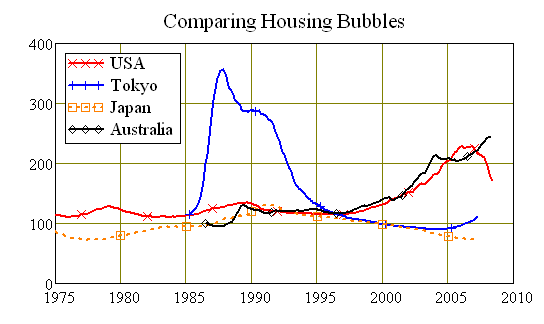


Source: Debt Deflation


The above is an interesting chart because it reflects a concentrated urban bubble. We had many suburbs popping up with home builders trying to create demand where there was nothing more than a bubble to chase. Many of these areas including the Inland Empire in California have large homes selling for half off (or more) with very little demand chasing after the homes. It is an interesting case study as to why values go up so quickly but miscalculations by the Federal Reserve and misguided policies led to the biggest and most widespread housing bubble here in the United States.


A 2003 paper by the Bank for International Settlements (BIS) focused on the Japanese housing bubble and concluded the following:


“What should be noted regarding Japan’s experience is that the enthusiasm of market participants, together with the inconsistent projection of fundamentals, contributed to a large degree to maintaining temporarily high asset prices at that time. Such enthusiasm is often called euphoria, excessively optimistic but unfounded expectations for the long-term economic performance, lasting for several years before dissipating.”


“It was thus excessive optimism rather than consistent projection of fundamentals that mainly supported temporarily high asset prices.”


There is little to debate that what fueled housing prices in the U.S. was also ignited by euphoria for real estate that was largely disconnected from fundamentals. Let us construct a chart similar to the above with Tokyo and Japan but in this case, we will look at the Los Angeles MSA and the 10 city composite from the Case Shiller data:
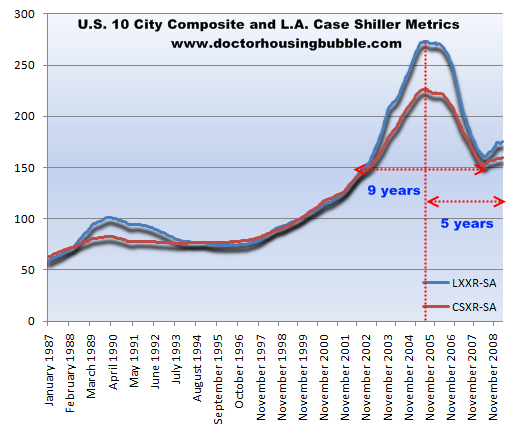


Although it would appear that Tokyo had a much quicker and faster rise in prices, an area like Los Angeles saw a very similar trend. Yet what separates the two bubbles is that the U.S. as an entire nation also saw a massive rise in prices over a short period of time. Looking back, we see that the peak for U.S. housing values was reached in 2006 with the Los Angeles MSA also reaching a peak in this year. The chart above shows the clear decade long boom in housing values. What we find over this decade period is that home values in the U.S. increased by a factor of 3 while home values in L.A. increased by a stunning factor of 4. In other words, the U.S. housing bubble was equally as large in magnitude as that faced by Japan but much more widespread.


The BIS paper also makes the comparison that Japan faced nearly two decades of bubbles, one started in the stock market followed by the real estate bubble:


“First, at the time of the Iwato boom, when Japan’s economy entered the so-called “high economic growth period”, asset prices increased rapidly, reflecting an improvement in fundamentals due to technological innovations. The real economic growth rate exceeded 10% per annum, driven mainly by investment demand due to technological innovations that replaced the post World War II reconstruction demand. On the price front, consumer prices rose while wholesale prices remained generally stable, thus leading to the so-called “productivity difference inflation”.


“Kakuei Tanaka, who became Prime Minister in 1972, effected extremely aggressive public investment based on his belief (remodelling the Japanese archipelago) that it was necessary to resolve overpopulation and depopulation problems by constructing a nationwide shinkansen railway network, which led to an overheated economy.”


This economy is largely seen by the charts below:
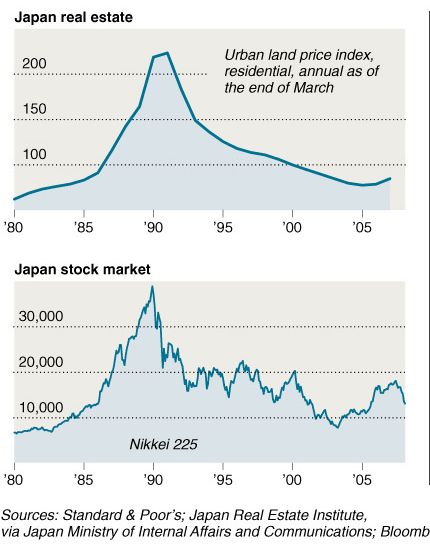


We have a very similar parallel here with our NASDAQ boom of the 1990s followed by the real estate boom reflected on the previous chart looking at Case Shiller home values. If we look at the NASDAQ, we realize that even after the recent boom in stock values prices are nowhere near their peak:
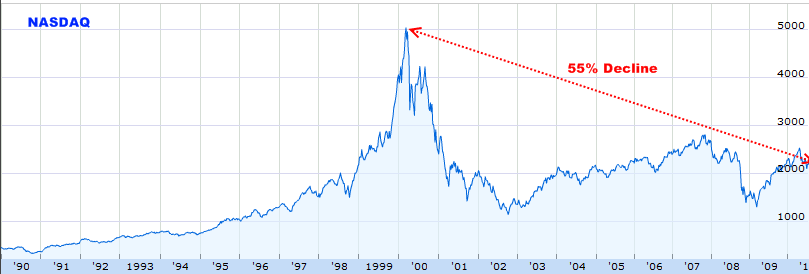


On a nominal level the NASDAQ is still off by 55 percent from the peak reached a decade ago. Often we hear about the lost decade comparison. In stock values, we are already there. In terms of real estate values, we are quickly approaching that point. So we have more similarities in our booms and busts with Japan than many would like to admit. The 1990s saw a rise also in productivity brought on by technological innovation but this also paved the wave for an economy largely decentralized on a global level. This hit hard in the manufacturing core of our country. Someone made the argument to me at the height of the real estate boom that “you can’t outsource real estate” which is true but that is a double edged sword as we are seeing. The Nikkei peaked on December 29, 1989 closing at 38,915.87. Today it stands at 9,431, a drop of over 75 percent. Massive bubbles can have long lasting impacts on the economy.


Missing asset bubbles and targeting inflation


Another important comparison made in the paper is that of perceived stable inflation and how central banks can miss asset bubbles while they are happening. It is the mistaking of a bubble for real economic growth:


“Third, in the Heisei boom, asset prices increased dramatically under long-lasting economic growth and stable inflation. Okina et al (2001) define the “bubble period” as the period from 1987 to 1990, from the viewpoint of the coexistence of three factors indicative of a bubble economy, that is, a marked increase in asset prices, an expansion in monetary aggregates and credit, and an overheating economy. The phenomena particular to this period were stable CPI inflation in parallel with the expansion of asset prices and a long adjustment period after the peaking of asset prices.”


“The decline in asset prices was initially regarded as the bursting of the asset price bubble, and an amplifying factor of the business cycle. Although the importance of cyclical aspects cannot be denied, further declines in asset prices after the mid-1990s seem to reflect the downward shift in the trend growth rate beyond the boom-bust cycle of the asset price bubble.”


This is an important key point. The Federal Reserve publicly stated that during the bubble (it wasn’t labeled as such) that inflation overall remained tame and therefore keeping interest rates low was viewed as a prudent policy. If the economy is growing and is stable, then the central bank should keep liquidity flowing into the system to keep building up legitimate businesses. Yet separating real growth with an asset bubble can be tricky especially when the policies taken are part of the reason for the asset inflation. Japan viewed there measures as stable. We did this in a similar fashion but part of it was that our metrics to measure inflation largely missed the housing bubble. The CPI measures “owners equivalent of rent” which completely ignored the rise in home values. This measure is the biggest in the CPI so the data was skewed. Also, innovation in mortgage products with teaser payments altered the true monthly payment and understated it. The government for most of this time also only focused on OFHEO (now FHFA) which only looked at home loans secured by Fannie Mae and Freddie Mac and ignored the vast majority of subprime Alt-A, and option ARMs that fueled the last stage of the housing bubble. In fact, year over year changes in the inflation measure from 1980 to 2000 seemed to be as stable as they come:
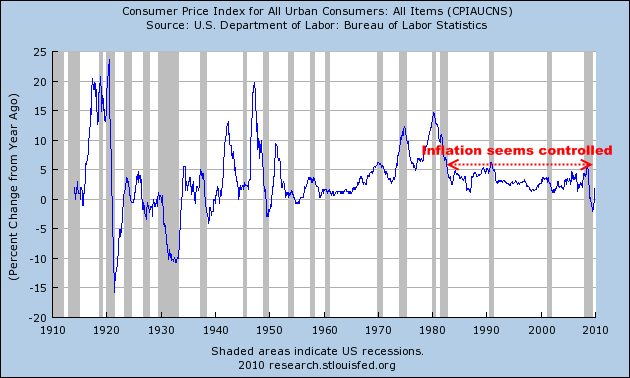


During this time we saw the massive NASDAQ bubble and also, the subsequent real estate bubble. Inflation data largely ignored most of it because the measure was flawed when it came to measuring bubbles. Japan had similar problems and taking policy decisions on this data has given their economy two lost decades and their economy is still suffering. Then why follow that same path?


Japan gives us a working sample as to what can happen with asset deflation, a stock bubble popping, allowing banks to remain propped up by government funding, and massive government spending:
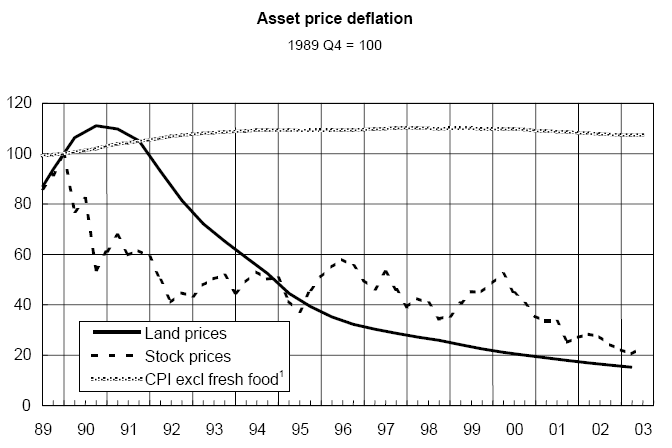


*Japan asset, stock and CPI measures


Some seem to think that Japan just sat back and did nothing during this time. There is nothing further from the truth. Japan was the first major economy to go down the path of quantitative easing. Japan also injected enormous amounts of money into their economy to stimulate growth. Yet the above chart is rather clear in the outcome. Some point to unemployment in Japan remaining low. This is more a sleight of hand with economic data. Although the official rate is low, nearly 1 out of 3 Japanese workers are considered part-time employed. That is, no security of long-term employment. We have seen a massive rise in the number of Americans that now work in a part-time fashion. No benefits, lower wages, and job security that is no longer an option in the longer term. It is easy to see why asset prices in Japan have remained depressed for so long. Prices in the U.S. are showing no sign of inflationary pressures because there is little mechanism to force wages up with such a giant over supply of labor in the market. This is possibly one of the major points missed by those who predict inflation or hyper-inflation in the future. Central banks can print but they can’t force wages up especially in a global market where cheap wages are the status quo. To the contrary, banks are following the zombie like behavior of Japan banks by hoarding funds:
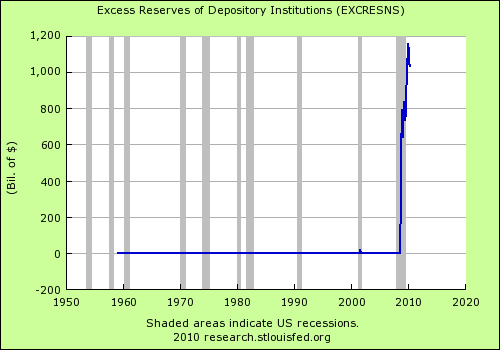


Now that we’ve had three full years after the bubble popped, we can see what banks have done to “fix” the problem:


-Hoard money to fix balance sheet imbalances


-Suspend mark to market (Japan banks zombie like tool of preference)


-Ignore major commercial real estate problems


-Drag out the real estate problems (we have done the same with banks delaying the foreclosure process, stopped lending their own capital in place of government loans, and banks have turned inward with government bailout funds).


The above chart shows that banks are still sitting on an enormous amount of excess reserves. Now that due diligence is back (to a certain degree) who are banks going to lend to? 4 out of 10 workers in the U.S. are employed by the low paying service sector. Close to 15 million are officially unemployed and unless we go back to the easy lending mortgage days, they won’t be getting any bank money soon. We have another 9 million workers that are employed part-time for economic reasons (similar to the large employment base of Japan). You think this group is going to get a loan for a home anytime soon? Banks have turned their profits inward while the real economy is largely in stagnation. Yet if Japan is any indicator, these profits will start to go down:
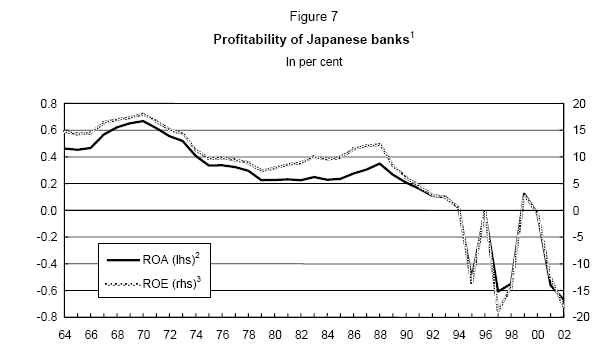


While it is easy to make money right now since a large part of the competition has failed while a select few have been given government backing and funding, as time goes on this profitability goes away. And the real economy in Japan has languished all this time. The BIS paper in 2003 gives a wonderful synopsis of what led to the Japanese boom and bust economy:


“The intensified bullish expectations were certainly grounded in several interconnected factors. The factors below are often pointed out as being behind the emergence and expansion of the bubble:


• aggressive behaviour of financial institutions


• progress of financial deregulation


• inadequate risk management on the part of financial institutions


• introduction of the Capital Accord


• protracted monetary easing


• taxation and regulations biased towards accelerating the rise in land prices


• overconfidence and euphoria


• overconcentration of economic functions in Tokyo, and Tokyo becoming an international financial centre


Focusing on monetary factors, it is important to note the widespread market expectations that the then low interest rates would continue for an extended period, in spite of clear signs of economic expansion. The movement of implied forward rates from 1987 to 1989 (Figure 5) shows that the yield curve flattened while the official discount rate was maintained at a low level.”


You might as well put this label on the U.S. Aggressive behavior of financial institutions? Doesn’t get more aggressive than giving a loan to someone with no job and no income. Progress of financial deregulation? What about repealing Glass-Steagall in 1999, protection we had put in place back from the Great Depression. Inadequate risk management? We need only look at AIG, Lehman Brothers, Bear Stearns, Fannie Mae and Freddie Mac, and many others. Protracted monetary easing? Does a zero percent interest rate and buying up of mortgage backed securities count? Taxation and regulations biased toward rising prices? How about giving new home buyers a tax credit when they were going to buy anyway? Over confidence and euphoria? Just go to YouTube and watch some of the real estate commercials from the peak days of the housing bubble.


We have a lot that is similar to Japan and their boom and bust economy. If their path is any indication of our own, we have a long road ahead and getting home prices back up is probably going to be the least of our concerns.


Did You Enjoy The Post? Subscribe to Dr. Housing Bubble’s Blog to get updated housing commentary, analysis, and information.


a


"

17 REASONS TO BE BULLISH

17 REASONS TO BE BULLISH: "

Regular readers know I tend to focus on the negative aspects of the markets as opposed to the positives – anyone could put on a smile and skip through oncoming traffic, but the truth is, the investment world can be a very dangerous place so skipping along as if there are no risks involved is beyond foolish. But ignoring the positives is equally foolish. In this world of heightened market risks and particularly clear uncertainty here are 17 reasons to consider the bullish case (via David Rosenberg at Gluskin Sheff):


  • Congress extending jobless benefits (yet again).


  • Polls showing the GoP can take the House and the Senate in November.


  • Some Democrats now want the tax hikes for 2011 to be delayed.


  • Cap and trade is dead.


  • Cameron’s popularity in the U.K. and market reaction there is setting an example for others regarding budgetary reform.


  • China’s success in curbing its property bubble without bursting it.


  • Growing confidence that the emerging markets, especially in Asia and Latin America, will be able to ‘decouple’ this time around. We heard this from more than just one CEO on our recent trip to NYC and Asian thumbprints were all over the positive news these past few weeks out of the likes of FedEx and UPS.


  • Renewed stability in Eurozone debt and money markets – including successful bond auctions amongst the Club Med members.


  • Clarity with respect to European bank vulnerability.


  • Signs that consumer credit delinquency rates in the U.S. are rolling over.


  • Mortgage delinquencies down five quarters in a row in California to a three-year low.


  • The BP oil spill moving off the front pages.


  • The financial regulation bill behind us and Goldman deciding to settle –more uncertainty out of the way.


  • Widespread refutation of the ECRI as a leading indicator … even among the architects of the index! There is tremendous conviction now that a double-dip will be averted, even though 85% of the data releases in the past month have come in below expectations.


  • Earnings season living up to expectations, especially among some key large-caps in the tech/industrial space – Microsoft, AT&T, CAT, and 3M are being viewed as game changers (especially 3M’s upped guidance). Even the airlines are reporting ripping results.


  • Bernanke indicating that he can and will become more aggressive at stimulating monetary policy if he feels the need and yesterday urging the government to refrain from tightening fiscal policy (including tax hikes).


  • Practically every street economist took a knife to Q2 and Q3 GDP growth, which has left PM’s believing we are into some sort of capitulation period where all the bad news is now “out there”.


Source: Gluskin Sheff

Post Footer automatically generated by Add Post Footer Plugin for wordpress.

"

Soft-Core Deflationism

Soft-Core Deflationism: "

There are two major schools of thought on what is coming next…and two renegade, home-schools too. There are those who believe we have a recovery…though weak…that will continue and eventually bring the economy back to health. This is the line of the Obama Administration and most mainstream economists.


Then, there are those who think the recovery will not come as planned…and that the feds’ efforts to spur a recovery – along with strong demand from Asia and the emerging markets – will lead to higher levels of inflation, destroying the dollar and bonds. This is what Marc Faber expects. He urges listeners to avoid going too heavily into cash, since it might be the number one victim of inflation. Instead, you’ll do better in stocks and real estate, he says.


A third line of thinking is what Faber calls “hard core deflationism” – typified by Robert Prechter and Gary Shilling. They think the de-leveraging trend will be catastrophic – leading to outright deflation, taking the Dow down below 1,000, for example.


Then, there’s The Daily Reckoning line. You can call it “soft-core deflationism”:


1) There is no recovery; there won’t ever be a recovery

2) The de-leveraging period will be longer and harder than people expect…leading to spells of deflation and double…triple…dipping

3) The feds will fight it with every weapon available

4) However, they will not push the ‘nuclear button’ – wanton, reckless money printing – until the bond market cracks

5) It will not crack soon, because the feds are incompetent; they will not succeed in getting higher rates of inflation; at least, not soon.

6) The dollar will remain strong. Bonds will go up…for now…

7) The Dow will fall…but not below 1,000…probably not below 5,000


What does that mean for gold? Well, it means gold won’t do spectacularly well. It might decline…say, down to $850 or so.


Eventually, the bull market in gold will resume, however. You can’t keep a good metal down. Just don’t expect it to go up dramatically while the private sector is reducing its debts in an orderly fashion.


Does that mean you should sell your gold? We wouldn’t if we were you. Because something could go very wrong. Another big bank failure. A blow-up in China. It wouldn’t take much to cause a panic. Investors could turn to gold for security.


Or, maybe the feds will panic…and dump dollars from helicopters as Ben Bernanke threatened.


Besides, we could be wrong. Predictions are always difficult to get right. Especially when they’re about the future.


Regards,


Bill Bonner

for The Daily Reckoning


Soft-Core Deflationism originally appeared in the Daily Reckoning. The Daily Reckoning, offers a uniquely refreshing, perspective on the global economy, investing, gold, stocks and today's markets. Its been called 'the most entertaining read of the day.'


"

Thursday, July 15, 2010

Valuations

Valuations: "

The latest weekly commentary by Comstock Partners.

We stated in the 4th of July holiday comment that we would discuss valuations in the "special report" we wrote last week. As it turned out the "special report" got too bogged down in the discussion of why the private debt in our country would have to be deleveraged before a significant recovery could take place. We encourage you to read it.

This comment will now address why there is so much controversy about valuations in the stock market presently. The bulls are constantly exclaiming in the financial press and financial TV why investors must buy equities due to these "fantastic valuations". We asked our viewers to prepare for this comment by taking a look at the section on our home page titled "Limbo, Limbo, How Low Can it Go?" There you will find many different metrics that show the historical valuations and where the stock market sold at the peaks and troughs over many years. All these charts were produced by Ned Davis Research, which we consider the best data source available.

We believe after studying the charts mentioned above you will find that none of the most popular metrics will show the stock market to be inexpensive. The only way the main valuation metric (P/E Ratios) could show the market to be cheap is to replace the age old "reported earnings" (Generally Accepted Accounting Principles-GAAP) with "operating earnings".

The pundits are using forward looking "operating earnings" in order to reach for their estimates of 10 to 12 times earnings. "Operating Earnings" which exclude "write-offs", make no sense whatsoever, and only came into existence in the mid 1980s in order to make the market look undervalued. We advised you to look at the articles written by us and published in Barron’s on our home page (Comstock in the News). The first was in May of 2003 titled "A Simple Calculation", and the second titled "What’s the Real P/E Ratio?" written in May 2008. We just reread the 2008 article and found some interesting statistics we used back then, and until now, didn’t recall just how far off the earnings estimates were.

This is what we stated in the article back in May 2008, "Look at the numbers. Reported earnings for the S&P 500 for 2007 were just over $66. The operating earnings for 2007 were $84.54. The estimated numbers for 2008 are about $69 for reported earnings and about $90 for operating earnings. By the way, these estimates have just recently been revised downward drastically, due to the slowdown in the U.S. economy." Imagine what they were before they were revised downward drastically. The actual numbers came in at $14.88 for reported earnings vs. the estimate of $69, and $49.51 for operating earnings vs. the estimate of $90 (see actual earnings in the attached chart–Sorry-the chart will be posted tomorrow). This means that with just 7 months to go in 2008 the earnings were off the $69 estimate by $54, and off the $90 estimate by $40. This goes to show how absurd it was and still is to use forward earnings-and imagine if we used the estimates before they were revised downward drastically. Numerous articles have been published which show that forward estimated earnings are not reliable.

The earnings estimates for the year 2010 are about $82 for operating and $67.35 for reported earnings. The earnings estimates for 2011 are $95 for operating, and $78 for reported earnings. As bad as it is to use forward earnings, the really insane part of these estimates is that virtually all of "Wall Street" is using Operating earnings that were not even in existence before the mid 1980s. Even more outrageous is the fact that these earnings exclude "write-offs" even if the write-offs are recurring and disregard the GAAP earnings (reported earnings) which were the only earnings ever used before the mid 1980s (and which became more popular each year as it became harder to make stocks look undervalued-especially during the dot.com bubble).

If you break down these earnings estimates by the quarter or half year, you will find that the estimates are higher for the second half of this year than the first and clearly higher by about 15% in 2011. We find this to be curious since it seems to us that the recovery is running out of steam. The main ingredients for virtually any upswing in the economy are dependent upon 1. Employment 2. Consumer Spending 3. Housing 4. Increase in Exports, and 5. Restocking of Inventory. Usually these ingredients need easy money or some form of inflation. Despite low interest rates banks are reluctant to loan money to small businesses and individuals. These ingredients needed to stimulate the economy have all either rolled over or never really got started (Housing-see 6/10/10 "The Dire Outlook for Housing"). Retail sales were just released and were disappointing for the second month in a row after a false start from the stimulus package. Employment continues to disappoint and the rebuilding of inventory has come to a screeching halt. The trade deficit has just recently gotten worse and that speaks volumes about our ability to export goods and services.

The worst part of the ingredients that produce an economic rebound is the fact that deflation is permeating the whole system. The Fed was worried about deflation back in 2003 and talked about it constantly. Well now, according to the Federal Reserve Bank of Cleveland, the median Consumer Price Index was virtually unchanged at 0.0% in May, while the CPI was down 0.1% in April and down 0.2% in May. The PPI released today was down 0.5% in June vs. down 0.3% in May. In 2003 the median CPI from Cleveland was up about 1.5% and the CPI was up 2.3% during all of the Feds ranting about deflation and how they would make sure it will not occur in this country. They were able to drop rates to 1% and keep them there for a year, which was the main impetus that drove housing and stocks into a bubble, comparable to the dot.com bubble, from 2003 to 2007. We suspect strongly that the recent easy policy will not produce a third bubble. It takes a while for investors to learn from past mistakes and there is no way to start another bubble in the near future.

It sure doesn’t seem that the economy has much going for it, and if that is the case, it is hard to believe that the earnings will be higher in the second half than the first (which is presently the estimate), and really hard to believe that they will increase by 15% next year (which is also the estimate). If we use the reported earnings estimate of $67.35 (which we don’t believe) you get a P/E of 16.2, if you use the estimate of next year of $77.64 (which we really don’t believe) the P/E works out to just over 14. All of these P/E ratios on reported earnings are above the average for forward earnings and do not reflect an undervalued market.

Our favorite means of determining a fair valuation is to smooth the reported earnings over a 9 year period of time by taking the 9 year average and grow the average for 4.5 years (one half the 9 years) at 6% (where earnings have grown historically) to arrive at the $64 of smoothed earnings. Using the smoothed earnings of $64 you arrive at the overvalued level of 17 times. We also believe that this market will not bottom out until it reaches 10 times or lower the smoothed earnings. Although this may sound implausible, we note that the S&P 500 sold at a P/E of 10 or under smoothed earnings in 17 of the past 60 years.


Share/Bookmark

Related posts:


Post Permalink: Valuations
Permalinks: RSS - Newsletter - Twitter - News - Contact
Copyright © by Credit Writedowns
Author: Charles Minter;
Site Meter Tags: , ,


"

Investing for the Fall of the American Empire

Investing for the Fall of the American Empire: "

Adrian Day of Adrian Day Asset Management says that you should be restructuring your portfolio to reflect the ongoing economic decline of the West and the rise of the East. The US is now in a period that historically parallels Great Britain at the end of WWII, when a pound cost $5, on its way to $1, some 37 years later.

While we are seeing some dollar strength now, this is only a fleeting move in a secular bear market (UDN). Central banks have cut their holdings of the greenback from 70% to 65%, and we could be on our way to 50% or lower. They no longer wish to hold such a heavy weighting of the currency of a country with such a large and worsening structural deficit. This will not be achieved through some great cataclysmic sell off, but a slow and steady diversion of new money into other assets. Adrian especially likes the Singaporean and Hong Kong dollars and the Chinese Yuan (CYB). Ownership of Canadian and Australian dollars, and gold, is rising. He is not a fan of the yen or the euro.

Day is extremely cautious about global stock markets for the time being, but likes emerging markets long term, which will be driven by a rising middle class in the decades to come. Brazil (EWZ) is a top choice, with vast improvements in governance since the bad old days of the eighties, and one of the world’s strongest currencies. He’s out now, awaiting an election that could bring a leftist tilt. He likes real estate mortgage lender Gafisa (GFA), in which Chicago mogul San Zell is the largest investor (click here for more depth at http://www.madhedgefundtrader.com/july_30__2009.html ). Adrian clearly adores Singapore (EWS), where companies have believable accounting and super strong balance sheets. Day has nothing in Africa or Eastern Europe.

Adrian is also a big gold bull (GLD), as it now is a defensive holding that does well in every economic scenario. He doesn’t see the retail rush to buy the barbaric relic as a fiat currency replacement any time soon. And then there’s the central bank bidding war. Ben Bernanke and Alan Greenspan are in denial, still don’t understand the Fed’s role in creating the credit bubble, and until they do, investors have no reason to trust in paper currencies.

The cerebral Englishman wants to buy oil and gas during the traditional summer weakness, as well as commodity producers. He worships Freeport McMoRan (FCX), the top copper miner, as one of the best managed companies in the world. He is bullish on food (CORN), ags like Potash (POT), and water (PHO) (click here for my piece on H2O at http://www.madhedgefundtrader.com/september_17__2009.html ). He also likes business development companies such as Apollo Investments (AINV) and Ares Capital (ARCC).

After getting a degree from the prestigious London School of Economics, Adrian devoted a lifetime to uncovering undervalued investment opportunities around the world. Today Adrian runs his own money management firm which focuses on global diversification for institutional clients. He is about to release a book entitled Investing in Resources: How to Profit from the Outsized Potential and Avoid the Risks. You can learn more about Adrian’s firm by visiting his site at http://www.adriandayassetmanagement.com/ .

To listen to my interview with Adrian on Hedge Fund Radio in full, please click here at http://www.madhedgefundtrader.com/july-6-2010-adrian-day.html and then on the “PLAY” arrow at “Today on Hedge Fund Radio.

To see the data, charts, and graphs that support this research piece, as well as more iconoclastic and out-of-consensus analysis, please visit me at www.madhedgefundtrader.com . There, you will find the conventional wisdom mercilessly flailed and tortured daily, and my last two and a half years of research reports available for free.

"

Presenting The Wall Of Worry: The 50 Ugliest Facts About The US eCONomy

Presenting The Wall Of Worry: The 50 Ugliest Facts About The US eCONomy: "

As we close on another week replete with ugly economic data and the usual bizarro counterintuitive market, here is a summary of the 50 most underreported facts about the state of the US economy, courtesy of the Coto report. After reading these it almost makes sense that the market has become completely desensitized to the sad reality now pervasive in this country. Readers are encouraged to add their own observations to this list.
Surely if the list is doubled, the market will go up to 72,000 instead
of just 36,000.

#50) In 2010 the U.S. government is projected to issue almost as much
new debt as
the rest of the governments of the world combined
.


#49) It is being projected that the U.S. government will have a
budget deficit of
approximately 1.6 trillion dollars
in 2010.


#48) If you went out and spent one dollar every single second, it
would take you more than 31,000
years
to spend a trillion dollars.


#47) In fact, if you spent one million dollars every single day since
the birth of Christ, you still would
not have spent one trillion dollars
by now.


#46) Total U.S. government debt is now up to 90
percent
of gross domestic product.


#45) Total credit market debt in the United States, including
government, corporate and personal debt, has
reached 360 percent of GDP
.


#44) U.S. corporate income tax receipts were
down 55%
(to $138 billion) for the year ending September 30th,
2009.


#43) There are now 8 counties in the state of California that have
unemployment rates of
over 20 percent
.


#42) In the area around Sacramento, California there is one closed business for every six that are still open.


#41) In February, there were 5.5
unemployed Americans for every job opening
.


#40) According
to a Pew Research Center study
, approximately 37% of all Americans
between the ages of 18 and 29 have either been unemployed or
underemployed at some point during the recession.


#39) More
than 40%
of those employed in the United States are now working in
low-wage service jobs.


#38) According to one new survey, 24% of American workers say that they
have postponed their planned retirement age
in the past year.


#37) Over 1.4 million Americans filed for personal bankruptcy in
2009, which represented a
32 percent increase over 2008
. Not only that, more
Americans filed for bankruptcy in March 2010
than during any month
since U.S. bankruptcy law was tightened in October 2005.


#36) Mortgage purchase applications in the United States are down nearly 40 percent
from a month ago to their lowest level since April of 1997.


#35) RealtyTrac has announced that foreclosure filings in the U.S. established
an all time record for the second consecutive year
in 2009.


#34) According to RealtyTrac, foreclosure filings were
reported on 367,056 properties in March 2010
, an increase of nearly
19 percent from February, an increase of nearly 8 percent from March
2009 and the highest monthly total since RealtyTrac began issuing its
report in January 2005.


#33) In Pinellas and Pasco counties, which include St. Petersburg,
Florida and the suburbs to the north, there
are 34,000 open foreclosure cases
. Ten years ago, there were
only about 4,000.


#32) In California’s Central Valley, 1 out of every 16 homes is
in some phase of foreclosure
.


#31) The Mortgage Bankers Association recently announced that more
than 10 percent of all U.S. homeowners with a mortgage had missed at
least one payment during the January to March time period. That was a record high and up from 9.1 percent a
year ago.


#30) U.S. banks repossessed
nearly 258,000 homes nationwide
in the first quarter of 2010, a 35
percent jump from the first quarter of 2009.


#29) For the first time in U.S. history, banks
own a greater share of residential housing net worth in the United
States
than all individual Americans put together.


#28) More than 24% of all homes with mortgages in the United States were underwater as of the end of 2009.


#27) U.S. commercial property values are
down approximately 40 percent
since 2007 and currently 18 percent
of all office space in the United States is sitting vacant.


#26) Defaults on apartment building mortgages held by U.S. banks
climbed to
a record 4.6 percent
in the first quarter of 2010. That was almost
twice the level of a year earlier.


#25) In 2009, U.S. banks posted their sharpest decline in private
lending since 1942.


#24) New York state has
delayed paying bills totalling $2.5 billion
as a short-term way of
staying solvent but officials are warning that its cash crunch could
soon get even worse.


#23) To make up for a projected 2010 budget shortfall of $280
million, Detroit issued $250 million of 20-year municipal notes in
March. The bond issuance followed on the heels of a warning from Detroit
officials that if its financial state didn’t improve, it
could be forced to declare bankruptcy
.


#22) The National League of Cities says that municipal governments
will probably come up between
$56 billion and $83 billion short
between now and 2012.


#21) Half a dozen cash-poor U.S. states have announced that
they are delaying their tax refund checks
.


#20) Two university professors recently calculated that the combined
unfunded pension liability for all 50 U.S. states is
3.2 trillion dollars
.


#19) According to EconomicPolicyJournal.com, 32
U.S. states have already run out of funds to make unemployment benefit
payments
and so the federal government has been supplying these
states with funds so that they can make their payments to the
unemployed.


#18) This most recession has erased 8
million private sector jobs
in the United States.


#17) Paychecks from private business shrank to
their smallest share of personal income in U.S. history
during the
first quarter of 2010.


#16) U.S. government-provided benefits (including Social Security,
unemployment insurance, food stamps and other programs) rose
to a record high
during the first three months of 2010.


#15) 39.68
million Americans
are now on food stamps, which represents a new
all-time record. But things look like they are going to get even
worse. The U.S. Department of Agriculture is forecasting that
enrollment in the food stamp program will exceed 43 million Americans in
2011.


#14) Phoenix, Arizona features an
astounding annual car theft rate of 57,000 vehicles
and has become
the new “Car Theft Capital of the World”.


#13) U.S. law enforcement authorities claim that there are now over 1
million members of criminal gangs inside the country. These 1 million
gang members are responsible for
up to 80% of the crimes committed
in the United States each year.


#12) The U.S. health care system was already facing a shortage of
approximately 150,000 doctors in the next decade or so, but thanks to
the health care “reform” bill passed by Congress, that number
could swell by
several hundred thousand more
.


#11) According
to an analysis by the Congressional Joint Committee on Taxation
the
health care “reform” bill will generate $409.2 billion in additional
taxes on the American people by 2019.


#10) The Dow Jones Industrial Average just experienced the
worst May
it has seen since 1940.


#9) In 1950, the ratio of the average executive’s paycheck to the
average worker’s paycheck was about 30 to 1. Since the year 2000,
that ratio has exploded
to between 300 to 500 to one
.


#8) Approximately 40%
of all retail spending
currently comes from the 20% of American
households that have the highest incomes.


#7) According to economists Thomas Piketty and Emmanuel Saez,
two-thirds of income increases in the U.S. between 2002 and 2007 went to
the wealthiest 1% of all Americans
.


#6) The bottom 40 percent of income earners in the United States now
collectively own less than 1 percent of the nation’s wealth.


#5) If you only make the minimum payment each and every time, a
$6,000 credit card bill can
end up costing you over $30,000
(depending on the interest rate).


#4) According to a new report based on U.S. Census Bureau data, only
26 percent of American teens between the ages of 16 and 19 had jobs in
late 2009 which represents a record low since statistics
began to be kept back in 1948.


#3) According to a National Foundation for Credit Counseling survey,
only 58% of those in “Generation Y” pay
their monthly bills on time
.


#2) During the first quarter of 2010, the total number of loans that
are at least three months past due in the United States increased for
the 16th consecutive quarter
.


#1) According
to the Tax Foundation’s Microsimulation Model
, to erase the 2010
U.S. budget deficit, the U.S. Congress would have to multiply each tax
rate by 2.4. Thus, the 10 percent rate would be 24 percent, the 15
percent rate would be 36 percent, and the 35 percent rate would have to
be 85 percent.

h/t Teddy KGB

"

The $4 Trillion Dollar Question

The $4 Trillion Dollar Question: "

I have been covering the US Real Estate market for decades. I grew up with RE (mom was a RE broker and an investor). I have been a housing bear for about 5 years. I recognized the credit bubble and inevitable bust long before most other analysts/strategists/economists did.


I mention this just to inform readers that it is very rare that I come across any housing analysis that surprises me or adds to my understanding of the real estate landscape in a major way.


Which is why I am so pleased to introduce you to Dhaval Joshi, Chief Strategist at London based hedge fund RAB Capital (and former Societe Generale and J P Morgan Strategist).


Dhaval’s analysis looks a variety of housing data relative to household formation, housing stock, vacancy rates, and inventory is not the typical housing review. It is quite illuminating.


Enjoy:


~~~


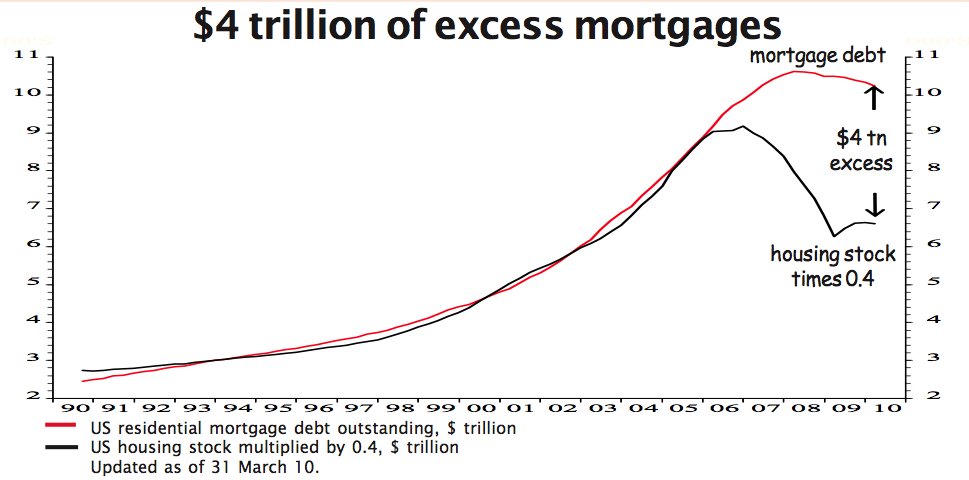
Can the US economy really return to “business as usual” when it has 4 million houses surplus to requirement, when 1 out of 4 mortgages are in negative equity, and when by our calculation, it is burdened with $4 trillion of excess mortgage debt, equivalent to 30% of GDP?


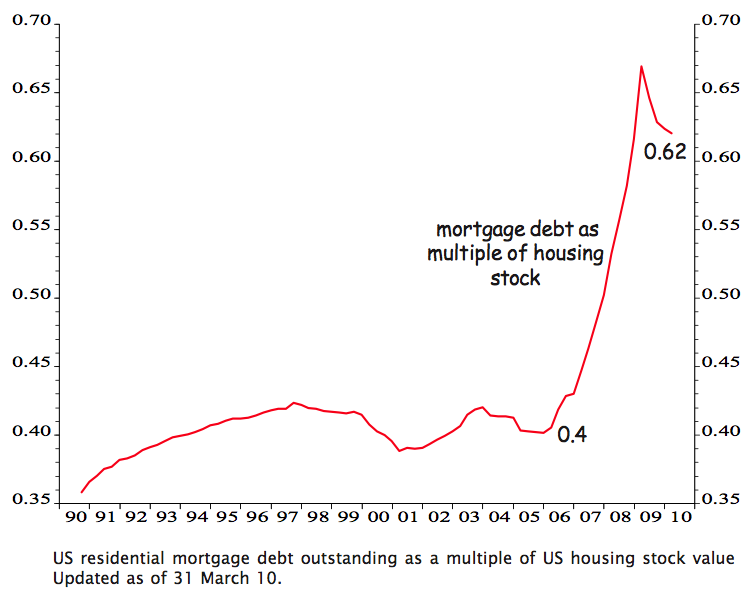
For many years, total mortgage debt consistently and reliably equalled 0.4 times the value of the US housing stock. Intuitively, this average of 0.4 makes perfect sense as every property usually has a mortgage ranging from 0 to 0.9 times its value. So in 1990, $6 trillion of housing collateral could support $2.5 trillion of mortgages, and by 2006, $23 trillion of housing collateral could support $10 trillion of mortgages. But since then, the US housing stock’s value has slumped to $16 trillion which means the amount of mortgage lending supportable by the collateral has plunged to $6 trillion. However, actual mortgage debt has remained at $10 trillion – $4 trillion too high.


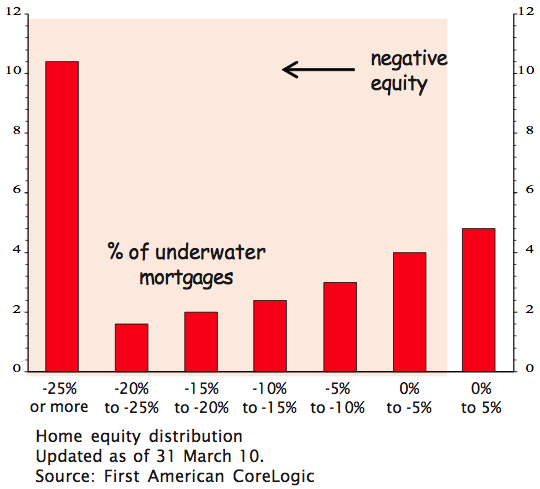
The fact that mortgage debt has barely declined suggests that relatively few homeowners have defaulted on their mortgages or paid off debt yet. Instead, a quarter of all borrowers are sitting on negative equity. That’s just as well – because were mortgage debt to shrink by even half of $4 trillion, the US economy would slump.


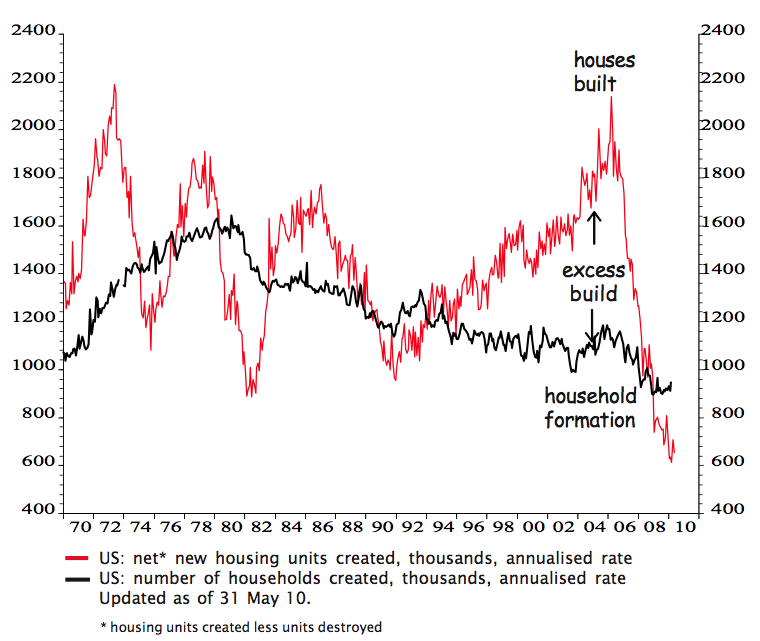
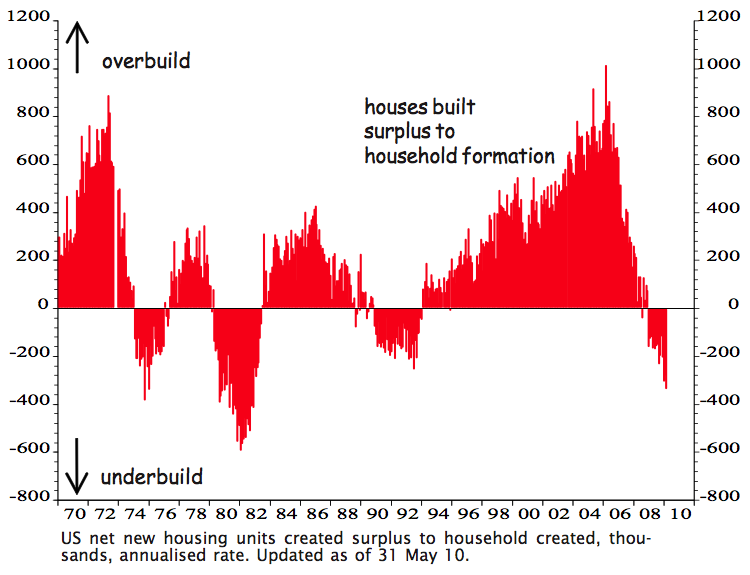
Perhaps homeowners are patiently expecting house prices to rise again. But if so, they may be in for a long wait. Prices are likely to be weighed down by a massive oversupply of homes relative to underlying demographic demand. Whether you look at the houses to population ratio, the houses to household ratio or vacant houses ratio, the conclusion is the same – there is a 3% surplus of properties, equivalent to 4 million homes. And with household formation running at just 0.9 million while the US is still building 0.6 million new homes annually, only 0.3 million of the oversupply will be absorbed per year (see page 5).


Ultra low rates to stay


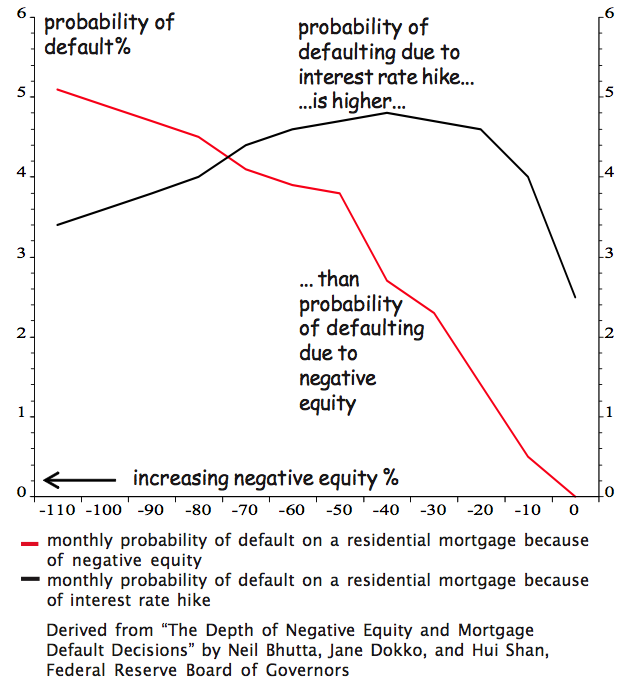
A recent study by the Federal Reserve (The Depth of Negative Equity and Mortgage Default Decisions by Bhutta, Dokko and Shan) investigated the question: at what point do underwater homeowners “strategically default” on their mortgages? Surprisingly, it found that the average borrower doesn’t walk away from his home until negative equity reaches a very high level, -62%. But the fascinating thing was that there was something that could trigger underwater borrowers to default much, much earlier – and that something was an interest rate rise.


With a quarter of US mortgages underwater, and likely to stay that way for some time, the Fed must follow its own research if it wants to prevent a cascade of defaults. Hence, expect US interest rates to stay ultra low for an ultra long time.


>


>


For many years, total mortgage debt consistently and reliably equalled 0.4 times the value of the US housing stock. Intuitively, this average of 0.4 makes perfect sense as every property usually has a mortgage ranging from 0 to 0.9 times its value. So in 1990, $6 trillion of housing collateral could support $2.5 trillion of mortgages, and by 2006, $23 trillion of housing collateral could support $10 trillion of mortgages. But since then, the US housing stock’s value has slumped to $16 trillion which means the amount of mortgage lending supportable by the collateral has plunged to $6 trillion. However, actual mortgage debt has remained at $10 trillion – $4 trillion too high.


>


Loan to value ratio is 1.5 times too high


>


To put it another way, the loan to value ratio of total mortgages outstanding to housing stock value is currently 1.5 times too high.


>


24% of US mortgages are underwater


>


The fact that mortgage debt has barely declined suggests that relatively few homeowners have defaulted on their mortgages or paid off debt yet. Instead, a quarter of all borrowers are sitting on negative equity.


>


Higher interest rates may trigger cascade of defaults


>


A recent study by the Federal Reserve investigated the central question: at what point do underwater homeowners “strategically default” on their mortgages? Surprisingly, it found that when the decision is based on negative equity alone, the average borrower doesn’t walk away from his home until it is very underwater (negative equity of 62%). But the fascinating thing was that there was something that could trigger underwater borrowers to default much, much earlier – and that something was an interest rate rise. In fact, higher interest rates were even more significant in triggering defaults than higher unemployment.


With a quarter of US mortgages underwater, the Fed must heed the advice of its own research if it wants to prevent a cascade of defaults and the consequent repercussions on the financial system and the economy. Hence, expect US interest rates to stay ultra low until millions of mortgages escape out of negative equity.


>


The US has built far too many houses


>


Perhaps homeowners suffering negative equity are patiently expecting house prices to rise again. But they may be in for a long wait. Prices are likely to be weighed down by a massive oversupply of homes relative to underlying demographic demand.


Between 2002 and 2006, US homebuilders went on a construction binge, building 12 million new homes while the number of households went up by just 7 million. The painful legacy is a massive oversupply of houses relative to the number of households.


>


The oversupply will take years to clear


>


With household formation running at just 0.9 million while the US is still building 0.6 million new homes annually, only 0.3 million of the oversupply will be absorbed per year. As there are currently 4 million too many homes, it may take years to mop up the huge oversupply of houses.


"