Sunday, October 24, 2010

The US Dollar is Doomed

The US Dollar is Doomed: "

Austerity be damned, at this rate Mr. Bernanke will go down in the history books as one of the greatest money creators ever to have walked this planet!


Never mind sky-high deficits and a crushing debt overhang, at its most recent FOMC meeting, the Federal Reserve all but guaranteed another round of quantitative easing.


While the American central bank did not officially expand its quantitative easing program last month, it did reiterate its willingness to institute more aggressive monetary policy measures in order to combat the risks of deflation. Furthermore, Mr. Bernanke did officially downgrade the Federal Reserve’s outlook for inflation.


The truth is that the US is insolvent and its policymakers will stop at nothing in order to avoid sovereign default. So, it should come as no surprise that at its latest meeting, the Federal Reserve downplayed the risk of inflation, thereby setting the stage for another round of money creation.


Make no mistake; Mr. Bernanke has already created copious amounts of money. Granted, the Federal Reserve’s previous monetisation was highly secretive, but you can be sure that it did occur. Allow us to explain:


You will recall that during the depths of the financial crisis, the Federal Reserve expanded its own balance-sheet and bought all sorts of toxic assets from the financial institutions. By doing so, Mr. Bernanke created money out of thin air and bailed out the major banks.


Thus, the banks were able to dump their garbage assets on to the Federal Reserve and once they received the newly created cash in exchange for these securities, they loaned this money to the US government by purchasing US Treasuries. In summary, in the previous round of quantitative easing, the Federal Reserve created new money and instead of lending it directly to the US government, it used the banking cartel as its conduit. Back then, not only did the Federal Reserve create more than a trillion dollars, it also dropped its discount rate to almost zero; thereby allowing banks to borrow money cheaply! It should be noted that since the banks were able to obtain such inexpensive funding from the Federal Reserve, they had absolutely no qualms about re-investing this capital in US Treasuries.


At first glance, the Federal Reserve’s stealth monetisation plan seemed flawless. The banks offloaded their toxic assets on to the Federal Reserve, they made fortunes by investing in US Treasuries and the American government got access to a cheap source of funding. Magic!


Despite the fact that this financial wizardry was a lifeline for American policymakers and their banking cronies, let there be no doubt that it was an unmitigated disaster for the American public. Not only did the Federal Reserve nationalise the banks’ losses but more importantly, Mr. Bernanke’s money creation efforts have seriously undermined the viability of the US Dollar.


It is noteworthy that since bailing out the major banks and orchestrating the stealth monetisation, the Federal Reserve has been busy purchasing US Treasuries. Furthermore, it is now almost certain that in next month’s FOMC meeting, Mr. Bernanke will unleash yet another round of quantitative easing. In other words, in order to fund Mr. Obama’s out of control spending, Mr. Bernanke will create even more dollars out of thin air! Allegedly, this new round of money creation will drive interest-rates lower, thereby helping the US economic recovery. Or so the story goes.


Unfortunately, as any serious student of economic history knows, there is no such thing as a free lunch. By adding trillions of additional dollars to the monetary stock, Mr. Bernanke may succeed in bailing out his friends in high places but he is seriously jeopardising the US Dollar. In fact, bearing in mind the recent developments, it has become clear to us that the Federal Reserve wants to debase its currency. In our humble opinion, the US Dollar is a doomed currency and there is a real risk of an abrupt plunge in its value.


If our assessment turns out to be correct and Mr. Bernanke unleashes the second phase of quantitative easing, you can be sure that the US Dollar will slide against most un-manipulated currencies (which are few and far between) and hard assets. In fact, monetary inflation is the prime reason why we believe that the ongoing bull-market in stocks and commodities will continue for several more months.


Look. The US economy is swimming in debt and the total obligations (including social security, Medicare and Medicaid) now come in at around 800% of GDP! Furthermore, this year alone, Mr. Obama’s administration plans to spend another US$3.5 trillion, meanwhile the US Treasury will raise roughly US$2.2 trillion from issuing new government debt! Clearly, these numbers are unsustainable and you can bet your bottom dollar that the Federal Reserve will end up buying a large proportion of the newly issued US Treasury securities. As the American central bank funds more and more of Mr. Obama’s spending by creating new money, it will trash the value of its currency. In fact, given the growing imbalance between the government’s spending and tax receipts, very high inflation is inevitable and even hyperinflation cannot be ruled out.


For the sake of their financial well being, it is crucial that investors understand that inflation or even hyperinflation is a monetary phenomenon and a strong economy is not a pre-requisite for the debasement of a national currency. Whatever the reason, if a central bank decides to significantly increase the quantity of money in the system, that currency’s purchasing power will always diminish. This is how fiat-money regimes have operated since the beginning of time and this era is no different.


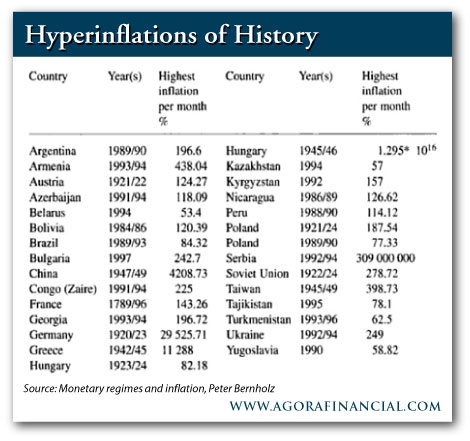
It is interesting to note that throughout recorded history, the worst excesses of inflation occurred only in the 20th century. Undoubtedly, this was a direct consequence of the adoption of fiat-money.


The following chart highlights all the hyperinflationary episodes in recorded history and as you can see, with the exception of the French Revolution (1789-1796), all of the other disasters occurred in the last century. In fact, it is an ominous sign that 29 out of the 30 recorded hyperinflations in human history occurred during the 20th century!


Hyperinflations in History


Let there be no doubt, a paper money system usually ends in the reckless destruction of money and it is no coincidence that all hyperinflations in history have occurred in the presence of discretionary paper money regimes. Furthermore, it is important to understand that a political system based on democracy is inherently inflationary and political leaders have been responsible for all major inflations in the past. Conversely, history has shown that monetary systems binding the hands of political leaders are essential for keeping inflation in check. If history is any guide, metallic monetary systems have shown the largest resistance to inflation and this is due to the fact that currencies anchored by a tangible asset cannot be inflated ad infinitum.


It is our conjecture that the current monetary system is absolutely pathetic; a system designed to enslave society. Unfortunately, the vast majority of humans do not understand the endless inflation agenda and this is why the perpetrators get away with this crime. Furthermore, let it be known that the Federal Reserve is largely responsible for the incredible inflation we have experienced over the past century.


The chart below plots the cost of living in Britain, France, Switzerland and the US. As you will note, the cost of living in these nations was relatively stable for over 160 years (1750-1913) but once the Federal Reserve came to power in 1913, everything changed. Suddenly, the cost of living exploded in these nations, so it should be clear that the Federal Reserve’s covert policy of currency inflation and debasement is solely responsible for this mind numbing inflation.


Cost of Living in Various Nations


Unfortunately, the Federal Reserve and its allies have not finished inflating and over the following years, they will create even more confetti money. Under this scenario, cash will continue to lose purchasing power and the asset poor middle-class will get even more impoverished. If our assessment is correct, cash will prove to be a disastrous ‘asset’ over the next decade and once the Federal Reserve’s manipulation ends, fixed income securities will also depreciate in value.


Bearing in mind our grave concern about high inflation and the very real possibility of hyperinflation, we continue to favour hard assets such as precious metals and energy. At present, we have allocated roughly half of our clients’ capital to these sectors and it is our belief that this should be an adequate inflation hedge.


Regards,


Puru Saxena

For The Daily Reckoning


The US Dollar is Doomed originally appeared in the Daily Reckoning. The Daily Reckoning, offers a uniquely refreshing, perspective on the global economy, investing, gold, stocks and today's markets. Its been called 'the most entertaining read of the day.'


"

The Subprime Debacle: Act 2, Part 2

The Subprime Debacle: Act 2, Part 2: "

The Subprime Debacle: Act 2, Part 2

October 23, 2010

By John Mauldin


>


The Subprime Debacle: Act 2, Part 2

They Knew What They Were Selling

Warning to Mr. Robert Rubin and Management

Popping Through

It’s Time for Some Putback Payback

The Worst Deal of the Decade?

And Now to the World Series


At the end of last week’s letter on the whole mortgage foreclosure mess, I wrote:


“All those subprime and Alt-A mortgages written in the middle of the last decade? They were packaged and sold in securities. They have had huge losses. But those securities had representations and warranties about what was in them. And guess what, the investment banks may have stretched credibility about those warranties. There is the real probability that the investment banks that sold them are going to have to buy them back. We are talking the potential for multiple hundreds of billions of dollars in losses that will have to be eaten by the large investment banks. We will get into details, but it could create the potential for some banks to have real problems.”


Real problems indeed. Seems the Fed, PIMCO, and others are suing Countrywide over this very topic. We will go into detail later in this week’s letter, covering the massive fraud involved in the sale of mortgage-backed securities. Frankly, this is scandalous. It is almost too much to contemplate, but I will make an effort.


But first, let me acknowledge the huge deluge of emails I got over last week’s letter, the most I can ever remember. I thought about just making this week’s letter a response to many of them, but decided I needed to go ahead and finish the topic at hand. Maybe another time. As a side note, I quoted a letter that came to me anonymously via David Kotok. I said if I found out who wrote it, I would give them credit. It was originally written by Gonzalo Liro, at www.gonzalolira.blogspot.com.


Many of you wrote to point out that his argument about the tracking of title was not correct, but others pointed out many other issues as well. This is one of the most complex problems we face, and I got a lot of good information from readers. It just makes me wish I had our new web site finished so you could avail yourselves of the wisdom among my readers. We are close, down to final changes. And now, on to today’s letter.


They Knew What They Were Selling


It’s hard to know where to start. There is just so much here. So let’s begin with testimony from Mr. Richard Bowen, former senior vice-president and business chief underwriter with CitiMortgage Inc. This was given to the Financial Crisis Inquiry Commission Hearing on Subprime Lending andnd Securitization andnd Government Sponsored Enterprises. I am going to excerpt from his testimony, but you can read the whole thing (if you have a strong stomach) at http://fcic.gov/hearings/pdfs/2010-0407-Bowen.pdf. (Emphasis obviously mine.)


“The delegated flow channel purchased approximately $50 billion of prime mortgages annually. These mortgages were not underwriten by us before they were purchased. My Quality Assurance area was responsible for underwriting a small sample of the files post-purchase to ensure credit quality was maintained.


“These mortgages were sold to Fannie Mae, Freddie Mac [We will come back to this - JM] and other investors. Although we did not underwrite these mortgages, Citi did rep and warrant to the investors that the mortgages were underwritten to Citi credit guidelines.


In mid-2006 I discovered that over 60% of these mortgages purchased and sold were defective. Because Citi had given reps and warrants to the investors that the mortgages were not defective, the investors could force Citi to repurchase many billions of dollars of these defective assets. This situation represented a large potential risk to the shareholders of Citigroup.


“I started issuing warnings in June of 2006 and attempted to get management to address these critical risk issues. These warnings continued through 2007 and went to all levels of the Consumer Lending Group.


We continued to purchase and sell to investors even larger volumes of mortgages through 2007. And defective mortgages increased during 2007 to over 80% of production.


Mr. Bowen was no young kid. He had 35 years of experience. He was the guy they hired to pay attention to the risks, and they ignored him. How could a senior manager not get such an email and not notify his boss, if only to protect his own ass? They had to have known what they were selling all the way up and down the ladder. But the music was playing and Chuck Prince said to dance and rake in the profits (and bonuses!). More from his testimony:


“Beginning in 2006 I issued many warnings to management concerning these practices, and specifically objected to the purchase of many identified pools. I believed that these practices exposed Citi to substantial risk of loss.


Warning to Mr. Robert Rubin and Management


On November 3, 2007, I sent an email to Mr. Robert Rubin and three other members of Corporate ManagementIn this email I outlined the business practices that I had witnessed and attempted to address. I specifically warned about the extreme risks that existed within the Consumer Lending Group. And I warned that there were ‘resulting significant but possibly unrecognized financial losses existing within Citigroup.’”


And now taxpayers own 75% of Citi, and our losses to them are huge. They are going to get worse, as we will see.


Now let’s turn to the testimony of Keith Johnson, who worked for various mortgage companies and in 2006 became the president and chief operating officer of Clayton Holdings, the largest residential loan due diligence and securitization surveillance company in the United States and Europe. This is testimony he gave before the Financial Crisis Inquiry Commission. Part of the testimony is by his associate Vicki Beal, senior vice-president of Clayton. The transcript is some 277 pages long, so let me summarize.


Investment banks would come to Clayton and give then roughly 10% of the mortgages that they intended to buy and put into a security. Clayton rated them on whether the documentation was what it was supposed to be, not as to whether they thought it was a good loan. Still, 46% of the loans did not have proper documentation (out of a pool of 9 million loans) and 28% had what was determined to be level 3 disqualifications that simply had no mitigating circumstances. Understand, these were loans that were already written, and there was no effort to check the facts, just the documentation.


And ultimately 11% of these loans (39% of the level 3′s) were put back in by the investment bank. And what happened to the loans that were rejected? (This might require an adult beverage and a few expletives deleted.)


Popping Through


They were put back into another pool, where again only 10% of the loans were examined. Quoting from the testimony:


“MR. JOHNSON: I think it goes to the ‘three strikes, you’re out’ rule.


“CHAIRMAN ANGELIDES: So this was a case of – okay, three strikes.


“MR. JOHNSON: I’ve heard that even used. Try it once, try it twice, try it three times, and if you can’t get it out, then put -


“CHAIRMAN ANGELIDES: Well, the odds are pretty good if you are sampling 5 to 10 percent that you’ll pop through. When you said the good, the bad, the ugly, the ugly will pop through.”


Yes, you read that right. If a loan was rejected a second time, it went back into yet another pool for a third try. The odds of coming up three times, when only 5 or 10 percent are sampled? About 1 in a thousand. Popping through, indeed.


Clayton presented their data to the ratings agencies, investment banks, and others in the industry. They were frustrated that no one was really paying attention or taking heed of their warnings.


Here is what Shahien Nasiripour, the business reporter for the Huffington Post, wrote (his emphasis). For those interested, the entire article is worth reading. (http://www.huffingtonpost.com/2010/09/25/wall-street-subprime-crisis_n_739294.html):


Johnson told the crisis panel that he thought the firm’s findings should have been disclosed to investors during this period. He added that he saw one European deal mention it, but nothing else.


“The firm’s findings could have been ‘material,’ Johnson said, using a legal adjective that could determine cause or affect a judgment.


“It’s unclear whether the firms ended up buying all of those loans, or whether Wall Street securitized them all and sold them off to investors.


“‘Clayton generally does not know which or how many loans the client ultimately purchases,’ Beal said. That likely will be the subject of litigation and investigations going forward.


“‘This should have a phenomenal effect legally, both in terms of the ability of investors to force put-backs and to sue for fraud,’ said Joshua Rosner, managing director at independent research consultancy Graham Fisher & Co.


“‘Original buyers of these securities could sue for fraud; distressed investors, who buy assets on the cheap, could force issuers to take back the mortgages and swallow the losses.


“‘I don’t think people are really thinking about this,’ Rosner said. ‘This is not just errors and omissions – this appears to be fraud, especially if there is evidence to demonstrate that they went back and used the due diligence reports to justify paying lower prices for the loans, and did not inform the investors of that.


“Beal testified that Clayton’s clients use the firm’s reports to ‘negotiate better prices on pools of loans they are considering for purchase,’ among other uses.


Nearly $1.7 trillion in securities backed by mortgages not guaranteed by the government were sold to investors during those 18 months, according to Inside Mortgage Finance. Wall Street banks sold much of that. At its peak, the amount of outstanding so-called non-agency mortgage securities reached $2.3 trillion in June 2007, according to data compiled by Bloomberg. Less than $1.4 trillion remain as investors refused to buy new issuance and the mortgages underpinning existing securities were either paid off or written off as losses, Bloomberg data show.


“The potential for liability on the part of the issuer ‘probably does give an investor more grounds for a lawsuit than they would ordinarily have’, Cecala said. ‘Generally, to go after an issuer you really have to prove that they knowingly did something wrong. This certainly seems to lend credibility to that argument.’


“‘This appears to be a massive fraud perpetrated on the investing public on a scale never before seen,’ Rosner added.”


It’s Time for Some Putback Payback


Investment banks large and small originated a lot of subprime garbage in the 2005-2007 era. This week PIMCO, Black Rock, Freddie Mac, the New York Fed, and – what I think is key and no one has picked up on – Neuberger Berman Europe, Ltd., an investment manager to a managed-account client, came together and sued Countrywide for not putting back bad mortgages to its parent, Bank of America. This is the first of what will be a series of suits aimed at getting control of the portfolio and peeking into the mortgages. (Text of lawsuit at http://www.ritholtz.com/blog/2010/10/full-text-of-letter-to-bofa-from-ny-fed-maiden-lane-freddie-mac-pimco-western-asset-mgmt-neuberger-berman-kore-advisors/)


Basically, if buyers of 25% or more of a mortgage-backed security can come together, they have standing to sue the mortgage servicer to do its duty to the investors and make putbacks of bad mortgages, and if they fail to do so the plaintiffs can take control of the process and take the issuer to court directly (that’s a very simplistic description but roughly accurate).


There are two key take-aways. First, note that a European entity is involved. Hundreds of billions of dollars of this junk was sold to European banks and funds. And these guys get together at conferences (sometimes they even invite me to speak). So Helmut will be talking to Lars who will talk to Jean Pierre and they will realize they all own some of this junk. They will be watching with very real interest to see how the big boys at PIMCO and Black Rock and the New York Fed fare in their efforts. And then you can count on them all piling on (more later on this).


Second, little noticed this week was the fact that The Litigation Daily wrote that Philippe Selendy of Quinn Emanuel Urquhart & Sullivan has been retained by the Federal Housing Finance Agency (FHFA), which oversees Fannie Mae and Freddie Mac, to investigate billions of dollars in potential claims against banks and other issuers of mortgage-backed securities.


Who? Not on your celebrity list? Just wait. He will soon be getting the best tables everywhere. He and his firm are the guys representing MBIA in all their cases against Countrywide and Merrill Lynch. And they are kicking ass. Slowly to be sure, but very steady. That means Fannie and Freddie are getting ready to get serious.


They were sold well over $227 billion of the subprime garbage issued in 2006 and 2007. And the bad stuff started before then. But they have one advantage that the guys at PIMCO, et al. don’t have: they (or actually the FHFA) are a federal agency. That means they have subpoena power. The agency has sent 64 subpoenas to issuers of mortgage-backed securities, and although they have not said who they went to, they obviously include almost everyone and clearly all the big players. (They couldn’t have ignored Goldman, could they? Naah. Too obvious.)


From American Lawyer.com (I know, this website is probably already on your favorites list, but for those souls who actually have a life I provide the text):


“Through those subpoenas, the agency could gain access to the loan files for the mortgages that backed the securities it bought and thus establish whether the mortgages were what the issuers represented them to be in securities contracts. According to the Journal, the difficulty of obtaining loan files has been a big obstacle for investors trying to force issuers to repurchase bonds.


“If the FHFA were to decide down the road to initiate litigation, it would still have to have the support of a percentage (usually 25 percent) of its fellow bondholders for each issue. But given what the agency and its Quinn lawyers will be able to see before bringing suit, it probably won’t be too hard to get other investors on the bandwagon.” (http://www.quinnemanuel.com/media/183456/hurricane%20warnings%20fannie%20mae%20and%20freddie%20mac%20hire….pdf)


It is tough not to jump to the conclusion, but we need one more piece of the puzzle before we get there.


The Worst Deal of the Decade?


Arguably Bank of America had Merrill shoved down their throats, but no one can say that about the acquisition of Countrywide. And Countrywide could end up costing BAC $50 billion or more in losses. That may prove to be a serious candidate for worst deal of the decade. (Although WAMU is a leading candidate too!)


Let’s look at a report by Branch Hill Capital, a hedge fund out of San Francisco. And before we start on it, let me point out they are short Bank of America. You can see the full PowerPoint at http://www.businessinsider.com/bank-of-america-mortgage-report-2010-10#-1.


(And let me say a big thanks to the author of the report, Manal Mehta, for all the background material he sent me and his help with this week’s letter. It helped make it a lot better. Of course, any erroneous conclusions or outrageous statements are all mine.)


First, they point out that the potential size of Bank of America’s (BAC) liabilities is $74 billion (with a B). And that is just for Countrywide. That does not include Merrill, which is also large. Against that they have set aside $3.9 billion. You can count on more suits than just the PIMCO, et al. mentioned above.


In the MBIA case, the judge has ruled that the suit can proceed even though BAC has denied responsibility. Although on appeal, this is high-stakes poker. Countrywide originated over $1.4 trillion of mortgages in 2005-2007. MBIA alleges that over 90% of the defaulted or delinquent loans in the Countrywide securitizations show material discrepancies. Care to take the under in the over/under bet on that?


Further to the case on BAC, Merrill was the largest originator of subprime CDOs during the housing boom, for another $120 billion, along with about $255 billion of residential mortgage-backed securities.


And then there are all those CDOs (collaterized debt obligations). Merrill did a lot of those that went sour. This deserves it own leter, but a gentleman named Wing Chau went from making $140k a year to $25 million in just a few years, putting together CDOs from Merrill, some of which were completely bankrupt in just six months.


Countrywide has already settled with the New York pension funds for $624 million, one of the largest securities fraud settlements in US history. And the line is growing longer.


Of course, BAC CEO Brian Moynihan denied this week that there is a problem. Let’s look at Moynihan’s statements at the last earnings call and compare them to what the judge in the case said earlier. Moynihan:


“… we execute repurchases on a loan by loan basis… And as we learn more, and again, our perspective on this – we’re going to be quite diligent as I said in defending the interest of our shareholders. This really gets down to a loan-by-loan determination and we have, we believe, the resources to deploy against that kind of a review.”


Back in June the judge on the case (a Judge Bransten) said (from the transcript):


“I think that it makes all the sense in the world that you can use a sample to prove the case because otherwise I can’t imagine a jury listening to 386 thousand cases. Even if you have that available, nevertheless you are not going to present that to a jury or even to a judge. I’m patient but not that patient. So therefore it is going to be a sample in the end…”


OK, let me get this straight, Brian. Your company committed fraud, with robosignings and all the rest, and you won’t man up and take responsibility? You and your lawyers want to thrash this out, case by case, fighting a trench-warfare, rear-guard action? Well I’m afraid that’s not going to work out for you. There are so many examples of Countrywide outright fraud that it is going to be hard to convince a jury that BAC is not on the hook. Will it take years? Of course.


You can read the PowerPoint for details. Bottom line: BAC is probably liable for putbacks that could total over a hundred billion. And that is just BAC.


Think Citi. And any of the scores of mortgage originators and investment banks. There were a couple of trillion dollars in these securitizations issued. Plus how many hundred of billions of second-lien loans? And can we forget CDOs? And CDOs squared?


And let’s not forget all those completely synthetic CDOs that were written at the height of the mania. Most of it AAA, of course. Frankly, anyone stupid enough to buy a synthetic CDO should lose their money, but that is not what the courts will base their decision on. It is all about representations and warranties. And maybe a little fraud.


I picked on BAC because that is the analysis I saw. But it could be any of dozens of banks. Look at this list from the Branch Hill PowerPoint.


Could we see a hundred billion in losses to the major banks? In my opinion we will for sure, over time. $200 billion? Probably. $300 billion? Maybe. $400 billion? It depends on how organized the investors in the securities get and what gets settled out of court. Out of a few trillion dollars in securitizations? It’s anybody’s guess. I just made mine.


But let’s not forget the $227 billion sold to Fannie and Freddie. Taxpayers are on the hook for $300-400 billion in losses. Those putbacks could save us a lot. Will this threaten the viability of some banks? Maybe. But most will survive. BAC made $3 billion last quarter. A steep yield curve (with the help of the Fed) can cure a lot of evils. But it will absorb the profits of a lot of banks for a long time.


And that of course, will come back to haunt the rest of us as banks have to raise more capital and get more conservative.


Anyone who owns stocks in banks with relatively large MBS exposure is not investing, they are gambling that the losses will not be more than management is telling them. There will be no bailouts (at least I hope not) this time around. Fool me once, shame on you; fool me twice, shame on me. There will be little sympathy for shareholders or bondholders this time, if it comes to that.


One more sad point. The FDIC (read taxpayers) is liable for some of this, as they took over some of these institutions. It just keeps on coming.


Final rant. If you were part of a group that knowingly created or sold flawed and fraudulent mortgage-backed securities to pensions and insurance companies and took home tens of millions in bonuses, up and down the management chain, maybe you should consider moving yourself and your money to a country that does not honor US extradition, because my guess is that, as all this comes out, you may have to hire some very expensive lawyers and get measured for pinstripes.


And the Mozilo agreement was a sham. Sigh. That would be the equivalent of fining me $10,000 and letting me keep my tanning bed. I don’t have the space to go into the fraud at Countrywide, but their internal documents show they all knew what was going on.


And Now to the World Series


Ok, it is past time to hit the send button. There may be a few more gaffs in this letter than normal. It is 2 AM. I admit I stopped writing to watch the Rangers beat the Yankees. You gotta have priorities. It is kind of bittersweet, as for 15 years I had an office in the Rangers Ballpark, where I could look out my window or walk onto my balcony to watch the games, often with friends. And the year I leave we get into the World Series! And now I find I will be in a mad scramble to get tickets, along with the rest of Texas, and I HAVE TO go to at least one game of a World Series. As do some of my kids. And friends.


I have to thank Barry Habib for letting me sit in the second row behind home plate, behind Mayor Bloomberg, for the Monday night Yankees-Rangers game, to watch Cliff Lee shut down the Yankees. What memories! I got to meet my favorite all-time musician, Paul Simon. And the Mayor was gracious enough to autograph a picture we took last year. And of course to I got to meet Nolan Ryan (and get a picture!), who had seats behind us. (Nolan, any chance you can sell me a lease for two days to my old office? It’s still empty. You remember me, don’t you? Your new best friend?)


There did not seem to be many Ranger fans at the game, unlike when the Yankees are in Texas, when half the crowd is wearing Yankees jerseys. But after that 9th inning, where we pasted them for 6 runs, the Yankee crowd left (even Barry), and so the few hundred Ranger fans stood out. It was a great night, sharing that moment. You have to understand, this franchise has been around 49 years without getting past the first round in the playoffs. We were 1-9 against the Yankees in the three times we even got to the first round. There were a lot of demons that were haunting this team.


And now we have Cliff Lee ready for three potential games. And what a story Colby Lewis is. And the Phillies and Giants both have superb pitching. It will be a great World Series. The good guys have a real shot at this. I intend to enjoy it.


I will be on Fox Business with Liz Claman on Monday at 3:30 Eastern, and at the Bank Credit Analyst Conference in NYC for the first of the week.


And you have a great week. Despite the financial issues we all face, it is the real part of life that makes it worthwhile. Family, friends and, every now and then, maybe a World Series.


Your tired but contented analyst,


John Mauldin

John@frontlinethoughts.comCopyright 2010 John Mauldin. All Rights Reserved


"

Niall Ferguson Explains Why Keynesian Policies Are Dooming The World Economy To Round After Round Of Asset Bubbles

Niall Ferguson Explains Why Keynesian Policies Are Dooming The World Economy To Round After Round Of Asset Bubbles: "

If there is one thing that everyone should watch to understand just why every policy attempt to fix the ongoing depression is doomed, it is the following short clip from Niall Ferguson in which he deconstructs the primary fatal flaw of Keynesianism. Ferguson explains why those who push for Keynesian policies in a globalized world are doing nothing to stimulate the economy, but merely inflate ever more bubbles. Quote Ferguson: 'I wonder if it's worth revisiting the now familiar debate about whether or not Keynes can save us. Because I have some doubts about this. Deep doubts.' Zero Hedge has no doubts about this - we are confident that the confines of a theoretical Keynesian system have been the recipe for the disaster unfolding now before our eyes (which is not to say that Austrian economics is necessarily better, although intuitively they certainly make a far more compelling case, and would certainly not have led to the current pre-apocalyptic economic situation, which only the most addicted to Kool Aid pig lipstickers refuse to acknowledge). However, that is not news - we have always made our position on the false voodoo religion of economics well known. We are, however, happy that more and more of the 'mainstream fold' are finally starting to question the key flawed premise of this fundamentalist doctrine.

Ferguson continues 'Remember what Keynes wrote in the 1930s about stimulus and the way in which government could get an economic going again really applied to a post-globalization world in which trade and capital flows had largely broken down, and most economies were quite isolated units. That's something that Keynes made clear in the German edition of the General Theory when he said the theory applies better in a closed totalitarian economy.' The conclusion - in a globalized world, such as that preached by the BRIC pundits whereby developing nations will bail everyone else out, or so the legend goes, additional stimulus will always and inevitably merely lead to bubbles - either commodity or emerging markets. And all we have is a bunch of idiot Ivy League Ph.D.s' wrong interpretation of Keynesianism to thank for destroying the economic system as we know it.

Niall on the direct effect of existing failed Keynsian policies in a globalized world:

Globalization has not broken down. In fact the US economy is more open than it has ever been. That means that stimulus, both monetary and fiscal if very prone to what is called leakage. We've had an enormous of stimulus in the US, it's the biggest fiscal stimulus in the world, and huge unprecedented monetary stimulus. What's been stimulated? Not jobs in Michigan. What's been stimulated has been commodity markets and emerging markets. Because the liquidity just leaks out, and that's why another round of stimulus would not stimulate in the promised way. It would stimulate the wrong things. And those things, commodity markets and emerging markets, are already overstimulated to the point of being nearly bubbles.

So simple, yet so incomprehensible by the cadre of false Keynesian prophets who will never admit to this most elegant of realizations. It also means that America can expect more such farces as double stimulus roadsigns, and oil back at $140 (or much higher) before even another job is created out of all the excess money sloshing around.

Must watch clip.


And for those who would rather work in the confines of these two mutually exclusive worlds (Keynesianism and Globalization), there is one thing we would like to share with you, and that is the following extract from an interview by Peter Cook of the last person standing in Obama's economic team Tim Geithner:

They're also letting their exchange rate move up. And they're doing that because it's in their interest. Makes no sense for China to have monetary policies set by the Federal Reserve. They're an independent country, large economy. They need the flexibility to run their policies in a way that makes sense for China. And that requires that their exchange rate move up over time, as they're now doing.

That our economic leaders are stupid enough to utter the bolded is sufficient validation that we are all doomed: not only is the world being guided by a flawed economic religion, but its priests are the most intellectually challenged individuals ever to enter 'public' service.

And as an aside, those who wish to hedge bubbling emerging market exposure, SocGen's Dylan Grice had a great analysis of various cheap inflationary (compared to rich deflationary) EM hedges (link).

h/t Credit Trader

"

New Mortgage Crisis in Iceland: Could U.S. Be Far Behind?

New Mortgage Crisis in Iceland: Could U.S. Be Far Behind?: "

By Dian L. Chu, Economic Forecasts & Opinions

The Icelandic financial crisis has been ongoing since 2008 when all three of the country's major commercial banks collapsed after they failed to refinancing their short-term debt and a run on deposits in the U.K.

In July, I talked about how Iceland is totally not a post-crisis miracle as Paul Krugman claims, but just how are things now with Land of Fire and Ice?

Scary Economic Numbers

Some of the scary economic figures, courtesy primarily of the plunging Icelandic króna:

  • Inflation has soared 41 percent from January 2007 through September this year (see screen print from Bloomberg)
  • Real disposable incomes slumped 20.3 percent last year
  • Real wages fell 10.1 percent from the beginning of 2007 through August this year
  • 63 percent of the nation's mortgage is underwater
  • 40 percent of homeowners are "technically insolvent"

$2 Billion Mortgage Write-off - Who Will Pay?

Bloomberg (clip below) reported that Iceland government last week proposed a debt relief bill to write off up to 220 billion króna ($1.99 billion) in mortgage loans. This is after about 8,000 protesters gathered outside parliament demonstrating their anger over rising homeowner insolvencies.

?Most of Iceland’s mortgage debt is inflation-linked. So, what that means is that the principal has gone up 41% in three years, while everything from wage, income to real purchasing power has gone the opposite direction.

This debt relief sounds all nice and dandy, but the problem is a write-down of almost $2 billion is equivalent to about 8 percent of total assets at Iceland’s three biggest banks, their 2009 balance sheets show.

Moreover, Iceland’s pension funds, which hold most of the bonds behind the nation's mortgage debt, said they will try to block proposals. If the banks are forced to take a flat write-off, the government most likely will need to cover the loss of pension funds, i.e. taking on more debt.

Iceland, Ireland & Japan - Default Inevitable?


Separately, a WSJ article noted that during a speech at the Value Investing Congress in New York, Kyle Bass, head of $900 million hedge fund firm Hayman Advisors, says,

Iceland had sovereign debt of roughly 35% of its GDP. However, the country's three largest banks amassed roughly $200 billion of assets -- 10 times the country's GDP. When the financial crisis hit and Iceland had to bail out its banks, the country's sovereign debt ballooned.

According to Bass, right now, in terms of the size of banking systems relative to GDP. Iceland and Ireland are top of the list, thus post the highest sovereign debt risk. Ireland's on balance-sheet obligations are about 85% of GDP, but the country's bank bailout program is another 50% of GDP.

Meanwhile, Bass also warned that Japan may default in coming years. He said From 1989 to 2009, government debt grew 137%. But since Japan's interest rate is close to zero (so is the United States), it will be getting more difficult to pile on debt without incurring higher interest payments, and increasingly will need to go abroad for financing.

Bass estimated Japan is currently paying about 9.5 trillion yen in interest. Every one percentage point increase in the interest rate increases Japan's interest payments by 10.5 trillion yen.

Currency Debase - No Solution to Debt

Since this season is all about currency war to prop up economies, there's an increasing chorus from Washington to famed economists believing that the U.S. will become more competitive, thus creating more jobs, through massive dollar devaluation (50%) or wage deflation (the two are one of the same, in my opinion).

Chart Source: Google Fiance


Well, we may take a look at Iceland to test that theory.

Iceland's currency has devalued almost 60% since July 2006 (see chart), wages also fell, and aside from IMF's loan, Iceland's been held together mostly by "technical defaults" and capital control.

While the currency devaluation might have helped the nation's export (while forcing debtors taking haircuts), the domestic inflation, and asset devaluation, most likely will wipe out the entire middle class (hence the "Angry Icelandic 8,000").

United States Not Far Behind?

Due to its size, massive resources and different macroeconomic makeup, the United States, although inching closer to Iceland, Ireland and Japan, in terms of debt levels, housing, mortgage and banking bust, has not quite fallen into the similar trap yet.

Nevertheless, US Federal debt is around 94.27% of GDP as of October, 2010, up from 57% just ten years ago. CBO projected U.S. debt would reach 100% of GDP within a decade (the next five years seems more likely the way it's going).

Meanwhile, by observing crisis unravel in countries with fiscal situations not that different from the U.S. hopefully would serve as a warning and prophecy of things to come. Whether the prophecy will be fulfilled is yet to be seen.


Dian L. Chu, Oct. 23, 2010

"

Guest Post: U.S. Financial Markets: The Well Has Been Poisoned (Anger of the Honest Part II)

Guest Post: U.S. Financial Markets: The Well Has Been Poisoned (Anger of the Honest Part II): "

Submitted by Charles Hugh Smith from Of Two Minds

U.S. Financial Markets: The Well Has Been Poisoned (Anger of the Honest Part II)

When financial markets have become riddled with fraud, embezzlement and corruption that goes unpunished, then institutional players will avoid that market as crooked: the well has been poisoned.

The full consequences of what I termed The Rot Within: Our Culture of Financial Fraud and the Anger of the Honest (October 15, 2010) are now unfolding: the well has been poisoned. One of my most astute correspondents made a critical observation that I've seen nowhere else: once a market has been poisoned by fraud which goes unpunished, then institutional players will avoid that market as untrustworthy.

Without institutional trust and participation, the market then withers on the vine-- exactly what has happened to the U.S. mortgage securities market. The market for mortgage-backed securities has vanished, except for one player: the Federal Reserve, which has bought a staggering $1.2 trillion in the past 18 months to create the facsimile of an active market.

The well has been poisoned. The only mortgages being traded are those 100% guaranteed by the U.S. government: in effect, the risks intrinsic to a corrupted market have been shifted to the taxpayers, while the criminals who profited from the fraud and embezzlement got away scot-free.

Here are the correspondent's comments:

RE: Will bankers Go to Jail for Foreclosuregate?:

When I was in the Wall Street game, our small-cap fund was for a time in the top 5% of performers. I got bored and left, which is a longer story. Anyway, I observed a phenomenon about fraud. First it happened. Then it was widely publicized. Then it was prosecuted, and some big names were jailed. At that point, it was safe to go back into the water.

This happened in a few industries prior to the mid-1990s, at which point basic law enforcement was neutered and there were no more fraud prosecutions that mattered. I have always thought that the lack of fraud prosecutions for Internet/telecom fraud was a significant reason why the NASDAQ has never made a significant recovery to anything close to its peak reached in March 2000.

Watch carefully on the foreclosure frauds. If real jail terms are handed out to some (doesn't need to be all) big players, that will be a green flag. The public at large won't see it or believe it, but the professionals will. I am not predicting that this will happen. In fact, I'm quite skeptical that it will. However, any intelligent skeptic considers all the possibilities.

This is why no institutional investor will touch private-market mortgage securities with a 10-foot pole. The U.S. government and the Fed had a stark choice: either impose the rule of law and indict and convict hundreds, if not thousands, of people who perpetrated and profited from the systemic fraud and embezzlement at the heart of the mortgage and mortgage-securities industries, or socialize the corrupted, poisoned markets and use taxpayer funds to prop up the wizened shell of a stripmined market and reward the criminals with freedom.

They chose to reward the criminals and prop up a simulacrum market with only one buyer: the Federal Reserve. You can go to the the Fed's balance sheet and see the $1.2 trillion in mortgage-backed securities it owns. There is no effort to hide the brazen socialization of what once was a private-sector, free market.

When the well has been poisoned, the only players dumb enough to drink from it are the taxpayers, who have no choice as the politico toadies of the investment banking/financial Power Elites have funneled some $13 trillion in cash, backstops and guarantees into their 'partners' who fund their campaigns and write the laws via their lobbyist proxies.

The Fed isn't dumb--it's desperate. The markets, systemically riddled with collusion, cronyism, fraud, embezzlement, misrepresentation and outright lies, have no participants except Central State proxies and 'marks' who sadly still believe the ceaseless propaganda about 'rising corporate profits,' 'recovery' and 'a free-market economy.' Hahahahaha--free market! Please don't make me laugh that hard, I might hurt myself.

If you are so confident in the 'transparency' and trustworthiness of the mortgage securities market, please tell us how many private institutional investors are buying mortgage securities which aren't 100% guaranteed by the Central State.

The same distrust has poisoned U.S. stock markets. The high keening cry to 'get into the market while stocks are cheap' which has been spewed daily for months on end on network TV and other channels of raw propaganda has been ignored by the 'retail investor,' a.k.a. the top 20% of Americans who have financial wealth to preserve and invest.

For 24 straight weeks, retail investors have been pulling tens of billions of dollars out of U.S. mutual funds and plowing hundreds of billions into low-yield Treasury bonds.

Why? Because they sense the stock market is hopelessly, deeply corrupt and by comparison Treasuries are trustworthy. You won't make a lot of yield in Treasuries, thanks to the Fed's zero-interest rate policy (ZIRP) which is designed to drive money into risky assets, but then you won't lose 40% like you did in 2008-09 or 2000-2002 in the stock market.

We can also see how insiders are responding to the knowledge that the well has been poisoned: they're selling 500 shares for every share they buy. This unprecedented cascade of insider selling has been noted elsewhere many times, as has the declining expectations for the 'recovery' of U.S. CEOs.

Those who know the most are selling their shares as fast as they legally can, and are publicly expressing their lack of faith in the tricked-up 'recovery.'

The U.S. financial markets have been poisoned, with long-term negative consequences. Only crooks, fraudsters and 'marks' (those who still believe the propaganda about the 'recovery' and 'stocks are cheap' poison) will be left in a stock market propped up by the same socialization of risk which keeps the flimsy facade of a mortgage market from crumbling. High-frequency trading machines create the illusion of a market, and State intervention via proxies and other corrupt games provides the liquidity needed to fund the facsimile of a 'rising market' and a 'recovery' in the U.S. economy. But the public isn't buying the fraud any longer; they finally 'get it': The well has been poisoned and only a fool drinks from a poisoned well.

This is why we can safely anticipate a hollowed-out stock market which trades at a steep discount to its present propped-up levels in the years ahead--until the crooked players are indicted and the financial markets thoroughly cleaned. That will take political will which is completely lacking in the Demopublican-Republicrat status quo. For more on this, please read:

The Loss of Trust and the Great Unraveling To Come
(October 18, 2010)

The Normalization of Sociopathology in America
(October 16, 2010)

The Rot Within: Our Culture of Financial Fraud and the Anger of the Honest
(October 15, 2010)

The Coming Collapse of the Real Estate Market
(October 14, 2010)

Runaway Feedback Loops, Wealth Concentration and Gaming-The-System
(October 13, 2010)

Bernanke's QE2 Heading for the Shoals
(October 11, 2010)

Look Out Below (I've got a bad feeling about this)
(October 8, 2010)

Special podcast: Steve over at Two Beers with Steve was kind enough to let me ramble semi-coherently for an hour; we had a great time and I think I should have interviewed him.... Check it out if you have an hour of sitting in traffic to invest: Two Beers with Steve podcast.

"

Tuesday, October 19, 2010

Fed: We Are In A Liquidity Trap Which Can Only Be Cured By Inflation

Fed: We Are In A Liquidity Trap Which Can Only Be Cured By Inflation: "

From The Daily Capitalist

Federal Reserve Bank of Chicago President Charles Evans said we are in what Keynesians call a 'liquidity trap':


A liquidity trap may be defined as a situation in which conventional monetary policies have become impotent, because nominal interest rates are at or near zero - so that injecting monetary base into the economy has no effect, because base and bonds are viewed by the private sector as perfect substitutes.


In order to make monetary policy 'effective' during a recession, they say you have to stimulate the economy by creating price inflation. They create price inflation by printing money (quantitative easing or QE). This will free up all those dollars that savers are 'hoarding.' What this will do, according to Krugman and Keynes, is cause people to spend because they will see that inflation is depreciating their dollars and there is no use continuing to maintain high savings. This new spending will break the 'trap' and people will spend, businesses will borrow, and banks will lend. But it won't work unless people know that the Fed really means it when it comes to creating inflation. If they think the Fed will 'chicken out,' then folks will just hold on to savings during economic uncertainty and they won't spend. So, the Fed really needs to push the money pedal hard.


This is all quite zany, but most modern economists believe it. They think that by debasing the currency they are actually creating real economic growth that will be sustained once the money pumping stops. They ignore the fact that people are doing the rational thing by paying down debt and increasing savings to prepare for the lean times. They do that by not spending as much. Thus, these economists say, we are trapped in this spiral of low consumer spending and high savings which tanks the economy. They think people are stupid so they believe they must trick savers into spending by devaluing the currency. They are right: if they create enough inflation folks will certainly want to dump deflating dollars.


These 'modern' economists ignore the need to deleverage and the need for malinvested capital tied up in unprofitable ventures to be liquidated and then reinvest capital in new profitable ventures. They ignore inflation's distortion of the economic function of the act of saving which gives false go signals to producers of higher order goods (goods that take a long time to make). They ignore the creation of a new boom-bust business cycle based on a papered over mirage of fake profits. They ignore the fact that once the inflation stops, the economy collapses again.


President Evans is a big QE guy and he has been writing a lot about it lately and he has a vote on the Fed's policy decisions (member of FOMC). Mr. Evans favors a "targeted inflation rate" which means they will print money until they achieve their desired inflation target of about 2%. Oh, and here is the latest idea which various Fed economists have invented: the "inflation deficit." What they mean is that they can create price inflation higher than 2% for a while because since we've had price inflation below the 2% target we can sort of average out to 2% inflation over time. Hey, you can never have enough inflation according to these guys.


Here's how they think it will work:


Click to enlarge


I hope you appreciate the 13% devaluation of the dollar by 2014.


Evans cites Keynesian economist Paul Krugman, among others, as a source for research that this will work (Krugman, Paul R., 1998, “It’s Baaack: Japan’s Slump and the Return of the Liquidity Trap,”Brookings Papers on Economic Activity, Vol. 29, No. 2, pp. 137–187.) You should know that Japan tried most of the things that Krugman had recommended during their decades long slump, without success. In other words these econometricians have created models of aggregate demand and production (you are reduced to an autonomic unit) by which they think they can pull a money lever and achieve a desired outcome. As if these models have worked well lately.


QE won't work to save the economy, but it will work to create inflation. Because of the lack of formation of real capital that savings creates and the failure to deleverage the economy, we will experience stagflation instead of the desired robust real economic growth.


This should give you a bit of a pause when you consider the quality of economic thinking coming out of the Fed. If you trust the Fed, you shouldn't. The only frame of reference these guys have is some form of Keynesian economics. It was the Fed that got us into this mess to begin with and this is like giving the keys back to the guys who drove the bus off the cliff.

"

Saturday, October 16, 2010

The Subprime Debacle: Act 2

The Subprime Debacle: Act 2: "

by John Mauldin


Trouble, oh we got trouble, Right here in River City!


With a capital "T" That rhymes with "P"


And that stands for Pool, That stands for pool.


We’ve surely got trouble!


Right here in River City,


Right here! Gotta figger out a way


To keep the young ones moral after school!


Trouble, trouble, trouble, trouble, trouble…


- From The Music Man


(Quick last-minute note: I think this (and next week’s) is/will be one of the more important letters I have written in the last ten years. Take the time to read, and if you agree send it on to friends and responsible parties. And note to new readers: this letter goes to 1.5 million of my closest friends. It is free. You can go to www.frontlinethoughts.com to subscribe. Now, let’s jump in!)


There’s trouble, my friends, and it is does indeed involve pool(s), but not in the pool hall. The real monster is hidden in those pools of subprime debt that have not gone away. When I first began writing and speaking about the coming subprime disaster, it was in late 2007 and early 2008. The subject was being dismissed in most polite circles. "The subprime problem," testified Ben Bernanke, "will be contained."


My early take? It would be a disaster for investors. I admit I did not see in January that it would bring down Lehman and trigger the worst banking crisis in 80 years, less than 18 months later. But it was clear that it would not be "contained." We had no idea.


I also said that it was going to create a monster legal battle down the road that would take years to develop. Well, in the fullness of time, those years have come nigh upon us. Today we briefly look at the housing market, then the mortgage foreclosure debacle, and then we go into the real problem lurking in the background. It is The Subprime Debacle, Act 2. It is NOT the mortgage foreclosure issue, as serious as that is. I seriously doubt it will be contained, as well. Could the confluence of a bank credit crisis in the US and a sovereign debt banking crisis in Europe lead to another full-blown world banking crisis? The potential is there. This situation wants some serious attention.


This letter is going to print a little longer. But I think it is important that you get a handle on this issue.


Where is the Housing Recovery?

We are going to quickly review a few charts from Gary Shilling’s latest letter, where he review the housing market in depth. Bottom line, the housing market has not yet begun to recover, and it is not only going to take longer but the decline in prices may be greater than many have forecast. I wrote three years ago that it could be well into 2011 before we get to a "bottom." That may have been optimistic, given what we will cover in this letter.


First, existing and new single-family home sales continue to slide, in the wake of the tax rebate that ended earlier this year. We have declined back to the down-sloping trend line. If you are a seller, this is not a pretty picture.


image001


The homebuilding industry, which was the source of so many jobs last decade (aka the good old days), is on its back. This country needs a healthy housing construction market to get back to lower unemployment, and until the overhang in the foreclosure market is cleared out, that is unlikely to happen.


image002


Lending is tighter, as is reasonable. Banks actually expect you to have the ability to pay back the mortgage you take out (solid FICO scores) and want reasonable down payments. Only 47% of applicants have the FICO score to get the best mortgage rates.


(Sidebar: Gary writes, "Furthermore, false appraisals rose 50% in 2009 from 2008. The tax credit for first-time homebuyers cost taxpayers about $15 billion, twice the official forecast, in part due to fraud. Over 19,000 tax filers claimed the credit but didn’t buy houses, while 74,000 who claimed $500 million in refunds already owned homes." Where are the regulators?)


Shilling thinks prices are likely to fall another 20%. Given what I am writing about in the next section, that is a possibility. There is certainly no demand pressure to push up housing prices.


Finally, two charts on foreclosures. Residential mortgages in foreclosure are near all-time highs, close to 1 in 21 of all mortgages, up from 1 in 100 just four years ago. That’s got to be bad for your profit models.


image003


image004


Anyone who tells you the housing problem is "bottoming" either has an agenda or simply does not pay attention to the data. I really want to see housing bottom and then turn around and the home builders come back; the nation desperately needs the jobs. But my job is to be realistic. When we see 3-4 months of non-stimulus-induced housing sales growth, then we can start talking about bottoms.


But housing sales are not really the issue. Let’s look at the next leg of the problem.


The Foreclosure Mess

OK, in a serendipitous moment, Maine fishing buddy David Kotok sent me this email on the mortgage foreclosure crisis just as I was getting ready to write much the same thing. It is about the best thing I have read on the topic. Saves me some time and you get a better explanation. From Kotok:


"Dear Readers, this text came to me in an email from sources that are in the financial services business and with whom I have a personal relationship. The original text was laced with expletives and I would not use it in the form I received it. Therefore the text below has had some substantial editing in order to remove that language. The intentions of the writer are undisturbed. The writer shall remain anonymous. This text echoes some of the news items we have seen and heard today; however, it can serve as a plain language description of the present foreclosure-suspension mess. There is a lot here. It takes about ten minutes to read it. – David Kotok (www.cumber.com)


"Homeowners can only be foreclosed and evicted from their homes by the person or institution who actually has the loan paper…only the note-holder has legal standing to ask a court to foreclose and evict. Not the mortgage, the note, which is the actual IOU that people sign, promising to pay back the mortgage loan


"Before mortgage-backed securities, most mortgage loans were issued by the local savings & loan. So the note usually didn’t go anywhere: it stayed in the offices of the S&L down the street.


"But once mortgage loan securitization happened, things got sloppy…they got sloppy by the very nature of mortgage-backed securities.


"The whole purpose of MBSs was for different investors to have their different risk appetites satiated with different bonds. Some bond customers wanted super-safe bonds with low returns, some others wanted riskier bonds with correspondingly higher rates of return.


"Therefore, as everyone knows, the loans were ‘bundled’ into REMICs (Real-Estate Mortgage Investment Conduits, a special vehicle designed to hold the loans for tax purposes), and then "sliced & diced"…split up and put into tranches, according to their likelihood of default, their interest rates, and other characteristics.


"This slicing and dicing created ‘senior tranches,’ where the loans would likely be paid in full, if the past history of mortgage loan statistics was to be believed. And it also created ‘junior tranches,’ where the loans might well default, again according to past history and statistics. (A whole range of tranches was created, of course, but for the purposes of this discussion we can ignore all those countless other variations.)


"These various tranches were sold to different investors, according to their risk appetite. That’s why some of the MBS bonds were rated as safe as Treasury bonds, and others were rated by the ratings agencies as risky as junk bonds.


"But here’s the key issue: When an MBS was first created, all the mortgages were pristine…none had defaulted yet, because they were all brand-new loans. Statistically, some would default and some others would be paid back in full…but which ones specifically would default? No one knew, of course. If I toss a coin 1,000 times, statistically, 500 tosses the coin will land heads…but what will the result be of, say, the 723rd toss? No one knows.


"Same with mortgages.


"So in fact, it wasn’t that the riskier loans were in junior tranches and the safer ones were in senior tranches: rather, all the loans were in the REMIC, and if and when a mortgage in a given bundle of mortgages defaulted, the junior tranche holders would take the losses first, and the senior tranche holder last.


"But who were the owners of the junior-tranche bond and the senior-tranche bonds? Two different people. Therefore, the mortgage note was not actually signed over to the bond holder. In fact, it couldn’t be signed over. Because, again, since no one knew which mortgage would default first, it was impossible to assign a specific mortgage to a specific bond.


"Therefore, how to make sure the safe mortgage loan stayed with the safe MBS tranche, and the risky and/or defaulting mortgage went to the riskier tranche?


"Enter stage right the famed MERS…the Mortgage Electronic Registration System.


"MERS was the repository of these digitized mortgage notes that the banks originated from the actual mortgage loans signed by homebuyers. MERS was jointly owned by Fannie Mae and Freddie Mac (yes, those two again …I know, I know: like the chlamydia and the gonorrhea of the financial world…you cure ‘em, but they just keep coming back).


"The purpose of MERS was to help in the securitization process. Basically, MERS directed defaulting mortgages to the appropriate tranches of mortgage bonds. MERS was essentially where the digitized mortgage notes were sliced and diced and rearranged so as to create the mortgage-backed securities. Think of MERS as Dr. Frankenstein’s operating table, where the beast got put together.


"However, legally…and this is the important part…MERS didn’t hold any mortgage notes: the true owner of the mortgage notes should have been the REMICs.


"But the REMICs didn’t own the notes either, because of a fluke of the ratings agencies: the REMICs had to be "bankruptcy remote," in order to get the precious ratings needed to peddle mortgage-backed Securities to institutional investors.


"So somewhere between the REMICs and MERS, the chain of title was broken.


"Now, what does ‘broken chain of title’ mean? Simple: when a homebuyer signs a mortgage, the key document is the note. As I said before, it’s the actual IOU. In order for the mortgage note to be sold or transferred to someone else (and therefore turned into a mortgage-backed security), this document has to be physically endorsed to the next person. All of these signatures on the note are called the ‘chain of title.’


"You can endorse the note as many times as you please…but you have to have a clear chain of title right on the actual note: I sold the note to Moe, who sold it to Larry, who sold it to Curly, and all our notarized signatures are actually, physically, on the note, one after the other.


"If for whatever reason any of these signatures is skipped, then the chain of title is said to be broken. Therefore, legally, the mortgage note is no longer valid. That is, the person who took out the mortgage loan to pay for the house no longer owes the loan, because he no longer knows whom to pay.


"To repeat: if the chain of title of the note is broken, then the borrower no longer owes any money on the loan.


"Read that last sentence again, please. Don’t worry, I’ll wait.


"You read it again? Good: Now you see the can of worms that’s opening up.


"The broken chain of title might not have been an issue if there hadn’t been an unusual number of foreclosures. Before the housing bubble collapse, the people who defaulted on their mortgages wouldn’t have bothered to check to see that the paperwork was in order.


"But as everyone knows, following the housing collapse of 2007-’10-and-counting, there has been a boatload of foreclosures…and foreclosures on a lot of people who weren’t sloppy bums who skipped out on their mortgage payments, but smart and cautious people who got squeezed by circumstances.


"These people started contesting their foreclosures and evictions, and so started looking into the chain-of-title issue, and that’s when the paperwork became important. So the chain of title became crucial and the botched paperwork became a nontrivial issue.


"Now, the banks had hired ‘foreclosure mills’…law firms that specialized in foreclosures…in order to handle the massive volume of foreclosures and evictions that occurred because of the housing crisis. The foreclosure mills, as one would expect, were the first to spot the broken chain of titles.


"Well, what do you know, it turns out that these foreclosure mills might have faked and falsified documentation, so as to fraudulently repair the chain-of-title issue, thereby ‘proving’ that the banks had judicial standing to foreclose on delinquent mortgages. These foreclosure mills might have even forged the loan note itself…


"Wait, why am I hedging? The foreclosure mills did actually, deliberately, and categorically fake and falsify documents, in order to expedite these foreclosures and evictions. Yves Smith at Naked Capitalism, who has been all over this story, put up a price list for this ‘service’ from a company called DocX…yes, a price list for forged documents. Talk about your one-stop shopping!


"So in other words, a massive fraud was carried out, with the inevitable innocent bystanders getting caught up in the fraud: the guy who got foreclosed and evicted from his home in Florida, even though he didn’t actually have a mortgage, and in fact owned his house free -and clear. The family that was foreclosed and evicted, even though they had a perfect mortgage payment record. Et cetera, depressing et cetera.


"Now, the reason this all came to light is not because too many people were getting screwed by the banks or the government or someone with some power saw what was going on and decided to put a stop to it…that would have been nice, to see a shining knight in armor, riding on a white horse.


"But that’s not how America works nowadays.


"No, alarm bells started going off when the title insurance companies started to refuse to insure the titles.


"In every sale, a title insurance company insures that the title is free -and clear …that the prospective buyer is in fact buying a properly vetted house, with its title issues all in order. Title insurance companies stopped providing their service because…of course…they didn’t want to expose themselves to the risk that the chain of title had been broken, and that the bank had illegally foreclosed on the previous owner.


"That’s when things started getting interesting: that’s when the attorneys general of various states started snooping around and making noises (elections are coming up, after all).


"The fact that Ally Financial (formerly GMAC), JP Morgan Chase, and now Bank of America have suspended foreclosures signals that this is a serious problem…obviously. Banks that size, with that much exposure to foreclosed properties, don’t suspend foreclosures just because they’re good corporate citizens who want to do the right thing, and who have all their paperwork in strict order…they’re halting their foreclosures for a reason.


"The move by the United States Congress last week, to sneak by the Interstate Recognition of Notarizations Act? That was all the banking lobby. They wanted to shove down that law, so that their foreclosure mills’ forged and fraudulent documents would not be scrutinized by out-of-state judges. (The spineless cowards in the Senate carried out their master’s will by a voice vote…so that there would be no registry of who had voted for it, and therefore no accountability.)


"And President Obama’s pocket veto of the measure? He had to veto it…if he’d signed it, there would have been political hell to pay, plus it would have been challenged almost immediately, and likely overturned as unconstitutional in short order. (But he didn’t have the gumption to come right out and veto it…he pocket vetoed it.)


"As soon as the White House announced the pocket veto…the very next day!…Bank of America halted all foreclosures, nationwide.


"Why do you think that happened? Because the banks are in trouble…again. Over the same thing as last time…the damned mortgage-backed securities!


"The reason the banks are in the tank again is, if they’ve been foreclosing on people they didn’t have the legal right to foreclose on, then those people have the right to get their houses back. And the people who bought those foreclosed houses from the bank might not actually own the houses they paid for.


"And it won’t matter if a particular case…or even most cases…were on the up -and up: It won’t matter if most of the foreclosures and evictions were truly due to the homeowner failing to pay his mortgage. The fraud committed by the foreclosure mills casts enough doubt that, now, all foreclosures come into question. Not only that, all mortgages come into question.


"People still haven’t figured out what all this means. But I’ll tell you: if enough mortgage-paying homeowners realize that they may be able to get out of their mortgage loans and keep their houses, scot-free? That’s basically a license to halt payments right now, thank you. That’s basically a license to tell the banks to take a hike.


"What are the banks going to do…try to foreclose and then evict you? Show me the paper, Mr. Banker, will be all you need to say.


"This is a major, major crisis. The Lehman bankruptcy could be a spring rain compared to this hurricane. And if this isn’t handled right…and handled right quick, in the next couple of weeks at the outside…this crisis could also spell the end of the mortgage business altogether. Of banking altogether. Hell, of civil society. What do you think happens in a country when the citizens realize they don’t need to pay their debts?"


(I am not sure who wrote this, but if you want your 15 minutes of fame, I will be glad to credit you next week. – John)


Some Foreclosure Takeaways

Let me add a few thoughts. First, I agree, this is very serious. It has the possibility of seriously hurting the housing market, which as we saw in the first section is already on the ropes. But at the end of the day, there is a cure.


Someone borrowed money for a mortgage. Some entity is cashing a check if that person is paying. That entity should have the title until it is paid off. If someone is not making their mortgage payments, they should be removed from the house and it should be sold to the benefit of the ultimately correct and what everyone thought was the proper title holder.


If you took out a mortgage and now the title is in some doubt because the investment banks and mortgage banks and all the middle guys screwed up (big-time!) because they wanted to save some bucks and make some commissions, you did not win the lottery. That is not America as I know it. You can’t pay the mortgage, I am sorry. But you do not get to keep the house. The people who (thought) they bought the mortgage in a fair deal need to end up with that mortgage.


If you pay your mortgage, you get to have the American Dream.


We CANNOT allow this debacle to continue. It will bring the system down. Who will want to buy a mortgage that is in a securitized package with no clear title? Who will get title insurance? Some judge somewhere is going to make a ruling that is going to petrify every title company, and the whole thing grinds to a halt.


Let’s be very clear. If we cannot securitize mortgages, there is no mortgage market. We cannot go back to where lenders warehoused the notes. It would take a decade to build that infrastructure. In the meantime, housing prices are devastated. Whatever wealth effect remains from housing gets worse, and the economy rolls over.


This is beyond my pay grade, but there have to be some adults who can make everyone play nice in the sandbox. Ideally, someone in authority at the Treasury, with bipartisan support steps in and says everyone follow these rules, whatever these rules need to be.


I had a very spirited conversation with good friend Barry Ritholtz today (of The Big Picture). Barry runs money but is also a lawyer and has a somewhat different perspective. He thinks we do not need any legislation and there is a legal cure. He says that real trained people (lawyers and paralegals) need to look at each mortgage and figure it out, and that it can get resolved. It is expensive to the banks; but I agree, if it is just dollars I don’t care. Fix it.


But that is a maybe. Other people I talk to disagree. Some think we need some regulatory fixes. Some think we will need a legislative cure. But if we need to, there need be no finger pointing, no partisan BS. This needs to get solved.


Someone took out a mortgage. Some entity thinks they are owed money. Fix the damn paper trail so that happens, whether in a legal if time-consuming manner, in a regulatory fix, or with legislation.


Now, that is not to say the people who did this stuff did not commit felonies and such. We can sort that out over time. The longer we wait the worse it will get. Fix the problem and then go round up the bad guys. There are bigger issues in play here. (I know this will be somewhat controversial. Oh well.)


I get the fraud being done here. I am regulated by FINRA, the NFA, various states, the British FSA, and ultimately the SEC. If I did something in my business like the stuff described above, someone would come in and justifiably shut me down, fine me, and ban me from the securities business. Oh, wait. These guys ARE regulated by the above groups.


Finally on this topic, I shake my head when I think that the FDIC is now running several of the banks (think IndyMac) that are part of this foreclosure crisis. These are the guys who are supposed to be preventing something like this. Again, where are the adults?


The Subprime Debacle: Act 2

OK, this letter is already getting too long. I am going to finish it next week, as the next topic needs a lengthy treatment. But I will not leave you hanging. A quick preview.


All those subprime and Alt-A mortgages written in the middle of the last decade? They were packaged and sold in securities. They have had huge losses. But those securities had representations and warranties about what was in them. And guess what, the investment banks may have stretched credibility about those warranties. There is the real probability that the investment banks that sold them are going to have to buy them back. We are talking the potential for multiple hundreds of billions of dollars in losses that will have to be eaten by the large investment banks. We will get into details, but it could create the potential for some banks to have real problems.


And all this coming as European banks are going to have to sort out their own sovereign debt problems. Shades of 2008. I hope I am wrong, but it’s all connected.


John Mauldin, Best-Selling author and recognized financial expert, is also editor of the free Thoughts From the Frontline that goes to over 1 million readers each week. For more information on John or his FREE weekly economic letter go to: http://www.frontlinethoughts.com/learnmore.


Related posts
Tags: , , , , ,


Post: The Subprime Debacle: Act 2 | Credit Writedowns

Permalinks: RSS - Newsletter - Twitter - News - Contact

Copyright © by Credit Writedowns


Site Meter


"

Art Cashin Explains Why The Stock Market Is Broken, Shares More Perspectives On Hyperinflation

Art Cashin Explains Why The Stock Market Is Broken, Shares More Perspectives On Hyperinflation: "

In today's interview with King World News, Art Cashin confirms that through its endless meddling, intervention and manipulation over the past two years, the Fed has essentially broken the market: 'You used to have markets that were not particularly correlated. The asset classes now seem to be so heavily dominated and in inverse relationship to the dollar, and in direct relationship to the euro... It's frustrating having honed my skills over 50 years to be able to interpret news, and look at a piece of economic data, and try and outwit the rest of the world by figuring out how it would work, and now all you have to do is look and see how the dollar is reacting and know how everything else works. And that huge correlation is not good for people because if everything is correlated in a basket like that, it is very difficult for people to hedge and protect themselves, and therefore when assets move they tend to move altogether.' In other words, step aside Value Investor Congress - meet Lack of Value Dollar Correlation Congress. But readers have known that for over three months. Just as they know that lately the biggest concern on Cashin's mind is hyperinflation 'the difficulty is while you can get what appears to be nominal benefit out of [hyperinflation], when you try to convert to a hard asset, or even use it to try to buy a needed good, and the perfect example is Zimbabwe. If you were from out of space, and just could get the records of the Zimbabwe stock market you would say, 'wow, they are having a pretty good time down there.' But they are going up because the assets they hold are going higher and higher in a debased currency.' And Cashin on his hyperinflationaty musings from earlier in the week: 'My hope is that we don't get anything like that - hyperinflation would be destructive to civilization... But you are right, not only Zero Hedge, I think that was the most emailed comment that day all over the country.' He may well be right. And he is certainly right about the Shazam moment: 'Money only gets velocity when you lend it or spend it. The difficulty with studying things like the Weimar republic, is that the money supply growing drastically the initial reaction was small. There was very little doing, and it went slowly, until it went suddenly, and when it went suddenly, it went parabolic.'

With $3+ trilion in excess reserves about to hit bank basements courtesy of QE2, the Fed will have to guard the biggest pent up demand of 'deferred' animal spirits in history. The biggest threat to the world will be not ongoing deflation at that point, but if the economy actually does pick up, and people start borrowing again! Then the money held in bank basemenets will flood the market, flood the streets, and hyperinflation will show up in a matter of seconds. And no, contrary to what Dudley and Sack believe, the cute IOER ploy will not work.

Once again, and we can not stress this enough, everyone should read this free copy of The Dying of Money (link) to understand just how serious our situation really is.

Full King World News interview with Art Cashin.

"