Last week I was talking with a colleague about how disappointed he was that prices in Pasadena have not corrected since the California real estate market drove off the depreciation cliff (they have by the way). To this I responded that the 91101 zip code in the city has a median price of $172,000. Of course, this isn’t the area that he is even considering. Yet many people are realizing that prices in some markets are resistant to price drops. For example, the median Southern California home price is now up to $305,000, an increase of 22.5% from last year. What gives? Well if you look at the data carefully, those once $500,000 homes are now moving at $400,000 or even less. So prices have fallen yet the current volume is reflecting higher priced homes (plus investors are pulling back from the Inland Empire from their manic buying of last year). In fact, Riverside and San Bernardino saw year over year sale decreases while the more expensive markets like San Diego and Orange County saw double digit jumps. This overall jump is basically the year long artificial stimulus party coming to its expected conclusion. Yet the market is still saturated with toxic mortgages and overpriced homes. There really isn’t any better time to be a renter in California.
Glut of rental housing
It is useful to go through one example to highlight this. A reader sent over this home in Sierra Madre that is listed for sale:
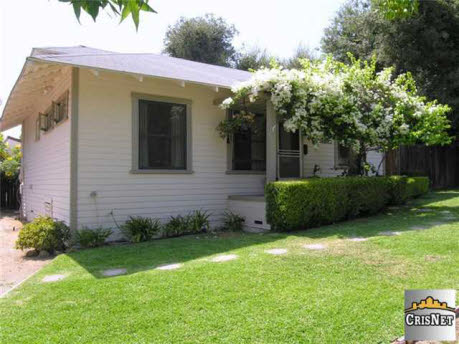
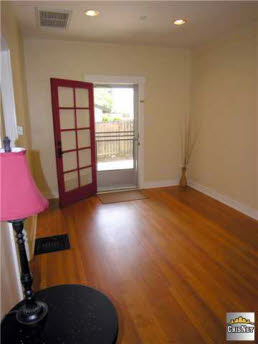
Let us look at the stats on the place:
2 beds, 1 bath
1,064 square feet
Price: $450,000
The place looks like it was recently remodeled and looks nice for a starter home. But all we need to do is look a few blocks down and we find a bigger rental for the following:
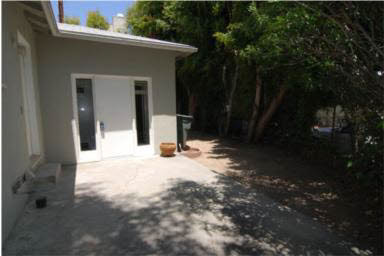
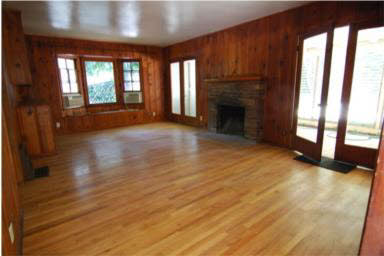
2 beds, 1 bath
1,100 square feet
Monthly rent: $1,795
In fact, if we plot this out on a map these places are right in the same neighborhood: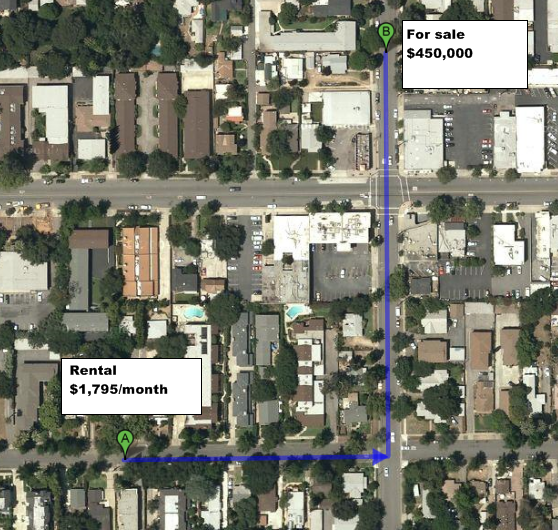
In the above situation, the obvious answer is to rent. You get to live in the same neighborhood while hedging your bets until all the toxic mortgages filter out of the California system. There is absolutely no rush to buy in today’s market. Mortgage rates have only one way to go and that is up. Even the FHA has recently added more guidelines for premiums because of the amount of defaults occurring. I can only see this getting tighter as time moves forward. The economy in the state has shown no sign of recovery so to expect that somehow wage growth will push prices higher is unwarranted. The only reason to buy right now in many areas is merely based on emotions. The fundamental economic metrics do not justify prices in many areas of California.
I’ve thought about the psychology of many that are sitting on the fence and are perched to jump in right now. They buy the argument that right now is the time to buy with all these incentives to purchase and rates destined to go up. But keep in mind, if rates go up, that future buyer you will sell to will only have access to mortgages that he or she can afford (unless you plan on staying 30 years in the place you buy). So if rates go up to say 9 percent for 30 year fixed rates, they may no longer be able to afford the home you bought with a 5.25 percent mortgage. It helps if we run the numbers. Let us assume you buy the above home with a 10 percent down payment:
Down payment: $45,000
PITI: $2,704 (with a 5.25% 30 year fixed mortgage)
Let assume you live there happy for five years but need a bigger place but mortgage rates are now up to 9 percent which is the 40 year historical average. What would the numbers look like for this future buyer? Let us assume you sell for the breakeven price:
Down payment: $45,000
PITI: $3,726 (with a 9% 30 year fixed mortgage}
Even if you sold at a breakeven point, this future buyer has a net housing payment that is higher by 37 percent. The good news after 5 years is that you have paid down the principal balance from $405,000 to $373,000. This is a total of $32,000. Good job right? But you are forgetting that renting the bigger similar place around the block will cost you roughly $900 less per month.
$2,704 (PITI) – $1,795 (rental) = $909 per month
5 years is equal to 60 monthly payments:
60 x $909 = $54,540
So even stashing the money away would make more sense here. In these markets, the rental rates are telling us a very significant disequilibrium is occurring between sales price and rental rates. These markets have a large number of Alt-A and option ARM products that will cause problems deep into 2012. There is no reason to jump into these markets.
But what if the landlord wants to up the rent? You move out. The market is saturated with properties. Even those areas that are “prime” like Downtown L.A. are seeing falling rents:
“DOWNTOWN LOS ANGELES – A study recently released by the USC Lusk Center for Real Estate had harsh tones for landlords, with a prediction that rents for Los Angeles County apartments would decline by an average of 3.5% this year.
A group of Downtown Los Angeles building owners don’t think they will take a hit.
“I don’t agree with this projection,” said developer Barry Shy, who owns six properties with more than 1,100 apartments in the Historic Core. “In my experience, new construction stopped a while back and we’re in a city where new people keep coming and the demand will still be there, but the supply is stopping.”
Shy’s stance was similar to that of several other Downtown landlords, who said that despite a 9.9% decline in Downtown rental prices last year, this year they are likely to hold steady and could even increase.”
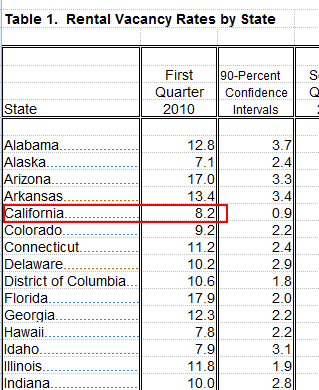
The current rental vacancy rate for California is 8.2 percent:
I wouldn’t worry too much about higher rents down the line. Plus, you have tons of failed condo conversions going back to apartments adding to more inventory. You also have the massive amount of distress inventory coming online so the rush to buy makes very little sense.
Mobility
I think many homeowners even at today’s adjusted prices are setting themselves up to be underwater in one or two years. As we know, FHA insured loans made up over 37 percent of Southern California purchases last month. From C.A.R. data we know the vast majority go in with the minimum 3.5 percent down payment. So even a modest drop of 5 percent will render these buyers underwater. In California one third of mortgages are underwater. That is, the owner has no mobility if he wanted to move today. Sure, he can strategically default at the cost of his overall credit but the renter in many cases is in a better position (certainly better than a third of California mortgage holders).
The fact that so many are buying homes today with little down payment products is troubling. If home prices drop even by 10 percent across the board, we are setting up another crisis in one or two years. If you really think about it, this is why a 20 percent down payment makes sense. A bank wouldn’t mind if you stop making your payments. Why? They’ll take the home with a built in 20 percent buffer. Assume 10 percent in fix up costs and sales commission and the bank actually makes money when they resell. But in today’s market, the buffer is razor thin even after the toxic mortgage escapades we went through. The government and Wall Street know the housing market is on thin ice. Here in California the unemployment and underemployment rate is over 23 percent. In this poor job market, it is actually useful to have mobility in housing if a new job comes along. Renting in this market makes complete sense. Pick a neighborhood you like and if home prices are too high, rent. In some areas like the Inland Empire you might find buying a home is in line with rental prices or a bit higher after you run the numbers. If that is the case, buy.
Hedge against future drops
I’ve noticed that some people psychologically are wedded to certain markets. “I can’t believe that Manhattan Beach still hasn’t corrected!” I get some e-mails from people making $50,000 to $70,000 hoping for home prices in Beverly Hills to fall to “reasonable levels.” Well even if say home prices drop from $2 million to $1 million, would you be able to buy that home? Probably not. So you have to be realistic about your own bottom line. If you like a neighborhood and home prices are too high then rent. So what? In California, we have as many homeowners with mortgages as we do renters (over 5 million for each group). So renting here isn’t uncommon. In fact, in today’s market it seems like the wisest thing you can do.
There is little reason to buy in some areas because:
-Home prices are highly unlikely to go up (if anything, they will go lower)
-A higher mortgage rate with a lower home price is better for you (easier to pay down and more options)
-Glut of inventory and distress properties (pipeline to keep prices low for a few years)
I see little reason to buy today. It seems like many are furious because the market they wanted to buy in simply has not corrected to their liking. Hey, in California we invented housing mania so some markets may stay irrational longer than you think. Just rent and be happy. If prices come down to more sensible levels then you can buy later. If not, just rent and enjoy being in the same area. Renting never made as much sense as it does today for some California markets.
 Did You Enjoy The Post? Subscribe to Dr. Housing Bubble’s Blog to get updated housing commentary, analysis, and information.
a
